2027 Mapping a Fictional Member's Administrative Service Path

Co-Founder and Chief Data Scientist
Maya is a fictional clinic scheduler who wants to move into administrative leadership without becoming a clinician. Her next step depends on the work she wants to manage, the experience she already has, and what employers require. This guide maps her possible path through education, practical experience, and career advancement. It is for readers making a similar decision: whether to pursue a healthcare administration degree, which kind to choose, and when a more targeted credential might serve them better.
Key Things You Should Know
- A healthcare administration degree can prepare someone to manage services, budgets, staff, and operations; it does not qualify them to practice clinical care.
- Maya could build from her clinic experience into a supervisory role before pursuing a graduate degree. The right credential depends on the job posting, not a single universal degree requirement.
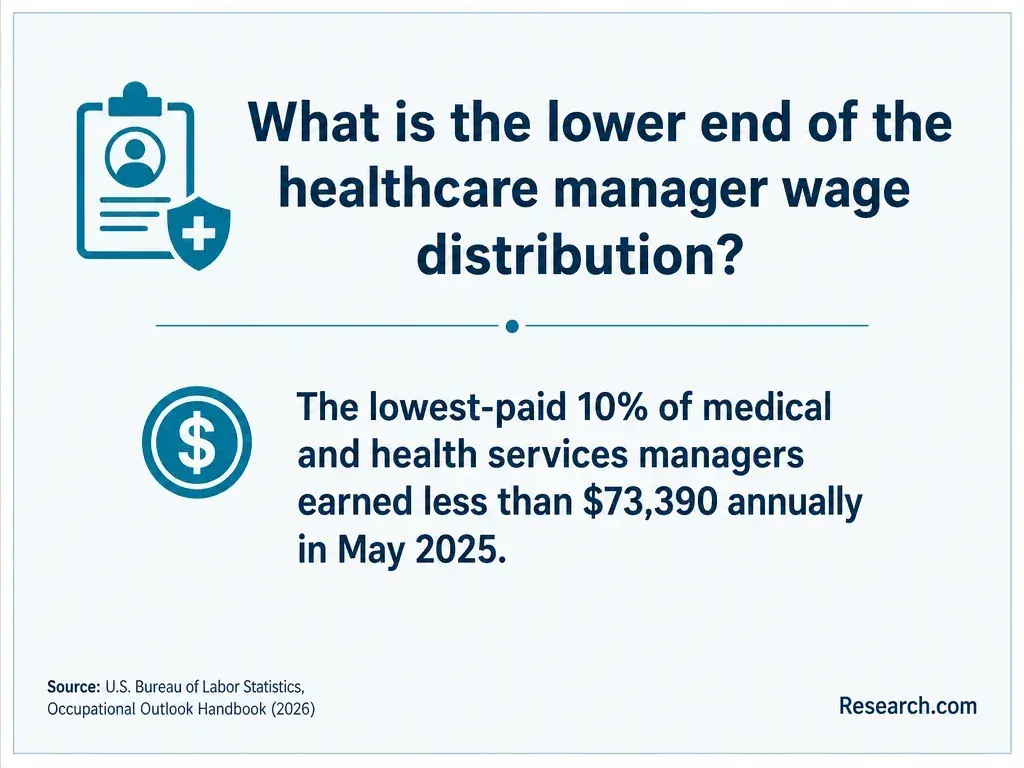
- The U.S. Bureau of Labor Statistics reports a May 2025 median wage of $126,520 for management occupations overall - not for healthcare administrators specifically. Compare pay for the particular role and location Maya wants.
What does a healthcare administration degree prepare you to do?
Healthcare administration is the business and organizational work that keeps care services running. Administrators may coordinate staffing, budgets, patient access, quality improvement, compliance, and information systems. The scope varies: leading a small practice is different from overseeing a hospital department.
For Maya, scheduling experience is a useful starting point. She knows where appointment delays arise, but leading an access team would also require skills in supervising employees, interpreting performance measures, and changing processes without disrupting care. A degree can develop those skills; responsibility usually grows through demonstrated work experience.
Some roles focus more narrowly on records and health data. Readers drawn to that work should compare administration curricula with accredited online HIM degree program choices. Health information management is a distinct path, not another name for general administration.
What degree do you need to become a healthcare administrator?
There is no single degree required for every U.S. healthcare administration job. Employers set requirements according to the role's scope. A bachelor's degree may support entry into administrative or supervisory work, while an MHA or a relevant MBA may be useful for larger operational responsibilities. Senior roles also typically call for substantial experience.
Maya's choice should follow her target job. If she needs a bachelor's degree to compete for clinic supervisor positions, transferring prior credits may be more direct than planning immediately for graduate school. She can use healthcare administration transfer pathways explained to identify questions to ask schools about credit acceptance and remaining requirements.
An MHA generally concentrates on managing healthcare organizations. An MBA provides a broader management core; a healthcare management concentration adds industry-focused study only if the school formally offers it. Neither substitutes for the clinical license required to provide regulated patient care.
How do you choose an accredited healthcare administration program?
First, verify the institution's accreditation through the accreditor's current directory and confirm that the credential meets the requirements of Maya's target employers. Then distinguish institutional accreditation from program-specific accreditation: they answer different questions, and not every administration program has or needs the same specialized approval.
Next, compare the actual curriculum, supervised practice or projects, transfer policies, total cost, and outcomes the school can document. A program advertising "healthcare leadership" may offer only a few relevant electives. For a bachelor's shortlist, selecting a U.S. university for online healthcare administration is a starting point, not a substitute for checking each program's current catalog.
Maya should also ask prospective employers whether they prefer a particular degree, experience level, or type of program. Their answers may matter more to her immediate advancement than a school's general reputation.
Coursework varies by degree level and school. Common subjects include healthcare finance, organizational leadership, operations, health policy, quality improvement, ethics, and the management of health information. Applied assignments may ask students to analyze a service bottleneck or propose a staffing change rather than provide medical treatment.
Maya should read course descriptions for the work she hopes to do. A program heavy in policy analysis could fit a public-agency goal; one with operations, budgeting, and team leadership may better support clinic management. An MBA's accounting and strategy core can be valuable, but she should check how much of the program addresses healthcare specifically.
Doctoral study serves a different objective, such as advanced research or organizational leadership. Comparing healthcare administration and management doctoral program options can clarify that distinction, but Maya need not plan for a doctorate to begin moving into administration.
Online delivery can teach the same subject matter, but effectiveness depends on program design and Maya's goals. She should compare faculty access, feedback, group work, career support, and opportunities to apply coursework at a healthcare organization. An online program that permits a workplace project may suit an employed scheduler; a campus program with strong local placements may better suit someone seeking a first healthcare role.
"Online" does not necessarily mean self-paced. Maya should request a sample course schedule and check for live meetings, examinations at fixed times, internships, and required visits before committing. The same scrutiny applies if she later explores fast-track claims for healthcare administration doctorates: a short advertised timeline does not establish that the workload or residency requirements fit her life.
Requirements depend on the institution and degree. Bachelor's applicants may need prior transcripts and must meet the school's transfer rules. Graduate programs commonly review a completed bachelor's degree and academic record; they may also request a résumé, statement, recommendations, or professional experience. Testing and prerequisite policies vary, so Maya should use each program's current admissions page rather than assume a universal rule.
Healthcare experience can strengthen an application, but it is not necessarily mandatory for every MHA. Readers entering from another industry can explore understanding MHA admission routes for non-healthcare graduates. Maya, meanwhile, can describe concrete improvements she helped make in scheduling or patient access, while being precise about what she personally did.
Time to completion depends on the credential, accepted transfer credits, course load, and required fieldwork. Price depends on more than advertised tuition: mandatory fees, materials, travel, and financing can change the total. Maya should request a written estimate based on her transcript and intended pace, rather than compare schools by a per-credit figure alone.
An accelerated master's may reduce time in school but increase the weekly workload or limit time for work-based learning. A one-year healthcare administration master's planning guide can help Maya frame questions about sequencing and feasibility. If her employer offers education assistance, she should check eligibility, reimbursement timing, and any continued-employment condition before counting it toward her budget.
Possible destinations include clinic supervisor, practice manager, patient access manager, departmental operations manager, and quality improvement coordinator. These are not interchangeable entry-level roles. Employers may expect supervision, budgeting, or healthcare experience beyond a degree, particularly for positions responsible for an entire facility.
Maya's adjacent move is from scheduling into patient access or clinic operations, where she can show familiarity with workflows and build management experience. If she later wants broader business roles, she can compare an MHA with economical online MBA options in healthcare management. The MBA may make more sense if she wants portable finance and strategy training; neither degree by itself secures a promotion.
Pay depends on the job, employer, location, and level of responsibility. The U.S. Bureau of Labor Statistics reports that management occupations as a group had a median annual wage of $126,520 in May 2025. That broad figure is not a healthcare administrator salary or an estimate of what Maya would earn after graduating.
For a useful financial decision, Maya should compare posted pay for the specific roles she can plausibly reach with her current experience against roles requiring a graduate credential. She can then weigh any realistic earnings difference against the full price and time commitment of graduate healthcare administration degree costs and options. If a supervisor role is available through experience and targeted training, a master's may be worth postponing.
What certifications and licenses do healthcare administrators need?
Most general administrative jobs do not have a universal healthcare administrator license. Requirements change with the position and jurisdiction: certain facility leadership roles may require state licensure, while employers may prefer role-specific professional credentials. Maya should check the state regulator and the exact job posting before paying for a certification or enrolling in a program on the assumption that it confers license eligibility.
A certification can demonstrate focused knowledge, but it does not replace experience or authorize clinical practice. A doctorate is likewise a separate educational choice, not a shortcut around licensing rules. If Maya considers one much later, affordable advanced study options in healthcare administration should be evaluated for their career purpose and full cost - not treated as a required step on her current path.
Other Things You Should Know About Healthcare Administration
Hospital administration concerns hospitals specifically. Healthcare administration also includes clinics, long-term care organizations, and other care settings.
Some administrative tasks can be done remotely, but positions involving facility operations, staff supervision, or on-site coordination may require a regular physical presence. Check the arrangement for each job.
It can help a newcomer learn how an organization operates and make professional contacts. It is most useful when the responsibilities build relevant, demonstrable skills.
She should ask what work she would perform, who would supervise her, whether it meets degree requirements, and whether the schedule fits her existing job.
- Health Insurance Portability and Accountability Act (HIPAA) Compliance - StatPearls - NCBI Bookshelf https://www.ncbi.nlm.nih.gov/books/NBK500019/
- Records Basics | National Archives https://www.archives.gov/records-mgmt/scheduling/basics
- Chapter 1 - Records Management Basics https://www.sos.ca.gov/archives/records-management-and-appraisal/records-management-handbook/chapter-1
- Selective Service System https://www.sss.gov/
- Your Health Information Security - ONC https://healthit.gov/privacy-security/your-health-information-security/
- Summary of the HIPAA Security Rule | hhs.gov https://www.hhs.gov/hipaa/for-professionals/security/laws-regulations/index.html
- Types of Records | Southern Connecticut State University https://inside.southernct.edu/records-and-info/rim-in-ct/types-of-records