2027 MHA-MBA Dual Degrees: Auditing Duplicate Coursework

Co-Founder and Chief Data Scientist
An MHA-MBA dual degree can combine healthcare administration with broad business training, but its value depends partly on how many courses actually count toward both degrees. A course that looks duplicated in two catalogs may still have to be taken twice - or may satisfy only one degree. This guide is for prospective students comparing dual programs with a standalone MHA or healthcare-focused MBA. It explains how to audit shared coursework, calculate the remaining workload, and weigh the added cost against a realistic career goal before enrolling.
Key Things You Should Know
- There is no universal MHA-MBA double-counting allowance. Get a written, course-by-course plan showing which credits satisfy both degrees and which requirements remain unique.
- Compare the dual degree's total remaining credits and costs with each standalone degree - not with the apparent overlap between course titles.
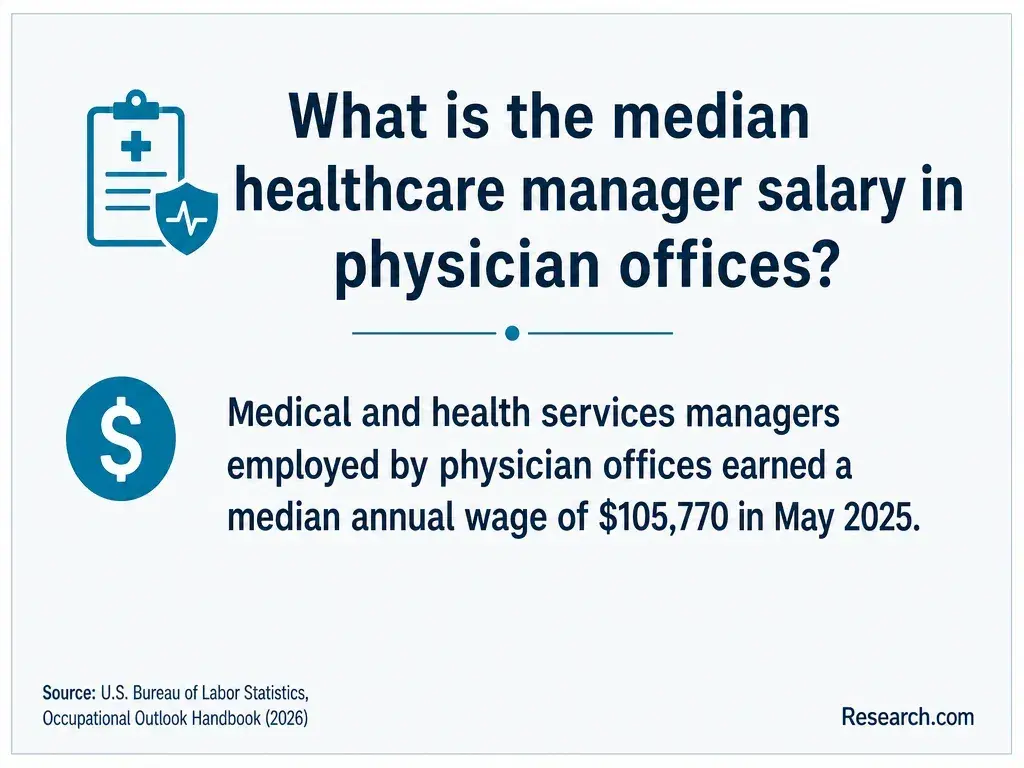
- The U.S. median annual wage for management occupations was $126,520 in May 2025, according to the Bureau of Labor Statistics; it is not an MHA-MBA graduate salary or a basis for assuming the degree will pay for itself.
What is an MHA-MBA dual degree, and how does it audit duplicate coursework?
An MHA-MBA dual degree is an approved path to a Master of Health Administration and a Master of Business Administration. The MHA generally emphasizes the operation, policy, and leadership of healthcare organizations; the MBA provides a broader management core.
Unlike taking two unrelated degrees in sequence, a dual program may permit specified courses to satisfy requirements in both curricula. An audit of duplicate coursework compares both degree plans against the school's formal shared-credit rules.
It is not simply a search for similar course names. Healthcare finance, for example, may cover reimbursement and provider budgets, while MBA finance may focus on corporate investment decisions. An advisor or registrar must confirm whether one course meets both learning outcomes and whether the school permits it to be applied twice.
If your goal is primarily healthcare operations rather than a second business credential, explore online graduate health administration programs as a comparison point.
How much coursework can MHA-MBA programs double-count between healthcare and business degrees?
The permitted overlap varies by institution and sometimes by the particular MHA and MBA tracks. A published combined-credit total is more informative than a promise that the program is "accelerated": it shows what students must complete, while the degree audits show why. Neither a similarly titled class nor prior completion of a graduate course establishes automatic eligibility for shared credit.
The distinctions below help separate genuine savings from requirements that only look alike on a course list.
| Coursework relationship | What the audit must establish | Possible result |
| One approved course appears in both plans | It meets both requirements and the dual-degree policy permits shared application | Credits may count toward both degrees |
| Courses cover related topics but have different outcomes | Faculty approve a substitution or equivalency | Both may still be required |
| A course replaces a prerequisite or foundation class | The school distinguishes a waiver from earned degree credit | Workload may fall without shared credits being awarded |
| Each degree requires a separate capstone or minimum unique credits | The applicable catalog and residency rules allow an exception | Separate work remains unless formally approved |
Request the two standalone credit totals, the dual-program total, and a marked list of shared courses. Ask whether credits shared between degrees differ from credits transferred into the program. If completing healthcare training quickly matters more than earning both credentials, compare fast-track online healthcare management graduate degrees instead.
Are MHA-MBA dual degrees worth the additional time and cost?
A dual degree is most defensible when the student needs both healthcare-specific preparation and broader business skills for a plausible next role - and the approved shared coursework meaningfully reduces the added expense.
For an experienced hospital manager moving toward enterprise strategy, the MBA component may fill a genuine gap. For someone seeking a first healthcare administration job, a well-chosen MHA, relevant work experience, or an internship may be more direct.
Calculate the incremental cost of the second degree, not just the advertised tuition per credit. Compare each option's remaining tuition and mandatory fees, materials, required travel, and any income lost to reduced work hours. Include financing costs if you expect to borrow.
Then ask whether your employer offers assistance and whether the target jobs actually value both credentials. A promotion or salary increase should not be assumed in the calculation.
Opportunity cost matters even when shared credits make the dual route shorter than earning two degrees separately. If the MHA alone meets your goal, compare affordable health administration graduate schools before paying for the additional MBA coursework.
Start with the institution's recognized accreditation and confirm that it covers the institution awarding the degrees. Then check each program separately. CAHME accredits eligible graduate healthcare management programs; business schools may hold specialized accreditation from organizations such as AACSB, ACBSP, or IACBE. One school's business accreditation does not establish that its MHA is CAHME-accredited, or vice versa.
Check the accreditor's directory and the school's current listing for the exact degree, campus or online delivery where specified, and status. Accreditation can matter for program quality signals and some employers' preferences, but it does not by itself determine how many courses the two degrees may share. Students prioritizing the MHA credential can use choosing a CAHME-accredited online MHA to evaluate that side of the comparison.
Expect the MBA portion to address areas such as managerial accounting, finance, strategy, operations, and organizational leadership. The MHA portion may add healthcare finance, health policy, quality improvement, population health, and the regulation of healthcare organizations.
Schools determine the actual requirements; a healthcare elective in an MBA is not the same as a full MHA curriculum. Pay particular attention to applied projects. A hospital operations project might serve both degrees only if each program accepts its scope, assessment, and supervision.
Health information management is another distinct field: students seeking deeper preparation for health information roles should compare online CAHIIM-accredited programs for health information careers rather than assume an MHA-MBA provides equivalent specialized training.
Requirements are school-specific. Applicants generally need to establish eligibility for graduate study, but a university may require separate approval from its business and healthcare administration programs, one coordinated application, or admission to one program before adding the other. Policies on professional experience, tests, prerequisites, recommendations, and interviews can differ between the two schools.
A nonbusiness bachelor's degree does not automatically rule out admission. It does make it important to check whether accounting or quantitative foundation work is required - and whether a foundation waiver actually reduces tuition-bearing credits.
Applicants should also confirm when they must declare the dual path; work completed before approval may not qualify for shared treatment. If the admission demands or career goal favor a single credential, considering a one-year healthcare administration graduate program offers a different path to examine.
Completion time depends on the approved combined curriculum, course sequencing, enrollment intensity, and whether required classes are offered each term. Online delivery removes some travel but does not necessarily permit self-paced study. Live sessions, group projects, internships, and campus visits can affect a working student's schedule; campus programs may have their own fixed cohort sequence.
Ask for a term-by-term plan based on the number of courses you can actually take while employed. Check whether a delayed MHA practicum or MBA capstone would extend graduation even after other coursework is complete, and whether taking a leave changes the catalog rules governing shared credits. If speed is the main priority, healthcare-focused MBAs with accelerated schedules may be more suitable than two degrees.
Relevant paths include healthcare operations, service-line management, practice administration, payer operations, and strategy roles. The credible next step depends heavily on prior responsibilities: a clinician moving into management may need budgeting and people-leadership experience, while an established administrator may use the combined curriculum to pursue broader organizational responsibilities. Neither diploma substitutes for experience in the target function.
For context, the Bureau of Labor Statistics reports a May 2025 median annual wage of $126,520 for U.S. management occupations. That figure covers a broad occupational group, not MHA-MBA alumni or entry-level healthcare administrators.
Compare compensation for your target occupation, location, and experience level when evaluating the investment. For examples of roles to investigate, see career options in healthcare administration and management.
An MHA or MBA does not generally confer a clinical license, and many administrative roles do not require an occupation-specific license. Requirements depend on the job and state. Nursing home administration, for example, is a regulated path with state-specific licensing rules; holding two management degrees does not waive those rules.
Optional certifications can demonstrate experience or knowledge in a particular administrative function, but their eligibility rules and value vary. Check actual job postings and the relevant licensing board before choosing coursework around a credential.
Likewise, a doctorate is a separate educational choice, not a routine licensing requirement for healthcare managers; doctoral degree formats and time requirements in healthcare administration are relevant chiefly if your longer-term goal calls for advanced study.
How can students compare reputable MHA-MBA dual-degree programs?
Compare written degree audits, not marketing descriptions of "seamless" integration. Request plans for the same enrollment pace at each school so that differences in shared credits, required projects, scheduling, and total expense are visible.
Before accepting an offer, use these questions to obtain a decision-ready answer from each program:
- Which exact courses satisfy requirements in both degrees, and who approves substitutions?
- What are the combined required credits, minimum unique credits for each degree, and separate capstone or practicum requirements?
- What will I pay in tuition, mandatory fees, and required travel at my planned pace?
- Which classes have live attendance or fixed sequences, and what happens if I pause enrollment?
- Will I receive career support relevant to my target healthcare role, including any access restrictions for online students?
Keep the responses alongside the applicable catalog and compare them with a standalone MHA and MBA. For the business-degree cost comparison, healthcare management MBA programs by tuition cost can help identify alternatives to investigate. The strongest choice is the one whose verified coursework, cost, and schedule fit your next career step - not necessarily the one advertising the most overlap.
Other Things You Should Know About Healthcare Administration
It is intended to lead to two degrees, but confirm the school's graduation rules and how each credential will appear on your transcript and diplomas.
Some schools permit it, subject to approval and deadlines. Ask for a new degree audit before switching; courses already taken may not all receive shared treatment.
Ask whether completed work can satisfy one degree independently. Remaining requirements and the treatment of shared courses depend on institutional policy.
Not necessarily. Check your employer's annual limits, approved-degree rules, grade requirements, and repayment conditions before relying on reimbursement.
- 60 Semester Credit Hour (SCH) Exemptions | Texas Higher Education Coordinating Board https://www.highered.texas.gov/new-program-development/60-semester-credit-hour-exemptions/
- An Overview of Accreditation of Higher Education in the United States | Congress.gov | Library of Congress https://www.congress.gov/crs-product/R43826
- Eligibility Requirements | Federal Student Aid https://studentaid.gov/understand-aid/eligibility/requirements
- Direct Assessment (Competency-Based) Programs | ed.gov http://www.ed.gov/laws-and-policy/higher-education-laws-and-policy/higher-education-policy/direct-assessment-competency-based-programs
- Double Counting and Sharing Courses - Degree Progress Unit https://degreeprogress.ucsc.edu/degree-progress-report/advisor-resources/double-counting/
- Master of Healthcare Administration (MHA) & Master of Business Administration (MBA) | Mary Baldwin University https://catalog.marybaldwin.edu/healthcare-administration-business/master-of-healthcare-administration-mha-master-of-business
- Financial Aid Eligibility Requirements | Saint Leo University https://www.saintleo.edu/tuition-financial-aid/aid/financial-aid-process/eligibility
- Eligibility for Federal Financial Aid Policy | SUNY Empire https://sunyempire.edu/policies/eligibility-for-federal-financial-aid-policy.html
- MHA vs. MBA in health care: choosing the right path for you | Capella University https://www.capella.edu/blog/business/the-difference-between-an-mha-and-mba-in-health-care-management/
- Dual MBA and MHA Degree - Online or On-Campus Program | The University of Scranton https://gradadmissions.scranton.edu/programs/dual-mba-mha/index.shtml