
2027 Healthcare Administration BS Programs With Employer Advisory Boards

Co-Founder and Chief Data Scientist
An employer advisory board can make a healthcare administration BS program more responsive to the workplace - but its existence alone says little about teaching quality or job prospects. If you are choosing a bachelor's program, the useful questions are who serves on the board, what they influence, and whether students gain practical experience. This guide explains how to assess those claims alongside accreditation, curriculum, cost, format, and career outcomes so you can choose a program that fits your starting point and goals.
Key Things You Should Know
- An employer advisory board is a potential advantage, not a credential: ask which healthcare employers participate and what changes their feedback has produced.
- Prioritize institutional accreditation, relevant coursework, accessible internships or projects, and a total-cost estimate over an unverified promise of employer connections.
- A BS can support entry into healthcare operations, but management jobs commonly require experience; the May 2025 median of $126,520 for all management occupations is not a starting salary for these graduates.
What are healthcare administration BS programs with employer advisory boards?
A healthcare administration Bachelor of Science (BS) teaches the business and organizational side of healthcare, rather than clinical practice. An employer advisory board is a group of outside professionals that may advise a program on workforce needs, curriculum, projects, or student preparation. Its members might represent hospitals, medical practices, insurers, long-term care organizations, or other healthcare employers.
Boards vary substantially. One may meet regularly, review course competencies, and help shape applied assignments; another may have little visible involvement. Board membership does not mean an employer helped design every course, offers internships, or gives graduates hiring preference. Ask for a current member list, meeting frequency, examples of resulting curriculum changes, and whether students can actually meet participating employers.
If you already have a bachelor's degree, compare a second BS with the time and prerequisites of a graduate option, such as a one-year healthcare administration master's planning guide. A shorter graduate route is not automatically the better entry point: its admissions expectations and depth may differ from undergraduate preparation.
Why does accreditation matter for healthcare administration bachelor's programs?
Institutional accreditation is the first check. It indicates that a recognized accreditor evaluates the college or university as a whole and can affect federal student-aid eligibility, credit transfer, and how other schools assess the degree. Verify the institution's current status directly with its accreditor or the U.S. Department of Education; an employer advisory board is not an accrediting body.
Specialized accreditation requires a separate check. The Commission on Accreditation of Healthcare Management Education (CAHME) accredits eligible graduate healthcare management programs; it should not be presented as a standard accreditation requirement for a healthcare administration BS. Readers comparing later graduate study can examine MHA programs online with CAHME accreditation, while checking undergraduate institutional accreditation independently.
Also ask whether your prospective BS has any applicable program-level recognition, what entity grants it, and whether it covers the exact program and delivery location you would enter. An accreditation logo on a university website may refer to a different degree or school.
What can you do with a bachelor's degree in healthcare administration?
For someone new to healthcare, realistic starting points may include patient-services coordination, medical-office administration, revenue-cycle support, scheduling operations, or quality-improvement support. Someone who already works in a clinic, hospital, or insurer may be able to use the BS to compete for broader operational responsibilities. Job titles and minimum qualifications vary by employer.
Healthcare managers oversee work such as staffing, budgets, service delivery, compliance, and performance improvement. A BS can supply relevant knowledge, but a new graduate generally should not expect immediate responsibility for a hospital department. Compare prospective positions by duties and experience requirements, not just titles; these career options in healthcare administration and management can help frame longer-term goals without treating senior roles as entry-level outcomes.
For career changers, the distance between your current work and the target role matters. Customer service, accounting, human resources, or operations experience may transfer, while healthcare-specific gaps may require an internship, an applied project, or an initial support role. Ask the advisory-board program to show how students obtain that experience - not simply which employers are represented.
The better format is the one that lets you complete required coursework and build relevant experience. This comparison highlights practical differences to confirm with each school; neither format guarantees employer access.
| Consideration | Online program | Campus-based program |
| Schedule | May reduce travel, but live classes, group work, and deadlines can still be fixed. | Typically requires scheduled travel and class attendance. |
| Applied experience | May allow a project or internship near home; placement support varies. | May offer nearby campus partnerships; access and placement still vary. |
| Employer advisory board | Ask whether remote students can join board-supported events or projects. | Ask whether board members interact directly with undergraduates. |
| Best fit | Often useful when relocating or commuting is impractical. | Often useful when regular in-person contact and local placements matter most. |
If speed is important, compare actual course sequencing and transfer-credit decisions rather than assuming an online label means accelerated completion. Faster online study routes in healthcare administration may suit students with substantial accepted credits, but compressed classes can intensify weekly work.
A typical BS combines general education with business fundamentals and healthcare-specific study. Depending on the school, that may include accounting, statistics, organizational management, healthcare finance, health information systems, policy, ethics, quality improvement, and healthcare law. Course titles alone are less informative than the assignments and skills students actually practice.
Look especially for work that connects decisions to healthcare constraints: building a staffing or budget proposal, interpreting operational data, improving patient access, or addressing privacy and compliance concerns. Ask whether an internship, capstone, or employer-reviewed project is required, optional, or unavailable to online students. If the advisory board influences coursework, the program should be able to give a concrete example.
Undergraduate breadth is different from graduate specialization. Students considering a later MHA can compare curricula across online MHA programs to see which advanced topics would add to, rather than repeat, their BS preparation.
Requirements depend on whether you apply as a first-year student, a transfer student, or a degree-completion applicant. Schools commonly request prior academic transcripts and evidence that you meet their general undergraduate admission rules. Some degree-completion tracks require transferable college credits; prerequisites, minimum grades, and deadlines must be checked for the specific program.
Before applying, request a written transfer-credit evaluation and ask which credits satisfy major requirements rather than only free electives. Also confirm whether internships require a background check, immunization documentation, or other site-specific clearance. Those conditions may come from a placement site and need not apply to every student or course.
Healthcare employment is not universally required for undergraduate admission. If you already hold a bachelor's degree but lack industry experience, MHA programs that consider applicants without healthcare experience may be worth comparing before committing to a second undergraduate degree.
A full-time bachelor's degree commonly takes about four academic years from the beginning of college; transfer credits, part-time enrollment, course availability, and internship timing can change that substantially. A school's advertised completion time may assume that you arrive with credits already accepted toward the degree.
There is no reliable single price for these programs. Compare the institution's current tuition basis - per credit, term, or year - along with mandatory fees, books, technology, transportation, and any internship-related expenses. Request a degree audit and a term-by-term cost estimate before treating a low per-credit rate as an affordable total price. Financial aid and employer assistance may reduce what you pay, but eligibility and conditions vary.
If your long-term plan extends well beyond the BS, budget each credential separately rather than treating later study as a required continuation. A guide to planning the duration of a healthcare administration doctorate illustrates how much the eventual path can differ from the timeline for an undergraduate degree.
Most general healthcare administration positions do not have a single, nationwide administrator license. Requirements depend on the role and state: nursing home administrators, for example, face state licensing rules that do not automatically apply to hospital operations or medical-office positions. A healthcare administration BS is not a clinical license.
Optional professional certifications may help an experienced worker demonstrate knowledge in a particular function, but employers and certifying organizations set their own eligibility rules. Check a target job posting before paying for a credential, and do not assume a degree substitutes for required work experience.
A doctorate is likewise not a general licensing requirement for healthcare administration. If advanced study is part of a longer leadership or academic plan, investigate healthcare leadership doctorate transfer credit considerations separately from state licensure rules; transfer policies do not determine legal permission to practice a regulated occupation.
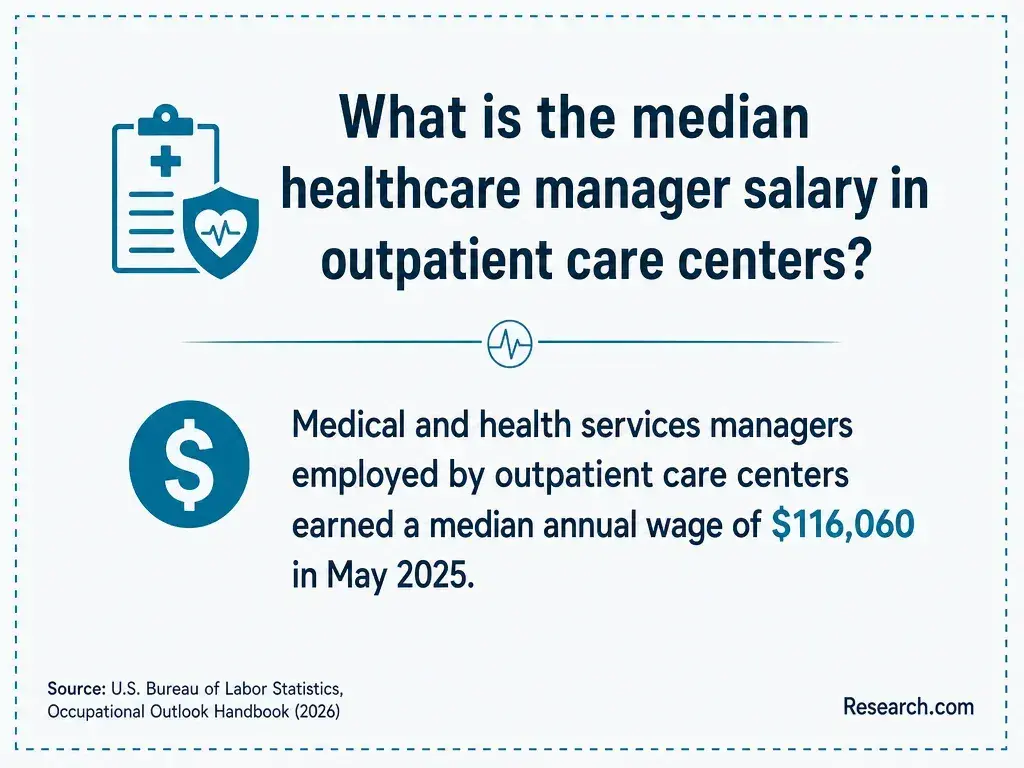
Pay depends heavily on the occupation, location, employer, and prior experience. The U.S. Bureau of Labor Statistics reports a May 2025 median annual wage of $126,520 for all management occupations. That broad figure includes many industries and experienced managers: it is not a healthcare administration BS graduate salary or an appropriate offer expectation for a first job.
BLS projects employment across management occupations to grow faster than the average for all occupations from 2025 to 2035. That describes management as a group, not guaranteed demand for any particular healthcare role. For a useful personal estimate, compare current local postings for the exact entry-level or next-step position you could plausibly obtain, including their experience requirements and pay ranges.
Further education may support a later transition, but it does not establish a salary increase by itself. For example, faster online master's programs in healthcare management may be relevant after gaining experience; compare their cost with the responsibilities and credentials employers actually request for your target role.
How can you choose a reputable healthcare administration BS program?
Start with institutional accreditation and a degree plan that matches your academic record. Then test the program's employer-board claim against opportunities available to you, especially if you will study online. A recognizable employer name on a webpage is less useful than documented student access to projects, placements, or feedback.
Use the following questions when speaking with admissions staff and the program director. Request written answers where a claim affects your cost or graduation timeline.
- Who currently serves on the advisory board, how often does it meet, and what has it changed in the BS curriculum?
- Can students in my delivery format take part in employer-sponsored projects, internships, or networking events?
- Which of my credits satisfy degree requirements, and what courses or placements could delay completion?
- What is my estimated total tuition and fee bill under a realistic enrollment schedule?
- What career-support services and graduate-outcome information are available specifically for this BS?
Choose the BS when you need foundational undergraduate preparation and can use its applied opportunities. If you already have a bachelor's degree and relevant management experience, compare the cost and purpose of another BS with graduate alternatives, including healthcare-focused MBAs with accelerated schedules. An MBA develops broader management skills; it is not interchangeable with undergraduate healthcare preparation or a guarantee of advancement.
Other Things You Should Know About Healthcare Administration
No. Strong teaching, applied work, and career support can exist without a formal board. Evaluate what students actually receive rather than using the board as a pass-or-fail label.
Not necessarily. Ask whether student-facing events, résumé reviews, or projects are scheduled, who can attend, and whether participation is guaranteed.
Possibly. The program may need to approve the site, supervisor, duties, and academic assessment; ordinary paid work may not automatically count.
Request a dated member list and recent examples of meetings or student activities. Confirm that the examples apply to the BS program and your campus or online format.
- Student Guide to Transfer | Maryland Higher Education Commission https://mhec.maryland.gov/preparing/pages/stuguide.aspx
- College Affordability and Transparency Center | ed.gov https://collegecost.ed.gov/
- Knowledge and Skills Needed for Future Health Administrators - PMC https://pmc.ncbi.nlm.nih.gov/articles/PMC11188648/
- Frequently Asked Questions (FAQs) - Transfer Credit Ohio https://transfercredit.ohio.gov/help-center/faqs/faqs
- Advisory Boards | Columbia University Mailman School of Public Health https://www.publichealth.columbia.edu/academics/departments/health-policy-management/who-we-are/advisory-boards
- 2025-26 Tuition and Fees Report | Virginia State Council Of Higher Education, VA https://www.schev.edu/research-publications/reports-publications/2025-26-tuition-and-fees-report
- Experiential Learning Courses | pitt.edu https://www.sci.pitt.edu/student-resources/experiential-learning/experiential-learning-courses
- Online Accelerated Bachelor's Degree in Health Care Administration | Purdue Global https://www.purdueglobal.edu/degree-programs/health-sciences/exceltrack-bachelors-healthcare-administration/
- Transfer credit policies - Office of Admissions https://admit.washington.edu/apply/transfer/policies/
- Experiential Learning - UW Information School https://ischool.uw.edu/programs/msim/curriculum/applied-learning-experiences


