2027 From Certified Nursing Assistant to Healthcare Administration

Co-Founder and Chief Data Scientist
Certified nursing assistants understand patient care firsthand, but moving into healthcare administration requires a different set of skills: coordinating services, managing people, working with budgets, and improving operations. For CNAs considering less hands-on work or a longer-term management career, the right next step depends on their education, experience, and target role.
This guide compares realistic entry points and degree options, explains what programs cost and teach, and puts salary and job-outlook figures in context so you can choose a path without assuming an MBA is necessary.
Key Things You Should Know
- CNAs can often pursue scheduling, patient-services, or administrative-support roles before earning a management degree; director-level roles usually require substantial additional education and experience.
- A bachelor's degree can support a move toward healthcare management, while an MHA or MBA is generally a later-career choice, not a prerequisite for an entry-level office transition.
- The U.S. Bureau of Labor Statistics reports a $126,520 median annual wage for management occupations in May 2025, but that figure covers many industries and career stages, it is not an expected starting salary for a CNA changing roles.
What healthcare administration careers can CNAs pursue?
Healthcare administration is the nonclinical work of organizing and improving healthcare services. A CNA's familiarity with patient needs, shift handoffs, and care-team workflows is valuable, but employers also look for skills in records, staffing, finance, compliance, and supervision. The most realistic first move is often into an adjacent support role rather than directly into management.
The paths below show how responsibilities tend to change as a CNA gains administrative experience. Job titles and minimum qualifications vary by employer.
| Path | Typical responsibilities | What a CNA may need next |
| Scheduling or patient-services support | Coordinate appointments, staffing, referrals, or communication with patients and families. | Office systems, accurate documentation, and customer-service experience. |
| Administrative coordinator or practice supervisor | Improve workflows, train staff, track service measures, or oversee daily operations. | Administrative experience and, for many supervisory openings, a relevant degree. |
| Department or facility management | Manage budgets, personnel, regulatory responsibilities, and organizational performance. | Progressive leadership experience; degree and licensing requirements depend on the position. |
Health information management is another route for CNAs who prefer records, data quality, and information systems to staffing or general operations. Comparing healthcare administration coursework with HIM coursework can help clarify which type of work fits your interests. Neither path turns a CNA credential into a nursing license, and some facility leadership positions have separate state requirements.
How can a CNA transition into healthcare administration?
Start by choosing a specific destination: front-office operations, staffing, health information, or management. "Healthcare administrator" is too broad to plan around because an entry-level coordinator and a facility executive need different qualifications.
A staged transition lets you test the work before committing to an expensive graduate degree:
- Review local job postings for the role you want and separate required qualifications from preferred ones.
- Ask your current employer about scheduling, admissions, quality-improvement, training, or office openings where your patient-care knowledge would help.
- Build evidence of administrative ability through relevant tasks, such as improving a handoff process or learning the organization's scheduling system, while respecting patient privacy.
- Choose education only after identifying the degree or skills that repeatedly appear in your target postings.
If you need an undergraduate degree, community college pathways into healthcare administration bachelor's programs may help you plan a lower-cost start. Confirm how credits transfer with the receiving school before enrolling; CNA training alone does not necessarily carry college credit.
What degree do CNAs need for healthcare administration?
There is no single degree required for every administrative job. The appropriate credential depends on whether you want an initial office role, a path into supervision, or advancement after you already have management experience.
This comparison separates entry requirements from degrees that may become useful later, so you do not pay for more education than your next role requires.
| Education option | Potential fit | Important limitation |
| Short courses or an associate degree | Develop office, records, or business skills for an initial administrative transition. | May not meet bachelor's-degree requirements for management postings. |
| Bachelor's in healthcare administration, business, or a related field | Build a foundation for coordinator, analyst, and eventual supervisory roles. | A degree does not replace experience managing staff or operations. |
| Master of health administration (MHA) | Study healthcare organizations, policy, finance, and operations in greater depth. | Usually makes more sense after earning a bachelor's degree and clarifying career goals. |
| MBA, with relevant healthcare coursework if available | Develop broad management skills that can transfer across industries. | A healthcare elective is not necessarily a formal concentration or a substitute for healthcare-specific experience. |
For someone committed to managing healthcare organizations, online MHA degrees for healthcare management preparation are worth comparing with MBAs. A current CNA without a bachelor's degree will generally get more immediate value from planning an undergraduate path or gaining administrative experience first.
Check institutional accreditation first. It is the baseline recognition to verify when evaluating a college and can affect credit transfer and eligibility for federal student aid. Then check whether a specialized accreditor is relevant to the particular program, not just the school's marketing language.
The Commission on Accreditation of Healthcare Management Education (CAHME) accredits eligible graduate healthcare management programs. Online graduate health administration programs with CAHME accreditation provide a useful starting point, but confirm the current status and the exact program with CAHME. Not every legitimate healthcare administration degree is CAHME-accredited, and CAHME accreditation is not a universal requirement for administrative employment.
If you are considering an MBA, business-school accreditors such as AACSB, ACBSP, or IACBE address a different kind of program review. Health information management has its own accreditation considerations. Verify institutional and applicable programmatic status directly with the accreditor and school before paying a deposit.
For CNAs working rotating shifts, an online program may reduce commuting without eliminating scheduling conflicts. Ask whether courses are asynchronous, when live meetings occur, how group projects are organized, and whether an internship or campus visit is required. "Online" describes delivery, not necessarily flexibility.
A campus program may be easier to navigate if you want in-person advising, structured class times, or access to nearby healthcare employers. Whichever format you choose, compare opportunities to complete a project or placement with a healthcare organization. That experience may help you demonstrate administrative skills that CNA work alone does not establish.
If speed matters, compare actual course sequencing and required fieldwork rather than relying on an advertised minimum completion time. Graduate health management programs with accelerated pacing may suit experienced students, but a compressed schedule can be difficult alongside full-time care shifts.
Healthcare administration programs commonly address healthcare operations, organizational leadership, finance, quality improvement, policy, ethics, and the use of information in decision-making. Undergraduate courses generally establish the foundations; graduate courses typically ask students to apply management concepts to more complex organizational problems. Curricula differ, so inspect required courses rather than relying on a degree title.
A CNA may already recognize the patient-care consequences of a staffing decision. Administration coursework should help connect that insight to budgets, workforce planning, and measurable service improvements. An MBA usually adds a broader core in accounting, finance, strategy, and organizational behavior; a healthcare concentration, when formally offered, adds industry-focused coursework rather than clinical training.
If records and data systems interest you more than general management, review accredited online HIM degree program choices. HIM coursework and its relevant accreditation are distinct from healthcare administration, so compare the actual courses with the jobs you want.
Requirements vary by school and degree level. Undergraduate applicants typically need to document their prior education; transfer applicants also need an official credit evaluation. Graduate applicants generally need a bachelor's degree and may be asked for a résumé, recommendations, or a statement of purpose. Work-experience expectations, prerequisite courses, and GMAT or GRE policies are program-specific - not universal rules.
A CNA credential can strengthen an application by showing knowledge of care settings, but it does not automatically satisfy business prerequisites or qualify an applicant for graduate study. Before applying, ask how the school evaluates transfer credits, whether healthcare work counts toward any experience requirement, and whether field placements can be completed near your home or workplace.
Applicants who already hold a bachelor's degree can also compare MHA admission criteria with online MBA planning for an accelerated healthcare management pathway. Confirm that any advertised healthcare management option is available in the online MBA and that its pace fits your work schedule.
Completion time depends heavily on credits already earned, transfer policies, enrollment pace, and required internships. An associate-to-bachelor's route may be shorter than starting a bachelor's degree from scratch; a graduate degree begins only after a bachelor's degree is completed. Accelerated programs can reduce calendar time while increasing the work due each term.
To compare affordability, request a program-specific estimate that includes more than advertised tuition:
- Remaining credits or courses after an official transfer evaluation, multiplied by the applicable tuition rate.
- Mandatory program, technology, and student fees, plus books or software.
- Travel, internship-related expenses, and any income lost if you reduce work hours.
- Grants, eligible employer tuition assistance, and the cost of borrowing after other funding is applied.
Published prices change, and a low per-credit rate may not produce the lowest total bill if fewer credits transfer. An affordable healthcare administration master's program comparison can help readers who already qualify for graduate study build a shortlist; request each school's current full-cost estimate before deciding. For an early-career CNA, an employer-supported undergraduate path may offer a better near-term return than borrowing for an MBA later.
Pay depends on the actual job, location, employer, education, and prior administrative experience. A first move into scheduling or patient services should not be priced as though it were a move into executive management.
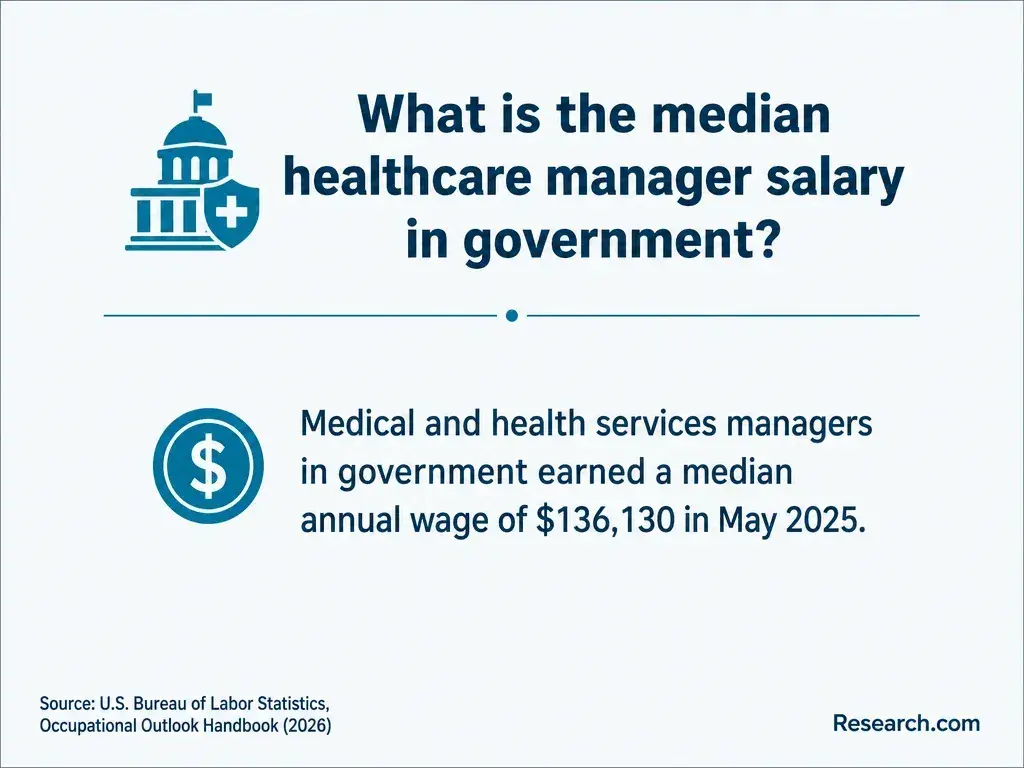
For context, the U.S. Bureau of Labor Statistics reports that the median annual wage across all management occupations was $126,520 in May 2025. That national figure spans industries and experienced managers, it is neither a healthcare-administrator starting wage nor a prediction of what a CNA will earn after a degree. Compare pay in local postings for your next realistic role, then assess how advancement might change your options.
When considering an education investment, tuition comparisons for online health administration programs are most useful alongside local job requirements and a complete cost estimate. An apparent salary increase does not establish that a degree caused it or that tuition and lost work time will be recovered.
What is the job outlook for healthcare administration careers?
Healthcare organizations need people who can coordinate services and manage operations, but opportunities differ by role and location. The U.S. Bureau of Labor Statistics projects that employment in management occupations overall will grow faster than the average for all occupations from 2025 to 2035, with about 1.1 million openings each year on average from growth and replacement needs. Those are all-management figures, not a count of healthcare administration vacancies or openings accessible to new graduates.
For a CNA, the more useful outlook test is local: examine openings at hospitals, clinics, long-term care organizations, and insurers, then note which roles accept clinical experience and which demand prior administrative leadership. Advancement into senior management is generally a progression through responsibility, not a direct consequence of completing graduate school. Some established managers may eventually investigate advanced healthcare management degree pathways online, but a doctorate is not a standard requirement for entering administration.
Other Things You Should Know About Healthcare Administration
No. Many nonclinical administrative jobs do not require a nursing license. Positions that combine administration with licensed nursing duties may have different requirements.
Yes, if your schedule permits. Staying employed can preserve income and help you learn about internal openings while you complete courses or gain office experience.
Not necessarily for a nonclinical job. Renewal rules vary by state; check your state's requirements before letting certification lapse if you may return to CNA work.
Not by itself. Nursing home administrator positions generally have state-specific licensing requirements that may include education, training, and examinations. Check the licensing board in the state where you intend to work.
- Certified Nurse Assistant - CDPH - CA.gov https://www.cdph.ca.gov/Programs/CHCQ/LCP/pages/cna.aspx
- Become a Certified Nurse Aide in Texas https://www.hhs.texas.gov/business/licensing-credentialing-regulation/long-term-care-credentialing/nurse-aide-registry/become-a-certified-nurse-aide-texas
- Types of Financial Aid: Grants, Work-Study, and Loans | studentaid.gov https://studentaid.gov/understand-aid/types
- ONC - Office of the National Coordinator for Health IT https://healthit.gov/
- Health Workforce Projections | hrsa.gov https://bhw.hrsa.gov/data-research/projecting-health-workforce-supply-demand
- Financial Aid Options | Ultimate Medical Academy https://www.ultimatemedical.edu/future-students/financial-aid/
- A guide to a career path in health care administration | Capella University https://www.capella.edu/blog/health-sciences/how-to-start-and-grow-a-career-in-health-care-administration/
- Healthcare Administrator Career Guide & Degree Paths | News & Updates from the Antioch University Community https://commonthread.antioch.edu/healthcare-administrator-career-guide-degree-paths/
- How To Become a Healthcare Administrator | Online Master of Healthcare Administration (MHA) https://mha.ucla.edu/articles/how-to-become-a-healthcare-administrator/
- What Do CNAs Do? A Career Guide | San Juan College https://www.sanjuancollege.edu/blog/cna-career-guide/