2027 Choosing a BS in Business Administration When You Need Transfer Credit Decisions Before an Application Deadline
Audited and Verified:
Our Editorial and Data Verification Process
Research.com uses government datasets, official education statistics and primary institutional information to support its career and degree guides. Our review process checks factual accuracy, occupational definitions, source dates and the requirements associated with the credentials discussed.
How This Article Was Fact-Checked
Our editorial team verifies salary estimates, employment projections, education requirements and program information against original data providers and official organizations. Salary figures are checked against the relevant occupational definitions and reporting periods. Information about licensure, accreditation and required in-person training is reviewed separately.
Fact-checked and verified on:

Co-Founder and Chief Data Scientist
An application deadline can arrive before a college tells you whether your previous coursework will count toward a BS in Business Administration. That uncertainty matters: credits accepted as electives may leave accounting, statistics, or other required courses unfinished.
This guide is for transfer and returning students who need to decide where - or whether - to apply without risking avoidable coursework and cost. You'll learn how to request an early evaluation, distinguish an estimate from an approved degree audit, and compare programs when a final decision will not arrive in time.
Key Things You Should Know
- Ask each school whether it can issue a written, course-by-course transfer evaluation before the application deadline; many cannot make a final decision until admission and receipt of official records.
- Compare credits that satisfy general education, business core, concentration, and residency requirements - not just the total credits a school says it will accept.
- If an evaluation will be late, protect the deadline only after checking application costs, document rules, and whether applying commits you to anything; do not enroll based on an unofficial credit estimate.
What Is a BS in Business Administration and Who Is It For?
A Bachelor of Science in Business Administration, or BSBA, combines general education with business subjects such as accounting, finance, marketing, management, and operations. It can suit someone who wants broad business preparation or needs a bachelor's degree to pursue roles that value it. A BBA or BA in Business may cover similar ground, but the degree title alone does not reveal which prior courses will satisfy its requirements.
For a returning student, the best fit depends less on how many credits appear transferable than on what remains after evaluation. A program with a generous elective-credit policy may still require a long sequence of business courses. If your goal is specifically HR and you already have relevant coursework, it may also be worth comparing ways to finish an HR bachelor's using previous college credits rather than assuming a general BSBA is the shortest route.
How Can You Get Transfer Credit Decisions Before an Application Deadline?
Contact the transfer admissions or registrar's office before paying an application fee. Ask whether the school offers a pre-application evaluation, what records it requires, whether admission to the business major is needed first, and when you can expect a written result. The institution awarding the degree - not your previous college - has final authority over how its requirements are met.
Use the following sequence to get the most useful answer available before the deadline:
- Collect transcripts from every college attended, plus course descriptions or syllabi for classes whose business equivalency is unclear. Include documentation for military learning, exams, competency-based work, or international study if applicable.
- Send the same records to each prospective school and ask for a course-by-course review against the BSBA catalog requirements for your intended entry term.
- Request a written breakdown of credits accepted, requirements satisfied, unresolved courses, any additional documentation needed, and whether the review can change after admission.
- Ask a business adviser to identify prerequisite chains, upper-division requirements, concentration rules, and courses that are not offered every term.
- Calendar separate dates for the application, official transcripts, business-major admission, deposit, and registration; ask which, if any, can be extended.
Schools use different names for early reviews. What matters is the decision's authority and detail. This comparison helps you judge whether you have enough information to choose a program.
| Decision received | What it establishes | What remains uncertain |
| Transfer estimate | Possible credit based on available records or published equivalencies | Final acceptance and application to degree requirements |
| Written course evaluation | How reviewed courses are expected to transfer under stated conditions | Unreviewed courses, catalog changes, and remaining degree requirements |
| Approved degree audit | How accepted credits apply to the student's recorded program requirements | Future course completion, course availability, and graduation approval |
If the school cannot finish its review before the deadline, ask whether you can apply while the evaluation is pending and when an admitted student receives an official audit. Compare nonrefundable fees and deposit dates before submitting multiple applications. An estimate can help narrow choices, but it is not a sound basis for assuming a graduation date. For a closer look at common entry rules, consult the business administration degree admissions requirements guide.
Which Accreditation Should You Look for in a Business Administration Program?
First, verify that the institution holds accreditation recognized by the U.S. Department of Education or the Council for Higher Education Accreditation. Accreditation is relevant to educational oversight and can affect aid or later study, but it does not guarantee that another institution will accept a particular course.
AACSB, ACBSP, and IACBE accredit business education within their respective scopes. If a school cites one, check the accreditor's directory and ask whether the specific BSBA and campus or online offering are covered. Treat business accreditation as one program-quality consideration - not a substitute for an individual transfer evaluation. National online business program rankings can help build a comparison list, but confirm accreditation and credit policies directly with each institution.
Requirements vary by school. A transfer applicant may need official college transcripts, a minimum amount of completed college work, satisfactory academic standing, and separate admission to the business major. Some programs admit students before they finish business prerequisites; others require specified coursework or grades first. The admissions office determines eligibility, while the transfer-credit office and business department determine how prior courses count.
"Transfer-friendly" should mean more than accepting many credits. Ask whether the school evaluates an AA, AS, or AAS as a block or course by course; whether older accounting or quantitative courses need review; and whether exams or prior learning can satisfy particular requirements. A program can accept an applied degree yet count much of it only as electives. If your intended work is specifically project coordination, compare the remaining requirements with transfer-friendly project management bachelor's degrees before choosing the broader BSBA.
Delivery format changes scheduling, not the need for an accurate credit decision. Online study may reduce travel, while campus classes may offer face-to-face access to faculty and recruiting. Neither format is automatically faster: required business courses may have limited sections, fixed deadlines, group projects, or scheduled exams.
When comparing formats, ask the business department which remaining courses run each term and whether online sections have live meetings, proctored assessments, campus visits, or an in-person internship. Working students should compare those obligations with their actual shifts and caregiving schedule, not just an advertised "flexible" label. If staying employed is essential, use resources on how to study business administration without leaving your job to frame questions for each school.
A BSBA commonly includes general education, introductory accounting and economics, quantitative work, and upper-division business courses in areas such as finance, marketing, management, operations, and strategy. Exact requirements differ. Some schools also offer formal concentrations, electives, internships, or a capstone; an elective does not automatically satisfy a concentration requirement.
For transfer decisions, inspect the remaining sequence, not merely the remaining credit total. A previously completed statistics course might satisfy a quantitative prerequisite at one school but transfer as an elective at another. That difference can affect when you can take later courses. If supply chain work is your target, an affordable supply chain degree planning guide can help you compare a specialized curriculum with the BSBA's available operations courses - but the schools must still evaluate your credits.
There is no reliable completion-time or price estimate until a school identifies the courses you still need and when you can take them. Two applicants with the same number of accepted credits can face different schedules if one has completed accounting and statistics prerequisites and the other has not.
Compare schools using the approved audit and published charges for your enrollment term. Add tuition and mandatory fees for remaining courses, books and technology costs, possible travel, and the cost of any extra term caused by course sequencing. Ask financial aid staff how your planned enrollment intensity affects aid and whether employer reimbursement arrives before or after you must pay. To evaluate price duration and outcomes of business administration degrees, keep the same assumptions across schools and revise the comparison when an official audit changes.
A BSBA can support applications for business operations, sales support, marketing coordination, HR, procurement, and project coordination roles. Which route is realistic depends on your prior work, chosen coursework, and evidence of skills such as spreadsheet analysis, budgeting, communication, or process improvement. Graduation alone does not confer a management position.
Use your target job postings to decide whether a broad degree is appropriate. For example, someone with employee-facing experience may benefit from business study while building HR-specific knowledge; human resources qualifications and degree routes provide a more focused comparison. An internship or approved workplace project can supply relevant work samples, but confirm academic requirements and employer permission before relying on either for credit.
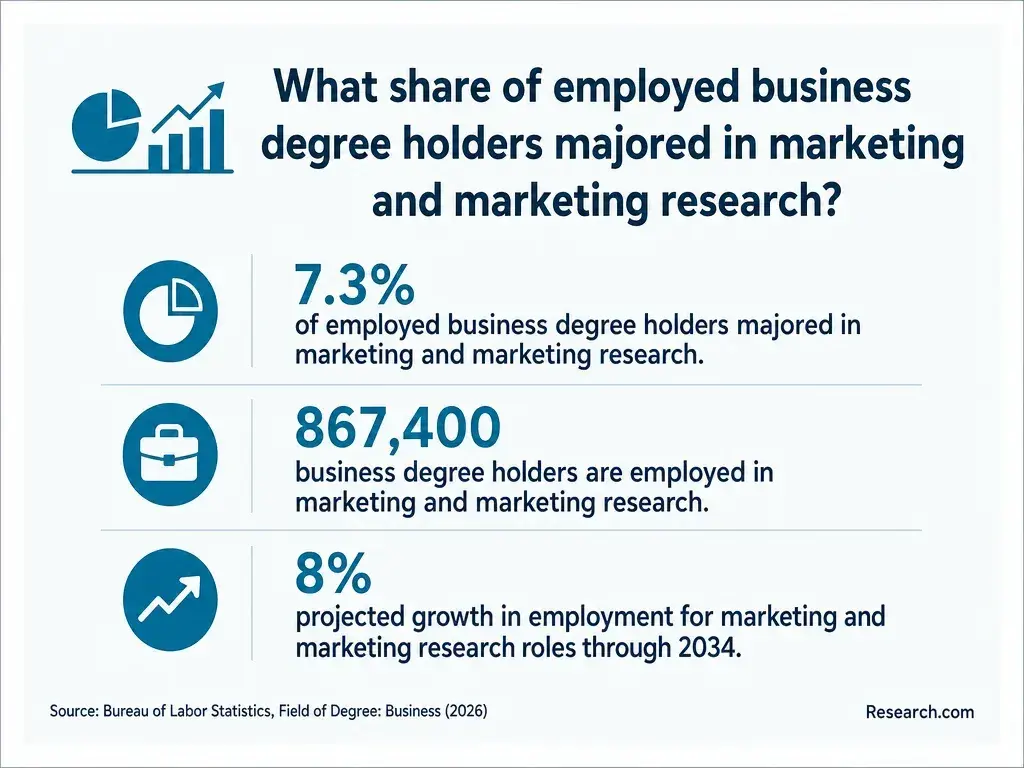
There is no single salary or job-growth rate for BSBA graduates because the degree can lead to different occupations. As one example, the U.S. Bureau of Labor Statistics reports a $78,760 median annual wage in May 2025 for market research analysts and projects 7% employment growth from 2025 to 2035. Those figures describe the occupation across workers with varying experience - not a starting salary or job-placement forecast for a new graduate.
Assess earnings against the particular roles you could qualify for now, local openings, and the cost of finishing the degree. If logistics interests you more than general business roles, shorter bachelor's pathways in supply chain management may be worth comparing. A faster advertised pathway is valuable only if your evaluated credits apply and its coursework supports the jobs you want.
Do Business Administration Graduates Need Licenses or Professional Certifications?
Most general business roles do not require a license simply because you earned a BSBA. Particular activities and occupations can have separate rules: public accounting licensure, certain financial-services work, and some other regulated practices require qualifications beyond a general business degree. Voluntary HR or project-management certifications also have their own eligibility criteria; a related course does not automatically qualify you.
Before adding a certification to your education plan, check the requirements set by the relevant licensing board or certifying organization and compare them with your target job postings. If employers primarily require a completed bachelor's degree rather than a separate credential, fast-track business degree options may be more relevant - provided their transfer decisions, course schedules, and costs hold up under review.
Other Things You Should Know About Business Administration
It can preserve options if deadlines are close. Compare application fees, required records, and deposit dates first, then use each school's written evaluation to narrow the choice before committing to enrollment.
Some schools will use them for a preliminary review, while others require official transcripts. Ask what the review covers and whether a later official transcript could change it.
Ask the school what alternative evidence it accepts, such as a catalog description from the term you took the course. The school may defer an equivalency decision without enough documentation.
Many schools have a review or appeal process. Request the stated reason, submit the relevant syllabus or learning outcomes, and ask which department has authority to reconsider the equivalency.
- .14 Evaluation and Review Process for Transfer of Courses and Credits. | Library of Maryland Regulations https://regs.maryland.gov/us/md/exec/comar/13B.06.02.14
- Admissions for Undergraduate Students - University of the West https://www.uwest.edu/admissions-undergraduate-students/
- Business Administration, BBA | uakron.edu https://bulletin.uakron.edu/undergraduate/colleges-programs/business-administration/general-business/business-administration-bba/
- View Transfer Guide - UNCW - Business Administration (BS) https://coursetransfer.northcarolina.edu/guide/2024-2025/428
- Transfer Student FAQ - The University of Utah https://transfer.utah.edu/faq.php
- Transferring Credits | Undergraduate Admission | University of Miami https://admissions.miami.edu/undergraduate/application-process/credit-information/index.html
- Transfer Credit | Office of the University Registrar (OUR) https://registrar.ucdavis.edu/records/transfer-credit
- Degree and Graduation Policies - Archive - University of Florida https://archive.registrar.ufl.edu/catalog1011/policies/regulationgraduation.html
- Transfer Credit | University of Alabama - UA Academic Catalog https://catalog.ua.edu/undergraduate/about/academic-regulations/policies/transfer-credit/
- Transfer Credit Process | Cal State LA https://www.calstatela.edu/undergraduate-student-success/transfer-credit-process