2027 Choosing a BS in Business Administration When Your Employer Supports a Concentration That May Not Match Your Career Plan
Audited and Verified:
Our Editorial and Data Verification Process
Research.com uses government datasets, official education statistics and primary institutional information to support its career and degree guides. Our review process checks factual accuracy, occupational definitions, source dates and the requirements associated with the credentials discussed.
How This Article Was Fact-Checked
Our editorial team verifies salary estimates, employment projections, education requirements and program information against original data providers and official organizations. Salary figures are checked against the relevant occupational definitions and reporting periods. Information about licensure, accreditation and required in-person training is reviewed separately.
Fact-checked and verified on:

Co-Founder and Chief Data Scientist
Your employer will help pay for a BS in Business Administration, but only if you choose a concentration that may not fit your next career move. The benefit could make finishing your degree more affordable; the wrong coursework could leave you needing additional training afterward.
This guide is for employees weighing that trade-off. It shows how to compare the supported concentration with your target role, calculate the benefit's real value, and check whether electives or workplace projects can bridge the gap before you commit.
Key Things You Should Know
- Choose the supported concentration when its courses build relevant skills or leave room for target-role electives; employer payment alone is not enough.
- Compare your out-of-pocket cost and completion date under both paths, including reimbursement limits, extra courses, and any repayment obligation.
- A concentration is not a job qualification by itself: relevant work samples and experience may matter more than its name, while regulated roles can have separate requirements.
What is a business administration degree, and how do concentrations shape career options?
A BS in Business Administration combines a broad business core with general education and, where offered, focused coursework in a concentration such as marketing, human resources, operations, or finance. The BS is the degree; a concentration is ordinarily a designated part of that degree, not a separate credential. A BBA or specialized bachelor's degree may cover similar subjects but have different requirements.
For an employee already handling budgets, customers, projects, or staff coordination, the most useful question is what the concentration adds to that experience. An operations concentration might strengthen process analysis for a future logistics role; an organizational leadership concentration might be more useful for supervising teams than for building technical supply chain skills. If leadership is your employer's approved option, examine the actual courses before treating fast-paced online organizational leadership bachelor's programs as a substitute for a function-specific curriculum. Course content and experience, not the label alone, determine the fit.
Should you choose your employer's supported concentration or follow your career plan?
Start with the job you want and the responsibilities you already perform. The supported concentration is often a sensible choice if it lets you finish the degree without delaying graduation and you can develop the missing target-role skills through electives, approved projects, or work. Follow your preferred concentration when the difference involves essential preparation that would be difficult or expensive to obtain later.
For example, an employee aiming for supply chain analysis should compare statistics, procurement, operations, and data coursework - not just concentration names. If the employer supports general management but not supply chain, accelerated supply chain bachelor's degrees offer a comparison point, not an automatic better choice: faster advertised timelines may not fit your transfer credits or work schedule.
Before deciding, ask HR whether support is limited to a concentration, specific courses, a school, or roles tied to your current department. Then ask an academic adviser to show both options on a degree audit. A supported concentration loses much of its advantage if changing into it adds prerequisites or postpones a required course.
Is an employer-sponsored business degree concentration worth choosing?
It can be, but compare the net value of each complete path, not the advertised tuition benefit. For each option, total the tuition and fees you expect to pay, uncovered books or technology costs, borrowing costs, and any additional terms of enrollment. Subtract only employer assistance you are eligible to receive. Then weigh the remaining cost against the skills and career access each path offers; do not assume a salary increase.
Read the written benefit policy for annual caps, approved schools and courses, minimum grades, reimbursement timing, tax treatment, and repayment terms if you leave. Reimbursement after a passing grade can still create an immediate cash-flow problem. If project management is one possible direction, tuition budgeting for an accredited project management degree can help frame a cost comparison, but your employer's policy and your official degree audit control your own calculation.
A useful middle ground is to accept the funded concentration only after confirming that remaining electives can fill the most important gap. If they cannot, estimate the cost and time of learning that material separately before calling the employer-funded route cheaper.
Compare the work you want to do with the learning each option actually provides. The table illustrates how an employer-approved concentration can overlap with a target field without being equivalent to it.
| Target direction | Potentially useful supported concentration | Gap to examine |
| Supply chain or procurement | Management or operations | Purchasing, inventory, logistics, and data-analysis coursework |
| Marketing research | General business or marketing | Research methods, statistics, and evidence of analytical work |
| Human resources | Organizational leadership | HR operations, employment-law exposure, and relevant workplace practice |
Use job postings for your target role to identify recurring tasks, then compare them with course descriptions and assessed assignments. If your goal is procurement, for instance, supply chain education costs and career prospects are relevant only after you establish whether a specialized program teaches skills your supported option lacks.
Bring the comparison to an adviser and ask which target-field courses count toward graduation under each plan. Also ask a supervisor or mentor whether a suitable project could demonstrate the missing skill. Workplace access is useful, but academic credit and permission to use company information require separate approval.
Business administration programs commonly cover accounting, economics, finance, marketing, management, operations, statistics or quantitative reasoning, business law, and communication. The depth and sequence vary by school. A concentration adds required or selected courses in its focus area; an elective taken outside that area does not necessarily change the concentration recorded by the school.
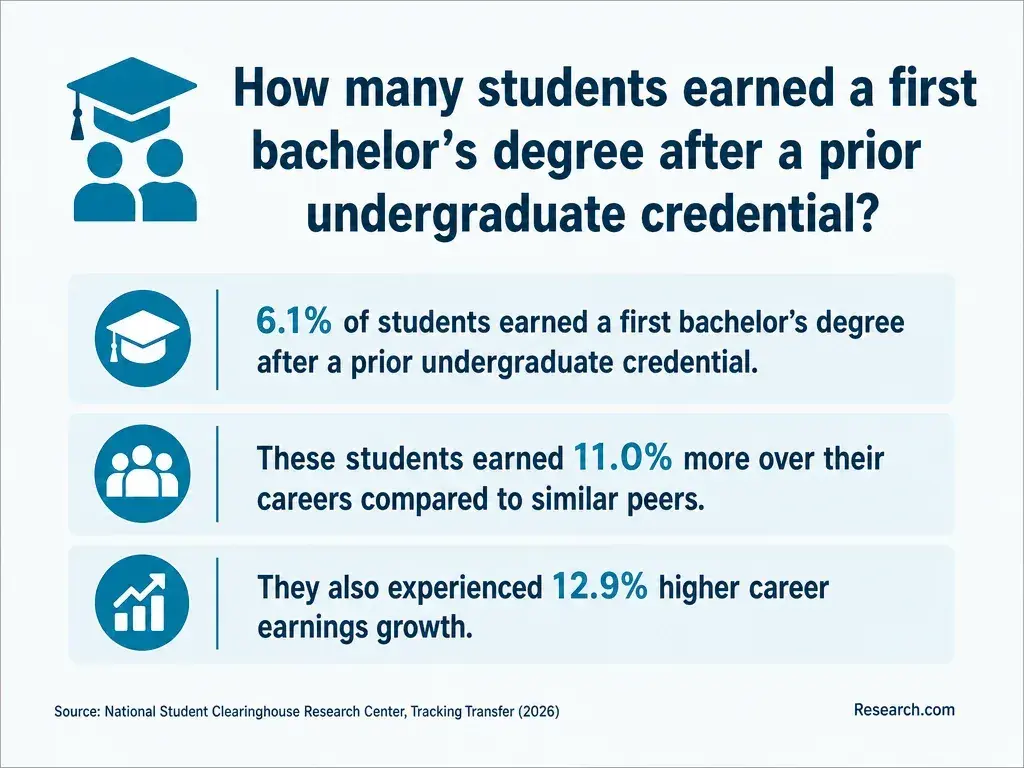
Examine prerequisites as well as course titles. An analytics course may depend on statistics, while advanced finance may follow introductory accounting and finance. If you have previous college work, an accepted course might count only as a general elective rather than satisfy a business-core or concentration requirement. Employees with prior project management study can use options to finish project management studies with transferred college credits for comparison, but only the receiving school can determine how particular credits apply to its BS requirements.
Look for assignments you can discuss with employers - such as an appropriately sourced process analysis - without assuming your workplace will release confidential data or approve the project.
Online delivery does not by itself make a business degree more or less useful. Compare the institution's accreditation, curriculum, assessed work, faculty access, and support for your target career. For an employed student, scheduling may be decisive: an online course can still require live meetings, group presentations, timed exams, or a fixed capstone schedule.
Use US online business education program comparisons to identify schools to investigate, then obtain the current course schedule and assessment rules directly from each program. Ask whether the employer approves the online format and whether required concentration courses are offered often enough for your intended completion date. An asynchronous core is little help if the only required concentration course conflicts with your work shift.
First, confirm that the institution holds recognized institutional accreditation. Then check whether its business school or the specific program has applicable business accreditation through AACSB, ACBSP, or IACBE. These are distinct checks: accreditation of an institution does not establish that every business program has separate business accreditation, and a school's marketing language may not describe the scope clearly.
Verify status and scope with the accreditor and the school before enrolling, particularly if your employer requires a particular kind of accreditation. An easier application is a separate consideration: fee-free online university applications may reduce an upfront expense but do not establish that a program meets your employer's approval rules. Request that approval in writing.
Requirements depend on the school and your entry route. Applicants may need prior transcripts and must meet institutional admission rules; admission to a business major can have additional prerequisites. A returning student should request an official evaluation showing which credits satisfy general education, the business core, the chosen concentration, and any residency requirement. A preliminary estimate is not a graduation plan.
Completion time depends on applicable transfer credits, prerequisite sequencing, course availability, and how many courses you can take while working. Cost depends on remaining courses, tuition and fees, materials, and employer payment rules. Compare online business administration school cost comparisons using your own remaining-credit audit rather than a published price alone. Ask financial aid and HR how their respective eligibility and payment schedules interact before enrolling.
A BS in Business Administration can support applications for roles such as operations coordinator, HR specialist, marketing coordinator, or procurement staff member. Your strongest route depends on prior responsibilities and evidence of the target skills. An employee who has tracked purchasing and improved a documented process may have a more direct transition into procurement than someone whose only exposure is an introductory course.
For wage context, the U.S. Bureau of Labor Statistics reports a May 2025 median annual wage of $75,940 for human resources specialists and projects 6% employment growth for that occupation from 2025 to 2035. Those are occupation-wide figures, not a starting salary or placement forecast for business administration graduates. Before paying for a concentration to pursue HR, check local postings for the experience and tasks employers expect.
If the supported program costs substantially less, low-cost online business degree programs may be useful comparison points. Compare affordability alongside recruiting access, relevant assignments, and the experience you can gain while enrolled; lower tuition alone does not establish a better career outcome.
Do business administration careers require licenses, certifications, or graduate education?
Many general business roles do not require an occupational license, but requirements depend on the work. A business administration concentration does not itself establish eligibility for CPA licensure or a financial-services license. Voluntary HR or project management certifications have their own rules; an MBA is graduate education, not a substitute for missing entry-level experience.
Check the actual target job before adding another credential. If a bachelor's degree is the main hiring requirement, completing it may matter more immediately than starting graduate study. Bachelor's degrees with compressed schedules may be worth examining if speed matters, provided their course sequence, workload, and employer approval are workable. If postings instead call for specialized software, supervised experience, or a regulated credential, plan for that requirement separately.
Other Things You Should Know About Business Administration
Benefits often end when employment ends, and some policies require repayment of recent assistance. Review the written agreement before accepting payment and ask how a departure would affect courses already underway.
An employer may require proof that you met its reimbursement conditions. Ask what documentation you must provide and what, if anything, you would authorize the school to release; do not assume the employer automatically receives your full record.
That depends on the school's catalog, available courses, and remaining degree requirements. Ask for an updated audit before adding one, since the extra courses may extend enrollment and may not be covered by your employer.
No. Tax treatment depends on the benefit and applicable rules. Ask payroll how assistance will be reported and consult a qualified tax professional about your circumstances.
- Your financial path to graduation | consumerfinance.gov https://www.consumerfinance.gov/paying-for-college/your-financial-path-to-graduation/
- Accreditation in the U.S. | ed.gov http://www.ed.gov/laws-and-policy/higher-education-laws-and-policy/college-accreditation/accreditation-in-the-us
- Frequently asked questions about educational assistance programs | Internal Revenue Service https://www.irs.gov/newsroom/frequently-asked-questions-about-educational-assistance-programs
- Regional vs. National Accreditation: Which is Better? | Drexel University Online https://www.online.drexel.edu/news/national-vs-regional-accreditation.aspx
- Do College Credits Expire? | University of Phoenix https://www.phoenix.edu/blog/do-college-credits-expire.html
- Top Concentrations for Business Majors | Excelsior University https://www.excelsior.edu/article/concentrations-for-business-majors/
- Degrees and Certificates Explained | roguecc.edu https://www.roguecc.edu/degrees-and-programs/degrees-and-certificates/degrees-and-certificates-explained.php
- Academic Policies - Grinnell College https://catalog.grinnell.edu/content.php
- What Is Tuition Reimbursement? How It Works for Grad School | University of Kansas https://admissions.ku.edu/blog/what-is-tuition-reimbursement
- Academic Rules - Course Catalog - Syracuse University https://courses.syracuse.edu/undergraduate/academic-rules