2027 Can a BS in Business Administration Prepare You for a Junior Business Analyst Role? Skills and Entry Requirements
Audited and Verified:
Our Editorial and Data Verification Process
Research.com uses government datasets, official education statistics and primary institutional information to support its career and degree guides. Our review process checks factual accuracy, occupational definitions, source dates and the requirements associated with the credentials discussed.
How This Article Was Fact-Checked
Our editorial team verifies salary estimates, employment projections, education requirements and program information against original data providers and official organizations. Salary figures are checked against the relevant occupational definitions and reporting periods. Information about licensure, accreditation and required in-person training is reviewed separately.
Fact-checked and verified on:

Co-Founder and Chief Data Scientist
A BS in Business Administration can give you a foundation for junior business analyst work, but employers also need evidence that you can examine a problem, work with data, and explain a useful recommendation. That distinction matters when you are choosing courses - or deciding whether you need a degree at all. This guide is for students and early-career employees considering the role.
It connects typical analyst tasks to coursework, projects, hiring requirements, and costs so you can identify the most direct route from your current experience to a credible application.
Key Things You Should Know
- Yes. A BS in Business Administration can prepare you for junior business analyst roles when you pair business coursework with data, process-mapping, and stakeholder-facing project work.
- There is no universal degree or license requirement for a job titled "business analyst." Check each posting: some seek a general business graduate, while others require technical skills or industry experience.
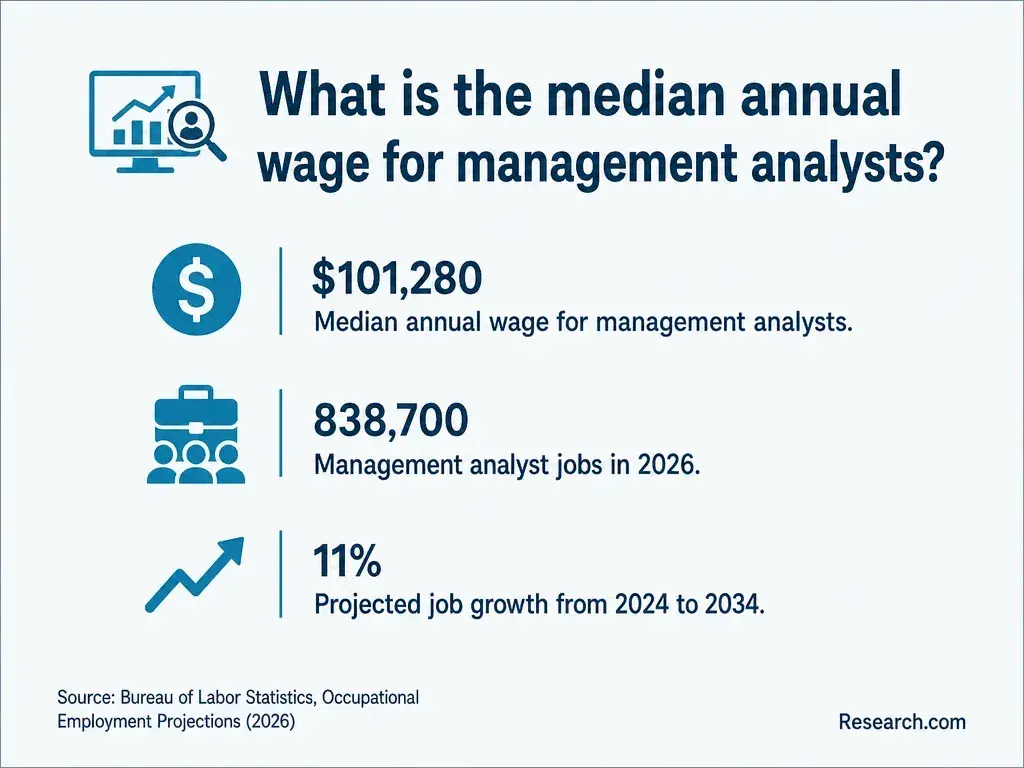
- The closest broad federal occupation, management analyst, had a $101,860 median annual wage in May 2025 and projected 10% employment growth from 2025 to 2035. That occupation-wide median is not a junior analyst starting salary.
Can a BS in Business Administration prepare you for a junior business analyst role?
Yes, provided you turn the degree's broad business foundation into evidence of analyst work. A junior business analyst typically helps define a business problem, documents how work is done, examines information, and communicates findings to people who will decide what to change. Depending on the employer, the role may emphasize operations, reporting, software requirements, or a particular industry.
Business administration courses can explain why a process affects costs, customers, employees, and revenue. They do not, by themselves, show that you can gather requirements from stakeholders or distinguish a useful finding from unreliable data. A supervised internship, relevant job assignment, or well-documented class project can fill that gap. For example, a process review is stronger evidence if it includes the question asked, the data available, a process map, limitations, and a recommendation - not just a polished chart.
If you primarily want to coordinate schedules and deliverables rather than investigate business requirements, compare that goal with accredited project management programs with low tuition. A second degree may be unnecessary if a relevant course and project experience address your gap.
What skills do junior business analysts need to succeed?
Junior analysts need both sound reasoning and the ability to make their work usable by others. The table connects common tasks to evidence a student or early-career employee could reasonably produce; it does not imply that every employer assigns all these tasks to a new hire.
| Common task | Skill behind it | Useful evidence |
| Clarify an unclear request | Interviewing, listening, and defining scope | A short problem statement and documented stakeholder questions |
| Examine a workflow | Process mapping and operational reasoning | A current-state map that identifies a bottleneck and its assumptions |
| Interpret a report | Spreadsheet analysis, data quality checks, and context | A reproducible analysis that explains missing data and limitations |
| Present options | Writing, collaboration, and judgment | A concise recommendation comparing benefits, costs, and risks |
Domain knowledge also matters: an HR reporting request calls for different definitions and privacy safeguards than a purchasing analysis. If your intended specialty is employee-related work, a human resources degree subject guide can help you assess whether deeper HR preparation is more useful than general business electives. In either setting, protect personal and confidential information when creating work samples.
What degree and education requirements do business analyst jobs have?
There is no single hiring standard for "business analyst." Many employers request a bachelor's degree in business, information systems, economics, or another relevant field; some accept equivalent experience. A BS in Business Administration can meet a general degree preference, but a posting focused on software systems may expect requirements documentation and database skills, while a finance-focused posting may demand stronger financial analysis.
Read the duties before judging your eligibility. Separate a posting's required qualifications from preferred ones, then compare each requirement with a course, work assignment, or sample you can describe. If you already hold a bachelor's degree, targeted coursework and a relevant project may be more direct than earning another bachelor's. If the work is chiefly project delivery rather than business analysis, economical project management education online offers a different curriculum to compare - not an automatic substitute for analyst experience.
Prioritize courses by the work they let you practice, not by whether "analytics" appears in the title. Statistics and business analytics support interpretation; accounting and finance explain measures and trade-offs; operations courses support process analysis; information systems courses can introduce requirements and data flows. Business communication ties those pieces to recommendations that stakeholders can use.
For an analyst goal, a strong elective or capstone asks you to define a decision, inspect suitable data, document assumptions, and defend an option. Check the syllabus for assignments and software rather than assuming every BS has the same quantitative depth. Also check whether statistics or another course must be completed before an analytics elective; a school's stated prerequisites for a business administration degree may differ from prerequisites for a particular upper-level course.
An official analytics or information systems concentration can be valuable if it adds relevant depth without delaying graduation. A collection of electives is still useful, but it should not be described on an application as a formally awarded concentration unless the school designates it one.
Start with spreadsheets: clean a small dataset, check formulas, summarize results, and explain what the numbers cannot establish. Then use a sample of relevant job postings to decide whether to add SQL for retrieving data, a dashboard tool for communicating measures, or process-diagramming and requirements tools. Tool names vary by employer; the underlying ability to define a measure and verify its source transfers more readily.
Learn tools through an achievable task rather than a list of software badges. For instance, use public or properly authorized data to document a question, prepare the data, build a simple view, and write a brief interpretation. Never put employer records or personal information into a portfolio without permission. If you are comparing online degrees with accelerated terms, check whether their course sequence leaves enough time for this practice rather than treating faster terms as proof of stronger technical preparation.
A bachelor's degree commonly follows a four-year full-time path, but your remaining courses - not the advertised duration - determine your completion time. Transfer credit, part-time enrollment, prerequisite sequences, and required course availability can change it. Ask for a degree audit showing which accepted credits actually satisfy general education, business core, and elective requirements.
For a cost comparison, request an estimate based on your remaining required courses. Include tuition, mandatory fees, books, software, travel or proctoring, and possible earnings lost if your work hours change. Then subtract only aid you have been offered or can confirm you qualify for; do not assume an advertised scholarship applies. Reviewing business administration college costs and potential career outcomes can frame the comparison, but a broad occupation's salary is not a reliable return-on-investment estimate for an individual new graduate.
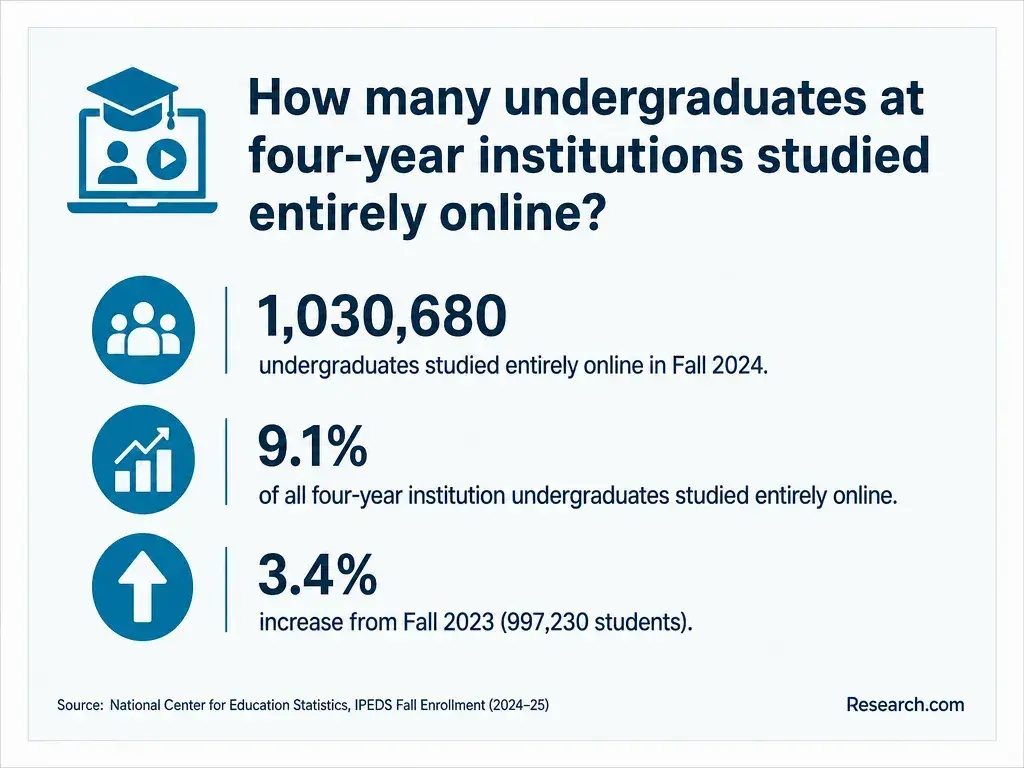
Neither format is inherently better. Choose the setting in which you can complete analytical assignments, get feedback, and access relevant projects or internships. Campus programs may offer convenient in-person recruiting and group work; online programs may fit employment or distance constraints. The advantage depends on what the particular school delivers and what you can attend.
For an online option, ask whether classes require live meetings, timed exams, team presentations, or campus visits, and whether analytics electives run often enough for your plan. An asynchronous lecture does not make a group project self-paced. If you need flexible scheduling, compare accelerated business education for working adults against your weekly capacity and the time needed to build analyst work samples. Confirm institutional accreditation and, if business accreditation matters to you, whether it covers the specific program.
Requirements depend on the institution and on whether you apply as a first-year, transfer, or returning student. Schools commonly request prior academic transcripts; some have separate admission standards for the business major or prerequisites for upper-level courses. Ask admissions which documents and deadlines apply to you, then ask an adviser how any previous coursework will apply to the degree. Admission and transfer-credit acceptance do not guarantee that a required business course has been satisfied.
If application costs are a concern, accredited online colleges without application fees can provide options to investigate. Verify the current fee policy, the exact business degree offered, its admission rules, and your likely remaining requirements before choosing where to apply.
There is no single reliable national salary figure for every job titled "junior business analyst": employers use that title for different work. The U.S. Bureau of Labor Statistics reports a $101,860 median annual wage in May 2025 for management analysts, with 10% projected employment growth from 2025 to 2035. Management analysts are a broader occupation that includes experienced workers, so neither figure describes a junior hire's likely offer. Use local postings with comparable duties and experience requirements to assess pay.
Strong projected growth supports investigating the field, not borrowing against an assumed future salary. Before committing to a program, compare its net cost and likely completion time with your current qualifications and lower-cost ways to build missing skills. If federal aid is part of that calculation, check whether prospective business administration colleges participating in federal aid programs also meet your curriculum and scheduling needs; participation alone does not establish your personal aid eligibility.
Do business analysts need certifications or professional licenses?
Business analysts generally do not need an occupational license simply to hold the role. A certification may help document specific knowledge, but eligibility rules and employer interest vary. For a first job, a relevant project, clear communication, and the tools named in local postings may be a better immediate investment than a credential chosen without a target employer in mind.
Keep business analysis credentials distinct from project management credentials and degrees. If your career review points toward project management study instead, compare the full financing consequences - including grants versus loans for project management bachelor's study - before treating another degree as the default route. Check any certification provider's current eligibility and exam rules directly before paying.
Other Things You Should Know About Business Administration
Yes. Label it as academic work, state your specific contribution, and describe the question, method, and deliverable. Do not present a proposed improvement as an implemented result.
Ask what your employer permits you to disclose. If permission is unavailable, describe your responsibilities at a high level and create a separate sample using public or synthetic data; do not reuse private records.
Ask what decisions the role supports, who defines requirements, what data and tools are available, and how a new analyst's work is reviewed. The answers clarify the job's actual scope.
No. Their duties can overlap, but a business analyst role may focus more on processes and requirements, while a data analyst role may demand deeper data preparation and analysis. Compare duties, not titles alone.
- Top Data Analyst Tools Every Professional Should Learn in 2026 | Edgewood College https://online.edgewood.edu/blog/top-data-analyst-tools-for-career-success/
- Becoming a business analyst in 2026 and beyond | Cornell SC Johnson College of Business https://business.cornell.edu/news/2026/03/20/how-to-become-a-business-analyst/
- Business Analyst Communication & Stakeholder Skills Guide | William & Mary Mason https://online.mason.wm.edu/blog/skills-for-a-successful-career-in-business-analytics
- How to Become a Business Analyst: Steps, Skills, and Salary | Touro University Worldwide https://www.tuw.edu/business/how-to-become-a-business-analyst/
- Knowledge and insights from job offer analysis | sciencedirect.com https://www.sciencedirect.com/science/article/pii/S2444569X25002045
- How To Become a Business Analyst | arizona.edu https://career.arizona.edu/blog/2022/06/03/how-to-become-a-business-analyst/
- Top 15 Data Analytics Tools You Should Be Using in 2025 | Syracuse University https://ischool.syracuse.edu/data-analytics-tools/
- Becoming a Business Analyst: What You Need to Know | Georgia Tech Professional Education https://pe.gatech.edu/blog/industry-trends/how-to-become-a-business-analyst
- Entry Level Business Analyst: No Experience Needed? | Readynez https://www.readynez.com/en/blog/business-analyst-career-roadmap-2026-starting-without-experience/
- What Are Business Analyst Requirements? (And Other Common Questions) | Indeed.com https://www.indeed.com/career-advice/career-development/business-analyst-requirements