2027 BS in Business Administration Curriculum: How to Evaluate Preparation in Recruitment Operations
Audited and Verified:
Our Editorial and Data Verification Process
Research.com uses government datasets, official education statistics and primary institutional information to support its career and degree guides. Our review process checks factual accuracy, occupational definitions, source dates and the requirements associated with the credentials discussed.
How This Article Was Fact-Checked
Our editorial team verifies salary estimates, employment projections, education requirements and program information against original data providers and official organizations. Salary figures are checked against the relevant occupational definitions and reporting periods. Information about licensure, accreditation and required in-person training is reviewed separately.
Fact-checked and verified on:

Co-Founder and Chief Data Scientist
A business administration degree can teach management and analytics without teaching a student how a hiring workflow actually runs. That distinction matters if you want to coordinate interviews, maintain recruiting systems, interpret hiring data, or improve candidate communication.
This guide is for prospective and current BS students evaluating recruitment operations preparation. It shows which courses and assignments provide relevant evidence, what a degree cannot establish on its own, and how to compare pathways before committing time and money.
Key Things You Should Know
- Look for a combination of human resources, operations, statistics, information systems, and an applied hiring-workflow assignment - not an HR course title alone.
- For context, the U.S. median annual wage for human resources specialists was $75,940 in May 2025; that occupation-wide figure is not an expected starting salary for recruitment operations graduates.
- Choose the degree only after checking its remaining cost, course sequence, access to relevant projects, and fit with the recruiting roles you want.
What Is a Business Administration Degree for Recruitment Operations?
Recruitment operations is the coordination, systems, reporting, and process work that helps an organization hire. Depending on the employer, it can include maintaining an applicant tracking system (ATS), scheduling interviews, documenting workflow steps, supporting recruiters and hiring managers, and checking whether reports accurately describe the hiring process. It is related to recruiting, but not identical to sourcing candidates or deciding whom to hire.
A BS in Business Administration is a broad undergraduate degree, not a standardized recruitment operations credential. Its management, operations, and data courses can provide a foundation, while HR electives and supervised projects add functional depth. A BBA or specialized HR bachelor's may cover similar ground, but compare actual requirements rather than degree labels.
Students primarily interested in supervising teams rather than hiring processes can also compare shorter online bachelor's pathways in organizational leadership; organizational leadership coursework is not necessarily a substitute for recruiting systems practice.
What Courses Prepare Business Students for Recruitment Operations Careers?
The strongest curriculum connects people decisions to repeatable processes and trustworthy data. The table shows what to inspect in a catalog or syllabus; a course title alone does not establish that an assignment is included.
| Course area | Recruitment operations connection | Evidence of useful depth |
| Human resource management and employment law | Hiring stages, documentation, and compliance awareness | Analysis of a hiring policy or structured selection process |
| Operations or project management | Workflow handoffs, scheduling, and bottlenecks | A process map with owners, delays, and proposed controls |
| Statistics and business analytics | Interpreting recruiting measures without overstating conclusions | A documented spreadsheet analysis that explains data limitations |
| Information systems | Data entry, permissions, reporting, and system changes | A system requirements or data-quality assignment |
| Business communication | Clear updates to candidates and hiring stakeholders | Audience-specific messages and a documented escalation plan |
Check prerequisites and scheduling: an advanced analytics elective may require statistics first, and an HR elective may not be offered every term. If you already hold a project-focused associate degree, project management bachelor's routes for associate degree graduates offer a useful comparison. Ask each school which prior credits actually satisfy the business core and whether its remaining electives cover HR as well as workflow design.
How Does Accreditation Affect a Business Administration Degree's Value?
Institutional accreditation and business-program accreditation answer different questions. Check an institution's recognized accreditation status, then verify whether any claimed AACSB, ACBSP, or IACBE accreditation covers the relevant business school or program. Neither designation proves that a particular student will practice with an ATS, complete an HR project, or secure a job.
Use accreditation as an initial check, not the final curriculum test. When reviewing US online business education program comparisons, confirm each school's current accreditation scope and catalog yourself. Then request the course sequence, sample assignment descriptions, internship rules, and any published outcomes with their cohort definitions. These details say more about recruitment preparation than a general program reputation does.
For an early-career student, a BS in Business Administration with HR and analytics electives offers broad business options alongside recruiting preparation. A formal HR concentration may provide more relevant coursework, but verify that it appears on the academic record and whether it adds credits or delays graduation. An HR-focused bachelor's may be a better fit when its required courses and placements offer substantially more hiring-process practice.
For someone already coordinating schedules, serving customers, or maintaining records, the missing qualification may be a specific skill rather than another full degree. Compare job descriptions with your documented experience before deciding. Accelerated online pathways for business students may suit a person who needs a bachelor's credential, but faster calendars do not replace relevant HR assignments or employer-facing work.
Use a simple decision rule: favor the pathway that closes your largest verified gap - degree requirement, HR knowledge, data skills, or practical experience - without paying for unnecessary credits. A business degree alone does not make someone a recruiter, HR specialist, or manager.
Look beyond whether students learn recruiting terminology. A useful program should require them to produce work that another person could review for accuracy, clarity, and responsible handling of information. Relevant examples include mapping an interview-scheduling process, defining the fields needed for a hiring report, explaining missing data, and writing a concise update for a hiring manager.
Metrics require particular care. "Time to fill," for example, is hard to compare unless the analyst states when the clock starts and stops, which requisitions are included, and whether pauses are recorded. A shorter interval does not, by itself, demonstrate better hiring quality or fairness. Coursework should also address access controls and confidentiality: student projects should use public, synthetic, or properly authorized data rather than identifiable applicant records obtained without permission.
If process planning interests you more than HR practice, compare the curriculum and financing of financial aid at low-cost project management schools with your business degree options. Project-management study can strengthen workflow skills, but you would still need hiring-specific context.
They can be, provided students can practice collaboration, data interpretation, and stakeholder communication - not just read about them. An online simulation or faculty-reviewed process project can develop these skills. It is not the same as maintaining an employer's live ATS, and a remote internship requires the same academic and workplace approvals as an on-site one.
Before enrolling, ask whether HR and analytics electives are available online, whether group meetings or presentations have fixed times, and whether exams, internships, or capstones require travel or employer access. Compare those answers with accelerated online bachelor's programs only after estimating the weekly workload. Online delivery does not necessarily mean self-paced study.
Requirements vary by school and by entry route. First-year applicants may need secondary-school records; transfer applicants generally need prior college transcripts. Some schools admit students to the institution before they can enter a business major or take upper-level courses. Ask whether mathematics, statistics, accounting, or economics must be completed before those courses - not merely before graduation.
Applicants comparing FAFSA-accepting colleges for business administration students should separately confirm admission, program eligibility, and their own financial-aid eligibility. A school's participation in federal aid does not establish an individual award. Transfer students should request a written evaluation showing where accepted credits apply; credit counted as a general elective may not satisfy a required HR or analytics course.
Time to completion depends on the school's requirements, applicable transfer credit, course availability, and enrollment pace. A transfer student's decisive figure is the number and sequence of remaining required courses, not the number of credits a school initially accepts. An internship or elective offered infrequently can affect the finish date even when few credits remain.
Build a cost-to-finish estimate from the school's current tuition and fees, required books or software, any travel or proctoring charges, and the terms needed to complete the approved degree audit. Compare business administration degrees for limited tuition budgets using the same assumptions. A lower advertised tuition rate may not yield a lower total if more courses are required or completion takes longer. Ask the financial-aid office how your planned enrollment pace affects aid before changing it.
Recruiting coordinator, talent acquisition coordinator, and recruitment operations assistant are plausible entry routes where employers offer those titles. Their duties may center on scheduling, records, candidate communication, and reporting support. HR specialist positions can involve broader recruiting or employee-related responsibilities and may require experience; recruitment operations manager roles generally require demonstrated responsibility beyond graduation.
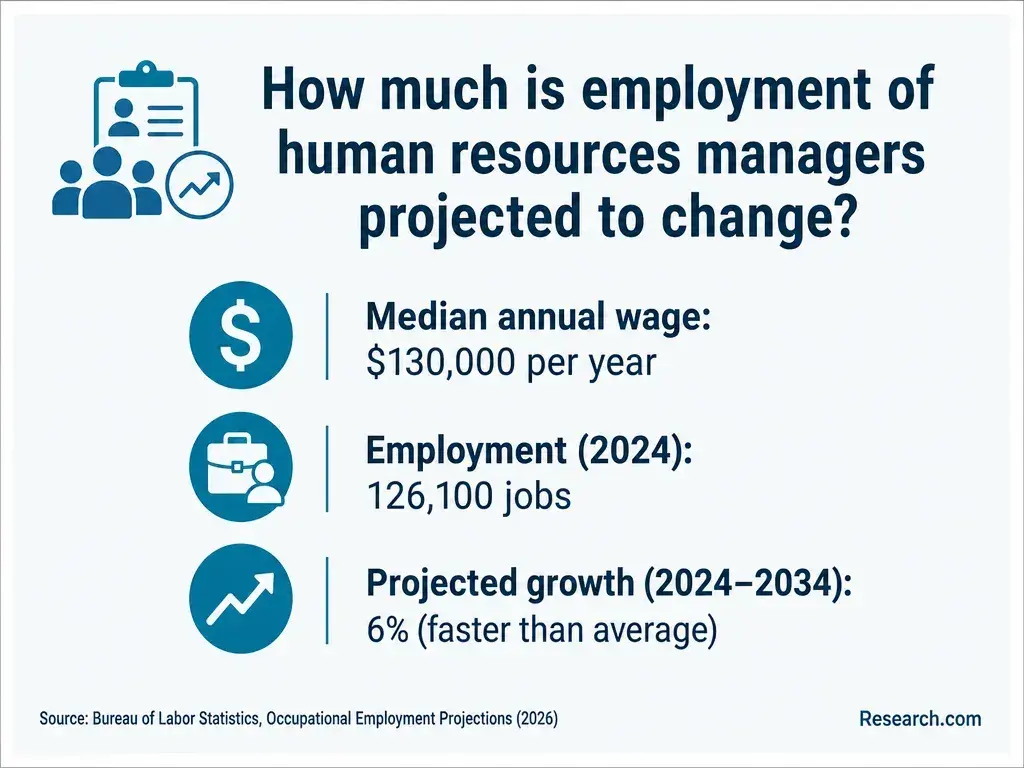
The U.S. Bureau of Labor Statistics reports a May 2025 median annual wage of $75,940 for human resources specialists and projects 6% employment growth for that occupation from 2025 to 2035. Those figures cover workers across experience levels and HR specialties, not graduates entering recruitment operations. Use local postings to assess actual pay, software expectations, and whether a bachelor's degree is required or preferred.
If earnings are part of your decision, compare cost-to-finish for shorter business administration programs against the qualifications in jobs you could realistically pursue. Do not calculate a degree's return using an occupation-wide median as though it were your first-job offer.
Are Certifications Required for Recruitment Operations Careers?
There is no single certification universally required for recruitment operations. Employers may value familiarity with an ATS, spreadsheets, HR processes, or particular platforms; a vendor course or professional certification is separate from a bachelor's degree. Check each credential provider's eligibility and renewal rules before paying, and check target postings to see whether the credential appears as a requirement or preference.
If your main obstacle is a missing bachelor's rather than a missing tool skill, compare the completion requirements behind US rankings for accelerated business bachelor's degrees instead of assuming a short certificate will satisfy degree-screened roles. If you already meet employers' education requirements, targeted training plus a documented recruiting-process project may be the more direct next step.
Other Things You Should Know About Business Administration
It may involve arranging interviews and supporting the process, but interview ownership varies by employer. Read the job description for the division of work among coordinators, recruiters, and hiring managers.
Yes, if your duties include documented scheduling, records, employer coordination, or process improvement. Describe what you actually did rather than presenting all career-center work as recruiting experience.
Ask who owns the hiring workflow, which systems the role uses, how data quality is checked, and what decisions the position may make independently. The answers clarify both the training you need and the job's level of responsibility.
Usually, you can show an original project built with synthetic or public information. For workplace material, obtain permission and follow confidentiality and intellectual-property rules before sharing even a redacted version.
- Overview | U.S. Equal Employment Opportunity Commission https://www.eeoc.gov/overview
- Equal Employment Opportunity | dol.gov https://www.dol.gov/general/topic/discrimination
- NASA Internship Programs https://www.nasa.gov/learning-resources/internship-programs/
- Project based learning framework integrating industry... - PMC https://pmc.ncbi.nlm.nih.gov/articles/PMC12246200/
- Work-based Learning Handbook - MDE https://education.mn.gov/mdeprod/idcplg
- Career Outcomes | University Career Center https://career.utdallas.edu/career-resource-library/career-outcomes/
- The impact of university ties on early labor market outcomes | sciencedirect.com https://www.sciencedirect.com/science/article/pii/S0272775723001036
- Bachelor of Science in Business Administration (BSBA) in Operations Management | Thomas Edison State University https://www.tesu.edu/degrees-programs/bachelors/bs-business-administration/operations-management.php
- Human Resources Degree Online Program | Courses | Capella University https://www.capella.edu/online-business-degrees/bs-business-program/bachelors-human-resource-management/courses/
- Business Administration - UF Online - University of Florida https://ufonline.ufl.edu/degrees/undergraduate/business-administration/