2027 BS in Business Administration with a Supply Chain Management and Logistics Focus vs. a Standalone Supply Chain Management Degree
Audited and Verified:
Our Editorial and Data Verification Process
Research.com uses government datasets, official education statistics and primary institutional information to support its career and degree guides. Our review process checks factual accuracy, occupational definitions, source dates and the requirements associated with the credentials discussed.
How This Article Was Fact-Checked
Our editorial team verifies salary estimates, employment projections, education requirements and program information against original data providers and official organizations. Salary figures are checked against the relevant occupational definitions and reporting periods. Information about licensure, accreditation and required in-person training is reviewed separately.
Fact-checked and verified on:

Co-Founder and Chief Data Scientist
If you want to work in procurement, logistics, or operations, both a business administration degree with a supply chain focus and a standalone supply chain management degree can be relevant. The better choice depends less on the title than on the specialized courses, applied experience, and credits you would need to finish. This comparison is for prospective and returning undergraduates choosing a path into supply chain work. It explains what each degree typically teaches, where career outcomes overlap, and what to verify before committing your time and money.
Key Things You Should Know
- A standalone supply chain major is usually the stronger choice for students seeking deeper preparation in procurement, logistics, planning, and analytics; a business administration focus offers broader business study when its supply chain coursework is substantial.
- The U.S. Bureau of Labor Statistics projects 18% employment growth for logisticians from 2025 to 2035, but that outlook applies to the occupation - not to graduates of either particular degree.
- Compare the required courses and your remaining credits before choosing: a specialized degree is not automatically worth extra tuition or a delayed graduation date, especially if you can gain relevant experience through the broader program.
What is the difference between a business administration supply chain focus and a supply chain degree?
A BS in Business Administration with a supply chain management and logistics focus is a general business degree with a defined set of supply chain courses. Depending on the school, that focus may be an official concentration, a track, or simply a group of electives. A standalone supply chain management degree makes the function itself the major and generally devotes more required coursework to it.
The distinction matters most when you compare what must be completed - not just the degree names. This table shows the usual trade-off; individual catalogs can differ substantially.
| Comparison point | Business administration with supply chain focus | Standalone supply chain management degree |
| Academic emphasis | Broad business core plus selected supply chain courses | Supply chain core alongside supporting business courses |
| Potential strength | Flexibility across business functions | More sustained study of supply chain decisions and tools |
| Main limitation to check | The focus may contain few required specialist courses | Required specialist courses may leave less room for other interests |
| Credential on graduation | Business administration degree; concentration notation depends on school policy | Supply chain management degree under the school's official title |
Ask for each program's current degree audit and count required upper-level supply chain courses, not just available electives. If the broader route meets your goals with fewer remaining courses, cost-saving online business administration school choices can provide comparison points - provided you verify that the advertised degree actually offers the focus you want.
Which degree offers better career opportunities in supply chain management?
For a clear goal such as inventory planning, purchasing, transportation analysis, or supplier coordination, a standalone major may provide more directly relevant coursework and projects. It does not, however, automatically outrank a business administration graduate who has stronger spreadsheet skills, an internship, and evidence of solving operational problems.
The business administration route can be a better fit if you are still choosing among supply chain, finance, sales operations, and general operations. It may also suit an employed student whose current logistics responsibilities can support approved coursework or a portfolio project. For that situation, business administration degree planning for employed applicants offers a useful way to assess study alongside work.
Neither degree makes a new graduate a supply chain manager. For an entry-level application, show how you used data to investigate a stockout, compare suppliers, document a process, or explain a delivery trade-off. If your actual goal is broad people-management preparation rather than supply chain work, compare completion times for other related degrees only after checking whether their curricula match the jobs you want.
Is a supply chain management degree worth it for salary and job growth?
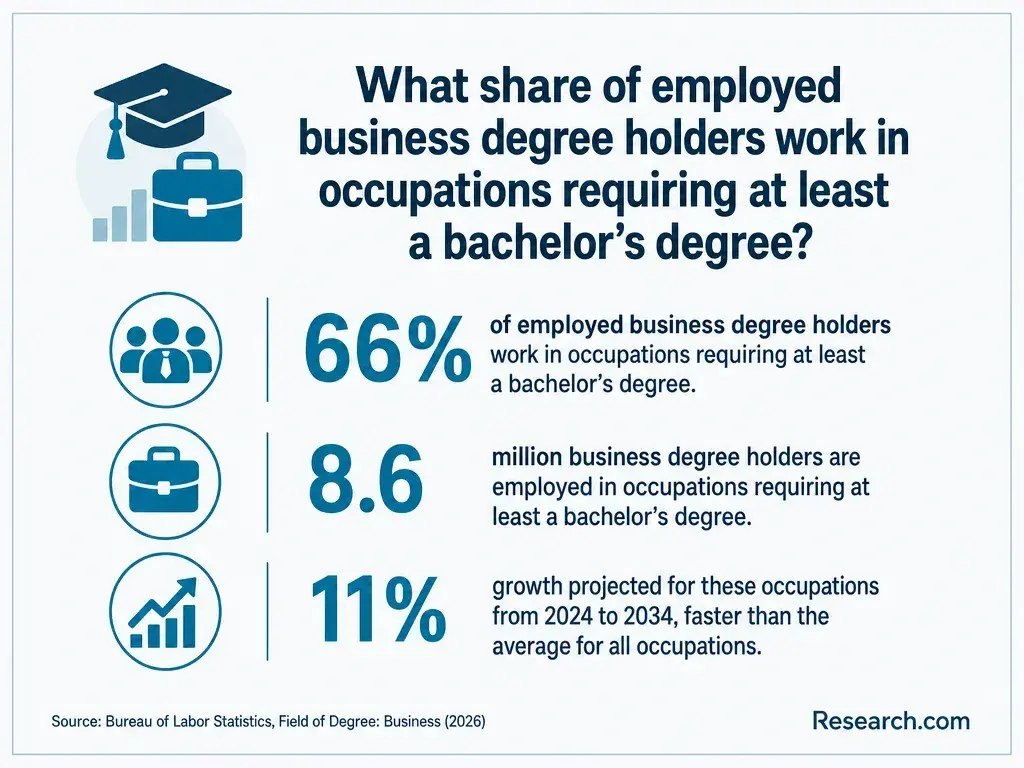
It can be worth it when the added specialist preparation, recruiting access, and applied work justify its total cost. The U.S. Bureau of Labor Statistics projects 18% growth in logistician employment from 2025 to 2035. That indicates demand for the occupation, not a guaranteed job, starting salary, or advantage for one degree title over another.
Judge the investment against the alternative you could actually complete. A standalone major may be attractive if it adds meaningful work in forecasting, procurement, and supply chain systems without delaying graduation. A business administration focus may deliver better value if it accepts more of your previous coursework and lets you build specialist experience through an internship or current job. When assessing supply chain college costs versus potential career outcomes, separate occupation-wide pay figures from outcomes reported for a school's graduates.
Both pathways commonly include accounting, economics, statistics, management, and operations. A business administration degree may spend more required time on marketing, finance, organizational behavior, and strategy, then add courses in logistics or supply chain management. A standalone major may require a longer sequence covering sourcing, inventory, transportation, demand planning, global supply chains, and analytics.
Course titles alone are weak evidence of depth. Compare prerequisites and assignments: does an analytics course require students to interpret uncertain demand data, or only introduce terminology? Does a purchasing course examine supplier risk and total cost, or provide a general overview? Look for authorized projects or simulations that let you explain your assumptions without exposing an employer's confidential information.
If project coordination is your primary interest, check whether either curriculum includes scheduling, budgets, and stakeholder communication before considering affordable online study routes in project management as a separate alternative. A project management course is useful, but it is not a substitute for supply chain-specific planning and procurement study.
Online delivery does not determine academic value by itself. What matters is whether students complete comparable required coursework, receive useful feedback, can access relevant software, and have realistic ways to gain applied experience. A campus program may offer easier access to nearby employers or recruiting events; an online program may be more practical for someone already working in logistics.
Before enrolling, ask whether courses have live meetings, fixed group-project schedules, proctored exams, campus visits, or an internship that must be arranged locally. Confirm which upper-level courses run in each term so that a required sequence does not unexpectedly extend your studies. Online business programs in US college rankings can help you identify options, but a ranking cannot confirm the supply chain courses or scheduling rules that apply to you.
First, verify the institution's accreditation and its current status through the accreditor and the U.S. Department of Education's recognized-accreditor information. Then check whether the business school or specific program has additional accreditation from AACSB, ACBSP, or IACBE. Those bodies have different scopes; accreditation of a business school should not be assumed to cover every degree offered by the institution.
Ask the school to identify the exact accredited entity and whether your intended degree is included. Accreditation is an important quality and eligibility check, but it does not prove that a program places graduates in supply chain jobs. It also does not, by itself, establish your personal eligibility for aid. For the financing side of this decision, use FAFSA planning for affordable business administration study alongside confirmation of the school's aid eligibility and your own award information.
Requirements vary by institution and by entry point. First-year applicants generally submit secondary-school records; transfer applicants typically submit transcripts from every college attended. Some schools admit students to the university first and require a separate step before entry into the business or supply chain major. Mathematics, accounting, economics, or statistics courses may be prerequisites for upper-level work even when they are not required for initial admission.
If you have previous college credit, request an official evaluation showing where each accepted course applies: general education, business core, supply chain requirements, or electives. Acceptance as elective credit does not mean a required course has been satisfied. Ask an adviser which prerequisites remain and whether required courses are offered in the terms you plan to attend. If application charges affect your shortlist, no-application-fee online college choices may help you identify schools to investigate without treating a waived fee as evidence of program fit.
Completion time depends on your accepted credits, how those credits satisfy degree requirements, course sequencing, and how many courses you can take while meeting other obligations. A standalone major may take longer for a transfer student if its specialist courses must be completed in sequence. A business administration focus may instead require additional general business courses that the student has not taken. Neither title is inherently the faster route.
Request a term-by-term plan and an itemized estimate from each school. Compare remaining tuition and mandatory fees, books or software, travel or proctoring, and the cost of any extra term. Include foregone earnings if a schedule requires you to reduce work hours. Compare tuition for online business colleges as an initial screen, then use each institution's official transfer evaluation and charges to calculate your own likely completion cost.
Graduates of either pathway may seek roles in logistics coordination, inventory analysis, purchasing support, transportation planning, or operations analysis. The fit depends on the job's tasks and the applicant's evidence of relevant skills, not solely on whether the diploma says business administration or supply chain management. Purchasing decisions, for example, may call for supplier evaluation and negotiation; logistics analysis may emphasize shipment data, service levels, and process improvement.
The U.S. Bureau of Labor Statistics reports a May 2025 median annual wage of $82,320 for logisticians. That is the median across workers in the occupation, not an expected starting salary or a measured outcome for either degree. Location, industry, responsibility, and experience can materially change an offer.
An employed applicant should compare target job postings with work already performed and identify missing evidence - such as a forecast, process map, or documented purchasing analysis that can be shared appropriately. If your interest turns out to be staffing or employee relations rather than moving goods and materials, transfer pathways into online human resources programs may be more relevant than either supply chain option.
Which supply chain certifications should degree graduates consider?
A certification is a separate professional credential, not an automatic result of graduating. ASCM's CPIM is commonly associated with planning and inventory; its CSCP addresses broader end-to-end supply chain concepts. ISM's CPSM is oriented toward supply management and procurement. Their value depends on the work you want to do, the eligibility rules in force when you apply, exam costs, and whether employers in your target market request them.
Choose a credential after reviewing job descriptions and your own experience. An early-career applicant may benefit more immediately from a relevant job, internship, or demonstrable analysis than from paying for an exam without a clear use for it. If your work centers on coordinating projects rather than purchasing or planning supply, compare project-management credentials and experience requirements separately; affordable online study routes in project management describe an academic alternative, not a certification or a substitute for checking a certifier's rules. Similarly, if your career trajectory leans toward broader management roles, you might compare completion times for organizational leadership degrees to evaluate how quickly an academic program fits alongside your professional timeline.
Other Things You Should Know About Business Administration
Possibly, but ask for a new degree audit before changing majors. Courses already completed may count only as electives, and a new sequence of required courses could change your graduation date.
Either can provide undergraduate business preparation. MBA admission is determined by the graduate program's requirements, which may include academic records and professional experience rather than a particular bachelor's title.
Some institutions assess documented prior learning, but experience does not automatically earn credit or replace a required course. Ask the school which assessment methods it accepts and how any awarded credit would apply to your degree.
Not necessarily. Schools differ in whether a concentration appears on the diploma, transcript, or both. Confirm its official designation with the registrar before describing it as a separately awarded qualification.
- Annual Earnings by Educational Attainment - COE https://nces.ed.gov/programs/coe/indicator/cba/annual-earnings
- Certification Procedures for Title IV of the HEA | ed.gov http://www.ed.gov/laws-and-policy/higher-education-laws-and-policy/higher-education-policy/ope-guidance-documents/frequently-asked-questions-certification-procedures-title-iv-of-hea
- New Pathways to a College Degree: How Transfer Credits Save Time | University of Arkansas Grantham https://www.uagrantham.edu/blog/transfer-college-credits-online-pathways-degree/
- Transfer Credits - Undergraduate - Policies - Campus Offices https://campus.collegeforcreativestudies.edu/policy/transfer-credits-undergraduate/
- Supply Chain Jobs: What Can You Do With This Degree? | WPUNJ https://online.wpunj.edu/degrees/undergraduate/bs-management-scm/supply-chain-jobs/
- What Can You Do With a Bachelor's Degree in Supply Chain, Transportation and Logistics Management? | Bellevue University https://www.bellevue.edu/articles/what-can-you-do-with-a-bachelors-degree-in-supply-chain-transportation-and-logistics-management/
- 8 Things You'll Learn in a Bachelor's Concentration in Supply Chain Management | Walden University https://www.waldenu.edu/online-bachelors-programs/concentrations/supply-chain-management/resources/things-youll-learn-when-choosing-a-bachelors-concentration-in-supply-chain-management
- How to Find Supply Chain Management Internships | Elmhurst University https://www.elmhurst.edu/blog/supply-chain-management-internships/
- What Is Supply Chain Management? A Guide to Careers, Salaries & Certifications | UW-Stout Polytechnic https://www.uwstout.edu/programs/bs-supply-chain-management/what-is-supply-chain-management-guide
- Top 30 Supply Chain Management Degree Programmes in USA | SCMDOJO https://www.scmdojo.com/supply-chain-management-degree/