2027 BS in Business Administration and Entrepreneurship: How to Check Whether a Job Needs a Separate Credential
Audited and Verified:
Our Editorial and Data Verification Process
Research.com uses government datasets, official education statistics and primary institutional information to support its career and degree guides. Our review process checks factual accuracy, occupational definitions, source dates and the requirements associated with the credentials discussed.
How This Article Was Fact-Checked
Our editorial team verifies salary estimates, employment projections, education requirements and program information against original data providers and official organizations. Salary figures are checked against the relevant occupational definitions and reporting periods. Information about licensure, accreditation and required in-person training is reviewed separately.
Fact-checked and verified on:

Co-Founder and Chief Data Scientist
A BS in Business Administration and Entrepreneurship can prepare you for many business roles, but it does not automatically qualify you for every job that mentions business, finance, or management. The distinction matters when a promising posting calls for a license, professional certification, or experience the degree cannot replace.
This guide is for students, graduates, and career changers comparing target roles. It explains how to separate legal requirements from employer preferences, check the right authority, and decide whether your next step is a credential, practical experience, or a different educational path.
Key Things You Should Know
- A business administration degree is an academic credential, not an occupational license; check the duties and work location before assuming a job requires another credential.
- Job postings may mix legal requirements, employer preferences, and experience requirements. Verify a claimed license with the relevant state regulator and a certification with its issuing organization.
- The U.S. Bureau of Labor Statistics reports a May 2025 median annual wage of $75,940 for human resources specialists, but that occupation-wide figure is not a starting salary for business graduates.
What is a business administration and entrepreneurship degree?
A BS in Business Administration and Entrepreneurship combines a general business foundation with study of how to evaluate, launch, or grow an enterprise. Depending on the school, entrepreneurship may be an official concentration, a set of electives, or part of the degree's name. Check the catalog and transcript designation rather than assuming those structures are equivalent.
The degree can build useful preparation for an employee developing new products as well as someone planning a small business. It does not establish that a graduate has operated a company, supervised staff, or met a profession's licensing rules.
If your goal is primarily to lead an existing organization rather than develop ventures, explore shorter organizational leadership bachelor's programs before choosing an entrepreneurship-focused curriculum.
Does a business administration job require a separate license or credential?
Not all business duties require a universal business-administration license. Coordinating operations, supporting marketing, or preparing an internal business plan are examples of tasks that typically do not carry such a license.
However, jobs involving regulated services may have requirements set by a state, federal regulator, or other authority. Additionally, an employer may request a voluntary certification, specialized degree, or work experience for certain positions. It's important to note that these conditions are different and should not be treated as interchangeable.
The distinction determines what evidence you need. These examples show why the job's duties matter more than its broad title.
| Target work | What to distinguish from the BS |
| General operations or marketing support | Usually employer-defined skills and experience, rather than a general occupational license. |
| Public accounting or certain financial services | Activity-specific licensing rules; business coursework alone does not establish eligibility. |
| Human resources or project coordination | Employers may prefer a voluntary certification, but its eligibility rules are separate from degree requirements. |
| Owning a business | Business formation and applicable local, industry, or activity-specific permits are separate from a personal professional credential. |
Use the posting as a lead, not the final authority. A repeatable check is especially important when a title such as "consultant," "advisor," or "manager" covers different duties at different employers.
- Copy the exact job title, duties, work location, and credential language from several relevant postings; separate "required" from "preferred."
- Identify whether the requirement attaches to a regulated activity, an employer's hiring policy, or a voluntary designation.
- For regulated work, confirm the applicable state or federal regulator's education, examination, experience, and application rules for that location and activity.
- For a certification, check the issuing organization's current eligibility rules; ask the employer whether an alternative credential or equivalent experience is accepted.
- Compare the remaining gap with your transcript and documented work, then choose the smallest credible next step.
For example, an HR-focused business degree and a professional HR certification serve different purposes. Use human resources degree planning basics to compare academic preparation, but confirm any certification eligibility with its issuer.
Which careers can you pursue with this degree?
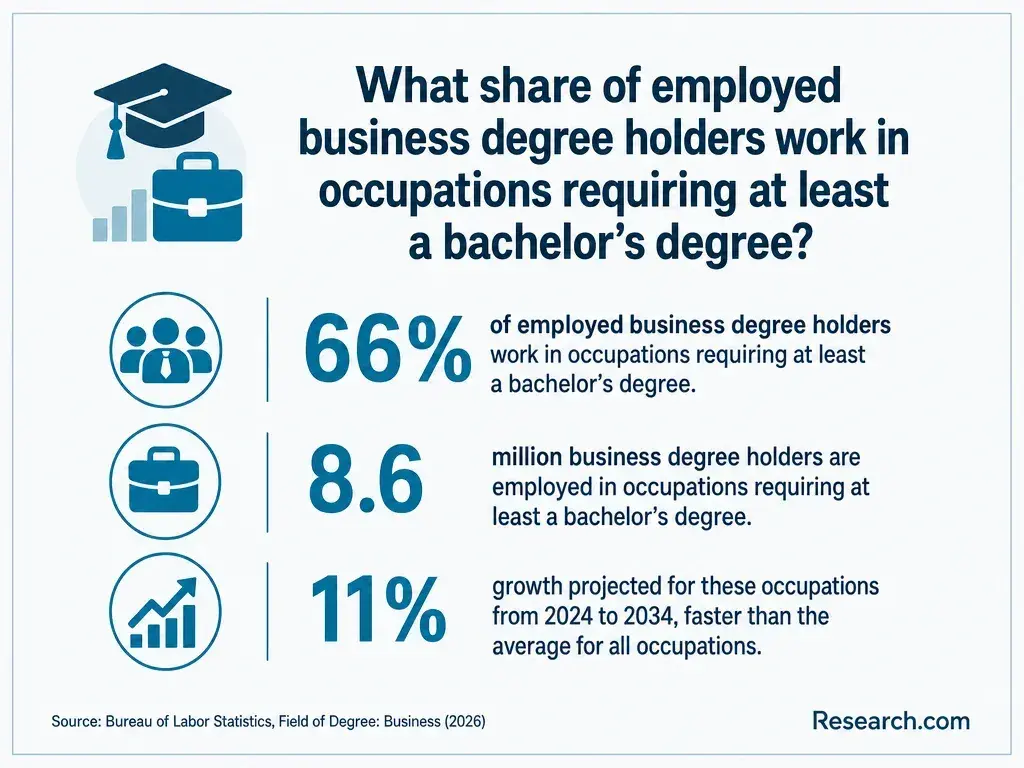
Reasonable targets depend on your existing skills and the responsibilities in the posting. An early-career graduate might pursue operations coordinator, marketing coordinator, HR assistant, sales operations, or project coordinator roles. A career changer may be able to move into an adjacent business function by showing relevant customer service, budgeting, logistics, or team-project experience. Neither route automatically leads to a management position.
Match the job's tasks to evidence you can show: a spreadsheet model for tracking costs, a clearly scoped market analysis, an improved workflow, or supervised work with customers. If supply chain is the target, compare the general business curriculum with fast-track online supply chain bachelor's options; a specialized program may offer more relevant operations coursework, while a general BS may suit someone still choosing a function.
First, confirm the institution's current accreditation and whether the recognized accreditor covers the school and location or delivery arrangement you plan to use.
Then check any claimed business-school or programmatic accreditation directly with AACSB, ACBSP, or IACBE, including whether the particular program is within its scope. Institutional accreditation and business accreditation answer different questions; neither awards an occupational license or guarantees that a certifying body will accept your coursework.
If you may later change majors or schools, ask the receiving institution for a written evaluation of how credits would apply - not merely whether they could be accepted. The same distinction matters when reviewing online undergraduate project management credit acceptance: accreditation is one consideration, while the receiving school decides whether courses satisfy its degree requirements.
Typical business foundations include accounting, economics, finance, marketing, management, statistics, and operations. Entrepreneurship study may add customer discovery, opportunity evaluation, business-model design, venture finance, or a business-plan project. Course names and depth vary, so inspect prerequisites and assignments rather than relying on the concentration label.
Choose coursework by the gap it closes. A prospective founder may need cash-flow modeling and customer research; an aspiring HR specialist may benefit more from employment practices and organizational behavior. Students considering that shift can examine transfer pathways into online human resources programs alongside their current degree audit. An entrepreneurship elective does not itself award a separate credential, and a classroom business plan is not evidence of a functioning venture.
Choose the format that lets you complete the required work and build evidence for your target role. Online delivery can reduce travel, but it may still involve scheduled presentations, group projects, proctored exams, or fixed deadlines. Campus study may make in-person recruiting and collaboration easier, though attendance can be difficult around employment or caregiving.
Before enrolling, request sample course schedules and ask whether entrepreneurship projects require live meetings, local placements, or access to an outside organization. If you plan to keep working, compare those obligations with guidance on business administration study alongside full-time employment. Format matters less than whether you can finish the courses and gain credible, permitted work samples.
Requirements vary by institution and by entry route. A first-time applicant may need secondary-school records; a transfer applicant generally supplies previous college transcripts and may face business-major prerequisites or a separate admission review. Admission to the university is not necessarily admission to the major, and accepted credits do not necessarily satisfy its core.
Ask admissions which requirements apply to your status, then ask an academic adviser how completed mathematics, accounting, economics, and general education courses would appear in an official degree audit. For a closer look at the distinction between prerequisites and admission decisions, see business administration admissions eligibility rules. Do not enroll in extra preparatory courses until the school confirms they are needed.
A full-time bachelor's pathway commonly spans four academic years, but transfer credits, part-time enrollment, prerequisite sequences, and course availability can change an individual timeline. For a returning student, the useful estimate is the school's written list of remaining applicable requirements, not the number of credits previously earned.
Compare total completion costs: tuition, mandatory fees, materials, technology, travel or residency costs, and borrowing. Ask whether charges are assessed per credit or term and whether taking fewer courses changes fees or aid eligibility. Short-term classes toward a bachelor's degree may shorten the calendar path if needed courses are offered in sequence, but a faster schedule does not by itself reduce the price or workload.
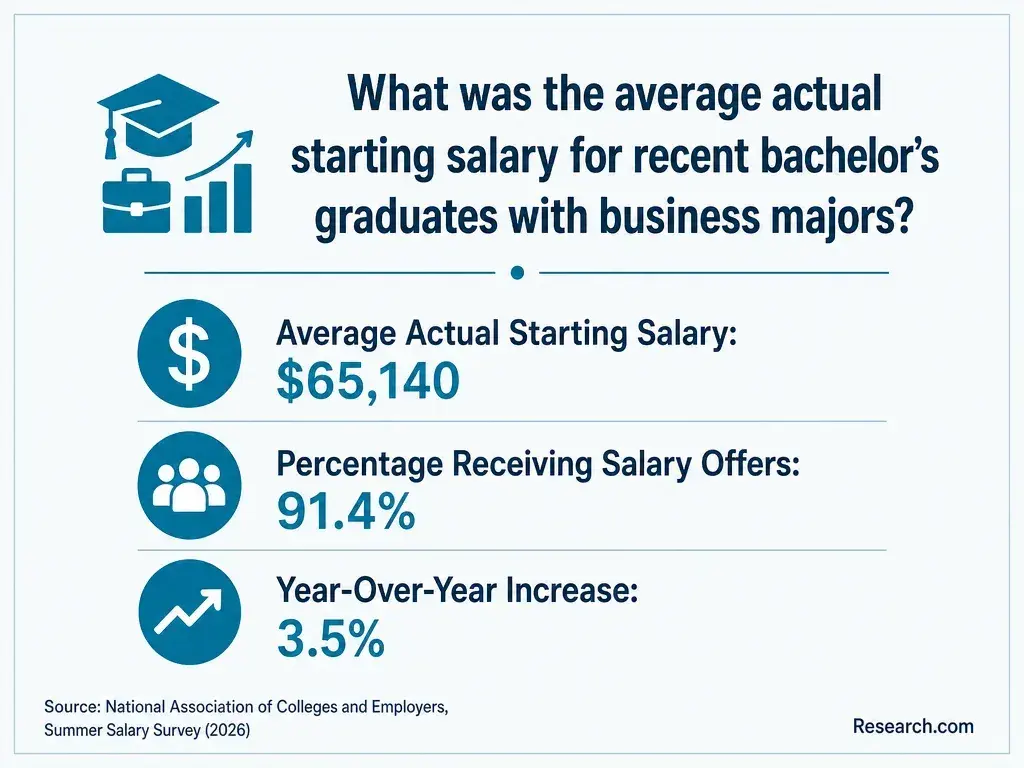
There is no single salary for this degree. Pay follows the occupation, location, employer, experience, and actual duties - not the concentration name. The U.S. Bureau of Labor Statistics reports a $75,940 median annual wage for human resources specialists in May 2025. That figure describes workers across the occupation, not the expected offer for a newly graduated HR assistant or a business graduate entering HR.
For a financial decision, compare realistic postings for roles you could qualify for now with the cost of closing any credential or experience gap. Borrowing affects that calculation: grants versus loans for project management bachelor's study illustrates why aid you do not repay differs from financing that adds future obligations. Do not justify a degree using a manager's occupation-wide median if management experience is the missing qualification.
What is the job outlook for business and entrepreneurship careers?
Outlook is occupation-specific; "entrepreneur" is not a single employment category with a reliable growth projection. For one possible specialization, the U.S. Bureau of Labor Statistics projects 18% employment growth for logisticians from 2025 to 2035. That suggests demand in a related function, not a promise of employment for every business graduate or startup founder.
If logistics is your goal, compare local openings and their software, experience, and education requirements with your planned coursework. Shorter online supply chain degree pathways may be worth comparing with a general BS when the target role consistently calls for deeper supply chain preparation. If openings instead emphasize experience you already have, a targeted project or employer training may be more direct than another degree.
Other Things You Should Know About Business Administration
Not when the applicable regulator requires a license. Experience may satisfy part of an application or an employer's hiring criteria, but confirm the regulator's rules before treating it as a substitute.
They can. The relevant rules may depend on where you perform the work, where clients are located, and the regulated activity. Ask the employer which jurisdictions apply and verify with the appropriate regulators.
Check several target postings first. If the certification is merely preferred, ask whether the employer hires candidates who can earn it later, and verify that you meet the issuer's eligibility rules before paying.
Ask the recruiter for the exact credential, issuing organization, and whether it is legally required or an employer preference. That clarification can prevent you from pursuing an unrelated certificate.
- Chapter 5 - Advanced Degree or Exceptional Ability https://www.uscis.gov/policy-manual/volume-6-part-f-chapter-5
- Licensure Credential Verification Process Letter | Texas Medical Board https://www.tmb.texas.gov/resources/for-the-public/licensure-credential-verification-process-letter
- Certified License Verification | michigan.gov https://www.michigan.gov/lara/bureau-list/bpl/cert-lic
- Verify Public Search | tn.gov https://verify.tn.gov/
- Business Administration, Undecided - The Ohio State University https://undergrad.osu.edu/majors-and-academics/majors/detail/247
- What Jobs Can You Get With a Business Degree? | snhu.edu https://www.snhu.edu/about-us/newsroom/business/what-jobs-can-you-get-with-a-business-degree
- Best Practices for Writing Job Postings | Human Resources https://hr.wisc.edu/hr-professionals/recruitment/best-practices-for-writing-job-postings/
- Financial Advisor Salary, Requirements, and Job Description | Warner Pacific University https://www.warnerpacific.edu/blog/business/financial-advisor/
- 17 types of business degrees and the jobs they can lead to | ASU Online https://asuonline.asu.edu/newsroom/online-learning-tips/types-business-degrees-jobs/
- Highly Skilled Immigrants Face a Changing Landscape for Credential Recognition | migrationpolicy.org https://www.migrationpolicy.org/journal/feature/highly-skilled-immigrants-face-changing-landscape-credential-recognition