
2027 Can a BS in Business Administration Prepare You for a Small Business General Manager Role? Skills and Entry Requirements
Audited and Verified:
Our Editorial and Data Verification Process
Research.com uses government datasets, official education statistics and primary institutional information to support its career and degree guides. Our review process checks factual accuracy, occupational definitions, source dates and the requirements associated with the credentials discussed.
How This Article Was Fact-Checked
Our editorial team verifies salary estimates, employment projections, education requirements and program information against original data providers and official organizations. Salary figures are checked against the relevant occupational definitions and reporting periods. Information about licensure, accreditation and required in-person training is reviewed separately.
Fact-checked and verified on:

Co-Founder and Chief Data Scientist
A small business general manager may oversee staffing, cash flow, customer service, and daily operations - all with limited specialist support. A BS in Business Administration can build knowledge across those functions, but coursework alone rarely establishes readiness to run them.
This guide is for students, employees, and career changers weighing the degree against experience or shorter training. It connects the work to the skills employers need, explains realistic entry routes, and shows what to check before investing in a program.
Key Things You Should Know
- A BS in Business Administration can prepare you across finance, operations, marketing, and people management; employers may still require industry experience and a record of supervising work.
- The U.S. Bureau of Labor Statistics reports a May 2025 median annual wage of $105,770 for general and operations managers, not a starting salary for new graduates or a small-business-specific figure.
- Employment for general and operations managers is projected to grow 5% from 2025 to 2035; choose education based on the responsibilities you need to demonstrate, not that projection alone.
Can a BS in Business Administration prepare you for a small business general manager role?
Yes, particularly when you pair the degree with substantial operating experience. A small business general manager typically coordinates several functions rather than managing only one department. The role may include setting schedules, controlling costs, resolving customer problems, monitoring sales, and reporting to an owner. The exact authority varies: some managers can hire staff and approve spending, while others must seek the owner's approval.
A broad business degree helps you understand how decisions in one function affect another. It cannot, by itself, show that you can handle a staffing shortage, protect cash during a slow period, or make sound decisions within a particular industry's rules. The comparison below separates academic preparation from the experience a hiring owner may value most.
| Pathway | What it can contribute | Main limitation for this role |
| BS in Business Administration plus relevant work | Cross-functional knowledge alongside evidence of operating responsibility | Time and cost; the degree does not award managerial authority |
| Progression through a small business | Knowledge of its customers, processes, staff, and industry | May leave gaps in budgeting or functions outside the current job |
| Targeted courses or employer training | Faster development in a specific weak area | Less breadth if the job spans the whole business |
If you already oversee people or processes but lack financial and strategic training, a BS may fill a meaningful gap. If you have little workplace experience, seek supervised responsibility while studying rather than treating graduation as the point at which management begins.
If you prefer delivering defined projects to overseeing an entire business, a project-management route may be more direct; compare its curriculum and financing, including FAFSA planning for project management bachelor's students, before changing direction.
What skills do small business general managers need to succeed?
The defining skill is cross-functional judgment: knowing which problem needs attention first and who has authority to act. A manager may need to interpret a profit-and-loss statement, check whether enough cash is available to pay suppliers, and decide whether a sales promotion is worth its operating cost. Revenue, profit, and cash on hand answer different questions.
Daily effectiveness also depends on scheduling and process improvement, clear communication with employees and customers, basic marketing measurement, and fair handling of personnel issues. Spreadsheet literacy helps a manager track inventory, labor hours, or sales patterns, but a dashboard is only as reliable as its data. Confidential employee and customer information requires appropriate access and care.
Build evidence alongside these skills: document the responsibility you held, the decision you supported, and what a supervisor observed. Someone whose main gap is employee relations rather than whole-business oversight might instead examine HR-focused study; evaluate transfer-friendly online HR colleges if prior credits and a specialist role are part of that decision.
What education and experience are required to become a general manager?
There is no single education requirement that applies to every small business general manager job. Employers set their own qualifications based on the industry, size of the operation, and authority attached to the position. A bachelor's degree may be required or preferred; demonstrated success in a relevant business can sometimes matter more. Industry-specific roles may also involve separate regulatory or employer requirements.
A realistic early-career route is to move from customer service, sales, administrative support, or operations coordination into responsibility for schedules, inventory, a budget, or a small team. An experienced employee may already have that evidence but need broader financial or marketing knowledge.
In either case, compare job postings with your actual duties, not just your title. Ask whether the employer expects hiring authority, budget ownership, industry knowledge, or a record of improving operations.
Working adults considering a degree should test whether classes can fit around the responsibilities that make them promotable. Accelerated business education for working adults may shorten the calendar, but an intensive schedule can compete with opportunities to gain hands-on management experience.
Look past the degree title and inspect the required courses and assignments. Financial and managerial accounting support cost decisions and interpretation of financial statements. Operations courses address workflow, capacity, purchasing, and quality.
Marketing and customer research help connect promotions to customer needs. Organizational behavior and HR coursework introduce supervision and employment practices, while business statistics and spreadsheets support decisions based on imperfect data.
The strongest fit is a curriculum that makes students combine these subjects in a case, simulation, internship, or approved capstone. For example, a student might prepare a hypothetical staffing and cash-flow plan, explain its assumptions, and revise it when demand changes. That is practice in decision-making - not proof of results at a real company. If using workplace information, obtain the required employer and academic permissions and protect confidential records.
An entrepreneurship or management concentration may add useful depth, but check whether it is an official concentration, which courses it adds, and whether they delay completion. An accelerated option deserves the same scrutiny: compare American fast-paced business bachelor's degrees by their applied coursework and course availability, not speed alone.
They can be, especially if you are already employed and can apply lessons to supervised work. Online delivery does not necessarily mean self-paced study: group projects, scheduled presentations, timed exams, and internship requirements can affect whether a program fits your job. Ask how students practice negotiations, receive feedback on financial work, and complete applied assignments when they cannot use employer data.
Compare the actual schedule, required technology, faculty access, career support, and any campus visits before enrolling. National online business program rankings can help identify programs to investigate, but the deciding evidence is each school's current curriculum and policies. A local in-person or hybrid option may be stronger if it provides better access to small-business employers and you can attend consistently.
Requirements vary by institution and by whether you apply as a first-year or transfer student. Schools generally request evidence of prior education, such as a high school record or college transcripts. Some business majors have separate entry standards or require particular mathematics or introductory courses before students progress into upper-level work. Confirm whether any requirement applies to university admission, entry to the major, or graduation.
If you have college credit, request an official evaluation showing where it applies. Credit accepted as an elective may not replace accounting, statistics, or a required business course. Returning students should also ask about course recency and residency rules. To limit application spending while comparing options, schools with zero-cost college applications may be worth reviewing; confirm the current fee and requirements directly with each school.
A traditional bachelor's path often takes about four years of full-time study. Transfer credit, part-time enrollment, prerequisite sequences, and required course availability can change the remaining timeline substantially. The useful estimate is not an advertised completion time: it is the school's degree audit plus a schedule showing when each remaining course is offered.
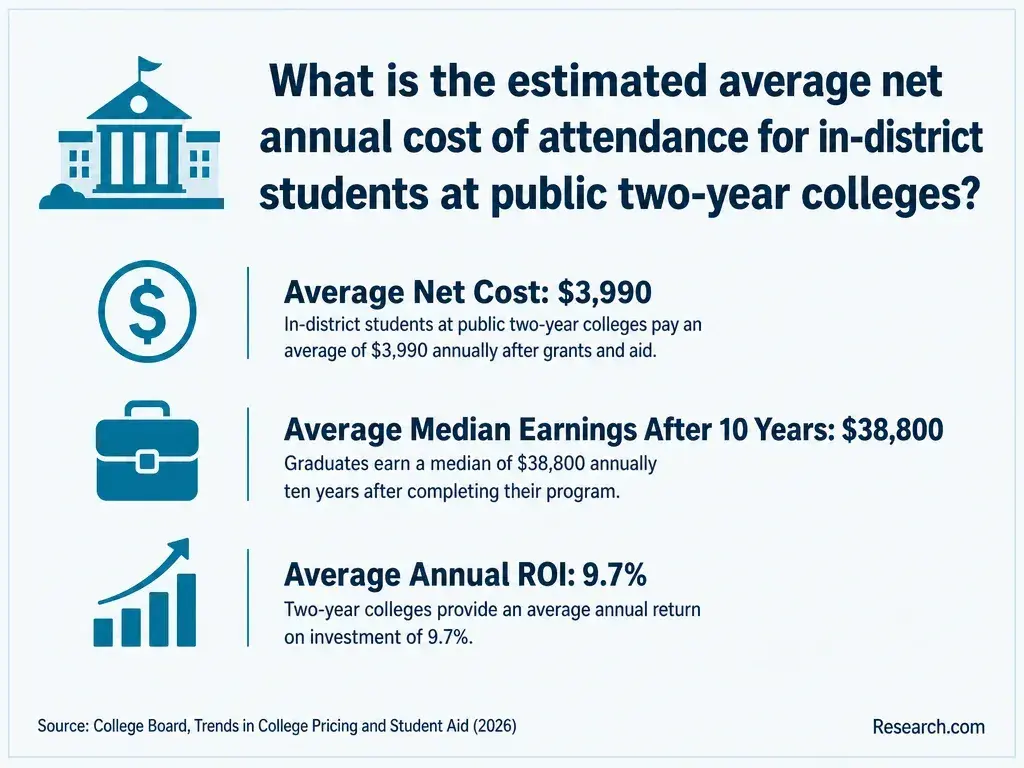
For cost, compare tuition and required fees against the credits you still need, then account for books, software, travel or proctoring, and any lost work time. A lower per-credit price may not produce a lower total if more courses remain.
Start with lower-priced accredited business administration study options, then request a school-specific cost estimate based on your evaluated credits and enrollment pace. Check financial-aid eligibility and employer reimbursement terms before assuming either will reduce what you must pay upfront.
First, confirm that the institution holds accreditation from an accreditor recognized by the U.S. Department of Education, using the school's stated accreditor and the department's accreditation records. Then check whether the business school or specific program is covered by any claimed AACSB, ACBSP, or IACBE accreditation. Institutional and business accreditation have different scopes; neither guarantees a management job.
Confirm the exact degree title, delivery format, and campus or online program covered by the school's current statements. Accreditation is also relevant when checking aid: check FAFSA eligibility at online business administration schools, then verify the particular institution's participation and your own eligibility with its financial-aid office. Do not infer aid eligibility solely from a program's accreditation.
The Bureau of Labor Statistics reports a $105,770 median annual wage in May 2025 for U.S. general and operations managers. This occupation-wide median includes managers across different employer sizes and industries. It is not a small-business-only estimate, an entry-level offer, or the expected salary of someone who has just earned a BS in Business Administration.
For a useful personal estimate, compare local postings with similar responsibilities, industry, staffing levels, and required experience. Also distinguish an employee's pay from an owner-manager's income, which may depend on business performance.
If you are weighing degree costs against a possible career move, business administration tuition time commitment and career value offers a starting point; use actual school costs and plausible job options rather than the national median as your return-on-investment assumption.
What is the job outlook for general and operations managers?
BLS projects 5% growth in U.S. employment from 2025 to 2035 for general and operations managers. That is above the approximately 3.5% projected across all occupations, but it does not indicate how many openings will be at small businesses, in your area, or available to first-time managers. Employer demand and competition can differ sharply by industry.
Use the projection as context, then investigate the responsibilities in local postings and build experience that matches them. If those postings mainly describe project delivery rather than ongoing oversight of staff and business operations, affordable college choices for aspiring project managers may be a better comparison than assuming every management-oriented job calls for a general business degree.
Other Things You Should Know About Business Administration
No. An owner has an ownership interest and bears the associated financial risk; a general manager may be an employee accountable to the owner. One person can hold both roles, but the responsibilities and compensation arrangements differ.
There is no universal general manager certification. A particular employer or industry may value specialized training, but assess it against the duties of the job rather than treating a certificate as a substitute for operating experience.
Yes, if you can describe relevant responsibilities such as coordinating people, managing a budget, or improving a process. Be precise about your authority and results; volunteer leadership does not automatically count as professional management experience or academic credit.
Describe the problem, your role, and your decision process without exposing customer, employee, or proprietary information. Obtain permission before sharing workplace materials, or use a clearly labeled hypothetical example.
- Soft Skills: The Competitive Edge | dol.gov https://www.dol.gov/agencies/odep/publications/fact-sheets/soft-skills-the-competitive-edge
- Manage your business - Small Business Administration https://www.sba.gov/counseling/manage-your-business/
- What Does a Business Manager Do? Role & Responsibilities | University of North Dakota https://und.edu/blog/what-does-a-business-manager-do.html
- Entry-Level Jobs With a Business Administration Degree | Warner Pacific University http://www.warnerpacific.edu/blog/top-entry-level-jobs-ba-business-administration/
- 11 Types of Business Degrees and Career Pathways | National University https://www.nu.edu/blog/types-of-business-degrees/
- 10 Key Subjects Taught in a Bachelor of Business Administration Program | Carson-Newman University https://www.cn.edu/cps-blog/10-key-subjects-taught-in-a-bachelor-of-business-administration-program/
- What Can You Do With a Business Administration Degree? | snhu.edu https://www.snhu.edu/about-us/newsroom/business/what-can-you-do-with-a-business-administration-degree
- General Managers: How To Become One in 2026 (& Beyond) | Franklin University https://www.franklin.edu/career-guide/general-and-operations-managers/how-to-become-general-managers
- Top Skills Employers Look for in Business Professionals | Lasell University https://www.lasell.edu/academics/lasell-insights/top-skills-employers-look-for-in-business-professionals.html
- How a Business Administration Degree Can Prepare You for Entrepreneurship - Missouri Baptist University (Mobap) https://www.mobap.edu/news/how-a-business-administration-degree-can-prepare-you-for-entrepreneurship/


