2027 Choosing a BS in Business Administration When Your International Degree Needs a US Credit Evaluation
Audited and Verified:
Our Editorial and Data Verification Process
Research.com uses government datasets, official education statistics and primary institutional information to support its career and degree guides. Our review process checks factual accuracy, occupational definitions, source dates and the requirements associated with the credentials discussed.
How This Article Was Fact-Checked
Our editorial team verifies salary estimates, employment projections, education requirements and program information against original data providers and official organizations. Salary figures are checked against the relevant occupational definitions and reporting periods. Information about licensure, accreditation and required in-person training is reviewed separately.
Fact-checked and verified on:

Co-Founder and Chief Data Scientist
Your international degree may qualify you for admission to a U.S. university without shortening a BS in Business Administration as much as you expect. A credential evaluation can establish the level and content of your previous study, but the university decides which courses satisfy its degree requirements.
If you studied abroad and want a U.S. business bachelor's degree, this guide will help you compare evaluation policies, remaining coursework, delivery formats, and costs before you commit to a program or pay for a report.
Key Things You Should Know
- Ask each university whether it requires a course-by-course international credential evaluation, accepts a particular evaluator, or assesses foreign coursework itself. Do this before ordering a report.
- Compare credits applied to degree requirements, not just credits accepted. A previous bachelor's degree may also trigger second-degree rules, including minimum credits that must be earned at the new university.
- Do not use career salary figures to estimate your return on tuition. For example, the U.S. median wage for market research analysts was $78,760 in May 2025, but that occupation-wide figure is not a new business graduate's expected pay.
What Is a BS in Business Administration for International Degree Holders?
A BS in Business Administration is a U.S. undergraduate degree combining general education with subjects such as accounting, economics, management, marketing, finance, and business analysis. Its exact curriculum differs by university. It is not the same credential as an MBA, and its title alone does not establish a specialization or qualify someone for professional licensure.
For someone who already holds an international degree, the central question is what additional education the U.S. bachelor's provides. A graduate of a non-business field might benefit from a structured business core. Someone whose previous degree already covered comparable subjects should first ask whether a certificate, targeted coursework, or a graduate program would meet their goal with less repetition.
Universities may treat a completed foreign bachelor's differently from unfinished undergraduate study, so ask specifically about second-bachelor's admission and credit rules. An accelerated business college program guide can help identify formats worth investigating, but a shorter advertised schedule does not establish how much of your international study will apply.
How Does a U.S. Credit Evaluation Affect Your Business Degree Transfer?
An international credential evaluation describes how prior study compares with U.S. education. Depending on university policy, you may need a course-by-course report rather than a document stating only the degree's U.S. equivalence. The evaluator reports its findings; the receiving university decides admission, course equivalencies, transfer limits, and graduation requirements.
These distinctions explain why an encouraging evaluation can still leave substantial coursework. Ask for an official degree audit that separates the following categories:
| Decision | What it tells you | Who decides |
| Credential recognition | Whether previous study is comparable to a U.S. credential or college-level coursework | Evaluator or university, under its policy |
| Credit acceptance | Whether the university will award transfer credit | Receiving university |
| Requirement applicability | Whether accepted credit satisfies general education, business core, concentration, or elective requirements | Receiving university and relevant academic department |
| Graduation eligibility | What remains after prerequisites, upper-level courses, residency, and other rules | Receiving university |
Before paying an evaluator, send the transfer office your degree details and ask which agencies and report types it accepts. Gather official transcripts, course descriptions or syllabi, and translations in the form the university requires.
If an accounting or quantitative course becomes a general elective, ask the business department about a documented equivalency review or appeal; do not assume that accepted credit replaces a required course. Students considering a different business function can also compare policies for prior college coursework toward an HR bachelor's.
What Accreditation Should You Look for in a Business Administration Program?
Check that the U.S. institution holds recognized institutional accreditation. Then determine whether its business school or the specific program has applicable accreditation from AACSB, ACBSP, or IACBE. These are distinct questions: an institution's status does not establish the scope of a business accreditor's approval, and business accreditation is not a substitute for checking transfer policies and outcomes.
Use the accreditor's and university's current records to confirm the school, degree level, and program covered. When you compare nationally ranked online business programs, treat rankings as a starting point. For this decision, an approved audit showing how your international courses apply is more useful than a ranking that cannot predict your completion path.
Online study can let you remain abroad or keep a job, but it may still involve live meetings, U.S.-time-zone deadlines, proctored exams, team presentations, or required visits. Campus study may offer more in-person recruiting and project access, while adding relocation and living costs. Neither format changes the need for an official review of your international coursework.
Ask each program where you may enroll from, when required activities occur, whether an internship or capstone can be completed where you live, and what happens if a required course is not offered next term. A comparison of career advancement study options in business administration may help working applicants identify scheduling questions to put to advisers. Enrollment in an online U.S. program does not itself provide a U.S. visa, permission to remain in the country, or employment authorization.
Most programs combine a business core with general education and electives; some offer formal concentrations. For an international transfer applicant, the important comparison is not whether a familiar subject appears on the course list. It is whether the department accepts your prior course as satisfying its specific requirement, including any required level, content, or recency.
Review accounting, economics, statistics, finance, and business-law equivalencies especially carefully. A prior management course, for example, may transfer as elective credit while the U.S. program still requires its own upper-level management course. If you want an HR focus, use a human resources program selection guide to distinguish a formal concentration from a few HR electives, then check whether either option adds courses to your remaining degree plan.
Universities set their own rules for international credentials, grades, English-language proficiency, and admission to the business major. Admission to the university does not necessarily mean admission to the major, and neither decision confirms how many credits will count toward graduation. Requirements may also differ for applicants seeking a first bachelor's degree and those who already hold one.
Request the current applicant checklist and confirm the accepted transcript-delivery method, translation standards, evaluation provider and report type, English-test requirements or waivers, and any business prerequisites. If you are missing a document or prerequisite, ask whether the university permits conditional admission or completion after enrollment rather than assuming an exception. A business administration admissions preparation guide can help organize those questions; the university's published policy controls your application.
Your remaining requirements - not the number of years you studied abroad - determine the likely timeline. A university might accept substantial prior credit yet still require sequenced business courses, upper-level work, or credits earned at that institution. Request a term-by-term plan based on an official audit, including the next available offering of each required course.
Compare schools using the same cost components: evaluation and translation fees, tuition for remaining required credits, mandatory fees, books and software, and any travel or campus attendance. Ask for written clarification of tuition classification and payment options; do not assume that living abroad makes you eligible for a particular rate.
Federal student aid eligibility depends on the applicant's status and applicable rules, not merely enrollment at a U.S. school. The FAFSA planning for affordable business administration study resource is relevant if you may qualify, but verify your own eligibility with the financial-aid office.
A BS in Business Administration can support applications for roles in operations coordination, sales support, marketing, procurement, and HR administration. Hiring depends on work authorization, location, relevant experience, and evidence of skills - not the degree title alone. Existing experience from another country may be valuable, particularly when you can explain the responsibilities you held and the results you can document without disclosing confidential information.
Match a target role to coursework and practical evidence. Procurement applicants might demonstrate spreadsheet analysis and vendor-comparison methods; marketing applicants might show a properly sourced research or campaign-analysis project. If supply chain is the specific goal, supply chain degree cost and duration comparisons can help test whether a specialized program serves it more directly than a general business degree.
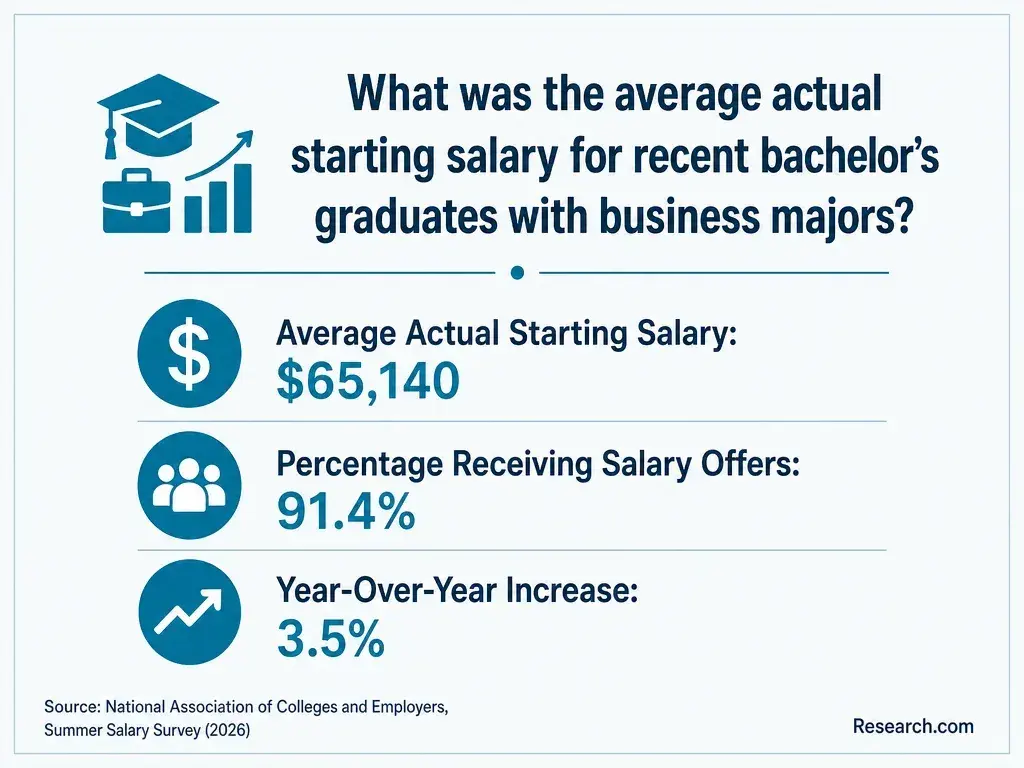
There is no single salary or growth rate for BS in Business Administration graduates. The U.S. Bureau of Labor Statistics reports figures by occupation, across workers with different degrees and experience levels. For example, the May 2025 median annual wage for market research analysts was $78,760, and employment in that occupation is projected to grow 7% from 2025 to 2035. Neither figure is a starting-pay estimate or a job-placement forecast for international graduates.
Evaluate a degree against the roles you could realistically seek, including any U.S. work-authorization requirements. If your goal is project work, distinguish an entry route such as project coordination from specialist roles that may expect substantial experience. You can compare affordable project management schools against the business programs on your shortlist, but use each school's actual remaining-credit audit - not advertised tuition alone - to judge value.
Which Certifications or Professional Standards Benefit Business Graduates?
Choose a credential only after identifying a target role and checking the credential issuer's eligibility rules. Project management, HR, accounting, and financial services have different experience, examination, education, or licensing requirements. A business bachelor's or relevant elective does not automatically award a professional designation or satisfy a state licensing board.
For project-focused work, compare job postings with your present experience before investing in another qualification. The affordability checks for accredited project management programs may help you evaluate a specialized academic alternative, but program accreditation and professional certification are separate. If a role calls mainly for demonstrated scheduling, budgeting, or stakeholder-communication skills, a supervised project or targeted training may be a better next step than a second full degree.
Other Things You Should Know About Business Administration
Possibly. Each university sets its own rules for accepted evaluators, report types, and delivery methods. Confirm those rules with every university before ordering additional copies.
Contact the U.S. university before applying. Its admissions or transfer office can tell you what alternative records it will consider and whether an evaluation is possible with the documents available.
Do not purchase one automatically. Ask the receiving university and its accepted evaluator what authentication they require; an apostille does not replace a course-by-course evaluation.
Ask admissions what evidence it accepts to connect the records, such as an official name-change document. Submit documents using its stated procedure rather than altering academic records.
- Evaluation of Foreign Degrees - United States Department of State https://www.state.gov/global-community-liaison-office/family-member-employment/family-member-employment-in-the-d-c-area/evaluation-of-foreign-degrees
- Understanding U.S. Accreditation | EducationUSA https://educationusa.state.gov/understanding-us-accreditation
- Chapter 2 - Eligibility Requirements https://www.uscis.gov/policy-manual/volume-2-part-f-chapter-2
- The impact of changing nonimmigrant visa policies on... - PMC https://pmc.ncbi.nlm.nih.gov/articles/PMC9708122/
- Recognition of Foreign Qualifications | ed.gov http://www.ed.gov/about/initiatives/international-affairs/recognition-of-foreign-qualifications
- DAPIP | Homepage - Office of Postsecondary Education (OPE) https://ope.ed.gov/dapip/
- FAQs - Transfer Students | University of Cincinnati Admissions https://www.admissions.uc.edu/information/transfer/ts-faq.html
- Business - Admissions - The University of Iowa https://admissions.uiowa.edu/academics/business
- International Students Face More New Hurdles This Year | acenet.edu https://www.acenet.edu/News-Room/Pages/International-Students-Face-New-Immigration-Hurdles-This-Year-.aspx
- How Do Transfer Credits Work When You Go Back to School? | Whitworth Online https://online.whitworth.edu/news-articles/how-do-transfer-credits-work-when-you-go-back-to-school/