2027 Paying for an Online BS in Business Administration: A Financial Aid Offer with Loans but No Grants
Audited and Verified:
Our Editorial and Data Verification Process
Research.com uses government datasets, official education statistics and primary institutional information to support its career and degree guides. Our review process checks factual accuracy, occupational definitions, source dates and the requirements associated with the credentials discussed.
How This Article Was Fact-Checked
Our editorial team verifies salary estimates, employment projections, education requirements and program information against original data providers and official organizations. Salary figures are checked against the relevant occupational definitions and reporting periods. Information about licensure, accreditation and required in-person training is reviewed separately.
Fact-checked and verified on:

Co-Founder and Chief Data Scientist
An offer of loans but no grants leaves a difficult choice: borrow for an online BS in Business Administration, find a less expensive path, or ask the school to reconsider your aid. The answer depends on more than the amount shown on the offer. Your remaining degree requirements, grant eligibility, enrollment schedule, and ability to work while studying all affect the cost. This guide explains what to verify with the financial aid office, how to compare completion costs, and when borrowing may - or may not - make sense.
Key Things You Should Know
- A loans-only offer does not necessarily mean you are ineligible for every grant; confirm FAFSA processing, Pell Grant eligibility, school deadlines, and whether the offer is final.
- Compare the cost of remaining required courses, not advertised tuition alone. Fees, loan interest, delayed graduation, and credits that transfer only as electives can change the decision.
- You can generally decline an offered loan. Before accepting one, request a degree audit and a term-by-term cost estimate, then compare scholarships, employer benefits, and lower-cost programs.
What Does an Online Bachelor's in Business Administration Include?
An online BS in Business Administration typically combines general education, a business core, electives, and sometimes a concentration or capstone. It can prepare students to analyze budgets, communicate with stakeholders, interpret business data, and understand how organizations operate. The exact curriculum and degree title vary by school; a BS, BBA, and specialized business bachelor's are not interchangeable simply because they share courses.
For a student considering loans, delivery details matter financially. Online classes may still require scheduled meetings, group assignments, proctored exams, or fixed deadlines that limit paid work hours. Compare those obligations with the programs described as online business administration degrees for employed adults, and ask each school for an actual course schedule before assuming the format fits your job.
Why Might a Financial Aid Offer Include Loans but No Grants?
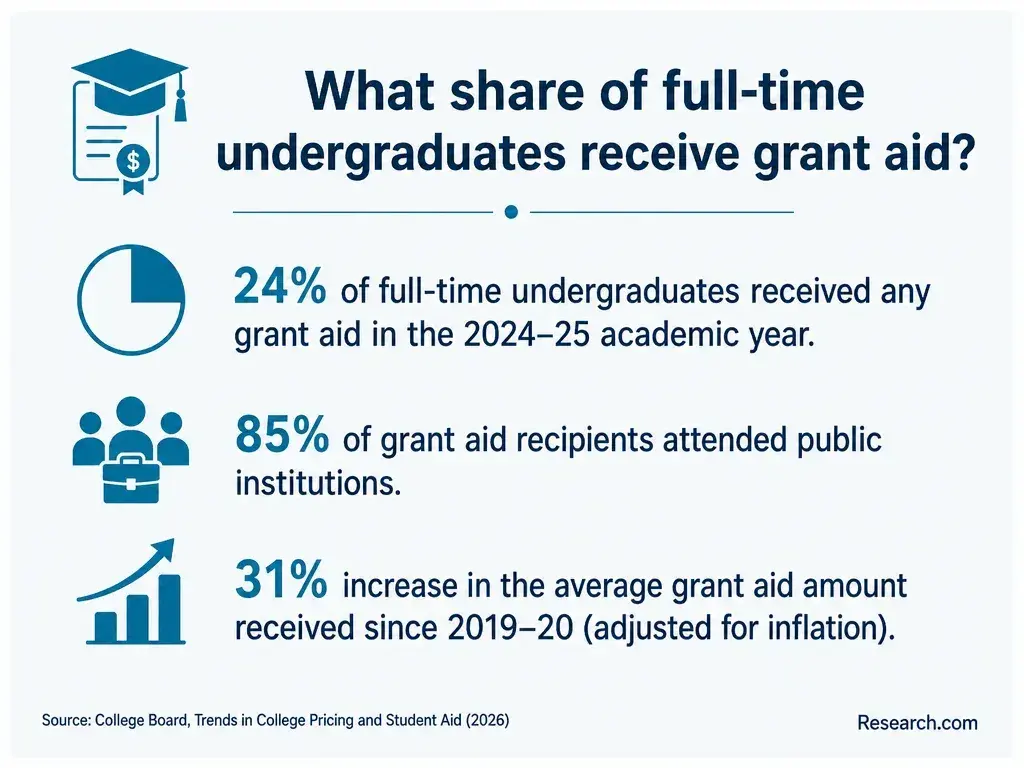
A school may offer federal loans even when it awards no grants because the programs have different eligibility rules. The FAFSA helps determine eligibility for federal aid, but it does not promise a Pell Grant. The school must also determine your eligibility using your record, enrollment, and the program's aid rules.
Possible explanations include a Student Aid Index that does not qualify you for need-based aid at that school, prior use of Pell eligibility, an earlier bachelor's degree, enrollment in courses that do not count toward your eligible program, or a missed institutional or state grant deadline. An incomplete aid file or an offer prepared before all information was reviewed can also matter. Institutional grants may be limited even when a student can borrow.
Ask the financial aid office which grants it reviewed, whether your offer is final, and whether any missing documents or FAFSA information need correction. If the program uses online bachelor's programs with short sessions as a comparison point, ask how your planned courses count toward aid enrollment for each payment period; a short class's calendar length alone does not establish grant eligibility.
How Can You Evaluate the Cost of an Online Business Degree?
Start with an official degree audit showing which prior credits satisfy general education, the business core, electives, and residency rules. A transferred course accepted as an elective may not replace a required accounting or statistics course. Then request charges and an expected course sequence for the credits you still need - not just the school's published per-credit rate.
The following components separate the bill you must pay soon from costs that can grow over the full degree.
| Cost component | What it represents | Why it changes the comparison |
| Tuition and required fees | Charges assessed by credit, course, or term | Enrollment pace and additional required courses can alter the total |
| Materials and technology | Books, software, equipment, or proctoring charges | These may sit outside advertised tuition |
| Borrowing costs | Applicable loan fees and interest | The amount repaid can exceed the amount applied to school charges |
| Time and work costs | Additional terms, reduced work hours, or delayed completion | A low price per credit may not mean a low completion cost |
Compare schools using the same planned enrollment pace and only credits each school has evaluated. Lower-priced college options for business majors are worth examining, but a school with lower tuition may cost more overall if it requires substantially more coursework. Do not count an unapproved transfer estimate or a hoped-for salary increase as a confirmed saving.
First, ask the aid office whether a change in household finances or an error on your FAFSA warrants a review. A documented change may support a professional-judgment request, but the school decides whether an adjustment is appropriate; an appeal is not a grant award.
If the offer remains loans-only, compare ways to reduce the amount you need to borrow. Each option has a different timing or eligibility constraint:
- Scholarships: Check school, community, professional, and employer awards, along with deadlines and whether an award changes other aid.
- Employer education assistance: Confirm eligible programs, grade requirements, annual limits, reimbursement dates, and any obligation to remain employed.
- Lower-cost enrollment: Consider a program with a lower verified completion cost or a pace you can cover partly from earnings; verify that slower enrollment will not disrupt aid or required-course access.
- Federal loans before private loans: If borrowing is necessary, compare the offered federal loan's terms and limits with private-loan terms rather than treating the amounts as equivalent.
Compare fast-paced online business degrees only after checking total charges and your available study time. Finishing sooner could reduce the number of terms billed, but it can also require fewer work hours or more borrowing at once. Likewise, employer reimbursement may lower eventual cost without paying the first tuition bill.
Check the institution's accreditation status and the accreditor's recognized status through the U.S. Department of Education's accreditation records. Confirm that the institution listed is the one awarding your degree, and ask the school whether your specific online program is eligible for the federal aid shown on your offer. Being accredited and being eligible to disburse federal student aid are related but distinct checks.
A business school may also hold AACSB, ACBSP, or IACBE accreditation. Verify which school, degree level, and programs that recognition covers; it is not a substitute for checking institutional accreditation, nor is it proof of employment outcomes. When reviewing accredited business administration programs and federal student aid, use each institution's current disclosures and the aid office's determination for your enrollment term.
Business cores commonly cover accounting, economics, finance, marketing, management, operations, and business law, alongside quantitative work such as statistics or analytics. General education and a final strategy course or capstone may also be required. Ask for the catalog that applies to your entry term: prerequisite chains and infrequently offered courses can extend your schedule and increase borrowing.
Choose electives for a specific skill gap rather than assuming they create a credential. For example, an HR elective does not necessarily constitute an HR concentration. If your goal is primarily HR work and you already hold college credit, compare the remaining requirements of a general business BS with HR bachelor's completion with transferred coursework. The cheaper path depends on how each school applies your credits, not merely how many it accepts.
Applicants generally need an accepted secondary-school credential and transcripts from previous colleges, but admission standards differ. Transfer or degree-completion programs may impose separate credit, GPA, or prerequisite requirements. Admission to a university does not establish admission to its business major or guarantee that prior courses fulfill major requirements.
Before paying an enrollment deposit, ask admissions and the transfer office for a written evaluation, then request an academic adviser's degree audit. Check whether prior math, accounting, economics, or statistics courses meet current requirements and whether residency rules leave additional credits to take. A guide to business administration admissions coursework and credit requirements can help frame those questions, but the receiving institution has final authority over your record.
Completion time depends on applicable transfer credit, course availability, prerequisites, and how many courses you can take while working. An accelerated calendar is not the same as fewer required credits. A delayed prerequisite or missed course offering can erase the time advantage of shorter sessions.
Request a term-by-term plan for the remaining degree requirements and ask whether every planned course is offered when needed. If you compare schools through a national comparison of accelerated business bachelor's schools, test the advertised timeline against your approved credits and realistic weekly workload. A faster plan is financially useful only if its total charges and effect on employment fit your situation.
A business administration BS can support applications for roles such as operations coordinator, project coordinator, sales operations assistant, or administrative specialist. Duties vary by employer, and relevant experience, spreadsheets, communication, and evidence of completed work often matter alongside the degree. A new graduate should not assume the credential alone qualifies them to manage staff or major budgets.
If you already work in a business function, identify the position you want next and compare its job postings with your current skills. Someone targeting HR, for instance, should compare the curriculum and total borrowing for a general business degree against human resources degree costs and options. A targeted course or employer-supported training may be a better financial choice if a second degree is not required for that goal.
What Salary and Job Outlook Can Business Administration Graduates Expect?
There is no single salary or growth rate for graduates of a BS in Business Administration: employers hire for occupations, not a universal "business administration graduate" job. As one relevant benchmark, the U.S. Bureau of Labor Statistics reports a May 2025 median annual wage of $75,940 for human resources specialists and projects 6% employment growth from 2025 to 2035. That median covers workers across experience levels and is not an expected starting salary or a return promised by a degree.
For a borrowing decision, focus on the requirements and pay ranges of positions you could plausibly pursue with your current experience. Compare those opportunities with the cost of the remaining degree and the loan repayment obligation. Even low-cost shorter business administration programs should be judged by verified completion costs and relevant career preparation - not an advertised association between a program and high-paying jobs.
Other Things You Should Know About Business Administration
No. An offer is not a requirement to borrow. Ask the aid office how to accept a smaller amount or decline the loan, and check what balance you would then owe.
Possibly. Contact the financial aid office promptly about its deadlines and documentation rules. A later review may not change charges already due.
Eligible loans may cover allowable costs within the school's cost of attendance after other aid is considered. Borrowing for living expenses increases the amount you must repay; ask how and when any remaining funds would be disbursed.
Not automatically. Online tuition and residency policies vary by institution and program. Get your applicable rate in writing before comparing offers.
- Federal Pell Grants | studentaid.gov https://studentaid.gov/understand-aid/types/grants/pell
- Your financial path to graduation | consumerfinance.gov https://www.consumerfinance.gov/paying-for-college/your-financial-path-to-graduation/
- Government grants and loans | usa.gov https://www.usa.gov/government-grants-and-loans
- Pell Grant Enrollment Intensity and Cost of Attendance | ed.gov https://fsapartners.ed.gov/knowledge-center/fsa-handbook/2025-2026/vol7/ch3-pell-grant-enrollment-intensity-and-cost-attendance
- Enrollment Intensity Definitions & Requirements for the Federal Pell Grant | American Public University (APU) https://www.apu.apus.edu/student-handbook/financing-education/how-to-pay-for-courses/enrollment-intensity-definitions-requirements-for-the-federal-pell-grant/
- Comparing Federal and Private Student Loans | Student Aid | The Pennsylvania State University https://www.psu.edu/costs-aid/types-of-aid/loans/comparing-federal-and-private-student-loans
- Grants | Financial Aid & Scholarships https://financialaid.ucla.edu/types-of-aid/grants