2027 Best Online Certificate Programs With Transfer-Friendly Policies

Co-Founder and Chief Data Scientist
Choosing an online certificate is risky when you need its credits to count later. A credit-bearing certificate can reduce time toward an associate or bachelor's degree, while a noncredit career certificate may build skills but usually will not transfer.
The Bureau of Labor Statistics projects healthcare support occupations to grow 15% from 2023 to 2033, illustrating why short, career-focused education remains relevant. This guide helps adult learners compare transferable online certificates, verify quality, estimate costs, and avoid enrolling in credentials that do not fit their long-term plan.
Key Things You Should Know
- Choose a credit-bearing academic certificate from an institutionally accredited college when your priority is transferring courses into a degree; noncredit certificates normally do not create transferable college credit.
- Ask for a written transfer evaluation before enrolling: schools may accept credits differently based on course equivalencies, grades, residency rules, and how old the coursework is.
- Transfer-friendly options are often stackable certificates in business, healthcare administration, IT, criminal justice, and skilled trades; BLS projections for 2023-2033 show healthcare support occupations growing 15%, but program completion alone does not guarantee employment or licensure.
Top 10 Best Online Certificate Programs With Transfer-Friendly Policies
Popular Trade School Programs
Transfer-friendly trade options often include certificates in welding technology, HVAC/R, electrical technology, construction management, industrial maintenance, and automotive service. Community colleges may design these as stackable credentials leading into an applied associate degree.
Online coursework is most practical for theory, safety, estimating, and codes; hands-on labs, clinical-style assessments, apprenticeships, or equipment practice may require campus or employer-site attendance. Choose a credit-bearing program if a future degree matters. A short noncredit course can suit immediate upskilling, but it is less likely to transfer and may not meet state licensing or apprenticeship requirements.
Healthcare Programs
Online healthcare certificates commonly cover medical billing and coding, health information technology, medical assisting prerequisites, pharmacy technician preparation, healthcare administration, and community health. Transfer-friendly academic certificates can feed into associate programs in health information management, nursing prerequisites, or healthcare administration.
However, clinical occupations frequently require in-person training, background checks, immunizations, and state-specific approval. A college certificate is not the same as professional certification: for example, coding employers may prefer a separate industry credential. Confirm whether courses carry semester credits and whether the receiving program accepts them before paying for specialized training.
Criminal Justice / Law Programs
Certificates in criminal justice, legal studies, paralegal studies, cybersecurity law, and public safety administration can introduce legal systems, ethics, report writing, and procedure. A transfer-oriented certificate generally works best when offered by a college with matching associate or bachelor's pathways.
Paralegal training deserves extra scrutiny: employers may value programs aligned with professional expectations, while rules for legal work vary by employer and state. These programs do not qualify graduates to practice law or become licensed attorneys. For police, corrections, or court roles, agencies can impose separate fitness, academy, background, and residency requirements.
Arts & Design Programs
Online certificates in graphic design, digital media, web design, photography, UX foundations, and animation can be useful when they combine transferable credits with a portfolio. Academic art and design certificates may stack into an associate degree, while platform-based professional certificates generally emphasize software skills rather than college credit.
Online study works well for critique, design history, and digital production, but students should budget for hardware, licensed software, and portfolio hosting. Transfer decisions may depend on course descriptions and portfolio review. Learners seeking studio-intensive fields should compare hybrid options with fully online formats.
What are transfer-friendly online certificate programs and how do they work?
Transfer-friendly online certificate programs are usually credit-bearing academic certificates offered by colleges or universities. They package a focused group of college courses - often within one subject area - that may apply toward a related associate or bachelor's degree.
"Transfer-friendly" does not mean credits transfer automatically. It means the program has features that make evaluation more likely to succeed, such as standard semester credits, documented learning outcomes, college transcripts, and clear degree maps.
These programs work best for learners who want a lower-commitment starting point but may pursue a degree later. A stackable certificate can let a student complete an entry credential, pause for work, then apply eligible courses toward a larger program. By contrast, a vendor-issued professional certificate, bootcamp, or continuing-education badge may be valuable to employers but usually is not academic credit.
Use this comparison to decide which credential model fits your goal:
| Credential type | Typical provider | Transfer potential | Best use |
| Academic certificate | Community college or university | Possible when courses are accepted by the receiving school | Starting a degree pathway |
| Stackable certificate | College with mapped credentials | Often strongest within the same institution | Working toward an associate degree in stages |
| Professional certificate | College, university extension, or training provider | Varies; often noncredit | Targeted workforce skills |
| Professional certification | Certifying organization | Not college credit by itself | Demonstrating occupation-specific competency |
For learners who already know they want a two-year credential, comparing the easiest associate degree to get online can be more sensible than piecing together unrelated certificates.
How can you tell if an online certificate program is properly accredited?
Proper accreditation matters most when a certificate awards college credit, is intended for transfer, or supports eligibility for regulated training. Start by confirming that the college is institutionally accredited by an accreditor recognized by the U.S. Department of Education or the Council for Higher Education Accreditation.
Then check whether a specialized accreditor, state approval, or programmatic approval is needed for your intended profession.
Do not rely solely on an institution's logo, a statement that it is "licensed," or an advertising claim that credits are accepted nationwide. Licensure to operate and accreditation are different. Programmatic accreditation can also matter more than institutional accreditation in certain healthcare and technical fields.
Before enrollment, complete these checks and retain the answers in writing:
- Find the institution and accreditor in the federal accreditation database or the accreditor's own directory.
- Confirm that the exact online certificate appears in the college catalog and awards transcripted semester or quarter credits.
- Ask the intended receiving school whether it will accept the specific courses, not merely the sending institution.
- For licensed occupations, verify requirements directly with the relevant state board before beginning online coursework.
A red flag is a provider that promises universal transfer, avoids naming its accreditor, or will not state whether its courses appear on a college transcript. Another is a healthcare program that discusses jobs but does not explain clinical placement, exam eligibility, or state authorization.
Which online certificate program formats make it easiest to transfer credits later?
The easiest credits to transfer later are usually standard, transcripted college courses with familiar titles and outcomes: English composition, college algebra, introductory psychology, anatomy and physiology, accounting, or foundational information technology.
Receiving institutions evaluate their own requirements, so a course's format is less important than its academic equivalency and documentation.
The following formats tend to offer different levels of transfer predictability:
| Online format | Transfer outlook | Main trade-off |
| College semester-credit course | Often the clearest basis for evaluation | May follow fixed terms and grading rules |
| College stackable certificate | Strongest when continuing at the same college | Outside transfer still requires review |
| Hybrid lab-based certificate | Can support technical or clinical requirements | Requires travel or scheduled attendance |
| Competency-based course | Varies by receiving institution | Credit transcription and equivalencies need confirmation |
| Noncredit provider certificate | Usually limited academic transfer value | May be faster and more job-skill focused |
If self-paced learning appeals to you, review how a competency based masters degree differs from a credit-bearing certificate: accelerated pacing does not automatically make coursework easier to transfer.
What admission requirements do online certificate programs typically have for adult learners?
Admission requirements depend on whether the certificate is an academic college program, a graduate certificate, or noncredit workforce training. Many undergraduate college certificates are accessible to adult learners with a high school diploma, GED, or equivalent.
Some colleges request transcripts for placement or prerequisite review rather than imposing a competitive GPA threshold. Graduate certificates normally require a bachelor's degree, and technical or healthcare programs may require specific prerequisite courses.
Adult learners should expect some combination of the following requirements, especially for credit-bearing programs:
- A completed application and identity or residency documentation.
- High school, GED, and sometimes prior college transcripts.
- Placement assessment or evidence of college-level reading, writing, or math readiness.
- Prerequisite coursework for technical, health, or advanced certificates.
- Background checks, drug screening, immunizations, or CPR training when clinical placement requires them.
Ask whether prior learning, military training, industry certifications, or workplace experience can produce credit. These pathways can shorten a program, but awards are school-specific and may not transfer onward. Do not assume that being admitted means every previous credit has been accepted.
How long do online certificate programs take and what do they cost?
Most undergraduate online certificates take from one semester to about one year when studied part time or full time, but technical programs with labs and healthcare programs with clinical requirements can take longer. Cost depends on resident status, credit count, institutional fees, technology, books, equipment, exams, and required travel - not tuition alone.
For labor-market context, the BLS reported a 2024 median annual wage of $48,780 for all occupations. Use occupational wage data only as a benchmark for the role you seek; it does not show what certificate completers will earn or whether a certificate alone meets hiring requirements.
This cost framework helps compare offers without treating a low tuition figure as the total price:
| Cost category | What to confirm | Why it affects value |
| Tuition | Per-credit rate and total credits required | Determines the base academic charge |
| Mandatory fees | Online learning, registration, laboratory, and graduation fees | May materially raise the billed total |
| Materials | Books, tools, software, uniforms, and devices | Often vary by field and delivery format |
| External requirements | Exam, background-check, clinical, or licensing fees | May be necessary for the intended pathway |
| Lost time and travel | Lab attendance, proctoring, and clinical travel | Can affect working adults more than tuition does |
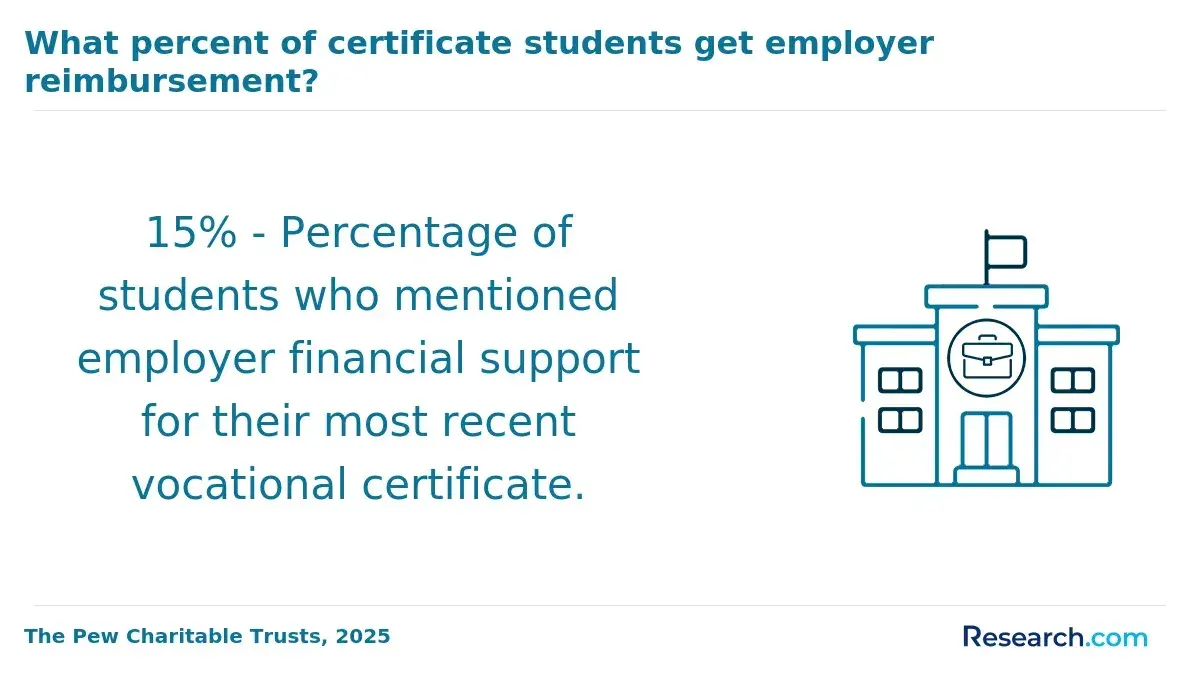
Federal student aid eligibility generally depends on the institution, program length, enrollment status, and other rules. Ask the financial-aid office whether the exact certificate is eligible; noncredit offerings often have different funding options. Employer tuition assistance and payment plans may help, but compare reimbursement conditions before relying on them.
What careers can online certificate programs lead to and in which fields?
Online certificates can support entry-level work, advancement in an existing role, or preparation for a degree. They are strongest when the curriculum matches a clearly defined job task and when employers in your area recognize the training.
A certificate may be enough for some administrative, support, or technician-adjacent jobs, while licensed clinical, legal, engineering, and highly technical occupations can require a degree, supervised experience, an exam, or all three.
The table separates career relevance from eligibility so you can avoid overreading a program's marketing claims:
| Field | Certificate may support | Important limitation |
| Business | Office administration, bookkeeping support, customer operations | Accounting and management advancement may favor degrees or certifications |
| Information technology | Help desk, technical support, data or cybersecurity foundations | Employers may also expect portfolios, experience, or industry certifications |
| Healthcare administration | Scheduling, records, billing, and coding preparation | Clinical roles have separate education and licensure rules |
| Skilled trades | Technical theory and entry preparation | Hands-on competence, apprenticeships, and licenses may be required |
| Criminal justice | Public safety or corrections foundations | Agency hiring standards remain separate |
For learners whose target role eventually requires graduate education, an easy online masters degree may be a later option after completing the appropriate undergraduate pathway, not a replacement for missing foundational prerequisites.
What salary ranges and advancement opportunities follow common online certificate programs?
Salary varies more by occupation, location, experience, schedule, employer, and licensure than by certificate title. The most responsible way to evaluate earnings is to identify the precise occupation a program supports, then compare its education requirements with current BLS data.
For example, the BLS reported a 2024 median annual wage of $67,310 for computer user support specialists and $42,000 for medical records specialists. Those figures describe the occupations, not a guaranteed outcome for online certificate graduates.
Advancement is most realistic when the certificate creates a documented next step: a promotion pathway, a qualifying prerequisite, industry-exam preparation, or credits toward an associate or bachelor's degree.
A stackable IT certificate may lead to additional technical courses; a healthcare administration certificate may complement experience in a medical office. If the desired job lists a bachelor's degree, clinical license, or years of experience, treat the certificate as preparation rather than a substitute.
AI and automation are also changing entry-level work. Programs that teach communication, data accuracy, digital workflow, ethical decision-making, and field-specific software can be more durable than programs focused only on one tool. Ask employers which skills they actually use before choosing a specialization.
How do online certificate credits transfer into associate or bachelor's degree programs?
Credits transfer through an evaluation process, not a promise printed in a catalog. The receiving college decides whether a course is equivalent to one of its requirements, counts only as elective credit, or is not accepted.
It may review institutional accreditation, course level, credit hours, grade earned, syllabus, learning outcomes, and the age of coursework. Many schools also require students to complete a minimum number of credits in residence before awarding their degree.
Take these practical steps before and during enrollment to protect future transfer options:
- Name the associate or bachelor's program you may pursue before selecting the certificate.
- Compare the certificate curriculum with the target degree's published requirements course by course.
- Request written confirmation from the receiving institution about likely equivalencies and any grade minimum.
- Save syllabi, assignments, catalog descriptions, and official transcripts in case a later appeal or evaluation is needed.
- Choose general education and foundational courses first when they fit both the certificate and degree plan.
Internal transfer within the same college is often simpler than transferring elsewhere, especially in formally stackable programs. Still, ask whether every certificate course applies to the specific degree concentration. Students considering a rapid graduate path later can compare fastest online masters options only after confirming they meet bachelor's-level admission and prerequisite requirements.
How can you choose a reputable online certificate program with strong transfer policies?
A reputable program is not simply the cheapest or fastest one. For a transfer-focused learner, the best choice is the program that documents its credits, fits the destination degree, offers the required learning format, and has realistic support for the career goal. Start with the receiving school whenever possible, because its policies control the final transfer decision.
Use the following questions when comparing programs with admissions staff or academic advisors:
- How many semester or quarter credits does the certificate award, and do they appear on an official college transcript?
- Is the institutionally accredited college the actual credit-granting provider?
- Which associate or bachelor's degrees explicitly accept all or most certificate courses?
- Can the school provide a course-by-course transfer guide or written evaluation?
- What are the full costs, including fees, software, labs, exams, and required in-person components?
- Does the program meet any state, clinical, certification-exam, or employer requirements relevant to my goal?
- What advising, tutoring, accessibility, and technical support are available to online students?
Common mistakes include choosing a noncredit course when degree transfer is the goal, assuming an accredited school guarantees course acceptance, overlooking lab or clinical travel, and comparing only advertised tuition. A stronger approach is to map credits first, verify requirements in writing, and calculate the full cost against the specific role or degree you intend to pursue.
Other Things You Should Know About
No. The receiving college decides whether credits meet its equivalency, grade, residency, and program requirements. Credit-bearing courses from an institutionally accredited college usually provide a clearer basis for review than noncredit training.
No. A certificate is generally awarded after completing an educational program. A professional certification is awarded by a certifying organization after meeting its standards, which may include an exam, experience, or continuing education.
Possibly. Eligibility depends on the institution, the exact credit-bearing program, enrollment status, and federal and school rules. Ask the financial-aid office about the specific certificate rather than assuming all online programs qualify.
Contact the college where you plan to earn your associate or bachelor's degree. Provide the certificate's course list and ask for a written course-by-course evaluation or guidance on which credits are likely to apply.
References
- Are Online Courses Better Than Community College? https://www.straighterline.com/blog/online-courses-better-than-community-colleges
- New data on college transfer outcomes and how N.C. compares - EdNC https://www.ednc.org/02-08-2024-what-do-national-transfer-outcomes-reveal-and-how-does-north-carolina-compare/
- 50-State Comparison: Transfer and Articulation Policies https://www.ecs.org/50-state-comparison-transfer-and-articulation/
- 2025's Best Online Graduate Certificate Programs in the U.S. https://www.onlinemastersdegrees.org/graduate-certificate-programs/
- Transferology https://www.transferology.com/
- Community college transfer processes discourage degree completion https://journalistsresource.org/education/community-college-transfer-bachelors-degree-barriers-research/
- Best Online Universities With Generous Transfer Credit Policies https://www.collegetransitions.com/blog/best-online-universities-with-generous-transfer-credit-policies/
- Completions and Outcomes https://www.txhighereddata.org/completions-and-outcomes/
- Top Online Schools That Accept Transfer Credits https://www.edvisorly.com/student-guides/online-schools-that-accept-transfer-credits
- Online Certificate Programs | Certifications Programs https://www.uscareerinstitute.edu/online-certificate-programs