2027 An MHA Case on Physician-Administrator Disagreement Over Capacity

Co-Founder and Chief Data Scientist
A hospital can have an open bed and still lack the staff, equipment, or clinical support to care for the next patient safely. That distinction often drives disagreements between physicians trying to secure timely treatment and administrators managing resources across the hospital. This MHA case shows how to analyze the conflict without treating either side as the obstacle. It is for prospective healthcare administration students and emerging leaders who want a practical way to make capacity decisions - and to judge whether an MHA will help them develop that skill.
Key Things You Should Know
- Capacity is not a bed count: A usable bed requires the right staffing, services, equipment, and patient placement; an empty room alone does not establish safe capacity.
- Resolve the case with shared evidence: Define the patient's clinical needs, verify operational constraints, agree on an escalation owner, and reassess the decision as conditions change.
- Choose education for the work you want to do: An MHA can build healthcare-specific operations skills, but it does not confer clinical authority. The BLS median of $126,520 for all management occupations in May 2025 is not an MHA graduate salary.
What is an MHA case involving physician-administrator disagreement over capacity?
In a healthcare administration case study, a physician-administrator capacity dispute asks students to decide what a hospital can safely deliver - not simply who wins an argument. Consider a hypothetical emergency department patient who needs an inpatient bed with close monitoring. The physician requests admission promptly. An administrator points to an apparently open unit bed, while the unit leader reports that the available staff and monitoring capability cannot safely support that patient at present. Meanwhile, other patients are awaiting admission and discharge decisions.
The strongest case analysis identifies the decision that must be made now, the evidence each person has, and who can authorize each response. The physician assesses clinical needs; nursing and other clinical leaders assess whether care can be delivered; administrators coordinate staffing, placement, and system-wide resources. Students entering healthcare administration from another field may find that a healthcare administration bachelor's with a suitable start date provides a foundation before graduate-level casework. Neither that degree nor an MHA replaces experience working with clinical teams.
How do physicians and healthcare administrators define hospital capacity differently?
A physician may focus on whether a particular patient can receive timely, clinically appropriate care. An administrator must also consider demand across units, staffing, costs, transfers, and the consequences of accepting one patient for others. These perspectives are complementary when everyone uses the same definition of usable capacity: the ability to provide the required level of care safely at the required time.
The distinctions below help a case team locate the source of disagreement before debating a solution.
| Capacity measure | What it tells the team | What it does not establish |
| Licensed beds | The facility's authorized bed inventory | Whether a bed is staffed or suitable for this patient |
| Physical beds | Rooms or spaces that appear available | Whether necessary personnel and equipment are available |
| Staffed beds | Beds supportable under current staffing plans | Whether the team can meet a patient's specific monitoring or specialty needs |
| Effective capacity | Patients who can receive appropriate care given current resources and patient mix | That capacity will remain unchanged through the next shift |
Data quality matters as much as the definition. A bed board may lag behind a discharge, and a staffing roster may not show a last-minute absence. Professionals interested in the integrity and use of these records can compare online CAHIIM-accredited health information management programs with an MHA: health information management emphasizes information systems and data governance, while an MHA generally places those data in broader operational decisions.
How should healthcare leaders resolve physician-administrator conflicts about capacity?
Leaders should treat the disagreement as a time-sensitive joint decision, not a contest between clinical and financial priorities. The immediate objective is an appropriate plan for the patient while protecting other patients and staff. A case response should specify actions, owners, and a point for reassessment.
This sequence gives students and new managers a way to work through the dispute without assuming that either an open bed or a physician request settles it.
- State the clinical requirement: Ask the treating team what level of care, monitoring, specialty support, and timing the patient needs.
- Verify current constraints: Confirm bed status with the unit, staffing leader, and placement team rather than relying on a single dashboard.
- Compare feasible options: Assess safe placement, staffing changes, a clinically appropriate alternative unit, a suitable transfer, or other options under hospital policy.
- Escalate unresolved risk: Involve the designated clinical and operational leaders, document their decision, and follow applicable emergency-care and transfer requirements.
- Set a reassessment trigger: Revisit the plan when staffing, patient condition, discharge timing, or demand changes.
After the immediate decision, examine whether the same bottleneck recurs. Someone comparing online MHA degrees for healthcare management preparation should look for cases or projects that require this kind of cross-functional decision-making, not just instruction in bed-utilization metrics.
Several frameworks make the case more rigorous. Systems thinking traces how emergency arrivals, inpatient staffing, discharge timing, and transfers affect one another; adding a bed in one place may simply move the bottleneck. Quality improvement tests a specific change, measures its effect on flow and safety, and revises it when results differ from expectations. Ethical decision-making makes leaders consider fairness and patient harm alongside efficiency.
A useful leadership test is whether a proposed metric creates the wrong incentive. Faster admissions may look successful while masking unsafe workload; lower occupancy may preserve flexibility but leave urgent patients waiting. Pair flow measures with patient-safety and workforce measures, and define who can stop an unsafe plan. Leaders pursuing research on such systems, rather than primarily managing them, may later compare PhD and professional doctorate completion routes. A doctorate is not a prerequisite for applying these frameworks in an operations role.
The most relevant MHA coursework connects healthcare operations, quality and patient safety, finance, health information, organizational behavior, and law or ethics. Operations courses can teach patient-flow and bottleneck analysis. Finance helps students assess staffing and resource trade-offs without treating cost as the sole objective. Leadership courses address the communication needed when people with different responsibilities disagree.
Look beyond course titles. Ask whether students analyze realistic, incomplete information; work with clinicians or healthcare employers; and explain how they would measure the safety of a proposed change. An MBA in healthcare management may fit someone seeking broader business leadership, but a general management core is not automatically a substitute for healthcare-specific operations instruction. Compare the actual curriculum and total price of cost-conscious MBA pathways for healthcare professionals against MHA options before paying for either degree.
Both formats can use simulations, case discussions, analytics projects, and applied work. Campus programs may make in-person collaboration and employer contact easier; online programs can let employed students apply assignments at their workplace. Neither format guarantees access to hospital data, a placement site, or the same recruiting opportunities.
For a capacity-management case, ask how the program handles live negotiation among students assigned physician, nursing, and administrator roles. Check required meeting times, group-project expectations, fieldwork, and campus visits before calling an online program flexible. An accelerated schedule can intensify these demands. If speed is a priority, compare the actual sequencing and experiential requirements of online healthcare management MBA program duration with MHA schedules rather than comparing advertised completion times alone.
First, verify that the institution holds recognized institutional accreditation. Then check whether the specific healthcare administration program holds accreditation from the Commission on Accreditation of Healthcare Management Education (CAHME), if that distinction matters to your goals or a prospective employer. Institutional accreditation and CAHME program accreditation answer different questions; neither should be inferred from a school's general reputation. Confirm the exact program and delivery format in current accreditation records.
Accreditation does not establish that a program teaches capacity planning well. Examine its operations courses, applied projects, faculty expertise, and access to healthcare settings separately. The same verification habit matters if considering online doctoral education for healthcare management professionals: check the institution and the particular degree rather than assuming MHA program accreditation extends to a doctorate.
MHA programs commonly request a bachelor's degree, academic transcripts, a statement of purpose, recommendations, and a résumé; testing, prerequisites, and work-experience expectations vary by school. Applicants without clinical or business degrees are not automatically excluded. They should identify gaps in healthcare terminology, quantitative work, or professional experience and ask how the program helps students address them.
Length and cost vary substantially with credits, enrollment pace, residency or fieldwork rules, and tuition policies. A short advertised timeline may require continuous or intensive study, so healthcare administration master's programs with one-year schedules deserve particular scrutiny if you plan to remain employed.
For an accurate comparison, request the required credits and current tuition basis from each school. Add mandatory fees, materials, travel, and any income lost to required fieldwork; then account separately for employer assistance or borrowing costs. Without verified school-specific prices, a single "typical MHA cost" would be a poor basis for an enrollment decision.
Graduates with relevant experience may pursue hospital operations, patient-flow, service-line, quality improvement, or practice-management roles. An experienced nurse or department coordinator may be able to build on existing clinical relationships; a career changer may need an analyst, coordinator, project, or fellowship role first. Senior capacity decisions usually require demonstrated operational judgment and organizational authority, not merely a graduate credential.
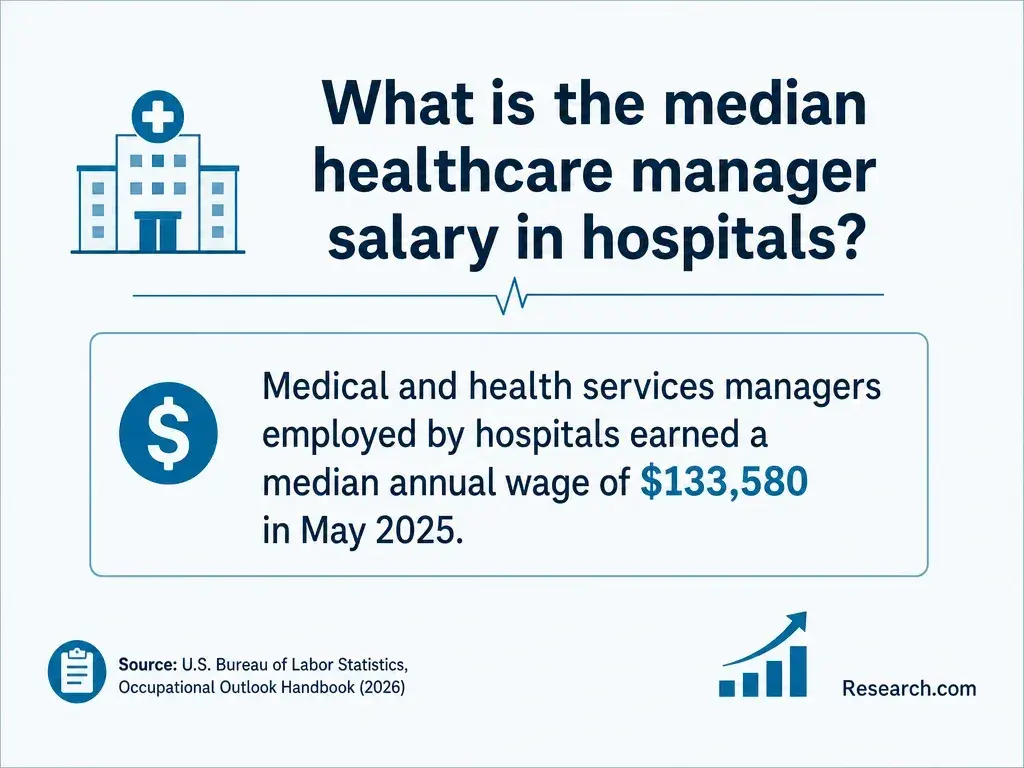
The U.S. Bureau of Labor Statistics reports a $126,520 median annual wage for management occupations in May 2025. That figure covers management jobs across industries and experience levels: it is neither the median for healthcare operations managers specifically nor a forecast of an MHA graduate's pay. Compare actual job postings by location, responsibility, and experience before estimating your return on a degree. For experienced leaders considering another qualification, lower-cost doctoral study in healthcare administration may be worth examining, but a doctorate is rarely the direct remedy for a missing operations track record.
What certifications and professional standards support healthcare capacity leadership?
Professional development can complement an MHA when it matches the work. Quality-improvement training may help a manager test patient-flow changes; project-management training may help implement them; health-information credentials may suit someone responsible for data governance. Eligibility, examinations, and continuing-education rules depend on the issuing organization. A certificate or course is not the same as professional certification, and neither grants clinical licensure.
Standards also come from the workplace: follow institutional scope-of-authority rules, patient-safety procedures, privacy requirements, and applicable emergency-care obligations. If a full MHA is more education than your next role requires, targeted employer training or accelerated online healthcare management master's options may offer a different time commitment. Compare the specific skills taught, not just the credential's name or speed.
Other Things You Should Know About Healthcare Administration
Only under the school's and healthcare organization's applicable privacy rules. Seek approval and use an appropriately de-identified or fictionalized case; removing a patient's name alone may not be enough.
Hospitals with emergency departments must follow applicable emergency-care law, including EMTALA where it applies. Crowding does not erase screening and stabilization obligations. Staff should follow legal guidance and hospital transfer and escalation policies for the specific situation.
There is no universal job title with that authority. Clinical decisions, placement decisions, and executive escalation follow the hospital's bylaws and policies. Students should identify those decision rights in the case rather than assume one professional can override everyone else.
Verify when each record was updated and ask the unit leader what has changed. A dashboard supports decisions, but it does not replace current information about staffing, equipment, and the patient's needs.
- When Team Conflicts Threaten Quality of Care: A Study... - PMC https://pmc.ncbi.nlm.nih.gov/articles/PMC6408685/
- Nursing Ethical Considerations - StatPearls - NCBI Bookshelf https://www.ncbi.nlm.nih.gov/books/NBK526054/
- Patient safety | who.int https://www.who.int/news-room/fact-sheets/detail/patient-safety
- Hospital Bed Capacity Project | NHSN https://www.cdc.gov/nhsn/bed-capacity/index.html
- Conflict Among Hospital Staff Could Compromise Care | Stanford Graduate School of Business https://www.gsb.stanford.edu/insights/conflict-among-hospital-staff-could-compromise-care
- 8 Managing bottlenecks in the perioperative setting | sciencedirect.com https://www.sciencedirect.com/science/article/pii/S1521689622000349
- Can the Patient Decide? Evaluating Patient Capacity in Practice | AFP | AAFP https://www.aafp.org/afp/2001/0715/p299
- Physician-Administrator Conflict in Healthcare | Americanhhm https://www.americanhhm.com/articles/physician-administrator-conflict-in-healthcare