2027 An MHA Case on Succession Risk in a Small Hospital

Co-Founder and Chief Data Scientist
A small hospital can lose more than an executive when a key leader leaves: it may also lose the person who knows its payer contracts, staffing constraints, and relationships with local clinicians. This MHA case shows how to assess that risk and build a workable succession response.
The guide is for prospective healthcare administration students and working professionals who want to test whether an MHA would strengthen their ability to lead such transitions. You will see what the case demands, which educational options fit, and what to verify before committing to a degree.
Key Things You Should Know
- A useful succession plan identifies critical decisions and relationships - not just a replacement for the CEO, and names who can act during an unexpected vacancy.
- An MHA can develop the finance, governance, workforce, and quality skills needed to analyze this case, but hospital experience and board support remain essential.
- Compare programs by applied hospital work, accreditation, scheduling, and total cost; the Bureau of Labor Statistics' $126,520 median wage for all management occupations in May 2025 is not an MHA graduate salary.
What is an MHA case on succession risk in a small hospital?
An MHA case is a teaching scenario in which Master of Health Administration students use evidence and management judgment to recommend a course of action. Succession risk is the possibility that an organization cannot sustain essential decisions, relationships, or services when a leader leaves.
Consider a fictional rural hospital whose CEO plans to retire. The CEO personally manages relationships with major clinicians, understands unresolved payer negotiations, and is the board's main source of financial interpretation. The chief financial officer could oversee finances temporarily but has little experience with clinical operations. The case is not simply about selecting the next CEO: students must separate immediate continuity needs from the longer search for a qualified permanent leader.
Someone entering this field without a bachelor's degree may first need to assess undergraduate health administration programs and entry schedules. An MHA case assumes a graduate-level ability to connect operational evidence with governance decisions; it does not confer authority to make those decisions for an actual hospital.
Why is succession planning essential for small and rural hospitals?
In a small hospital, one executive may hold knowledge that a larger organization distributes across several departments. A vacancy can therefore slow budget approvals, recruitment, regulatory responses, or negotiations even when day-to-day clinical teams continue working. Rural recruitment constraints can make a permanent replacement harder to find, while a hospital's obligations to patients and staff continue throughout the search.
The practical goal is continuity of authority and knowledge, not a guarantee that every disruption can be prevented. A board needs to know who may make urgent decisions, which matters require board approval, and where critical information is documented. It should also distinguish a capable interim leader from a candidate ready for the permanent role.
For experienced administrators, developing internal leaders may be more useful than immediately pursuing another degree. A professional considering advanced study can explore planning an accelerated healthcare leadership doctoral pathway, but doctoral study is not a substitute for an operational succession plan or board oversight.
How can MHA students analyze leadership succession risks in hospitals?
A strong case analysis traces what would fail after a departure, tests available coverage, and recommends actions the hospital can realistically carry out. The following sequence keeps the analysis focused on decisions rather than a generic list of leadership qualities.
- Map critical work: Identify who currently owns financial approvals, medical-staff relationships, workforce decisions, compliance escalation, and external negotiations.
- Test vacancy scenarios: Compare a planned retirement with an immediate, unplanned absence; note which decisions cannot wait for a permanent hire.
- Assess coverage: Examine each potential interim leader's authority, capacity, conflicts, and support needs rather than assuming the next person on an organization chart is ready.
- Recommend controls: Specify delegated authority, documented handoffs, cross-training, board check-ins, and a permanent-search process.
- Define evidence of progress: Look for completed handoffs, functioning decision pathways, and continuity in essential operations; revise the plan if those checks expose gaps.
Students should state their assumptions. For example, the appropriate interim arrangement changes if the hospital is financially distressed, part of a larger system, or unable to recruit locally. An MHA case emphasizes an actionable management recommendation, a student primarily interested in studying succession as a research question can compare shorter doctoral pathways in healthcare administration separately.
An MHA is the most directly aligned graduate option for many aspiring hospital administrators because it combines healthcare organizations, finance, operations, policy, and leadership. An MBA can be useful for broader managerial mobility, but applicants should check how much of its curriculum addresses hospital governance, clinical stakeholders, and healthcare payment. Neither degree replaces experience managing people and decisions in a care setting.
The right starting point depends on the reader's current role. A hospital department manager may benefit from an MHA with an applied project and access to executive mentors. A clinician moving into administration may need focused preparation in budgeting and organizational governance. An experienced executive with a narrow knowledge gap may get more immediate value from employer-supported training or a targeted course than from a full master's degree.
When reviewing online MHA programs for advancing healthcare administration education, ask whether students can apply assignments to a real hospital, receive useful feedback from healthcare-experienced faculty, and build relationships with administrators. The program label alone does not establish those opportunities.
The Commission on Accreditation of Healthcare Management Education (CAHME) accredits eligible graduate healthcare management programs. Its program-level review is particularly relevant to an MHA applicant assessing leadership preparation. Institutional accreditation is a separate check on the university; it does not mean every individual degree program has specialized accreditation.
For this case, accreditation is a screening tool, not proof that a graduate can manage a succession crisis. Check a program's current accreditation status directly with the accreditor, then inspect its curriculum and applied-learning requirements for evidence of training in governance, ethics, financial judgment, quality, and workforce leadership. If comparing an MHA with an MBA, do not mistake business-school accreditation for CAHME accreditation.
Accreditation questions also change with the degree being considered. Readers who compare doctoral pathways in healthcare management should check the recognition and requirements of those specific programs rather than assuming MHA program accreditation extends to a doctorate.
Look for courses that require students to make and defend decisions under healthcare-specific constraints. Organizational behavior and human resources can help with leadership development and retention; healthcare finance can expose the consequences of delayed approvals; quality and safety courses can show why an executive handoff must preserve escalation routes. Governance, law, and ethics help students distinguish a manager's recommendation from a board's responsibility.
An especially useful capstone or practicum asks students to produce a succession-risk assessment, an interim-authority plan, and a communication approach using realistic organizational evidence. Check whether a program provides access to such projects or expects students to arrange their own placement. Students evaluating a compressed schedule should examine comparing one-year master's curricula in healthcare administration with this question in mind: does the shorter timeline still leave room for meaningful applied work?
Choose the format that lets you complete substantial applied work while maintaining access to the people and settings relevant to your career. Online study can let a working hospital employee remain in their job and use workplace problems in assignments. Campus study may offer easier access to local placements and in-person relationships, particularly for someone trying to enter healthcare administration from another field.
Delivery mode does not establish flexibility. Before enrolling, verify whether classes meet live, whether group projects require fixed meeting times, whether a residency or practicum requires travel, and whether placements are available near home. A student considering planning an accelerated online health administration degree should also confirm how the faster pace affects work schedules and applied-learning opportunities.
Requirements vary by school. Applicants commonly need a bachelor's degree and may be asked for transcripts, a résumé, recommendations, and a statement of purpose. Some programs value or require healthcare experience; test policies, prerequisite coursework, and practicum rules differ. Applicants from nonbusiness backgrounds should check whether introductory finance or quantitative preparation is expected rather than assuming their major disqualifies them.
Program length depends on required credits, course sequencing, enrollment pace, and applied requirements. For cost, compare the complete budget - not a tuition headline. The components below identify what to request from each school.
- Tuition based on the program's required credits and the rate applicable to your enrollment status.
- Mandatory program, technology, and university fees, plus books or required software.
- Travel and time away from work for any residency, practicum, or campus visit.
- Expected employer assistance, grants, and borrowing costs, subject to eligibility and program rules.
Use the same assumptions across schools when making tuition comparisons for MHA and related master's programs. Ask each program for its current total-credit requirement, fee schedule, and likely time to completion at your planned course load before calculating affordability.
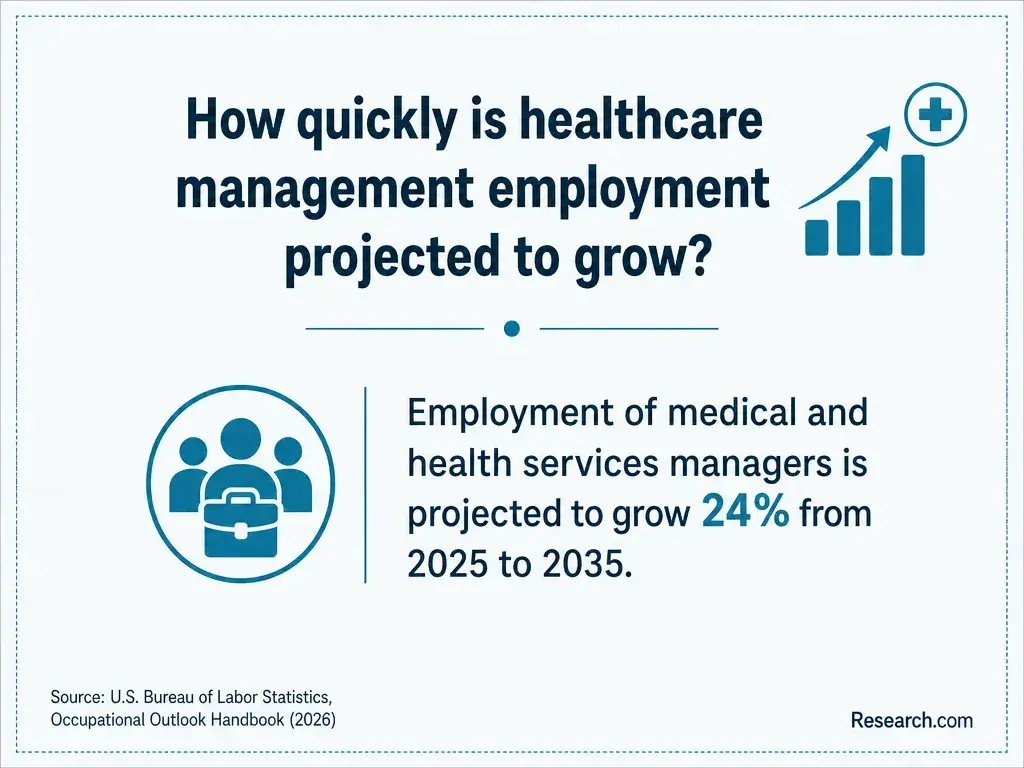
An MHA can support progression in hospital operations, service-line administration, quality management, finance, or executive leadership. The realistic next role depends heavily on prior experience: a current department manager may seek broader operating responsibility, while a career changer may first need a coordinator or analyst role to learn healthcare workflows. CEO appointments require a record of leadership and board confidence, not simply a graduate credential.
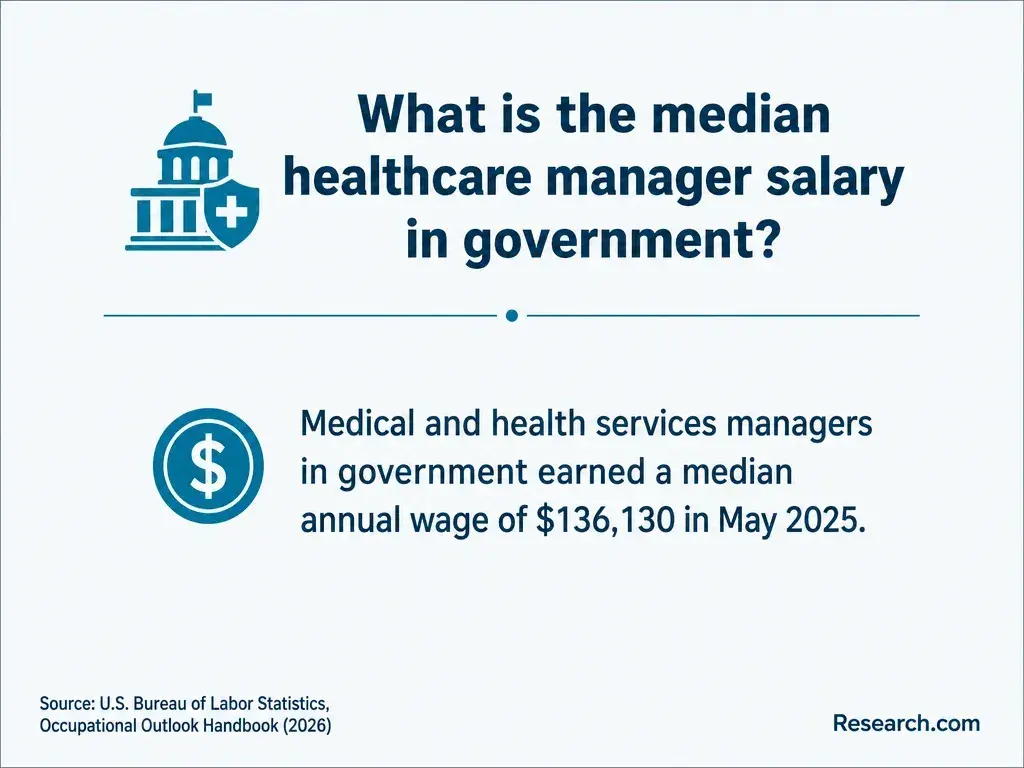
The Bureau of Labor Statistics reports a $126,520 median annual wage for all management occupations in May 2025. That figure spans many industries and seniority levels; it is neither a hospital administrator salary nor an earnings prediction for MHA graduates. The BLS projects management occupations overall to grow faster than the average for all occupations from 2025 to 2035, but a local hospital's hiring needs may differ substantially.
If speed to a first healthcare management credential matters more than an MHA designation, review healthcare management master's duration and program choices. Compare the roles you can credibly pursue with your current experience before paying for a faster or more specialized program.
Which certifications and professional standards strengthen hospital administration careers?
Professional credentials can signal continued development, but they serve different purposes from an MHA. The American College of Healthcare Executives' FACHE designation, for example, has experience and other eligibility requirements; applicants should verify current criteria directly before treating it as a near-term goal. Training in areas such as project management or healthcare quality may address a specific operational gap, but no certificate by itself grants authority to run a hospital.
For a succession-focused career, seek responsibilities that demonstrate sound handoffs, ethical decision-making, and collaboration with clinical and board leaders. If later doctoral study is part of the plan, compare healthcare administration doctorate program expenses against the specific research, teaching, or leadership objective it would serve. An additional degree is a poor substitute for experience you could gain in your current organization.
Other Things You Should Know About Healthcare Administration
Typically, the hospital's governing board appoints or authorizes an interim CEO under its bylaws and applicable organizational rules. Students should check the case's governance facts rather than assume a departing CEO can name a successor independently.
It should preserve necessary organizational records while promptly reviewing the departing leader's system access under its security and records policies. The responsible teams should coordinate the handoff without sharing credentials.
No. Succession planning concerns continuity when people change roles or leave. Leaders should explain the plan's purpose clearly and avoid implying that staffing decisions have been made when they have not.
Possibly, if the board authorizes the appointment and the clinician has appropriate management support and capacity. Clinical expertise alone does not establish readiness for the executive role.
- Succession Planning Leadership Model for Nurse Managers in Hospitals: A Narrative Review - PMC https://pmc.ncbi.nlm.nih.gov/articles/PMC9956194/
- Chapter 11: Key Management Staff | hrsa.gov https://bphc.hrsa.gov/compliance/compliance-manual/chapter11
- Why Metrics Matter for Succession Planning | UNC Executive Development https://execdev.unc.edu/metrics-matter-succession-planning/
- The Critical Importance of Succession Planning - Administration https://adminvc.ucla.edu/news/critical-importance-succession-planning
- Key Facts About Hospitals | KFF https://www.kff.org/health-costs/key-facts-about-hospitals/
- CEO Succession Planning | tht.org https://www.tht.org/governance-resources-by-topic/governance-best-practices/ceo-succession-planning/