2027 Comparing a BS in HIM With a Healthcare Administration Concentration

Co-Founder and Chief Data Scientist
A health information management degree with a healthcare administration concentration combines work with health data and records with preparation for organizational decision-making. That combination can be useful, but it is not the same as a general healthcare administration degree - and the concentration alone does not establish eligibility for a professional credential.
This guide is for prospective and transfer students comparing those paths. It explains what to check in the curriculum, accreditation, costs, and career outcomes so you can choose a program that supports the work you actually want to do.
Key Things You Should Know
- Choose the HIM route if you want to manage health information, data quality, records, or related operations; choose a broader administration degree if those functions are not central to your goal.
- For RHIA exam eligibility, verify the specific HIM program's CAHIIM accreditation and current AHIMA requirements; a healthcare administration concentration is not sufficient by itself.
- Compare total remaining credits, required practical experiences, and fees - not tuition rates alone - especially if you are transferring or studying online.
What Is a BS in Health Information Management With a Healthcare Administration Concentration?
A Bachelor of Science in health information management (HIM) focuses on how healthcare organizations collect, protect, maintain, and use patient information. A healthcare administration concentration adds coursework in areas such as organizational operations, budgeting, leadership, and policy. The degree's foundation remains HIM; the concentration does not turn it into a general business or healthcare administration degree.
That distinction matters when reviewing program names. Schools may use "concentration," "track," or "electives" differently. Ask whether administration courses form a formally designated concentration, how many are required, and whether they replace or supplement HIM courses. If you already hold an associate degree, map each completed course to the new program before assuming it will shorten your path; associate-to-bachelor's credit planning in healthcare administration offers a useful starting point for transfer questions, though HIM requirements must be checked separately.
What Careers Can This HIM Degree Prepare You For?
Graduates may pursue roles involving health records, data integrity, privacy operations, coding oversight, quality reporting, or HIM department coordination. The administration concentration may be especially relevant when those responsibilities involve staffing, budgets, workflows, or communication across departments. Job titles and entry requirements vary by employer; a bachelor's degree does not by itself confer a management position.
Your starting experience affects which roles are realistic. Someone already working in medical records or revenue cycle operations may be positioned to seek broader responsibility. A newcomer may first need hands-on experience with health information systems, regulations, and clinical workflows. For a wider view of adjacent roles, compare healthcare administration jobs and career paths, then read actual postings to see which ones emphasize HIM expertise rather than general operations leadership.
Is a Healthcare Administration Concentration Right for Your Career Goals?
The concentration is a strong fit when you want to connect HIM expertise with departmental leadership. It may be less direct if your goal is to manage a hospital service line, enter clinical practice, or build advanced business skills unrelated to health information. This comparison separates the credentials by the work they primarily prepare you to pursue.
| Education path | Primary emphasis | Consider it when |
| BS in HIM with administration concentration | Health information practice plus organizational coursework | You want HIM-centered roles with room for operational responsibility. |
| BS in healthcare administration | Broader healthcare operations and management | You do not need an HIM-specific curriculum or RHIA pathway. |
| Graduate management degree | Advanced leadership or business study | You already have a bachelor's degree and need skills for a defined next step. |
For experienced professionals aiming well beyond department management, evaluating faster healthcare leadership doctorate pathways is a separate, later-career decision - not a substitute for foundational HIM education. Start by identifying the duties in your target job, then choose the curriculum that teaches them.
HIM coursework commonly addresses health data, information systems, records management, privacy, coding and reimbursement concepts, and the use of information to support care and organizational decisions. Administration coursework may add healthcare finance, human resources, operations, leadership, or health policy. General education, electives, and applied experiences also affect what you will study; no single course list applies to every school.
Read the catalog rather than relying on the concentration name. Check which courses are required, which are optional, and whether an internship or other applied experience can be completed near where you live. If your main gap is broad managerial finance or strategy rather than HIM practice, comparing faster MBA routes for healthcare managers may help clarify the alternative - but an MBA's management curriculum does not replace specialized HIM preparation.
Yes, particularly if RHIA eligibility matters to you. The Commission on Accreditation for Health Informatics and Information Management Education (CAHIIM) accredits eligible HIM programs. Check the specific bachelor's HIM program and its current status, not just the university's institutional accreditation or a statement about its healthcare programs generally.
Institutional accreditation and programmatic accreditation answer different questions, so verify both. Accreditation also differs across degree types: for example, evaluating accredited universities for a health administration degree does not establish that any listed school's HIM program is CAHIIM-accredited. Confirm the exact program in CAHIIM's directory and ask admissions how its status applies to your expected graduation date.
It can, but the degree title and concentration are not enough to answer yes. The Registered Health Information Administrator (RHIA) is an AHIMA credential. The relevant question is whether your completed degree meets AHIMA's current exam eligibility rules, including the applicable CAHIIM-accredited HIM education requirement. Passing the exam and meeting any other current requirements are separate from graduating.
Before enrolling, ask the program to identify its RHIA eligibility pathway in writing, then check it against AHIMA's current candidate guidance. Do not confuse RHIA with qualifications for general healthcare administration roles. Even an advanced administration degree - such as one found while comparing CAHME-accredited online healthcare administration study - should not be assumed to satisfy RHIA requirements.
A full-time student starting without college credit would generally plan around the usual four-year bachelor's timeline. Transfer credits, part-time enrollment, course availability, and required applied experiences can change the actual finish date. An accelerated calendar is only useful if the necessary HIM and concentration courses are offered in a workable sequence.
Request a term-by-term degree plan showing accepted transfer credits and remaining requirements. If speed is your priority, healthcare administration degree completion through accelerated study provides a point of comparison; verify that any faster option still offers the HIM curriculum and credential pathway you need.
There is no reliable single price for this degree type. Your cost depends on the school's tuition structure, the credits you still need, mandatory fees, books and software, and any expense associated with an applied experience. An online program may also charge fees that differ from campus rates. Financial aid, employer assistance, and transfer credit can change what you pay, but eligibility and award amounts require individual confirmation.
Ask each school for a written estimate based on your transfer evaluation and intended course load. Compare the total remaining cost alongside accreditation and required experiences, rather than choosing by advertised tuition alone. Finding a healthcare administration degree within your budget can help frame the price comparison, provided you confirm that a candidate program actually offers the HIM education you want.
Online delivery can support the same educational goal, but effectiveness depends on the individual program's curriculum, instruction, support, and opportunities to apply what you learn. Online students still need access to appropriate software, meaningful feedback, and a feasible arrangement for any required practical experience. CAHIIM status should be checked for the specific program regardless of delivery mode.
Ask whether classes have required live meetings, how group work is scheduled, and who helps arrange practical experiences. Those details matter more than an "online" label when you are balancing study with employment. Format claims also should not be borrowed from unrelated degree levels: doctoral program selection in healthcare management involves different expectations from choosing an undergraduate HIM program.
What Salary and Job Outlook Can HIM Graduates Expect?
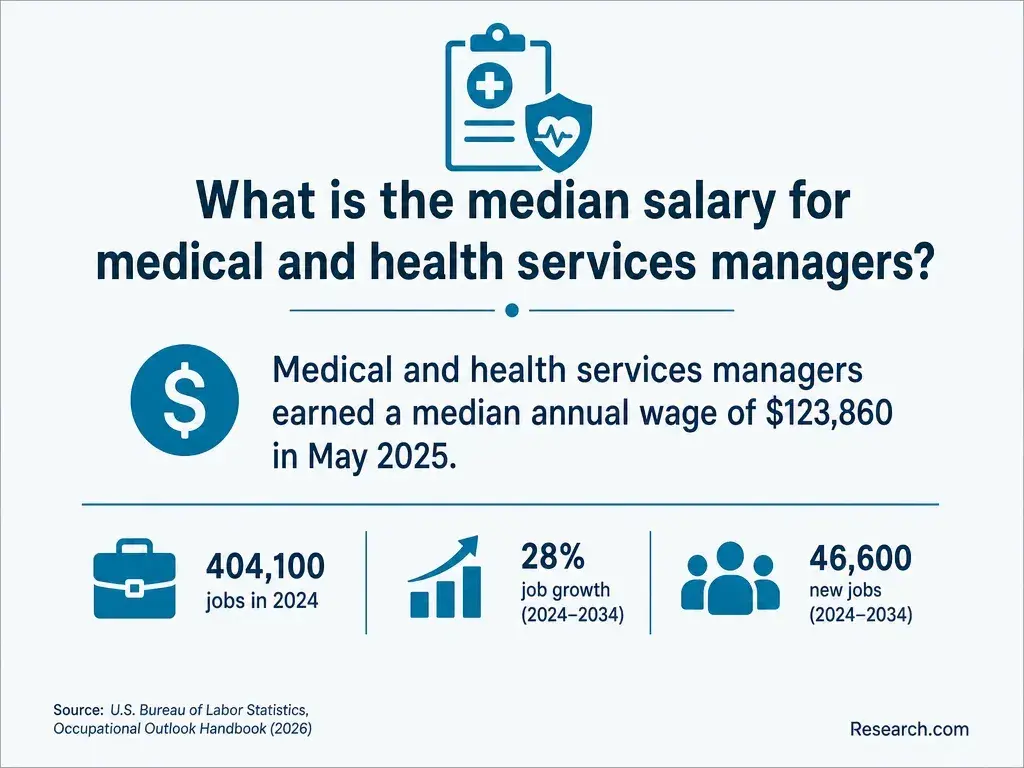
No single salary or job-growth figure describes all HIM graduates. Entry-level records work, specialized information roles, and experienced management positions differ substantially in responsibility and pay. For context, the U.S. Bureau of Labor Statistics reports a $126,520 median annual wage for management occupations in May 2025. That figure covers managers across industries; it is not the expected salary for a new HIM graduate or proof that the concentration causes a pay increase.
Use job postings in your location to compare required experience, credentials, and pay for the specific roles you want. If you later consider graduate education for advancement, weigh its cost against a credible career plan rather than assuming another credential will raise earnings; that applies even when you review low-tuition healthcare administration doctorate options. The immediate value of this bachelor's degree is strongest when its HIM preparation matches the qualifications employers request.
Other Things You Should Know About Healthcare Administration
Not necessarily. Admission requirements vary by school. Prior healthcare experience can help you understand the coursework, but check each program's published requirements rather than treating it as a universal prerequisite.
Many students do, particularly with part-time or online study. Confirm class meeting times, assignment schedules, and any practical-experience hours before committing to a workload.
No. HIM and administration education focuses on information and organizational work. Clinical roles have their own education, training, and, where applicable, licensing requirements.
Yes, if suitable roles are available. Relevant work can build familiarity with healthcare systems and help you test whether HIM or broader administration is the better long-term fit.
- Health Information Management, Bachelor of Science | USC Upstate Academic Catalog https://academic-catalog.uscupstate.edu/cst/ies/health-information-management-bs/
- How Do Transfer Credits Work When You Go Back to School? | Whitworth Online https://online.whitworth.edu/news-articles/how-do-transfer-credits-work-when-you-go-back-to-school/
- Health Information Management - Health Sciences https://healthsciences.louisiana.edu/academic-programs/health-information-management
- CAHIIM Accredited Program: Why is it important? | UIC https://healthinformatics.uic.edu/news-stories/why-is-a-cahiim-accredited-program-important/
- RHIT vs. RHIA Certification: Which Is Right for You? | UW Online Collaboratives https://uwex.wisconsin.edu/stories-news/rhit-vs-rhia-certification/
- Healthcare Administration Associate vs Bachelor's Degree | Campus https://campus.edu/blog/healthcare/healthcare-administration-associate-vs-bachelors-degree
- Health Information 101 | AHIMA https://www.ahima.org/certification-careers/certifications-overview/career-tools/career-pages/health-information-101/