2027 Healthcare Administration BS Programs With Independent Study: When It Helps

Co-Founder and Chief Data Scientist
An independent study can make a healthcare administration bachelor's degree more relevant to your career goal - but only if the program offers it, a faculty member can supervise it, and the project fits your schedule. That matters especially for online students who want to investigate a problem at work or build experience in a healthcare setting. This guide explains when independent study is worth pursuing, when a structured internship may be better, and how to check the degree's accreditation, requirements, cost, and likely career value before enrolling.
Key Things You Should Know
- Independent study is usually a supervised, credit-bearing project, not permission to skip required healthcare administration courses; confirm eligibility and approval rules with each school.
- It helps most when you have a focused healthcare operations question, access to appropriate evidence, and a faculty mentor; an internship is often better when you need workplace exposure.
- Do not treat management pay as a starting-salary estimate: the US median for all management occupations was $126,520 in May 2025, a broad figure that does not describe new healthcare administration graduates.
What is independent study in healthcare administration bachelor's programs?
Independent study is an individualized course in which a student investigates an approved topic under faculty supervision. A healthcare administration project might analyze appointment-scheduling workflows, compare patient-access policies, or examine how a clinic measures service quality. The student and instructor typically agree on a question, methods, deliverables, and assessment criteria before work begins.
It differs from an asynchronous class: flexible access to recorded lessons does not mean the student designs the course. It also differs from an internship, which centers on supervised experience in an organization, and from a capstone, which may be required of every student. Schools vary in whether independent study is available to undergraduates, how it counts toward major requirements, and whether remote supervision is possible.
Transfer students should ask whether an independent-study course can satisfy a degree requirement rather than assume its credits will fit. This is particularly important when considering associate degree transfer into healthcare management study: an elective credit and a required major course are not interchangeable.
When does independent study benefit healthcare administration students?
Independent study is most useful when standard courses do not address a specific, manageable question tied to your next step. For a student already working in a medical office, that might mean evaluating a proposed registration process using permitted, nonidentifiable information. For a career changer without healthcare contacts, a structured internship may provide more valuable exposure.
The options below serve different purposes. Compare the experience you need - not just the flexibility advertised - before choosing a program.
| Learning option | Best fit | Main limitation |
| Independent study | A focused question and a student prepared to manage a self-directed project | Mentorship and project access must be arranged; it may offer little direct workplace experience |
| Internship or practicum | Learning how a healthcare organization operates and building professional contacts | Placement, set hours, or site requirements may constrain scheduling |
| Required capstone | Applying coursework to a defined final assignment | The topic or format may allow less customization |
Ask whether the independent study can be completed in the term you need. Online healthcare administration bachelor's programs with rolling starts may offer flexible entry dates without offering independent-study supervision in every term.
How do you choose an accredited healthcare administration bachelor's program?
Start by verifying the institution's current accreditation through its accreditor and the US Department of Education's recognized-accreditor information. Then check the actual bachelor's curriculum and ask the department - not just an admissions representative - whether independent study is available to online students, who may supervise it, and which requirements it can fulfill.
Institutional accreditation and program-specific accreditation answer different questions. Do not assume a bachelor's program has specialized healthcare administration accreditation because the university offers a graduate program. For example, CAHME-accredited MHA universities and program options concern particular graduate programs; that status does not automatically extend to a school's BS degree.
Request a degree plan showing required courses, transfer-credit decisions, any internship or capstone, and where an independent study would fit. If the school cannot confirm a supervisor or explain its approval process before enrollment, treat independent study as a possibility rather than a dependable feature.
A healthcare administration BS generally combines general education with business and health-sector subjects. Common areas include accounting and budgeting, organizational management, healthcare law and ethics, health policy, quality improvement, and the use of data in administrative decisions. Course titles and the balance of business versus healthcare content vary by institution.
Look for a foundation that supports your proposed project. A student interested in clinic staffing needs operations and data-literacy coursework; one interested in reimbursement needs a grounding in healthcare finance and payment systems. Independent study should deepen that foundation, not replace introductory instruction the student has not yet mastered.
Healthcare administration and health information management also have different emphases. If your goal is managing health records, information systems, or data-governance functions, compare the curriculum with CAHIIM program options for health information management students rather than assuming an administration elective supplies the same preparation.
Requirements depend on whether you apply as a first-year or transfer student. Schools commonly review prior academic records, while transfer applicants also need an evaluation of earlier college work. A school may impose separate prerequisites, minimum academic-standing rules, or upper-division eligibility before approving independent study. None of those independent-study conditions should be assumed from the degree's general admission policy.
Before applying, ask when students can propose a project and whether they must first complete research-methods or major courses. If you already hold a bachelor's degree and want to enter healthcare leadership, another undergraduate degree may not be the most direct route. Compare your preparation and career goal with graduate healthcare administration pathways for industry newcomers; admission to any particular graduate program still depends on its own requirements.
A full-time student entering without college credit will usually plan around the standard four-year bachelor's pathway. Transfer credits, part-time enrollment, course availability, and internship requirements can change that timeline. Independent study does not necessarily speed completion: proposal approval and faculty availability can delay a course that is otherwise self-paced.
Published tuition alone may not show what you will pay. The components below are worth checking in a written estimate from each school.
| Cost component | What to confirm |
| Tuition | The rate for your enrollment status and the credits still required after transfer evaluation |
| Mandatory fees | Online, technology, course, and graduation charges, if applicable |
| Project expenses | Whether independent study has a separate fee or requires software, materials, or travel |
| Financing | Grant eligibility, employer assistance, and borrowing costs under your circumstances |
Compare the remaining degree cost, not just the advertised per-credit rate. A starting point for identifying affordable bachelor's pathways in healthcare administration is useful, but your transfer evaluation and required fees determine the more meaningful comparison.
Online delivery can support the same academic goals, but effectiveness depends on course design, feedback, access to faculty, and opportunities to apply what you learn - not the delivery label alone. For independent study, ask how often you and your supervisor will meet, how project milestones are reviewed, and whether the school supports remote research or a workplace-based project.
Online study may suit a working student with a usable project topic. Campus study may be preferable if you need easier access to local organizations, face-to-face mentoring, or scheduled study time. Check for live meetings, group assignments, site visits, and internship hours before calling either option flexible.
If graduate study is a later goal, compare those delivery requirements separately; online MHA programs and degree requirements do not establish what an online bachelor's program offers.
A BS can support applications for administrative and operations roles in clinics, hospitals, insurers, and other health organizations. Depending on prior experience, realistic targets may include patient-access coordinator, practice operations specialist, scheduling supervisor, or quality-support analyst. Responsibilities and titles vary; leadership positions commonly require demonstrated experience beyond the degree.
Independent study can strengthen an application when its output matches the job: a clearly scoped process analysis may demonstrate problem definition, stakeholder communication, and evidence-based recommendations. It is less persuasive than relevant hands-on experience when an employer needs someone who has already managed staff, budgets, or regulated workflows.
For experienced professionals aiming at higher-level administrative roles, choosing a 12-month health administration master's pathway may become relevant later. First determine whether the target job calls for graduate education or for experience you can build now.
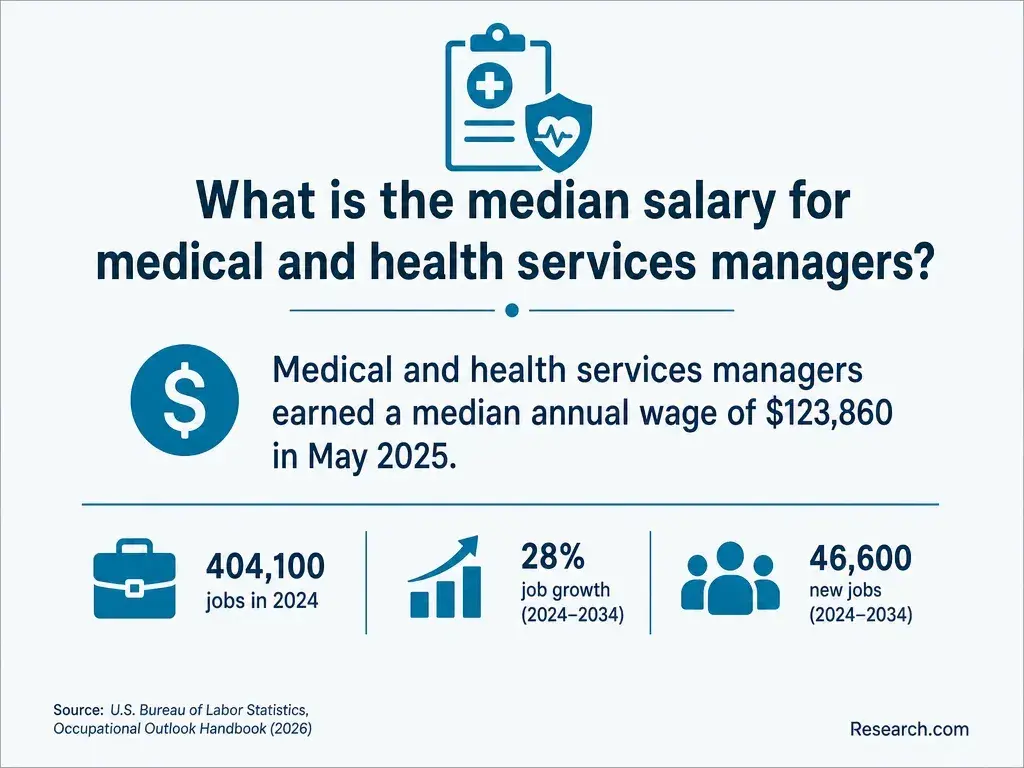
There is no single reliable salary for everyone with this degree. Pay depends on the occupation, experience, employer, location, and scope of responsibility. The US Bureau of Labor Statistics reports a May 2025 median annual wage of $126,520 for all management occupations. That figure covers many industries and experienced managers; it is not the median for healthcare administration BS graduates or an appropriate entry-level expectation.
For a useful financial comparison, look up pay for the specific job titles and locations you are targeting, then weigh likely earnings against the remaining cost of your degree. If graduate study is under consideration, finding an affordable healthcare administration graduate program matters only alongside a realistic assessment of whether that credential would help you qualify for different work.
Do healthcare administration careers require licenses or certifications?
Many general healthcare administration jobs do not require a professional license simply because they involve healthcare. Specific roles can be different: administrators of nursing homes or other regulated facilities may face state licensing requirements, and employers may prefer role-specific certifications. Check the state regulator and actual job postings for the position you want rather than treating a BS or an independent-study project as a licensing credential.
Additional degrees also serve different purposes. A doctorate may support research, teaching, or particular leadership goals, but it does not replace a required facility-administrator license. If that longer-term path interests you, treat planning the duration of a healthcare administration doctorate as a separate decision from meeting the legal requirements of a specific job.
Other Things You Should Know About Healthcare Administration
Usually, a credit-bearing independent study appears as a course, but the transcript may show only a generic title. Ask whether the school can record your project topic or provide another way to document the work.
Do not use patient information without the required organizational permissions and faculty guidance. Privacy rules and institutional review procedures may apply even when the project is for a class.
It depends on the school's course offerings and faculty availability. Confirm supervision and registration deadlines before building a summer completion plan around it.
Some schools permit an approved independent project to contribute to honors work; others require a separate thesis or course sequence. Check both the honors and healthcare administration departments' rules.
- ONC - Office of the National Coordinator for Health IT https://healthit.gov/
- Department Expectations: Faculty | New York State Education Department https://www.nysed.gov/college-university-evaluation/department-expectations-faculty
- Bachelor of Science in Health Care Administration | azjobconnection.gov https://www.azjobconnection.gov/etp/public/institution_programs/21079
- HCM Program Topics | South University https://www.southuniversity.edu/news-and-blogs/2024/01/hcm-program-topics
- Academic Program Approval Procedures: Faculty Senate | umass.edu https://www.umass.edu/senate/course-and-curriculum-management/academic-program-approval-procedures
- BS in Health Administration: Undergraduate Degrees & Minors | Richard M. Fairbanks School of Public Health https://fairbanks.indianapolis.iu.edu/academics/undergraduate/bsha/index.html
- Program: Health Services Administration, B.A.S. | sfcollege.edu https://catalog.sfcollege.edu/preview_program.php
- Academic Policies - NYU Bulletins - New York University https://bulletins.nyu.edu/undergraduate/arts-science/academic-policies/
- Independent Study and Internships | College of Staten Island Catalog https://csi-undergraduate.catalog.cuny.edu/policies/independent-studies-and-internships
- Independent Study | umich.edu https://sph.umich.edu/undergrad/independentstudy.html