2027 A Second BS in Business Administration After a Bachelor's in Graphic Design: Credits, Cost, and Alternatives
Audited and Verified:
Our Editorial and Data Verification Process
Research.com uses government datasets, official education statistics and primary institutional information to support its career and degree guides. Our review process checks factual accuracy, occupational definitions, source dates and the requirements associated with the credentials discussed.
How This Article Was Fact-Checked
Our editorial team verifies salary estimates, employment projections, education requirements and program information against original data providers and official organizations. Salary figures are checked against the relevant occupational definitions and reporting periods. Information about licensure, accreditation and required in-person training is reviewed separately.
Fact-checked and verified on:

Co-Founder and Chief Data Scientist
A graphic design bachelor's can prepare you to create effective visual work, but it may not cover the budgeting, operations, or management skills needed for your next role. A second BS in business administration is one way to fill those gaps - not necessarily the fastest or least expensive way. This guide explains how schools assess prior credits, what drives the remaining cost, and when a business degree is worth comparing with an MBA, certificate, or work-based training. The goal is to help you request the right degree audits before committing.
Key Things You Should Know
- A conventional U.S. bachelor's degree is often built around 120 semester credits, but a second-degree student's remaining credits depend on the school's business requirements and written credit evaluation.
- Calculate cost from courses still required - not credits merely accepted - and include fees, financing, and time away from paid design work.
- A second BS makes the most sense when a target role calls for broad undergraduate business preparation; an MBA, targeted courses, or relevant projects may be more direct for other goals.
What Is a Second Bachelor's Degree in Business Administration?
A second bachelor's is a separately awarded undergraduate degree earned after your graphic design bachelor's. A BS in business administration generally combines business fundamentals with quantitative coursework and, at some schools, a concentration. A BBA or BA in business may serve similar goals, but the title alone does not establish which courses you would need.
For a designer, the value lies in the new learning: interpreting financial statements, evaluating customers and markets, managing operations, or making organizational decisions. If you already lead projects or run a studio, compare that curriculum with an MBA's admission requirements and graduate-level content. If your aim is specifically to supervise creative teams, you can also compare three-year-or-less leadership degree pathways; a leadership curriculum may be narrower than the business training you want.
How Many Credits Are Required for a Second Business Bachelor's Degree?
Do not subtract your first degree's total credits from a new degree's published total. Although a conventional U.S. bachelor's commonly uses a 120-semester-credit framework, a second-degree policy may waive completed general education while still requiring the business core, prerequisites, upper-level courses, and credits taken at the new institution. Some schools limit how much prior coursework can count toward a second major or require additional credits beyond the first degree.
Ask each school for a written, program-specific degree audit showing credits accepted, the requirement each credit satisfies, and every course still needed. Check accounting and statistics prerequisites, course rotation, and whether the capstone must be taken near graduation. An advertised fast format does not override those requirements; compare accelerated business programs using your remaining-course audit rather than their advertised completion times.
How Much Does a Second Bachelor's Degree in Business Administration Cost?
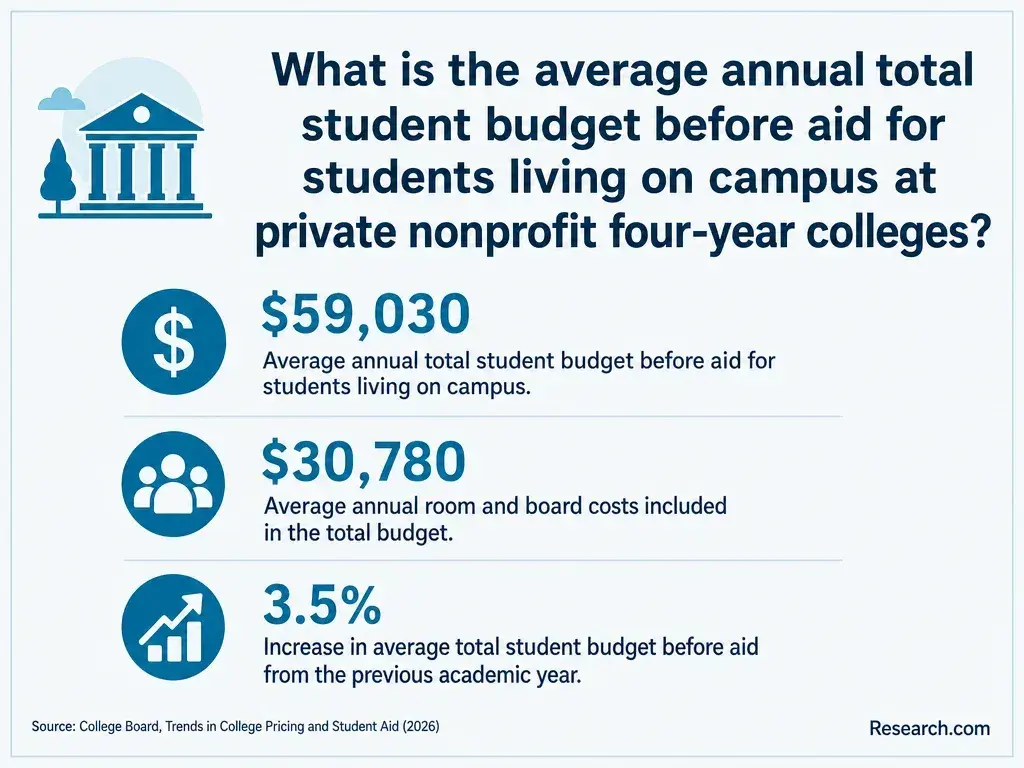
There is no reliable single price for a graphic design graduate. For a per-credit program, start with required remaining credits × tuition per credit, then add mandatory fees, books, software, and any travel or proctoring charges. For a term-priced program, estimate the number of terms needed at a realistic course load. In either case, account separately for borrowing costs and paid work you may give up.
Compare written estimates for the same remaining courses, not published tuition rates in isolation. A cheaper per-credit school can cost more if it applies fewer design credits or schedules a required course infrequently. When looking to find accredited affordable business administration colleges with aid options, confirm the aid you personally qualify for; eligibility after a prior bachelor's differs from eligibility for a first degree. Ask financial aid about loan limits, satisfactory academic progress, and employer reimbursement timing before treating any assistance as a reduction in your out-of-pocket cost.
Yes, some may - but credit acceptance is not the same as satisfying a business requirement. Writing, mathematics, statistics, economics, or general education courses may apply directly if the receiving school finds them equivalent. Studio courses may count only as electives, which provide little benefit once elective space is full. Experience using design software does not normally replace a course in accounting or finance.
The distinction is easiest to see by grouping prior work by its likely destination. These are possibilities, not promised equivalencies.
| Prior graphic design study | Possible application | What to verify |
| Writing or general education | General education or a second-degree waiver | Whether the school waives the category or requires a specific course |
| Mathematics, statistics, or economics | Business prerequisite or general education | Course content, level, grade, and any recency rule |
| Marketing-related or design studio courses | Elective, or possibly a reviewed substitution | Whether business faculty approve a major requirement substitution |
| Internship or portfolio credit | Usually elective credit if accepted | Transfer policy and any separate experiential requirement |
Send official transcripts and, for borderline courses, syllabi to the transfer office. Request business-department review for proposed substitutions and keep the approved audit. As you compare cost-effective paths to a business degree, use credits that apply to graduation rather than the larger number a school may accept in total.
Schools commonly request an application and official college transcripts, but policies differ: some admit second-degree applicants directly, while others restrict second bachelor's degrees or require separate admission to the business major. A prior graphic design degree does not by itself rule you out, and admission does not establish how many credits will apply.
Check the program's minimum grades or GPA rules and whether calculus, algebra, statistics, economics, or introductory accounting must be completed before entry to the major rather than before university admission. If application costs matter while you compare policies, schools with zero-cost college applications may be worth reviewing - but a waived application fee says nothing about the remaining degree cost.
Choose the format that lets you complete the specific remaining courses while maintaining your design income and access to useful projects. Online study can reduce commuting, but group presentations, fixed exam windows, live sessions, and capstone meetings may still conflict with client deadlines. Campus study may offer easier in-person recruiting or team collaboration, particularly if you are moving away from design work.
Ask for the upcoming course schedule, attendance rules, exam arrangements, and any internship or campus-visit requirements. Then map required courses against your available hours and prerequisite sequence. If speed is a priority, review accelerated online bachelor's programs with the same questions: shorter terms do not necessarily mean fewer assignments or a lower total cost.
Expect a business core that may include financial and managerial accounting, economics, marketing, management, finance, operations, business law, statistics, and strategy. Exact requirements and their sequence vary. For a graphic designer, the most useful additions depend on the goal: accounting and pricing for a studio owner, customer research and analytics for a marketing transition, or operations and finance for broader organizational roles.
Look past course titles to prerequisites and assignments. A marketing elective may build on skills you have, while an analytics course may require statistics you have not taken. The school's published entry conditions for prospective business administration students can help you frame questions, but the current catalog and your audit control your plan. Ask whether an advertised focus is an official concentration or simply a choice of electives.
A business administration degree does not require a general professional license. Check that the institution holds recognized institutional accreditation, then determine whether it also claims business-school or programmatic accreditation through AACSB, ACBSP, or IACBE. Those are different forms of recognition: verify the accreditor's listing and whether the specific degree is within its scope.
Accreditation is not a substitute for checking course fit, credit policies, or employment support. Nor does a business degree confer a separate occupational credential. For example, someone comparing a second BS with a specialized project-management program can use affordability checks for accredited project management programs, but should verify any certification's requirements with its awarding body rather than assuming either degree qualifies them.
The combination is most persuasive where you can show both creative execution and business judgment. Possible transitions include marketing coordinator, creative-operations or project coordinator, brand or client-services specialist, and small-business operations roles. A portfolio showing how you defined an audience, managed a budget, reported campaign results, or improved a workflow may be more compelling than listing two degree titles alone. Use only work you have permission to share.
For a larger shift into procurement or logistics, design experience may help with communication and process mapping, but employers may also expect function-specific systems knowledge. Compare that gap with an affordable supply chain degree planning guide before choosing a general business second degree. A managerial title, meanwhile, usually depends on demonstrated responsibility and results, not simply graduation.
What Are the Salary and Job Outlook for Business Administration Careers?
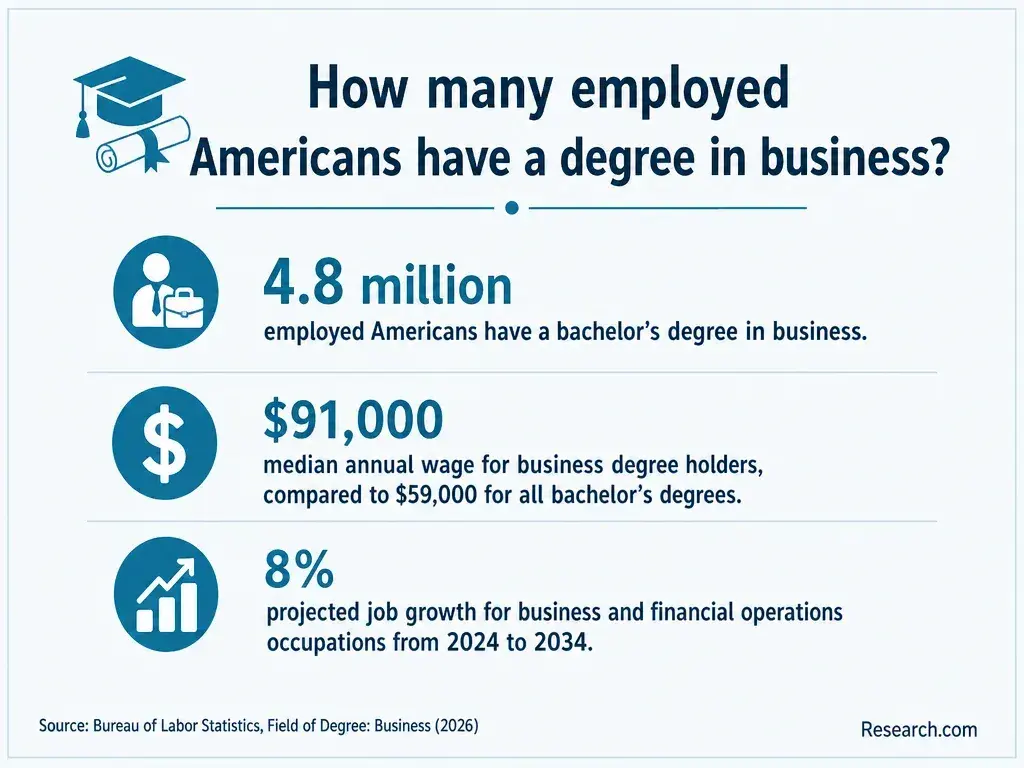
Use occupation data to test a specific career target, not to forecast the payoff from a second degree. The U.S. Bureau of Labor Statistics reports a May 2025 median annual wage of $78,760 for market research analysts and projects 7% employment growth from 2025 to 2035. That occupation can connect a designer's audience knowledge with research and business analysis, but its occupation-wide median includes experienced workers; it is not an expected starting salary or a return-on-tuition estimate.
Compare actual postings in your location for required research methods, spreadsheets, analytics tools, and experience. If your goal is HR rather than marketing, review education options for future HR professionals against those postings before paying for a broad second BS. The strongest financial case is one tied to a documented qualification gap and a feasible route to the work - not an assumed salary increase.
Other Things You Should Know About Business Administration
Often, yes. Many MBA programs consider applicants from nonbusiness majors, though they may expect work experience or require foundational preparation. Check each program's admission and prerequisite policies.
Generally, students who already hold a bachelor's degree are not eligible for a federal Pell Grant. Other aid, including federal loans subject to eligibility and limits, may still be available; ask the school's financial aid office to assess your situation.
Only if the school offers a relevant prior-learning or experiential-credit process and approves the evidence against its requirements. Professional experience does not automatically replace business coursework.
Policies vary. A school may consider earlier grades for admission while calculating its institutional GPA only from coursework taken there. Ask the registrar how transfer grades and academic standing are treated.
- School-Determined Requirements - FSA Partner Connect https://fsapartners.ed.gov/knowledge-center/fsa-handbook/2025-2026/vol1/ch1-school-determined-requirements
- Academic Credits & Policies of Transfer | West Virginia State University https://wvstateu.edu/academics/transfer/academic-credits-policies-of-transfer/
- How Many Credits Do You Need to Graduate College? | snhu.edu https://www.snhu.edu/about-us/newsroom/education/how-many-credits-to-graduate-college
- Federal Financial Aid Eligibility After Degree Completion | Monmouth College https://www.monmouthcollege.edu/live/files/1060-federal-aid-policy-and-degree-completion
- Second Bachelor's Degree-seeking Students | University of Illinois Springfield https://www.uis.edu/financial-aid/applying-aid/second-bachelors-degree-seeking-students
- Financial Aid Eligibility After First Bachelor's Degree Have Been Met | The University of Iowa https://financialaid.uiowa.edu/eligibility/financial-aid-eligibility-after-first-bachelors-degree-have-been-met
- Transfer Credit Policy | Undergraduate Admission https://www.k-state.edu/admissions/undergrad/manhattan/apply/transfer/tools/transfer-credit-policy.html
- How to Choose Between MBA Degree vs. Certificate | University of Phoenix https://www.phoenix.edu/articles/business/how-to-choose-between-mba-degree-vs-certificate-programs.html