2027 Choosing a BS in Business Administration When You Want Immediate Career Value Without Assuming an MBA Later
Audited and Verified:
Our Editorial and Data Verification Process
Research.com uses government datasets, official education statistics and primary institutional information to support its career and degree guides. Our review process checks factual accuracy, occupational definitions, source dates and the requirements associated with the credentials discussed.
How This Article Was Fact-Checked
Our editorial team verifies salary estimates, employment projections, education requirements and program information against original data providers and official organizations. Salary figures are checked against the relevant occupational definitions and reporting periods. Information about licensure, accreditation and required in-person training is reviewed separately.
Fact-checked and verified on:

Co-Founder and Chief Data Scientist
If you do not plan to earn an MBA, your bachelor's degree needs to stand on its own. A BS in Business Administration can prepare you for business roles, but its immediate value depends on the work you want, the skills you can demonstrate, and what finishing the degree will cost.
This guide is for prospective and returning students who want a practical first step into business or a stronger position in their current field. It explains how to judge programs by career-relevant coursework, experience opportunities, realistic job paths, and total completion cost - not by a presumed graduate-school payoff.
Key Things You Should Know
- A BS in Business Administration can be worthwhile without an MBA if its coursework and applied experiences help you qualify for a specific next role; the degree alone does not qualify you to manage people or budgets.
- Choose the program by working backward from job requirements: compare functional depth, internships or approved workplace projects, career support, and the credits you still need to graduate.
- The U.S. Bureau of Labor Statistics reports a May 2025 median annual wage of $75,940 for human resources specialists. That occupation-wide figure is not a starting salary or a promised outcome for business graduates.
What Is a Bachelor's Degree in Business Administration?
A BS in Business Administration is an undergraduate degree combining general education with study across business functions such as accounting, marketing, finance, management, and operations. Some programs add a formal concentration; others offer electives without awarding a named specialization. Neither structure requires you to pursue an MBA afterward.
The label "BS" does not guarantee more quantitative or practical training than a BBA or BA in Business. Compare required courses and assignments rather than degree initials. If your goal is specifically to develop supervisors or lead organizational change, undergraduate leadership programs with shorter timelines offer a comparison - but check whether they provide enough accounting, analytics, and operations preparation for the jobs you want.
What Careers Can You Pursue With a Business Administration Degree?
Start with your existing experience and a target function. Someone who has coordinated schedules or served customers may be able to show relevant evidence for an operations or sales-support role; a move into financial analysis usually requires a more substantial quantitative skill bridge. These examples distinguish plausible entry routes from jobs that commonly demand additional experience.
| Target work | Useful evidence alongside the degree | Important limit |
| Operations or project coordination | Schedules, process maps, spreadsheet tracking, and documented team responsibilities | Coordination is not the same as authority over a project budget or staff. |
| HR assistant or specialist work | HR coursework, careful record handling, communication, and relevant supervised experience | Employers may expect knowledge of specific HR systems and employment practices. |
| Marketing coordination or research support | Campaign briefs, customer research methods, and clearly explained data analysis | More analytical positions may require deeper statistics and research experience. |
If HR is already your clear destination, compare human resources degree pathways against a general business degree before choosing. A broader degree offers flexibility; a specialized pathway may devote more coursework to the function you intend to enter.
Is a Business Administration Degree Worth It Without an MBA?
Yes, when the bachelor's degree removes a real hiring or advancement barrier and gives you usable evidence of business competence at a manageable cost. An MBA is a separate graduate decision, not the mechanism that makes an undergraduate degree valuable. Conversely, a BS may be poor value if your target job calls chiefly for a technical qualification, a regulated credential, or experience you could gain more directly.
Use three tests before enrolling. First, inspect actual postings for your target role: is a bachelor's required, preferred, or irrelevant? Second, identify the missing skills and ask whether required courses and projects address them. Third, compare the remaining cost and time with a specialized degree, targeted coursework, employer training, or relevant work experience. A business degree tuition comparison guide can help you identify programs to investigate, but your own net completion cost - not an advertised tuition figure - should drive the financial comparison.
Prior work changes the calculation. For an employee already handling purchasing or team coordination, the degree may formalize broader skills and meet an employer's bachelor's requirement. For someone with no related experience, the program needs credible ways to build work samples, contacts, and supervised experience before graduation.
The business core typically teaches students to read financial statements, understand customers, evaluate costs, interpret data, and communicate decisions. To assess immediate career value, look past course titles: does a class require a spreadsheet model, a research brief, a process analysis, or a presentation with defensible recommendations? Introductory exposure is useful, but it is not proof of specialist competence.
Choose electives or a concentration for the responsibilities you want next. Operations coursework might support process improvement; marketing research can strengthen analysis of customer evidence; accounting and statistics can support more rigorous financial or analytical work. Check prerequisites and whether the courses you need are offered when you can take them. If you have prior college work and are considering HR, transfer admission options for human resources majors provide a specialized comparison; ask each school which accepted credits actually satisfy its major requirements.
Favor an assessed internship, capstone, or approved workplace project when it fits your goal. Confirm supervision and academic requirements before counting on credit, and obtain permission before using employer records or sharing a project publicly.
Neither format is inherently more career-relevant. Campus study may make in-person recruiting and team work easier to access; online study can preserve employment and widen program choice. In either format, the deciding question is whether you can complete relevant courses and applied work without sacrificing the experience that strengthens your résumé.
Online does not necessarily mean self-paced. Ask for sample syllabi showing live meetings, group-project schedules, exam arrangements, presentation requirements, and deadlines. Also confirm how remote students use career services and find internships. If you need to balance employment and business administration college study, compare those obligations with your actual work schedule before accepting a program's flexibility claim.
Verify that the institution holds recognized institutional accreditation. Then determine whether any advertised business accreditation - such as AACSB, ACBSP, or IACBE - covers the school or program you would actually enter. Institutional accreditation and business-school accreditation have different scopes; neither guarantees a job, an internship, or credit acceptance elsewhere.
Accreditation is also one part of an aid check, not proof that a particular student or program qualifies for funding. When reviewing business administration colleges participating in federal aid programs, confirm the institution's current participation, the program's eligibility, and your own eligibility with its financial-aid office. Compare career services and reported outcomes separately from accreditation claims.
Requirements depend on the school and whether you apply as a first-year or transfer student. Institutions may request secondary-school or college transcripts, while admission to the business major can have separate GPA or prerequisite rules. Ask whether mathematics, statistics, accounting, or economics must be completed before entering the major or can be taken after enrollment.
For returning students, an admission offer is not a degree-completion plan. Request a written evaluation showing how previous courses apply to general education, the business core, electives, and any concentration. If application charges matter, you can apply to accredited online colleges for free where the stated no-fee policy applies to your application; still verify the current policy and program requirements before submitting.
A traditional full-time bachelor's path is often planned around four academic years, but your timeline depends on applied transfer credits, prerequisite sequences, course availability, and enrollment pace. A short advertised completion time is useful only if the school's official degree audit shows you can meet every remaining requirement on that schedule.
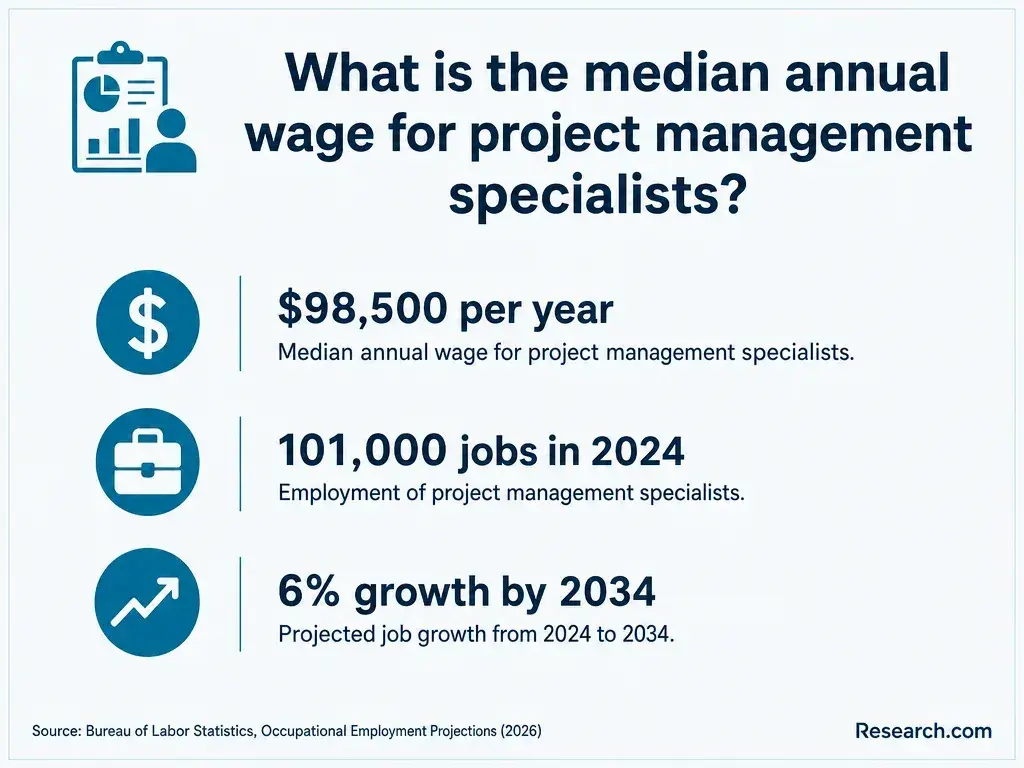
Calculate cost from the courses you still need, not the price of an entire degree or tuition alone. Include mandatory fees, books and software, travel or proctoring, borrowing costs, and any earnings you would give up. If comparing a general business degree with a more focused route, comparing project management tuition and mandatory fees illustrates why both tuition and required charges belong in the same comparison. Request a program-specific estimate from each school and ask whether employer reimbursement arrives only after you complete a course.
There is no single salary for this degree: employers pay for occupations, responsibilities, experience, and location, not a degree title alone. The U.S. Bureau of Labor Statistics reports a May 2025 median annual wage of $75,940 for human resources specialists. That median covers workers across experience levels and should not be treated as a new graduate's offer.
For a useful earnings comparison, match local job postings to roles you could realistically pursue after graduation, then weigh their stated pay against your cost to finish. If supply chain work appeals to you, supply chain college costs versus potential career outcomes offers another pathway to examine. Compare its required skills and total cost with the business administration option rather than assuming the higher-paid occupation is immediately accessible.
What Is the Job Outlook for Business Administration Graduates?
Outlook belongs to the occupation you enter, not to all holders of a business administration degree. The Bureau of Labor Statistics projects U.S. employment of market research analysts to grow 7% from 2025 to 2035. That signals demand for the occupation, but it does not show how many openings will accept a general business graduate without research and analytical experience.
Read outlook figures alongside job requirements in your intended location and industry. A growing function can favor a specialized program when employers seek deeper preparation: online colleges with accelerated supply chain bachelor's study may merit comparison if that function is your firm goal. Choose the BS in Business Administration when its flexibility serves several realistic roles and you can leave with evidence for at least one of them.
Other Things You Should Know About Business Administration
Usually, there is no need to discuss a degree you do not intend to pursue. Explain the skills, projects, and experience relevant to the job you are seeking now.
Yes, if you label it accurately as work in progress or a classroom exercise. Do not claim implemented results, and remove confidential or employer-owned information unless you have permission to share it.
That depends on the institution. Ask whether the concentration is formally recorded on the transcript or diploma; a cluster of electives may not be an official credential.
Check the target employer's degree requirement before pursuing a second bachelor's. Relevant work, a small set of business courses, or employer training may address your gap more directly; ask schools about second-degree rules if another bachelor's is necessary.
- Accreditation in the U.S. | ed.gov http://www.ed.gov/laws-and-policy/higher-education-laws-and-policy/college-accreditation/accreditation-in-the-us
- Fast Facts: Tuition costs of colleges and universities (76) | ed.gov https://nces.ed.gov/fastfacts/display.asp
- Your financial path to graduation | consumerfinance.gov https://www.consumerfinance.gov/paying-for-college/your-financial-path-to-graduation/
- Employer Assessments of Business Interns - ERIC https://eric.ed.gov/
- First Destination Outcomes: College of Business | Career Management Center Colorado State University https://bizcareers.colostate.edu/resources/first-destination-outcomes-college-of-business-undergraduate/
- Effects of Business Internships on Job Marketability | wcupa.edu https://digitalcommons.wcupa.edu/cgi/viewcontent.cgi
- Virtual internships as alternative work-based learning | sciencedirect.com https://www.sciencedirect.com/science/article/pii/S0360131525002076
- Develop an Effective Internship Program - USC Career Center https://careers.usc.edu/resources/develop-an-effective-internship-program/
- Starting and Maintaining a Quality Internship Program | Engineering Career Center https://ecc.ku.edu/starting-and-maintaining-quality-internship-program