2027 Management Information Systems vs. Organizational Leadership for a Business Administration BS: Which Fits?
Audited and Verified:
Our Editorial and Data Verification Process
Research.com uses government datasets, official education statistics and primary institutional information to support its career and degree guides. Our review process checks factual accuracy, occupational definitions, source dates and the requirements associated with the credentials discussed.
How This Article Was Fact-Checked
Our editorial team verifies salary estimates, employment projections, education requirements and program information against original data providers and official organizations. Salary figures are checked against the relevant occupational definitions and reporting periods. Information about licensure, accreditation and required in-person training is reviewed separately.
Fact-checked and verified on:

Co-Founder and Chief Data Scientist
Choosing between Management Information Systems (MIS) and Organizational Leadership changes what you practice during a Business Administration BS - and which early career opportunities you can credibly pursue. MIS emphasizes business systems and data; Organizational Leadership emphasizes people, teams, and change. That distinction matters if you are entering business, changing careers, or finishing a degree while working.
This comparison shows how to judge each concentration by its courses, projects, career relevance, and total path to graduation, rather than choosing by name alone.
Key Things You Should Know
- Choose MIS if you want to improve business processes through systems and data; choose Organizational Leadership if you want to develop teams, communication, and change-management skills.
- Neither concentration makes a new graduate an IT specialist or manager. Compare required courses and applied projects with the tasks in jobs you actually want.
- The Bureau of Labor Statistics projects 11% employment growth for training and development specialists from 2025 to 2035, but that occupation-wide forecast is not a placement rate for Organizational Leadership graduates.
What is the difference between Management Information Systems and Organizational Leadership?
Management Information Systems connects business needs with information technology. In a business administration concentration, students may learn to document requirements, work with databases or reports, and assess how systems support decisions. Its focus is not necessarily software engineering.
Organizational Leadership examines how people coordinate work: communication, team dynamics, motivation, conflict, and organizational change. It is not the same as human resources (HR), which may cover more specialized staffing, compensation, and employment-practice responsibilities. If HR is your specific goal, compare the leadership curriculum with dedicated HR programs, including transfer pathways into online human resources programs.
Both concentrations usually sit within a broader business degree, but schools define them differently. Check whether the focus is an officially recorded concentration, a minor, or simply a set of electives; the distinction can affect your transcript and graduation requirements.
Which specialization better fits your business career goals?
Start with the work you want to do, not the title you hope to hold. MIS is usually the stronger choice for someone who enjoys tracing a process, finding where information breaks down, and helping users adopt a better system. Organizational Leadership is usually stronger for someone whose next step involves training colleagues, coordinating teams, or supporting a change initiative.
Prior experience can reverse that recommendation. A working supervisor who already handles team communication but lacks reporting and systems skills may gain more from MIS. Someone with technical experience who struggles to present recommendations, coach others, or manage stakeholder disagreement may gain more from Organizational Leadership. For either choice, identify a project you could complete with permitted data and appropriate supervision.
If your goal is specifically project management, compare both concentrations with a dedicated project-management pathway before paying for extra courses. Examine the required tools and assignments as well as financial aid at low-cost project management schools; a concentration is worthwhile only if its incremental learning fits the role you seek.
What courses do MIS and Organizational Leadership bachelor's programs include?
Both paths may share accounting, statistics, operations, marketing, and management courses. The useful comparison is what the concentration adds beyond that core. The table summarizes common subject areas, not a curriculum promised by every school.
| Curriculum feature | MIS concentration | Organizational Leadership concentration |
| Typical subjects | Business systems, databases, analytics, systems analysis, and technology governance | Organizational behavior, team leadership, communication, conflict, and change |
| Useful applied assignment | Map a workflow and propose requirements for a reporting or systems improvement | Design a stakeholder communication or employee-development plan |
| Depth to check | Hands-on tools, data quality, privacy, and technical prerequisites | Feedback, employment practices, evidence-based decisions, and supervised practice |
Ask for the catalog's required-course list and a sample degree audit. An attractive elective may be offered infrequently, require statistics or another prerequisite, or not count toward the concentration. For returning students, business administration admissions eligibility rules are a starting point; the receiving school must determine whether prior courses satisfy its particular requirements.
Either format can support both subjects, but the practical work differs. Online MIS students may need access to specified software, datasets, and remote group meetings. Online leadership students may need live discussions, presentations, or team simulations. Campus programs can make in-person collaboration easier, but commuting and fixed meeting times may be harder to manage.
Ask for the actual timetable, not just an "online" or "accelerated" label: Which sessions are live? When do group projects meet? Are exams proctored? Are internships or campus visits required? Bachelor's degrees with compressed schedules may shorten the calendar while increasing weekly workload. If you work or provide care, compare that workload with the course sequence needed to finish your chosen concentration.
Requirements vary by institution and by whether you apply as a first-year student, transfer student, or returning student. Schools commonly request prior transcripts and may set academic-standing or prerequisite conditions; admission to the university does not necessarily mean admission to the business major or either concentration.
Ask admissions which requirements apply to you, then ask the business adviser to review math, statistics, accounting, and any concentration prerequisites. If you have prior college work, request a written evaluation showing where accepted credits apply - not merely how many transfer. Application costs can also differ; accredited colleges offering free online applications may be worth considering, but a waived fee says nothing about how your credits will count.
Many bachelor's degrees are designed around four years of full-time study, but your remaining time depends on applicable transfer credits, enrollment pace, prerequisites, and course availability. Neither concentration is automatically faster or cheaper. A required MIS course offered only in certain terms - or a leadership elective that does not fulfill the official concentration - can change the plan.
Compare schools using a written estimate of remaining credits and required terms. Include tuition, mandatory and technology fees, materials, travel, and any income lost to scheduling changes. Then subtract only aid or employer assistance you can verify. Affordable accredited business administration programs accepting FAFSA can help form a shortlist, but the lowest advertised tuition is not necessarily the lowest cost to finish your degree.
MIS coursework can support applications for business systems support, reporting, operations-analysis, or technology-project coordination roles - especially when paired with evidence of spreadsheet, database, or requirements-gathering skills. Organizational Leadership coursework can support training coordination, operations coordination, team-support, or change-support roles, particularly alongside relevant workplace experience.
These are pathways, not job entitlements. Employers may expect specific software skills for systems roles and demonstrated supervisory responsibility for management roles. If project coordination is your target, inspect job descriptions for scheduling, budgeting, and stakeholder requirements; transfer admission options for project management undergraduates provide another route to compare if you already have substantial college credit.
For either concentration, a credible work sample helps: an MIS student might present a de-identified process map, while a leadership student might present an approved training plan. Obtain permission before using workplace information, and do not present a classroom proposal as an implemented result.
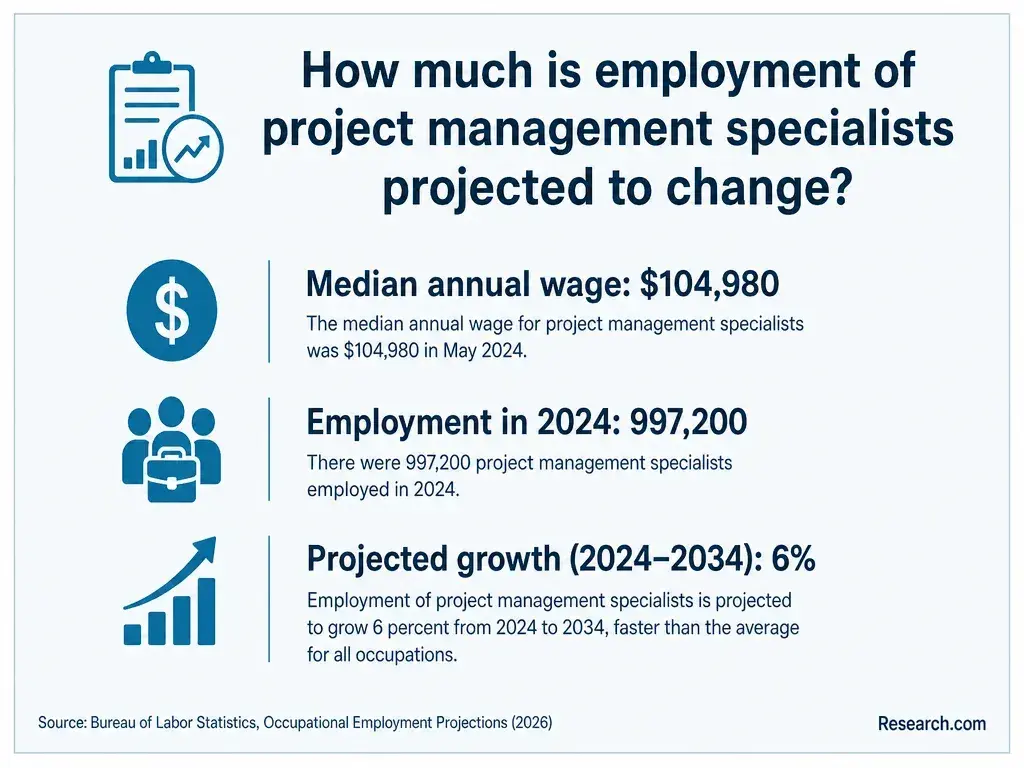
There is no reliable national salary attached to either concentration itself. The U.S. Bureau of Labor Statistics (BLS) reports pay and projections by occupation, not by undergraduate specialization. The examples below show two possible directions, rather than the expected pay or hiring prospects of a new graduate.
| Relevant occupation | May 2025 median annual pay | Projected U.S. employment growth, 2025-2035 |
| Project management specialist; potentially relevant to systems or process projects | $102,320 | 7% |
| Training and development specialist; potentially relevant to leadership and employee development | $69,280 | 11% |
These figures cover workers across experience levels, industries, and educational backgrounds. Neither occupation belongs exclusively to one concentration, and a systems-focused applicant should also examine local postings for the particular technical role sought. Use occupation data to investigate a career path - not to calculate a promised return on the degree. For broader business administration program length and salary context, keep completion costs separate from occupation-wide wages.
Neither concentration generally grants a professional license, and most related entry-level business roles do not require one. An employer may nevertheless prefer a technology, analytics, HR, or project-management certification. Those credentials have separate eligibility rules, assessments, and costs; a degree course does not automatically satisfy them.
Choose additional training after identifying a target job's actual requirements. A short course or employer training may address one missing tool more directly than additional degree credits, while a bachelor's may matter if the employer requires one for advancement. For employees considering that longer route, degree options for working business administration students offer a way to compare study alongside employment.
How can you evaluate accreditation and program quality before enrolling?
Confirm that the institution holds recognized institutional accreditation, then check the exact scope of any claimed business accreditation, such as AACSB, ACBSP, or IACBE. An accreditor's recognition of a business school or specified programs should not be assumed to cover every degree or concentration the institution offers.
For this decision, curriculum evidence is just as important: request the current catalog, concentration requirements, sample assignments, faculty or career support information, and a term-by-term completion plan. Ask whether MIS students use relevant tools and whether leadership students receive assessed practice in communication and change. If speed matters, compare ranked US colleges for faster business degree completion against your official credit evaluation and course schedule; a published fast track may not be fast for you.
Other Things You Should Know About Business Administration
Often, if electives and scheduling allow. Ask an adviser which courses count toward graduation and whether a second formal concentration requires additional credits.
Possibly. Some business-focused MIS programs emphasize systems use and analysis more than coding, but others require programming. Check the actual course descriptions and assignments.
It can build relevant skills, but employers usually consider your work record, judgment, and experience with responsibility before assigning supervisory duties.
Schools often permit changes, but completed courses may become general electives rather than satisfy the new concentration. Request an updated degree audit before switching.
- Occupational Employment Projections Methodology | ca.gov https://labormarketinfo.edd.ca.gov/data/occupational-employment-projections-methodology.html
- Interpersonal and intrapersonal leadership competencies - PMC https://pmc.ncbi.nlm.nih.gov/articles/PMC12405269/
- TEN_25-19_Attachment_1.pdf | dol.gov https://www.dol.gov/node/161266
- Long-Term Occupational Projections - Department of Labor https://dol.ny.gov/long-term-occupational-projections
- Students & Recent Graduates | U.S. Office of Personnel Management https://www.opm.gov/policy-data-oversight/hiring-information/students-recent-graduates/
- About the Undergraduate Business program | Sacramento State https://www.csus.edu/college/business-administration/undergraduate/advising/cob-undergraduate-program.html
- 10 Essential Organizational Leadership Skills (With Examples) | App State Online https://onlineprograms.appstate.edu/blog/organizational-leadership-skills/
- Business and Organizational Leadership | Valencia College https://catalog.valenciacollege.edu/degrees/bachelorofscience/bas/
- Department of Management Information Systems | Speech-Language-Hearing Center https://uca.edu/ubulletin2017/colleges-departments-programs/college-of-business/department-of-management-information-systems/
- Organizational Leadership: What It Is & Why It's Important | Harvard Business School https://online.hbs.edu/blog/post/what-is-organizational-leadership