2027 Comparing Business Administration BS Costs Without Assuming a Salary Increase
Audited and Verified:
Our Editorial and Data Verification Process
Research.com uses government datasets, official education statistics and primary institutional information to support its career and degree guides. Our review process checks factual accuracy, occupational definitions, source dates and the requirements associated with the credentials discussed.
How This Article Was Fact-Checked
Our editorial team verifies salary estimates, employment projections, education requirements and program information against original data providers and official organizations. Salary figures are checked against the relevant occupational definitions and reporting periods. Information about licensure, accreditation and required in-person training is reviewed separately.
Fact-checked and verified on:

Co-Founder and Chief Data Scientist
A business administration BS can be worth pursuing even if your paycheck stays the same - but the cost must fit a budget that does not depend on a promotion. This matters especially if you are finishing a degree while working, comparing transfer offers, or deciding whether to borrow.
This guide shows how to estimate the amount you will actually pay, account for time and financing, and judge whether the degree serves a concrete goal without treating higher earnings as a certainty.
Key Things You Should Know
- Compare the cost to finish, not advertised tuition: count requirements still unmet, mandatory fees, aid, financing, and any work income you would give up.
- Set expected salary growth to $0 in your base case; enroll only if the remaining cost is manageable and the degree has a purpose you value without a raise.
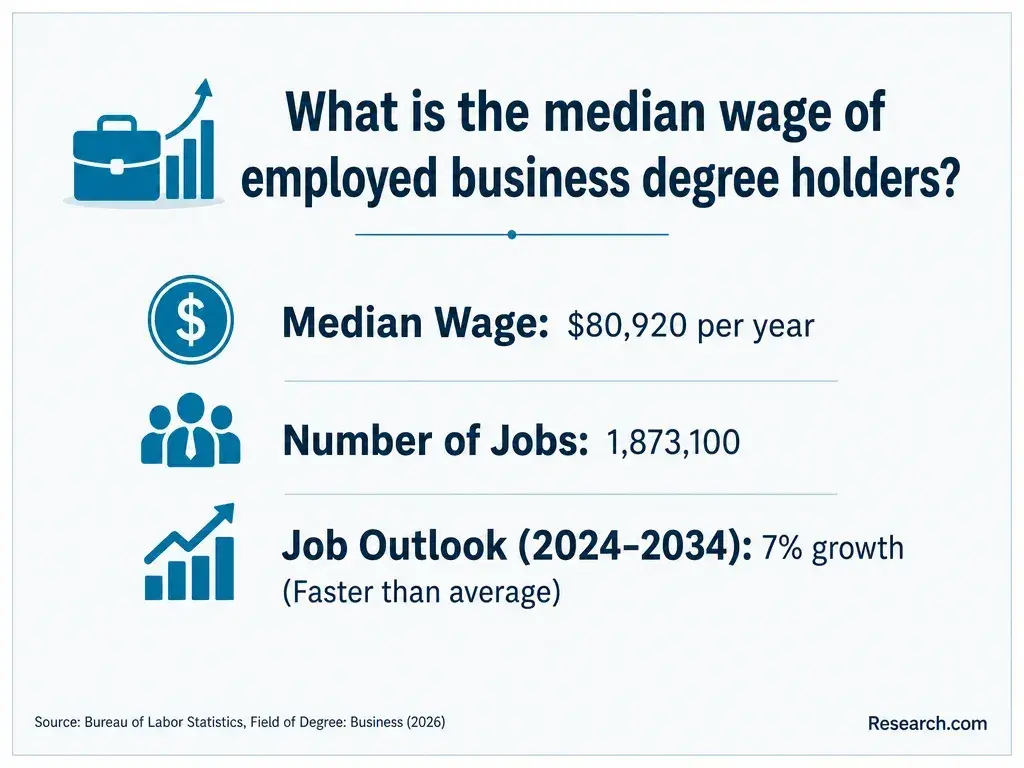
- Occupation-wide pay is not a graduate salary: the U.S. Bureau of Labor Statistics reports a May 2025 median of $82,320 for logisticians, but that figure cannot establish what a new business administration graduate will earn.
How much does a business administration bachelor's degree cost?
There is no single reliable price for a business administration bachelor's degree. The amount you pay depends on the school's charging method, the courses remaining after an official credit evaluation, your enrollment pace, required fees, and aid you actually receive. A published per-credit rate is a starting point, not a completion quote.
The following cost categories help separate charges that schools advertise from expenses that can still affect your household budget.
| Cost category | What to obtain | Why it can change the comparison |
| Tuition | Current rate and whether it is charged per credit, course, term, or subscription period | Extra required courses or terms can change the total. |
| Mandatory expenses | Program, technology, proctoring, books, software, and graduation charges | A low tuition rate may exclude substantial required costs. |
| Living and travel | Incremental commuting, campus visits, housing, or childcare expenses | Count costs caused by enrollment, not ordinary expenses you would have anyway. |
| Financing | Loan amount, interest terms, and repayment estimate | Borrowing changes the eventual price even if it reduces the bill due now. |
Compare published charges alongside each school's net price calculator and your personalized financial-aid offer. For an initial search, find inexpensive online business administration colleges, then request a school-specific estimate based on your record. A list price cannot tell a transfer student what graduation will cost.
What is a business administration BS degree?
A Bachelor of Science in Business Administration is an undergraduate degree combining general education with business subjects such as accounting, finance, marketing, operations, management, and quantitative decision-making. The BS label does not guarantee a particular amount of math or analytics; the catalog determines the actual requirements.
For a cost decision, the degree's value depends on what it enables for you. It may satisfy a bachelor's requirement for an internal position, help you complete a credential you previously started, or provide structured business preparation. None of those benefits requires assuming an immediate raise, but each should be specific enough to weigh against the cost.
A BBA or a specialized bachelor's degree may meet the same goal with a different set of remaining requirements. If your main objective is organizational leadership rather than broad business preparation, compare the curriculum and total credits still needed; even fast-paced online organizational leadership bachelor's programs are not automatically a faster or cheaper route for your transcript.
How can you compare business administration degree costs accurately?
Ask each school for an official degree audit and a term-by-term completion plan before comparing totals. Credits a school accepts may count only as electives, leaving business core, concentration, prerequisite, or residency requirements unfinished. The audit - not the headline transfer-credit total - determines what you must still buy.
Use the same assumptions for every school. This sequence turns competing offers into a comparison you can check and revise:
- Record every remaining required course and the terms in which it is offered; ask who can approve any substitution or transfer appeal.
- Apply the school's actual tuition structure and add mandatory fees, materials, travel, and childcare attributable to attendance.
- Subtract confirmed grants and scholarships; record employer reimbursement separately until you know its timing, eligibility, grade rules, and repayment conditions.
- Estimate lost work income only if your planned schedule would reduce paid hours, then compare borrowing and repayment under a no-raise budget.
Keep three figures distinct: net educational cost after confirmed gift aid, cash needed when bills come due, and eventual cost if you borrow. Employer reimbursement can lower the first figure without solving the second. A course added by a transfer decision or an unavailable prerequisite may increase all three.
A shorter advertised timeline is useful only if the required courses fit your schedule and transfer evaluation. When examining cost-to-finish for shorter business administration programs, compare your own remaining requirements rather than treating an advertised completion time or earning potential as a personal outcome.
Not necessarily. Online study may remove commuting or relocation costs, but a school may charge separate technology or proctoring fees, and its tuition can differ from campus tuition. Compare both formats at the same institution when possible, using the same transfer evaluation and enrollment pace.
Delivery also affects opportunity cost. An asynchronous course may fit around work, while scheduled exams, group meetings, presentations, or a required campus visit may still require time away. Ask for sample course schedules and assessment rules before assuming that an online format preserves all your paid hours. If keeping your job is the controlling constraint, business administration programs for advancement while working are worth comparing on actual attendance obligations, not the word "online" alone.
Start by verifying that the institution holds recognized accreditation and checking its status with the accreditor and the U.S. Department of Education's accreditation records. Accreditation can affect federal aid eligibility and credit recognition, although another school or employer makes its own acceptance decisions.
Then check whether the business school or specific program has applicable AACSB, ACBSP, or IACBE accreditation. These are business-focused accreditors with different scopes; a school's mention of an accreditor does not establish that the BS you intend to take is covered. Ask the school to identify the exact accredited unit or program. Accreditation is a quality-screening factor, not proof of a salary increase or a reason to ignore a large difference in cost to finish.
You can use online business programs in US college rankings to build a comparison list, but verify accreditation scope, degree requirements, and your personal net cost directly with each institution.
Most programs combine general education with a business core and electives or a formal concentration. Common subjects include financial and managerial accounting, economics, finance, marketing, organizational behavior, operations, statistics, and business law. Some add a capstone or applied project. Consult the catalog for the exact curriculum; an elective cluster is not necessarily an awarded concentration.
Courses matter financially because prerequisite chains and limited course availability can extend enrollment. If accounting or statistics must precede upper-level work, a missing equivalent may cost more than its tuition alone. Before applying, check prerequisites before applying to business administration programs and ask whether previous courses satisfy them and count toward graduation.
Requirements vary by institution and by whether you apply as a first-year, transfer, or returning student. Schools commonly request prior academic transcripts; some set separate requirements for entry to the business major or for upper-level courses. Admission to the institution does not establish how your previous credits will apply.
Request an application checklist, the applicable catalog, and a transfer review before paying nonrefundable costs. Ask when the evaluation becomes official and whether an admission offer includes any conditions. If application charges are meaningful to your search budget, no-application-fee online college choices can reduce the cost of comparing options, but an absent application fee says nothing about the eventual degree price.
Completion time depends on remaining requirements, enrollment intensity, course sequencing, and how often required classes run. A returning student with many accepted credits can still face delays if those credits do not satisfy the business core or if a required course is offered infrequently. Ask an adviser for a term-by-term plan based on the official audit, including a version you could sustain while employed.
Faster completion can reduce the number of terms carrying recurring fees, but compressed sessions may demand more weekly study time or force a reduction in paid work. When considering business degree options with shorter sessions, compare the total charge and feasible work schedule - not just the graduation date.
A business administration BS can support applications for roles in operations coordination, administrative services, marketing coordination, sales support, procurement, or HR, depending on your skills and experience. It does not automatically qualify a graduate to manage staff or enter a regulated profession. Someone already employed may gain more immediate value from meeting a bachelor's requirement for a specific opening than from expecting a general postgraduation raise.
Use actual job postings to test the financial case: identify positions you would pursue, note whether they require a bachelor's degree, and separate that requirement from experience or technical skills you still need. If HR is your clear target, compare the remaining cost and curriculum of a general business BS with online human resources programs for associate degree holders. The more specialized option makes sense only if its requirements and opportunities fit your goal better.
What salaries and job outlook can business administration graduates expect?
There is no single salary or job-growth rate for business administration graduates. The U.S. Bureau of Labor Statistics reports that logisticians had a May 2025 median annual wage of $82,320 and projects 18% employment growth from 2025 to 2035. Those are occupation-wide figures across experience levels, not a starting salary, a forecast for every business graduate, or evidence that this degree will increase your pay.
Use occupation data to investigate a specific career path, then compare local postings with your qualifications. For example, someone considering supply chain work should check whether employers seek logistics experience or specialized coursework before comparing a general BS with supply chain bachelor's programs with compressed schedules. Keep your degree budget viable at your current income; treat a future raise as a possible benefit, not the money that pays the bill.
Other Things You Should Know About Business Administration
Potentially. Check that the institution is eligible and that each expense qualifies under the plan and applicable tax rules. Confirm treatment of books, equipment, and any other charges before withdrawing funds.
It can. A change of major may alter which courses count toward satisfactory academic progress or the maximum timeframe for aid. Ask the financial-aid office to review your proposed degree audit before switching.
Do not assume so. The same expense generally cannot be used for overlapping tax benefits. Eligibility depends on your circumstances and how the employer benefit is treated; consult current IRS guidance or a qualified tax professional.
Pause before committing to a loan or nonrefundable term. Ask about a sustainable part-time plan, additional confirmed gift aid, or a less costly credential that meets your immediate goal. Revisit the BS when its payments fit your existing income.
- An Overview of Accreditation of Higher Education in the United States | Congress.gov | Library of Congress https://www.congress.gov/crs-product/R43826
- Types of Financial Aid: Grants, Work-Study, and Loans | studentaid.gov https://studentaid.gov/understand-aid/types
- Cost of Attendance (Budget) | 2025-2026 Federal Student Aid Handbook https://fsapartners.ed.gov/knowledge-center/fsa-handbook/2025-2026/vol3/ch2-cost-attendance-budget
- Non-Completion, Student Debt, and Financial Well-Being | Board of Governors of the Federal Reserve System https://www.federalreserve.gov/econres/notes/feds-notes/non-completion-student-debt-and-financial-well-being-20230821.html
- Data Home - College Scorecard - Department of Education https://collegescorecard.ed.gov/data/
- Publication 970 (2025), Tax Benefits for Education | Internal Revenue Service https://www.irs.gov/publications/p970
- Credit for Prior Learning - The City University of New York https://www.cuny.edu/academics/academic-policy/credit-prior-learning/
- Academic Advising & Transfer Credits | nyu.edu https://cas.nyu.edu/newstudents/transfer-transition-students/external-transfers/academic-advising.html
- How Many Credits Do You Need to Graduate College? | snhu.edu https://www.snhu.edu/about-us/newsroom/education/how-many-credits-to-graduate-college
- Online Bachelor's Degree in Business Administration | Financial Aid and Scholarship Office https://www.sjsu.edu/online/programs/business-administration-bachelors-degree.php