2027 Major vs Concentration: What Is the Difference?

Co-Founder and Chief Data Scientist
Choosing a major is the big academic commitment; choosing a concentration is the specialization inside it. The distinction matters because the cost of changing direction can be high: College Board reported average published tuition and fees of $11,610 for in-state public four-year students and $43,350 at private nonprofit four-year colleges for 2024-25.
This guide is for students comparing degree options, transfer paths, online programs, or career-focused specializations. You will learn how majors and concentrations affect diplomas, transcripts, credits, resumes, graduate school, and job planning.
Key Things You Should Know
- A major is the primary field of study that defines the degree; a concentration is a narrower focus area within that major and usually requires fewer credits.
- Concentrations often appear on transcripts but may not appear on diplomas, while majors almost always appear in official degree records; policies vary by school.
- BLS 2024 data shows workers age 25 and older with a bachelor's degree had median weekly earnings of $1,543, so choosing a major-concentration combination should be tied to career fit, skills, and cost-not the label alone.
What is the difference between a college major and a concentration?
A college major is your main academic field, such as psychology, computer science, nursing, accounting, marketing, biology, or mechanical engineering. It determines the core curriculum you must complete and usually appears as the central subject of your degree record. If you are still comparing what counts as a strong program in college, start by matching the major to your long-term academic and career goal before looking at narrower options.
A concentration is a focused track inside a major. For example, a business administration major may offer concentrations in finance, human resources, entrepreneurship, business analytics, or supply chain management. A psychology major may offer concentrations in child development, industrial-organizational psychology, mental health, or neuroscience. The concentration does not replace the major; it customizes it.
The easiest way to think about the difference is this: the major answers "What field is your degree in?" while the concentration answers "What part of that field did you emphasize?" This distinction is important when comparing schools because one college may offer "cybersecurity" as a full major, while another may offer it as a concentration inside information technology or computer science.
The table below summarizes the practical differences students usually encounter. Use it as a first-pass comparison, then verify each school's catalog because terminology can vary.
| Feature | Major | Concentration |
| Main purpose | Defines the primary academic field of the degree | Provides specialization within the major |
| Typical scope | Broad field foundation plus required upper-level courses | Narrower sequence of electives or advanced courses |
| Administrative importance | Usually required to award the degree | Often optional, unless built into the program |
| Career signal | Shows broad preparation for a field | Shows targeted interest or skill depth |
| Example | Major in business administration | Concentration in business analytics |
How does choosing a major versus a concentration affect your degree and diploma?
Your major has the strongest effect on the degree you earn because it is tied to the official academic program approved by the institution. If you complete a Bachelor of Science in Biology, Bachelor of Arts in English, Bachelor of Business Administration in Accounting, or Bachelor of Science in Computer Science, the major is part of the degree pathway and graduation audit.
A concentration usually affects your degree by shaping the required electives or upper-level courses you take. It may help you graduate with a more coherent academic focus, but it generally does not create a separate degree unless the school explicitly defines it that way. For instance, "Bachelor of Science in Information Technology, Concentration in Cybersecurity" is usually still an IT degree, not a standalone cybersecurity degree.
Diploma rules vary. Some colleges print both the major and concentration on the diploma, some print only the degree title, and others do not print either the major or concentration on the diploma but list them on the transcript. This matters if you plan to show official documents to employers, graduate schools, immigration authorities, licensing boards, or tuition reimbursement programs.
Before enrolling or changing your academic plan, ask the registrar or advising office these specific questions because admissions pages may not tell the full story:
- Will the major appear on the diploma, transcript, or both?
- Will the concentration appear on the diploma, transcript, degree audit, or only internal advising records?
- Is the concentration officially approved by the institution, or is it an informal advising pathway?
- Can the concentration be completed fully online, in the evening, or within the normal graduation timeline?
- If you change or drop the concentration, will it delay graduation or affect financial aid eligibility?
Does a concentration show up on transcripts and resumes the same way as a major?
No, a concentration does not always show up the same way as a major. The major is typically part of your official academic record because it determines the degree requirements you completed. A concentration is more variable: it may be recorded on the transcript, listed in the student information system, printed on the diploma, or omitted from formal documents depending on institutional policy.
For resumes and LinkedIn profiles, students can usually list both the major and concentration if the concentration was officially declared and completed. A clear format would be "Bachelor of Science in Business Administration, Concentration in Finance" or "Major: Psychology; Concentration: Child Development." Avoid listing a concentration as a separate major unless the school awarded it that way.
Employers generally care less about the formatting label and more about whether the coursework, projects, internships, certifications, and skills match the role. For example, a concentration in data analytics is more persuasive when paired with SQL, Python, statistics, dashboard projects, or internship experience. A concentration in marketing strategy is stronger when paired with campaign analytics, content strategy, market research, or CRM tools.
The table below shows how to present majors and concentrations honestly in common academic and career documents. This helps avoid overstating credentials while still making your specialization visible.
| Document or setting | How the major is usually shown | How the concentration is usually shown | What students should do |
| Official transcript | Usually listed as the primary program or plan | May be listed as a subplan, track, emphasis, or not shown | Request an unofficial transcript before assuming how it appears |
| Diploma | Depends on school policy, but degree title is always central | Often omitted unless the institution prints concentrations | Ask the registrar before graduation |
| Resume | Listed under education | Can be listed after the major if officially completed | Use accurate wording from the catalog or transcript |
| Graduate application | Used to evaluate academic background | May support fit for a specialized program | Explain relevant courses and projects in the statement of purpose |
| Job interview | Signals broad field preparation | Supports a focused career story | Connect it to skills, work samples, and role requirements |
How do credits and coursework requirements typically differ between majors and concentrations?
Majors require more credits because they define the academic field of the degree. A bachelor's degree in the United States commonly requires about 120 total credits, including general education, major courses, electives, and sometimes a capstone, internship, lab, practicum, or clinical component. The major portion often includes a structured sequence from introductory courses to advanced requirements.
Concentrations are smaller. Many concentrations require a focused group of courses, often drawn from electives or upper-level requirements already inside the major. In practical terms, the concentration can either fit neatly into your existing degree plan or add extra courses if the required classes do not overlap with graduation requirements.
Course planning matters because a concentration that looks small on paper can still delay graduation if courses are offered only once a year, require prerequisites, have limited seats, or are unavailable online. This is especially important for transfer students and working adults who need predictable scheduling.
The table below gives a general view of how credit requirements usually differ. These are typical planning ranges, not universal rules, so always confirm the catalog for the exact program year you enter.
| Requirement type | Major | Concentration | Decision impact |
| Credit load | Often a substantial share of the 120-credit bachelor's degree | Often a smaller cluster of specialized courses | The major drives graduation planning; the concentration refines it |
| Prerequisites | Usually sequenced across multiple years | May require completion of core major courses first | Late declaration can limit course availability |
| Elective flexibility | Moderate to limited, depending on the field | May use electives efficiently if planned early | Good advising can prevent excess credits |
| Capstone or fieldwork | Common in professional and applied majors | Sometimes includes a specialized project or practicum | Can strengthen a portfolio or graduate school application |
| Licensure relevance | Often more important for regulated fields | May support specialization but may not meet legal requirements | Check state and board rules before relying on a concentration |
A common mistake is choosing a concentration because it sounds marketable without checking the actual course sequence. A better approach is to map the concentration against your remaining credits and ask whether each course builds a skill you can explain to an employer or graduate admissions committee.
Can you add a concentration to any major, and when do students usually declare it?
You usually cannot add any concentration to any major. Concentrations are normally attached to specific majors and controlled by the department, college, or school offering the program. A finance concentration may be available only to business majors, while a bioinformatics concentration may be restricted to biology, computer science, or data science students, depending on the institution.
Students often declare a concentration after completing lower-division or introductory major courses. That timing allows them to understand the field before specializing. However, some highly sequenced programs require earlier planning because specialized classes may have prerequisites or limited annual availability.
Use this process before declaring a concentration so the choice supports graduation, cost control, and career fit:
- Review the official catalog for your catalog year, not just the marketing page.
- Compare the concentration requirements with courses you have already completed.
- Ask an academic advisor whether the concentration adds credits beyond the degree minimum.
- Check when required courses are offered and whether they are available in your preferred format.
- Confirm whether the concentration appears on the transcript or diploma.
- Look for internships, labs, portfolios, exams, or projects that align with the concentration.
The same logic applies at the graduate level, where specialization labels can vary even more. For example, students comparing doctoral formats may see options such as capstone-based doctorates, professional doctorates, or PhD no dissertation alternatives, but they should still verify whether the specialization is formally recorded and whether it matches employer or academic expectations.
How do majors and concentrations influence career paths, job roles, and specialization?
Majors and concentrations influence career paths in different ways. The major usually opens the broad career lane, while the concentration helps you tell a more specific story about your skills and interests. A major in computer science may support software development, systems analysis, cybersecurity, or data engineering; a concentration in cybersecurity makes the security pathway more visible.
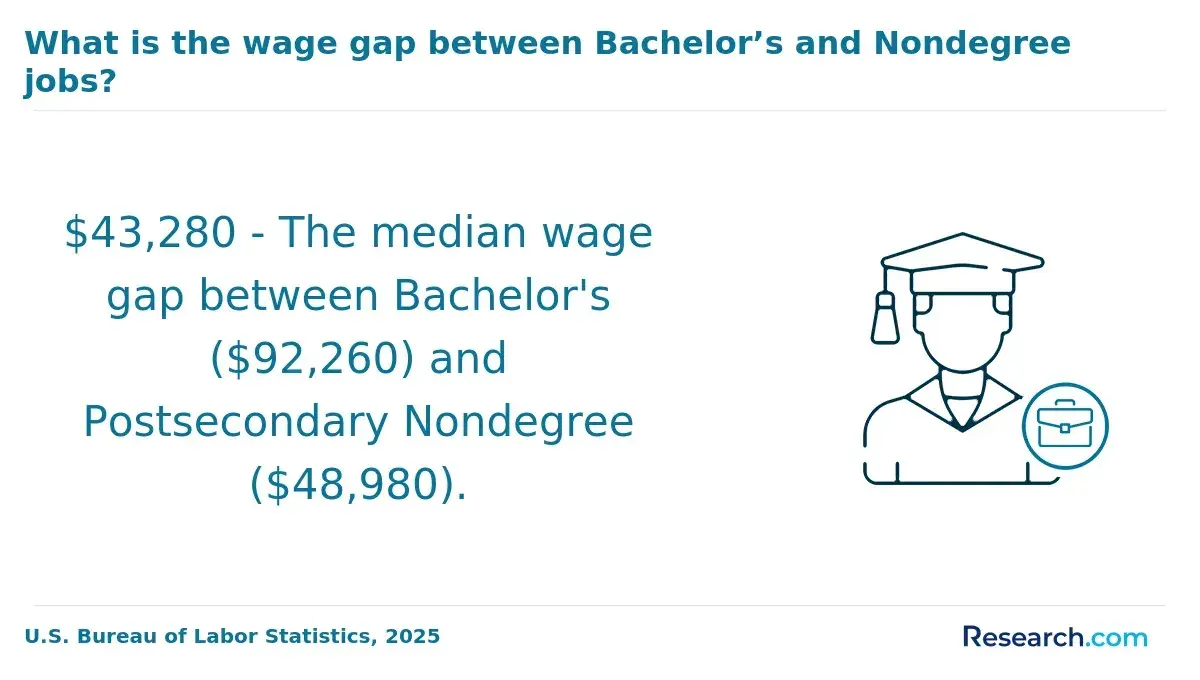
The labor market still rewards broad degree completion, but employers increasingly look for demonstrable skills. BLS reported that workers age 25 and older with a bachelor's degree had median weekly earnings of $1,543 in 2024, compared with $930 for those with only a high school diploma.
That gap does not mean every major has the same payoff, but it shows why students should connect degree choices to credible job paths, internships, and skill development; comparing bachelor's degrees job outlook can help frame that decision.
Concentrations can be especially useful in fields where employers scan for specific tools, populations, industries, or regulatory knowledge. Examples include business analytics, cybersecurity, forensic accounting, public health, digital marketing, human resources, sports management, child development, environmental policy, and clinical laboratory science.
The table below shows how a concentration can shift a broad major toward more targeted job roles. Use it to think in terms of career direction rather than academic labels alone.
| Broad major | Possible concentration | Career direction it may support | Skills to build beyond coursework |
| Business administration | Business analytics | Business analyst, operations analyst, reporting analyst | Excel, SQL, dashboards, statistics, data storytelling |
| Psychology | Industrial-organizational psychology | HR assistant, talent coordinator, research assistant | Survey design, workplace analytics, communication, ethics |
| Computer science | Cybersecurity | Security analyst trainee, SOC analyst, systems support | Networking, scripting, risk assessment, security labs |
| Criminal justice | Forensic investigation | Evidence technician, compliance assistant, investigations support | Report writing, chain of custody, legal procedures |
| Public health | Health education | Community health worker, program coordinator, outreach specialist | Program evaluation, cultural competence, health communication |
A concentration is not a substitute for experience. If two students have the same major, the one with a relevant internship, portfolio, clinical exposure, research project, or certification may be more competitive than the one who only completed a specialized track. Treat the concentration as a framework for building evidence, not as the evidence itself.
Do employers, graduate schools, or licensing boards care more about your major or concentration?
Employers, graduate schools, and licensing boards usually weigh majors and concentrations differently. Employers often start with the major because it signals the broad field of preparation, then look at the concentration, coursework, experience, technical skills, and work samples.
Graduate schools may care deeply about specific prerequisite courses, not just the name of the major or concentration. Licensing boards typically care most about approved programs, required coursework, supervised hours, exams, and state rules.
For regulated careers, the major may be much more important than the concentration. Nursing, education, social work, accounting, engineering, counseling, and certain healthcare fields may require completion of a board-approved or professionally accredited pathway. A concentration with a relevant title may not satisfy licensure requirements if the underlying program is not approved.
For non-licensed business, technology, communications, and liberal arts roles, the concentration can be a useful differentiator. It can show that a student intentionally built expertise in a niche, such as analytics, user experience, digital media, international business, or nonprofit management. Still, employers may ask for proof through projects, assessments, internships, or software proficiency.
Use the following priority check when evaluating how much the major or concentration matters for your goal:
- If the career requires a license, check the licensing board and program approval first.
- If the career requires graduate school, check admissions prerequisites and faculty expectations before choosing a concentration.
- If the career is skill-based, compare job postings and identify tools, portfolios, or certifications that complement the concentration.
- If the career path is broad or uncertain, choose a major with flexibility and use electives or minors to test specialization.
- If tuition reimbursement or military benefits are involved, confirm that the declared program and concentration are eligible under the payer's rules.
The biggest red flag is assuming that a concentration title automatically qualifies you for a specific role. In reality, qualification depends on the employer, state, accreditation status, supervised experience, exam requirements, and the strength of your applied skills.
How do online programs handle majors and concentrations differently than campus-based programs?
Online programs often handle majors and concentrations more intentionally than campus programs because course availability must be planned around asynchronous classes, term starts, remote advising, and national student populations. A campus program may offer many concentration electives in person, while an online program may offer fewer tracks but with more predictable scheduling.
Online learning is now a mainstream part of higher education. NCES reported in 2024 that millions of U.S. college students enrolled in at least one distance education course in recent fall enrollment data, which means students increasingly compare not only majors and concentrations but also delivery format, pacing, and support services.
For military-connected learners, comparing a military online college can be especially important because transfer credit, deployment flexibility, and benefit processing may affect completion.
The main advantage of online concentrations is convenience. Working adults, parents, transfer students, and rural students may be able to complete a specialized track without relocating. The trade-off is that some hands-on fields require labs, simulations, clinical placements, student teaching, internships, or local site approvals that can complicate online completion.
The table below compares common differences between online and campus-based major-concentration planning. It is especially useful if you are choosing between flexibility and access to specialized in-person resources.
| Factor | Online programs | Campus-based programs | What to verify |
| Concentration availability | May offer fewer but more standardized tracks | May offer more electives and faculty-led options | Whether your preferred concentration is available in your format |
| Scheduling | Often built around working adults and multiple start dates | Often tied to semester schedules and classroom times | Whether required courses rotate predictably |
| Hands-on requirements | May require local placements or virtual simulations | May provide campus labs, studios, clinics, or field sites | Who arranges placements and whether they are guaranteed |
| Networking | Can include virtual career services and remote projects | May provide more in-person clubs, events, and recruiting | How students access internships and alumni networks |
| Transfer credits | Often designed for adult and transfer learners | Policies vary widely by department | How transfer credits apply to the major and concentration |
A common mistake is assuming an online concentration is easier or less rigorous. Accreditation expectations, learning outcomes, and major requirements can be the same as campus programs, especially at institutions that offer the same degree in multiple formats. The better question is whether the online format supports the specific kind of specialization you need.
What should students consider when choosing between a broad major and a specialized concentration?
Choosing between a broad major and a specialized concentration is really a question of flexibility versus focus. A broad major may be better if you are still exploring careers, planning for graduate school, or want transferable skills across industries. A specialized concentration may be better if you already know the kind of role, population, technology, or industry you want to target.
Rising education costs make this choice more than academic. If a concentration adds extra credits, it can increase tuition, fees, books, and opportunity cost. If it fits inside existing electives, it may add career value without extending your timeline. The financial question is not "Which sounds better?" but "Does this option help me graduate on time with marketable skills and manageable cost?"
Students returning after a break, working adults, and caregivers should pay special attention to scheduling and course rotation. Resources on degrees for moms going back to school can be useful because the same planning issues-flexibility, transfer credits, childcare, pacing, and online support-also affect whether a concentration is realistic.
Before choosing, compare your options using these decision points:
- Choose a broad major if you want flexibility, are undecided, or plan to use internships and electives to explore multiple paths.
- Choose a concentration if you can name the roles, graduate programs, or industries it supports.
- Avoid a concentration that adds credits unless the added time and cost clearly support your goal.
- Prioritize concentrations with projects, internships, labs, portfolios, or employer-recognized tools.
- Check whether the concentration limits elective freedom you may need for prerequisites, a minor, transfer credits, or study abroad.
- Ask whether the concentration has enough course availability for part-time, online, evening, or accelerated study.
Common mistakes include choosing the most impressive-sounding label, following a friend's choice, ignoring prerequisites, or assuming specialization is always better. A broad major with strong experience can outperform a narrow concentration with weak planning. The best option is the one that aligns with your career target, learning style, budget, and completion timeline.
How can you compare schools' major and concentration options to find a reputable program?
To compare schools well, look beyond the name of the major or concentration. Two programs with the same label can differ significantly in faculty expertise, accreditation, course depth, internships, technology access, advising, transfer credit policy, and employer connections. A reputable program should make requirements transparent and should not pressure you to enroll before you understand the full academic plan.
Accreditation is the first filter. Institutional accreditation helps confirm that a college meets broad quality standards and is typically important for federal financial aid, transfer credit, employer recognition, and graduate school eligibility.
Programmatic accreditation may also matter in fields such as business, engineering, nursing, education, social work, counseling, public health, and healthcare. For advanced study, especially if you are comparing specialized doctorates or formats such as PhD pathways, verify both institutional legitimacy and how the final project or specialization is viewed in your field.
Ask schools practical questions that reveal whether the major and concentration are truly well supported:
- Is the institution accredited by an agency recognized by the U.S. Department of Education or CHEA?
- Does the program have programmatic accreditation if the field commonly expects it?
- How many credits are required for the major, and how many additional credits are required for the concentration?
- Will transfer credits apply to the major, concentration, general education, or only electives?
- Are required concentration courses offered every term, annually, or only when enrollment is high enough?
- Who teaches the specialized courses: full-time faculty, adjunct instructors, or rotating professionals?
- What internships, clinical placements, labs, capstones, portfolios, or employer projects are built into the concentration?
- Where does the concentration appear in official records?
- What career services are available for students in that specific major or concentration?
- Can the school provide transparent total cost estimates, including fees, books, technology, and possible extra terms?
Watch for red flags: vague concentration descriptions, missing catalog pages, unclear accreditation claims, "guaranteed job" language, pressure to enroll quickly, poor transfer credit transparency, or advisors who cannot explain whether the concentration appears on official records. A reputable school should help you understand both the opportunity and the limitations of the academic path.
Other Things You Should Know About
No. A concentration is usually a specialization inside your major, while a minor is a secondary field outside or alongside the major. A concentration is typically more closely connected to your degree requirements.
Often, yes, but it depends on school policy and credit limits. Before adding both, ask whether they will fit within your graduation plan without extra terms or unnecessary debt.
Neither is automatically better. Choose a concentration if it supports a clear career, graduate school, or skill goal. Choose a broader major if you need flexibility or want to explore several paths.
Yes, if it was officially declared or completed and relates to the role. List it accurately under education, and support it with relevant courses, projects, internships, certifications, or technical skills.
References
- Grad School vs. Work: Weighing the Pros and Cons https://www.bartonassociates.com/careers/blog/grad-school-vs-work-weighing-the-pros-and-cons/
- Do your graduate and online programs offerings match what students actually want? | EAB https://eab.com/resources/blog/adult-education-blog/do-your-graduate-and-online-programs-offerings-match-what-students-actually-want/
- Online Degree vs. Traditional: Choosing the Right Path https://beal.edu/online-degree-vs-traditional/
- Do Employers Care About College Accreditation? https://www.accreditedschoolsonline.org/accreditation/do-employers-care/
- How Do Employers Determine which College Degrees Rank Higher? https://www.greatvaluecolleges.net/faq/how-do-employers-determine-which-college-degrees-rank-higher/
- Differences in Majors, Minors, Concentrations, and Certificates - Goldey-Beacom College https://www.gbc.edu/academics/differences-in-majors-minors-concentrations-and-certificates/
- Which Business Concentration Should I Choose? | Tips From TUW https://www.tuw.edu/business/business-concentration-tips/
- How to List a Degree on a Resume [+ Examples & Best Practices] https://www.tealhq.com/post/how-to-list-a-degree-on-a-resume
- Putting your major to work: Career paths after college - The Hamilton Project https://www.hamiltonproject.org/publication/paper/putting-your-major-to-work-career-paths-after-college/
- Comparing Colleges or Training Programs https://www.vsac.org/plan/searching-for-a-college/comparing-colleges