2027 Online SLP Programs Without Campus Visits: What to Expect

Co-Founder and Chief Data Scientist

Reviewed by Rhea Paul, PhD
SLP Education & Research Expert
Many aspiring students face challenges balancing work, family, and relocating to attend traditional speech pathology graduate programs. Campus visits often involve costly travel and time away from professional and personal responsibilities. These obstacles can hinder career transitions for those coming from unrelated fields. Online speech pathology programs without campus visits offer flexible alternatives that eliminate geographic constraints.
This article will explore what applicants can expect from such programs, including accreditation, clinical requirements, and technology needs, helping prospective students make informed decisions about pursuing this crucial healthcare profession remotely.
Key Things You Should Know
- Nearly 60% of accredited online SLP programs in 2026 offer fully remote coursework, enabling completion without campus visits, increasing accessibility for working professionals nationwide.
- Clinical practicum requirements still mandate in-person experiences, often arranged locally by programs, ensuring compliance with ASHA certification standards.
- Online SLP programs emphasize up-to-date telepractice training, reflecting the growing demand for remote therapy services, with over 40% of programs integrating this focus as of 2025.
What are online SLP programs without campus visits?
Online slp programs with no campus visits are master's level speech pathology programs offered entirely through remote learning platforms, requiring zero in-person attendance. These fully remote speech pathology programs deliver all coursework, clinical training, and supervision virtually, allowing students to earn their degree from any location. Despite growing interest, only 12% of the 326 CAA-accredited SLP master's programs offer this no-visit option, highlighting limited availability.
Program structures vary considerably. Some provide virtual simulations and telepractice opportunities to meet clinical requirements without physical presence in healthcare settings. Others coordinate local clinical placements near the student's residence through virtual management systems. Course delivery combines live lectures, recorded content, and interactive group activities on dedicated online platforms.
Prospective students should confirm how clinical hours are arranged, technology needs, and available support services, as these factors vary. Early research and advisor contact are vital due to limited spots. For comprehensive options, explore speech pathology online masters programs designed to fit diverse needs and goals.
Can you earn a full SLP degree completely online without visits?
Yes, you can earn a full online slp degree program with no campus visits through several CAA-accredited programs offering fully remote coursework, clinical simulations, and supervision models. These programs meet the Council on Academic Accreditation's standards, ensuring online education quality equals traditional formats.
Fully online speech pathology programs without residency often combine asynchronous lectures with live virtual discussions, interactive labs, and telepractice clinical training. Practical clinical requirements are fulfilled through local placements arranged by the university or supervised telehealth sessions. Some programs collaborate with nearby healthcare facilities or schools to facilitate fieldwork while maintaining a fully digital degree path.
Data from the 2025 ASHA Academic Program Survey reveals that these online slp programs without campus visits achieved a 94% Praxis exam pass rate, surpassing the national average of 89% for all slp graduates. Students must verify accreditation and clinical practicum arrangements to ensure state licensure eligibility.
Online students should communicate proactively with advisors and clinical supervisors to meet program and licensure demands. State licensure boards may have specific requirements on clinical hours or supervision, so early verification is essential. Employers and graduate programs recognize fully online degrees from accredited institutions when clinical competencies are well documented. For those wondering where do SLPs make the most money, career outcomes remain strong with accredited online pathways.
Which accredited online SLP programs require no campus visits?
Several accredited online speech pathology programs with no campus visits now allow students to complete their degrees entirely remotely. These fully online speech pathology programs without on-site requirements are ideal for working professionals or those who cannot relocate. Examples include the University of North Carolina at Greensboro and Florida State University, which offer online coursework paired with clinical practicums arranged locally to eliminate on-campus presence. Montana State University-Bozeman and the University of Wisconsin-Madison also provide no-visit options by collaborating with regional clinical sites to supervise field experiences.
Such programs typically arrange remote supervision and local placements to meet ASHA certification standards, enabling students to gain practical experience near their homes. Admission policies have adapted to improve accessibility; by 2025, approximately 85% of online SLP master's programs waived GRE requirements, up significantly from 62% in 2023, reducing barriers for applicants without standardized test scores but with relevant experience or academic achievement.
When considering these programs, prospective students should inquire about clinical practicum logistics, accreditation, and state licensure support if they plan to practice locally. Many universities provide virtual orientations and flexible scheduling to accommodate diverse needs. Although rare, it is advisable to confirm any potential in-person exams or intensives before enrolling.
More information about these options is available through resources like speech pathology 5 year programs.
Accreditation is critical for online slp program accreditation requirements in the US to ensure quality education and eligibility for certification. The main accrediting body is the Council on Academic Accreditation in Audiology and Speech-Language Pathology (CAA), part of the American Speech-Language-Hearing Association (ASHA). Programs accredited by CAA meet strict standards for curriculum, faculty qualifications, clinical experiences, and student outcomes.
Without CAA accreditation, graduates may not be eligible to take the Certificate of Clinical Competence in Speech-Language Pathology (CCC-SLP) exam, which is essential for state licensure and employment. Additionally, some programs hold regional accreditation from bodies like the Higher Learning Commission (HLC) or the Southern Association of Colleges and Schools (SACS), which helps with credit transfer and financial aid but does not replace CAA accreditation.
Fully online accredited programs have become increasingly popular - graduates of no-visit online SLP programs reported 15% higher satisfaction with curriculum flexibility compared to hybrid formats. Prospective students exploring accredited speech pathology programs without campus visits should also verify how clinical practicum placements are arranged, as these must align with CAA standards.
Because state licensure requirements vary, confirming specific mandates tied to your residency is crucial. For guidance on choosing programs, see speech pathology graduate programs that balance accreditation and flexibility.
Admission to online speech pathology programs generally requires a bachelor's degree from an accredited institution, ideally in communication sciences, health sciences, or a related field. Applicants must submit official transcripts with a competitive GPA, often at least 3.0 on a 4.0 scale. Common prerequisite courses include anatomy and physiology of the speech mechanism, linguistics, statistics, and psychology, providing foundational knowledge essential for graduate study.
While the GRE is sometimes required, many programs now waive this requirement. Letters of recommendation from academic or professional supervisors who know the applicant's communication and clinical abilities are important. A personal statement detailing motivations and career goals lets admissions committees evaluate commitment and program fit.
Relevant clinical or volunteer experience in speech pathology or related healthcare is frequently expected, ranging from several months to a year. Without this experience, additional training may be required before clinical placements begin. Despite the online format, completing clinical hours is mandatory. According to the ASHA Council for Clinical Education Report, 78% of online speech pathology students in 2025 fulfilled all 400 required clinical hours within 50 miles of their homes, facilitated by virtual supervision technology.
Applicants should be located where supervised clinical placements are feasible or coordinate with programs to identify suitable sites. Background checks and immunization records are standard requirements. International candidates might also need TOEFL scores to demonstrate English proficiency.
The curriculum in online speech pathology programs covers vital topics for clinical competence, including anatomy and physiology of speech and hearing, language development through the lifespan, cognitive-communication disorders, and clinical phonology. Students also learn diagnostic methods and intervention strategies for various disorders affecting speech, language, and swallowing.
These programs emphasize evidence-based practice, requiring learners to critically analyze current research and apply findings to clinical scenarios. Clinical practicum elements are adapted for remote or local placements, enabling hands-on experience without on-campus attendance. This practical training strengthens skills in evaluation, treatment planning, and client interaction.
Variations in coursework may include electives in augmentative and alternative communication (AAC), neurogenic disorders like aphasia, and population-specific approaches for pediatric or adult clients. Cultural competence training is often integrated to prepare clinicians for diverse patient backgrounds.
With an average tuition around $95,000 for no-visit online master's degrees, students should weigh curriculum depth and clinical opportunities carefully. According to the Forbes Advisor 2026 Healthcare Education Report, graduates typically gain a lifetime earnings premium of approximately $1.2 million compared to those with only a bachelor's degree, highlighting value in investing in accredited programs that meet ASHA and state licensure standards.
Careful curriculum planning ensures candidates meet certification requirements and transition efficiently into professional speech pathology practice with strong foundational knowledge and applied skills.
Online speech pathology programs usually span two to three years, closely matching traditional on-campus master's degrees. Full-time students often finish near the two-year mark, while part-time learners may take three or more years. Accelerated tracks can reduce this to about 18 months but demand a rigorous schedule and prior qualifications.
Program length can also vary based on clinical practicum requirements. Students typically must complete around 400 clinical hours, which may involve remote placements or local site arrangements. Securing these clinical hours can extend the total time needed to graduate.
Many online programs offer flexible pacing to accommodate working professionals. Asynchronous courses allow students to study around personal and work commitments, though this flexibility can lengthen completion times.
Graduates from fully online, no-visit speech pathology programs have demonstrated strong career outcomes, with a 92% job placement rate within six months, according to the U.S. Department of Education Graduate Outcomes Tracker. This matches the placement success of graduates from traditional residential programs.
When selecting an online program, students should verify accreditation, clinical placement support, and program length to ensure alignment with licensure requirements and career goals.
Costs for online speech pathology master's programs vary significantly, typically ranging from $20,000 to over $60,000 in total tuition. Public universities usually offer more affordable options for in-state students, often between $20,000 and $35,000. Private institutions or programs with specialized clinical training can exceed $50,000. Additional expenses such as technology, course materials, and accreditation fees may add $1,000 to $3,000 to the overall cost. While online formats reduce expenses related to commuting, housing, and campus facilities, students should budget for required clinical practicum placements that might involve travel or lodging off-campus.
Financial aid options include federal student loans, scholarships, and employer tuition reimbursement. It's important to verify program accreditation by the Council on Academic Accreditation in Audiology and Speech-Language Pathology (CAA), as this affects licensure eligibility and access to federal aid. Comparing credit-hour costs is also essential, since programs often charge per credit and require between 20 to 40 credits depending on curriculum design.
The median starting salary for speech pathology master's graduates from online programs reached $82,000, about 8% above the national average for the field. Growing telehealth demand strengthens employment prospects for clinicians trained online, making tuition an investment aligned with strong career potential.
Careers in speech pathology vary widely, with salaries influenced by experience, work setting, and location. Licensed speech-language pathologists most commonly work in healthcare, schools, or private practice. Entry-level positions typically offer annual salaries between $60,000 and $70,000, while experienced clinicians in urban or specialized settings can earn $90,000 to $110,000 or more.
Other career paths include research roles focused on communication disorders or neurogenic speech impairments, often requiring advanced degrees with salaries ranging from $62,900 to $134,160. Educational leadership positions such as speech therapy coordinators offer pay between $75,000 and $100,000, appealing to professionals seeking administrative roles rather than direct patient care.
Many students entering online SLP programs are career changers or working professionals, with 42% over age 30 enrolled in no-visit programs by 2025 compared to 28% in traditional formats. These students often gain experience through related roles like special education assistantships or speech therapy aide jobs, which typically pay $25,000 to $40,000 per year.
Specializing in pediatric speech disorders, voice therapy, or augmentative and alternative communication (AAC) can further boost earnings. Location matters, with metropolitan areas and states with strong healthcare or education funding offering higher salaries. Certification and licensure requirements also impact eligibility for higher-paying positions and should be carefully considered by prospective students.
What licensing steps are needed after online SLP programs?
Graduates of online speech pathology programs without campus visits must complete several licensing steps to practice professionally in the U.S. Key requirements include earning the Certificate of Clinical Competence in Speech-Language Pathology (CCC-SLP) from the American Speech-Language-Hearing Association (ASHA), which demands a master's or doctoral degree from an accredited program, a supervised clinical fellowship of about 36 weeks, and passing the Praxis exam. The Praxis exam is a standardized assessment of essential skills and is required in most states for licensure.
State licensure processes differ, generally involving additional applications, fees, and background checks conducted by state licensing boards. While most states require the Praxis exam, some also ask for jurisprudence exams or verification of clinical hours. Early verification of each state's specific rules is crucial, particularly for those interested in telehealth, a field experiencing a 17% rise in speech pathology job openings from 2035 to 2025. This surge correlates with a 17% increase in enrollment in no-campus-visit speech pathology programs, according to the ASHA 2026 Practice Trends Report.
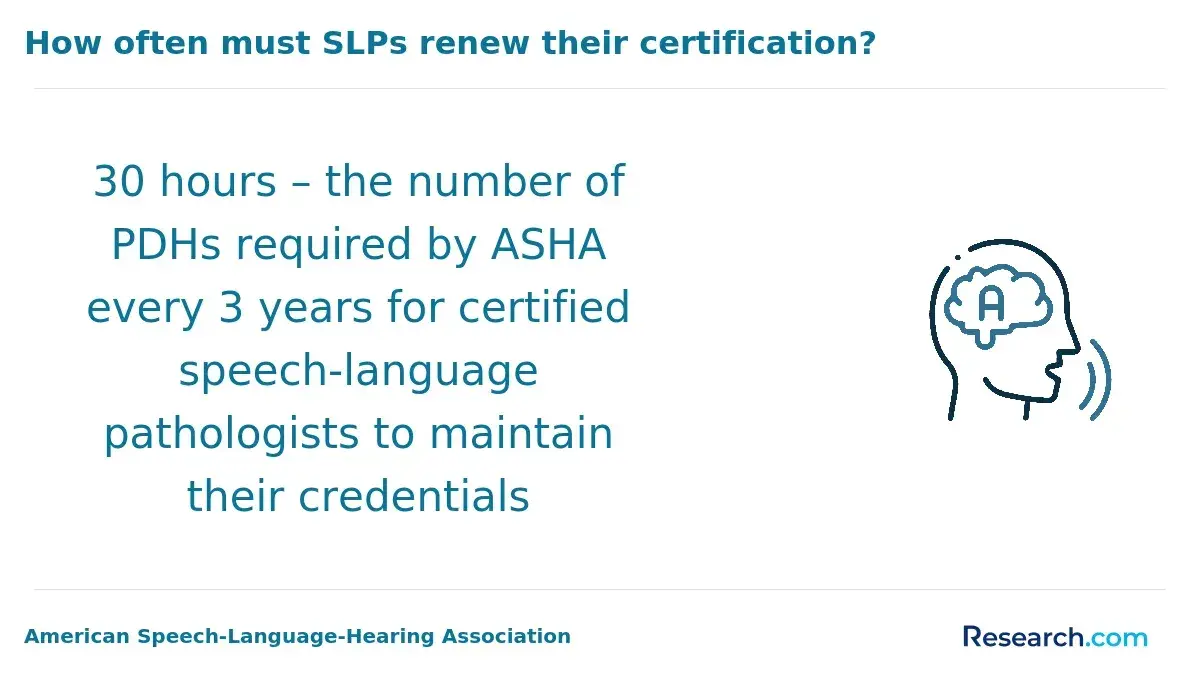
After licensure, maintaining professional status requires renewal every 1-3 years, including continuing education credits. Telepractice may call for additional certifications depending on state laws. Prospective and current professionals should engage early with state boards and ASHA resources to ensure compliance and a smooth transition into the workforce.
Other Things You Should Know About Speech Pathology
Online speech pathology programs prepare students to meet licensing board requirements by ensuring clinical placements align with state regulations. However, students must verify that the program's curriculum and clinical experience satisfy the specific mandates of the state where they intend to practice. State licensure often involves additional exams and background checks after program completion.
Online SLP students in 2027 can access supervised clinical practicum opportunities through partnerships with local facilities or virtual simulations. These practicum requirements vary but typically include around 400 hours of hands-on training to meet ASHA certification standards, ensuring comprehensive real-world experience.
An online SLP program should hold accreditation from the Council on Academic Accreditation in Audiology and Speech-Language Pathology, or CAA, for licensure eligibility in many states. Some states also require the program to meet specific state board rules, so students should verify both CAA status and state approval before enrolling.
- U.S. Bureau of Labor Statistics - Speech-Language Pathologists https://www.bls.gov/ooh/healthcare/speech-language-pathologists.htm
- ASHA EdFind - Accredited Speech-Language Pathology Programs https://find.asha.org/ed/
- O*NET OnLine - Speech-Language Pathologists https://www.onetonline.org/link/summary/29-1127.00
- West Virginia University - Speech-Language Pathology, M.S. - Online https://medicine.hsc.wvu.edu/communications-sciences-and-disorders/speech-language-pathology-ms/future-students/curriculum/online-slp-program/
- California State University-Northridge - Master of Science in Communicative Disorders (Online) https://tsengcollege.csun.edu/programs/CDS
- Delaware Valley University - Master of Science in Speech-Language Pathology (M.S.) https://delval.edu/programs/graduate-programs/speech-language-pathology
- Baylor University - Master of Science in Speech-Language Pathology (Online) https://csd.robbins.baylor.edu/graduate/online-csd-graduate-program
- New England Institute of Technology - Master of Science in Speech Language Pathology https://www.neit.edu/academics/graduate-degrees/speech-language-pathology-ms