2027 Career Paths for MSW Graduates in School Systems

Co-Founder and Chief Data Scientist
An MSW can open a path into K-12 education, but the route is not the same in every state or school district. The main decision is not simply whether to earn a Master of Social Work; it is whether the program, field placement, licensure path, and school credential will qualify you for the type of school-based role you want.
This guide explains how MSW graduates work in school systems, what education and credentials are typically required, how online and campus programs compare, and what to consider before choosing a program. It is designed for career changers, current social service professionals, and prospective graduate students who want a practical way to evaluate school social work as a career path.
Key Things You Should Know
- MSW graduates in 2026 have expanding roles in school systems, including counseling, crisis intervention, and policy advocacy, driven by growing student mental health needs.
- Employment for social workers in schools is projected to grow 12% from 2024 to 2034, outpacing many professions, reflecting increased investment in school-based support services.
- Credentialing requirements vary by state, with many districts requiring LCSW licensure or specialized training for school social workers, impacting career entry and advancement opportunities.
What do Master of Social Work graduates do in school systems?
Master of Social Work graduates in school systems help students overcome barriers that affect learning, attendance, behavior, safety, and emotional well-being. Their work often sits at the intersection of mental health, family support, special education, crisis response, and student advocacy.
In many districts, MSW graduates serve as school social workers or licensed clinical social workers assigned to one school or several campuses. They may assess student needs, provide individual or group counseling, respond to crises, coordinate with families, and connect students to community resources. Common concerns include trauma, bullying, family instability, housing insecurity, grief, substance abuse, chronic absenteeism, and behavioral challenges.
According to the Council on Social Work Education's 2023-2024 Annual Survey, 21,092 MSW graduates from 225 programs are entering school settings, highlighting the growing role of social work training in education.
Common responsibilities in school settings
- Conducting psychosocial assessments and documenting student needs
- Providing short-term counseling, intervention planning, and crisis support
- Participating in multidisciplinary teams, including special education and student support teams
- Helping families access housing, healthcare, food assistance, mental health services, or child welfare resources
- Supporting attendance improvement, behavior intervention, and school climate initiatives
- Advising teachers and administrators on trauma-informed and culturally responsive practices
- Managing mandated reporting responsibilities and ethical confidentiality boundaries
MSW graduates who succeed in schools are usually strong collaborators. They must communicate clearly with teachers, administrators, caregivers, community agencies, and students from diverse backgrounds. They also need sound judgment because school-based work often involves urgent decisions, sensitive information, and competing priorities.
Licensure expectations vary by state and district. Some positions require an LMSW, LCSW, school social work endorsement, or a state education credential. Graduates who want advanced clinical, supervisory, or leadership roles may later consider accredited online DSW programs, but most school-based entry and mid-level roles begin with the MSW plus the required state credential.
What are the educational requirements to become a school social worker?
The standard educational requirement for school social workers is an MSW from a Council on Social Work Education (CSWE) accredited program. Accreditation matters because many states, public school systems, and licensure boards rely on CSWE accreditation when determining whether a graduate is eligible for professional licensure or school-based credentials.
Requirements vary by state, but most candidates should plan for three layers of preparation: graduate education, supervised field experience, and state-specific licensure or certification. Some states require a school social work license or endorsement issued through the education department. Others accept a social work license, such as an LMSW or LCSW, with school-based experience or additional coursework.
Typical preparation path
- Earn a bachelor's degree from an accredited institution.
- Complete a CSWE-accredited MSW program.
- Choose coursework or electives related to children, families, schools, mental health, and policy when available.
- Complete a field placement that meets program and state requirements, ideally in a school or youth-serving setting.
- Apply for the required state social work license, school credential, or endorsement.
- Meet continuing education requirements after licensure or certification.
School-based fieldwork is especially important. A general social work placement can build useful skills, but a school placement exposes students to attendance policies, special education processes, multidisciplinary teams, mandated reporting, and the practical limits of providing services within an educational setting.
The U.S. Bureau of Labor Statistics projects a 7% employment growth for social workers from 2023 to 2033, driven in part by rising student mental health needs. Candidates can improve their competitiveness by pursuing training in trauma-informed care, crisis intervention, child welfare, special education advocacy, and substance abuse counseling.
Students comparing cost-conscious routes can review affordable MSW programs, but price should be weighed alongside accreditation, field placement quality, licensure alignment, and school social work coursework.
How long does an MSW program take, and what are typical costs?
A traditional MSW program usually takes two years of full-time study. Students with a Bachelor of Social Work may qualify for advanced standing pathways, while working adults often choose part-time formats that can take three or more years. Some accelerated options can be completed in 12 to 18 months, depending on the student's prior coursework, enrollment status, and program structure.
Program length affects both cost and career timing. A faster program may reduce time away from the workforce, but it can also be academically intense and less flexible for students with full-time jobs or caregiving responsibilities. A part-time program may be easier to manage, but the longer timeline can delay licensure and full-time school social work employment.
| Program format | Typical timeline | Best fit | Key trade-off |
| Traditional full-time MSW | Two years | Students who can prioritize graduate study and fieldwork | Faster completion than part-time study but less schedule flexibility |
| Accelerated MSW | 12 to 18 months | Students prepared for an intensive pace | Shorter timeline but heavier workload |
| Part-time MSW | Three or more years | Working professionals and caregivers | More manageable schedule but longer path to completion |
Students who need flexibility may want to compare accelerated online MSW programs, especially if they can complete required fieldwork near their home community.
Costs vary by institution, residency status, delivery format, and available aid. When evaluating cost, look beyond tuition. Include fees, books, travel to field placements, lost work hours, exam fees, background checks, and licensure costs. The typical tuition and fees for MSW school system graduates should also be weighed against salary expectations. Median wages for school social workers reached $62,650, about 15% higher than the general social work median wage, reflecting public sector benefits and job stability.
Financial aid may include federal loans, scholarships, graduate assistantships, employer tuition support, and service-based programs. Some public school systems also offer loan forgiveness for MSW graduates who work in underserved communities or schools. Before enrolling, ask each program for a realistic total cost estimate and confirm whether its field placement schedule is compatible with paid employment.
Online and campus-based MSW programs can both prepare students for school social work if they are properly accredited and meet state requirements. The main differences are delivery format, schedule structure, access to local networks, and how field placements are arranged.
Online programs are often attractive to working adults, parents, rural students, and career changers who cannot relocate. Coursework may be synchronous, asynchronous, or a mix of both. However, online students still complete in-person field education, and they should confirm early that the program can help secure placements that satisfy school social work and licensure expectations in their state.
Campus-based programs provide face-to-face interaction with faculty, peers, and local agencies. They may be especially useful for students targeting nearby public school districts because the program may already have field placement agreements and employer relationships in that region. The trade-off is usually less scheduling flexibility and the need to commute or relocate.
| Factor | Online MSW | Campus-based MSW |
| Flexibility | Often stronger for working adults and remote learners | Usually more structured around fixed class times |
| Fieldwork | Completed in person, often near the student's location | Often arranged through established local partnerships |
| Networking | Requires more intentional effort | More built-in peer, faculty, and local employer contact |
| Best use case | Students who need location or schedule flexibility | Students who want a local professional network and in-person support |
Both formats can lead to licensure. The Council on Social Work Education (CSWE) reports that 79% of 2020 MSW graduates intended to obtain LMSW licensure within five years, showing that licensure planning is central regardless of how coursework is delivered.
Before choosing either format, verify CSWE accreditation, field placement support, state authorization, school social work coursework, and graduate outcomes. For a broader evaluation of the return on investment, review whether a social work degree is worth it based on your career goals and financial situation.
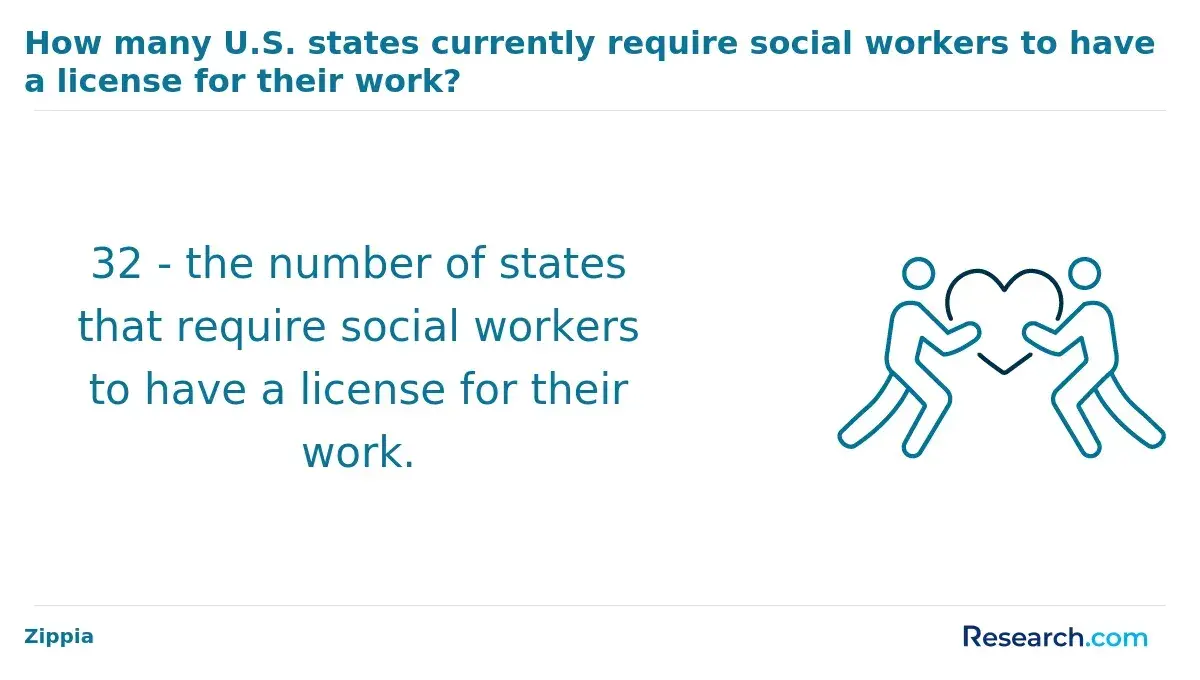
School social workers usually need state-specific licensure, certification, or an education credential before they can practice in public school systems. The exact title and process differ by state, so candidates should check both the state social work board and the state education agency before choosing an MSW program.
Most pathways begin with an MSW from a CSWE-accredited program. After that, candidates may need to pass an exam, complete supervised experience, submit fingerprints or background checks, document school-based fieldwork, and complete continuing education. Some states issue a school social work license, school social work endorsement, or "School Social Work Specialist" certification. Others allow an LCSW or related license when paired with school-focused preparation.
Credentials to ask about before enrolling
- Whether the state requires an LMSW, LCSW, or another social work license
- Whether a separate school social work credential or education department endorsement is required
- Whether the MSW field placement must be completed in a school setting
- Whether specific coursework is required in child development, education law, special education, or school social work
- Whether supervised post-graduate hours are required before independent or clinical practice
About 13% of licensed master's-level social workers specialize in children and youth, reflecting a high demand amid school staffing shortages, according to Job Outlook in Public Schools. That demand does not remove credential requirements. In public schools, being otherwise qualified as a social worker may not be enough if the district requires a school-specific license or endorsement.
Licensure protects students, families, and schools by setting minimum standards for ethics, competence, supervision, and continuing education. Candidates who skip this step or assume requirements are the same nationwide may graduate from a program that does not fully align with their intended state or role.
MSW curricula combine foundation training in social work practice with advanced coursework, field education, and electives. Students preparing for school systems should look for courses that build competence in child and adolescent development, family systems, educational policy, mental health, crisis intervention, and culturally responsive practice.
Core coursework typically covers human behavior, social welfare policy, research methods, ethics, assessment, and practice with individuals, families, groups, organizations, and communities. School-focused students may then choose specializations such as school social work, child and family services, youth mental health, trauma-informed practice, or clinical practice with children and adolescents.
Course areas that matter for school-based practice
- Assessment and intervention: evaluating student needs and designing appropriate supports
- Child and adolescent development: understanding age-appropriate behavior, risk factors, and protective factors
- Family engagement: working with caregivers while respecting culture, language, and family context
- Special education collaboration: contributing to IEP-related discussions and student support planning
- Crisis response: supporting students after violence, loss, self-harm concerns, or community trauma
- Legal and ethical practice: managing confidentiality, mandated reporting, documentation, and consent
- Equity and cultural responsiveness: addressing barriers that affect students from diverse communities
Field practicum is a central part of MSW training. For students aiming at K-12 roles, a school placement can be more valuable than a general social service placement because it provides direct exposure to school calendars, student support teams, disciplinary systems, attendance issues, and family-school communication.
Considering that 34.6% of MSW graduates have average loan debt of $38,500, students should evaluate whether a specialization improves their employment options enough to justify the total cost. Some graduates may be attracted to charter schools offering higher pay and flexible resources for innovative programs, but compensation and benefits can vary by employer.
The strongest school-focused MSW curriculum is not just a list of child-related electives. It should connect coursework, field education, supervision, and licensure preparation into a coherent pathway toward school-based employment.
Accredited MSW programs generally require a bachelor's degree from an accredited institution. Many programs expect a minimum GPA near 3.0 on a 4.0 scale, though policies vary. Applicants do not always need an undergraduate degree in social work, but a background in social services, psychology, education, public health, sociology, or related fields can strengthen an application.
Common application materials include official transcripts, a resume, two to three recommendation letters, and a personal statement. The personal statement is especially important for career changers because it explains why the applicant is moving into social work, what populations they hope to serve, and how their prior experience connects to the profession's ethics and values.
Typical application components
- Completed application form and fee
- Official undergraduate transcripts
- Resume or curriculum vitae
- Personal statement or statement of purpose
- Two to three academic or professional recommendations
- Documentation of volunteer, internship, or paid human services experience when available
- Background check requirements for field placement eligibility
- TOEFL or IELTS scores for international students when required
Many programs are moving away from mandatory GRE scores, and some offer waivers based on prior academic performance, professional experience, or graduate coursework. Applicants should not assume the GRE is required; they should verify the policy for each program.
Relevant experience can improve admission prospects. Schools often value applicants who have worked or volunteered in mental health, education, child welfare, disability services, community organizations, crisis hotlines, housing programs, or youth development. For school social work, experience with children, adolescents, families, or educational systems is especially useful.
Prospective students should also confirm that the program aligns with state licensure requirements before applying. This is particularly important for online students and applicants planning to move after graduation. Data from Career Advancement Pathways show 31% of PhD social work graduates secure tenure-track academic roles, emphasizing the benefit of programs with strong research connections for leadership aspirations in education systems.
Choosing an MSW program should begin with one non-negotiable requirement: CSWE accreditation. Without it, graduates may face barriers to licensure, school credentials, and employment. After confirming accreditation, compare programs based on how well they support your intended state, schedule, budget, and school social work goals.
Key factors to compare
- Licensure alignment: Confirm the program meets requirements in the state where you plan to work.
- School social work preparation: Look for relevant coursework, electives, certificates, or concentrations.
- Field placement quality: Ask whether the program has partnerships with K-12 schools or youth-serving agencies.
- Faculty expertise: Review whether faculty have experience in child, family, school, or mental health practice.
- Format: Decide whether online, hybrid, campus-based, full-time, or part-time study best fits your life.
- Outcomes: Review graduation rates, licensing exam pass rates, employment outcomes, and alumni feedback when available.
- Total cost: Compare tuition, fees, travel, lost work time, scholarships, and assistantships.
- Student support: Evaluate advising, field placement assistance, writing support, career services, and licensure guidance.
Faculty credentials and district partnerships are especially important for students who want school placements. A strong program should be able to explain how it supports field education, how placements are approved, and what happens if a student's local placement options are limited.
Diversity and cultural responsiveness also matter in school social work. Recent data show 55.3% of MSW graduates identified as White, with increasing representation from underrepresented groups reflecting inclusivity efforts relevant for school social work roles. Students should consider whether a program prepares graduates to serve communities with different languages, cultures, income levels, disability needs, and immigration experiences.
Before enrolling, contact the state licensing board or education agency and ask the MSW program directly whether its curriculum and fieldwork satisfy the requirements for school social work. Do not rely only on broad marketing language. The best program is the one that connects accreditation, licensure preparation, field education, affordability, and career support in the state and school system where you want to work.
What specific career roles can MSW graduates pursue in K-12 schools?
MSW graduates can pursue several K-12 roles, though job titles and requirements vary by state and employer. The most direct role is school social worker, but MSW training can also support positions in student support services, special education teams, behavioral health programs, family engagement, attendance intervention, and district-level student services.
| Role | Primary focus | Common responsibilities |
| School social worker | Student mental health, behavior, attendance, and family support | Counseling, assessments, crisis response, referrals, family outreach, documentation |
| Student support services specialist | Coordinated support for students facing academic or social barriers | Case coordination, intervention planning, collaboration with teachers and administrators |
| Special education social work team member | Support for students with disabilities and their families | IEP-related input, family communication, service coordination, advocacy |
| Behavior intervention or mental health program coordinator | Schoolwide prevention and intervention systems | Program planning, staff consultation, data tracking, crisis protocols |
| Family liaison or community resource coordinator | Connecting families to outside supports | Referrals for housing, healthcare, food assistance, counseling, and social services |
| District policy or student services role | Systems-level student welfare and compliance | Program oversight, policy implementation, child welfare coordination, outcome evaluation |
Some positions resemble school counseling, but the roles are not always interchangeable. School counselors typically focus on academic planning, college and career readiness, and student development within a counseling framework. School social workers are more likely to address environmental, family, community, mental health, and social service factors that affect a student's ability to learn. Licensure rules determine which titles an MSW graduate can legally use.
MSW holders may also work closely with special education teams by helping identify barriers, supporting families during service planning, and advocating for appropriate accommodations. In high-need schools, they may spend substantial time addressing housing insecurity, food access, transportation, healthcare access, and child welfare concerns.
Trends indicate nearly 30% of master's-level social workers earned degrees online or in hybrid formats, easing transitions from clinical and community roles into K-12 education settings. For career changers, the most strategic approach is to choose school-focused field placements, complete the correct state credential, and build experience with children, adolescents, families, crisis response, and multidisciplinary teams.
Other Things You Should Know About Social Work
Most school social workers must hold a state school social work credential and, in many districts, a professional educator license. To serve on a special education team, they also need knowledge of IDEA, Section 504, and IEP procedures, plus supervised school-based field experience required by the state.
Yes, school social workers often play a vital role in advocating for policies that promote safer and more inclusive school environments. They work to influence school district policies on bullying prevention, mental health services, and attendance issues. Their advocacy supports systemic changes that benefit students and families at a broader level.
One common challenge is managing large caseloads while addressing complex student needs. MSW graduates must navigate limited resources and balancing confidentiality with school protocols. They also face pressure to demonstrate the impact of social work interventions within educational settings.
MSW graduates can advance by gaining experience and additional certifications, such as Licensed Clinical Social Worker status. Advancement may include supervisory roles, program development, or district-level coordinator positions. Continuing education and specialization in areas like trauma-informed care can also open doors for career growth.
- MSW Specializations: Clinical, Macro, Advanced Generalist Programs https://www.masterofsocialwork.com/resources/msw-specializations
- Types of Social Workers: Exploring the Many Fields in Which They Serve https://www.umassglobal.edu/blog-news/types-of-social-workers
- Social Work Careers https://socialworklicensemap.com/social-work-careers/
- Careers in Social Work https://www.kysu.edu/academics/college-as/school-of-social-work/careers/index.php
- How to Become a School Social Worker in Texas https://www.texassocialworkedu.org/social-work-industries-in-texas/schools-and-universities/
- Master of Social Work- Non-social work degree https://socialwork.ucalgary.ca/future-students/master-social-work/msw-entry-routes/non-social-work-degree
- Online MSW vs Campus MSW: 2025 Outcomes & Career Guide https://www.socialworkdegrees.org/online-msw-vs-campus-msw
- School Social Work: An Introductory Guide https://www.onlinemswprograms.com/careers/school-social-work/
- Wisconsin School Social Work Association - Certification https://wsswa.org/certification
- Social Worker Salary and Jobs in Social Work https://teach.com/online-ed/social-work-degrees/online-masters-social-work/salary-and-career-outlook/