# 1 position
Best Pharmacy Technician Training Programs & Trade Schools in Raleigh for 2027
Audited and Verified:
Our Editorial and Data Verification Process
Research.com uses government datasets, official education statistics and primary institutional information to support its career and degree guides. Our review process checks factual accuracy, occupational definitions, source dates and the requirements associated with the credentials discussed.
How This Article Was Fact-Checked
Our editorial team verifies salary estimates, employment projections, education requirements and program information against original data providers and official organizations. Salary figures are checked against the relevant occupational definitions and reporting periods. Information about licensure, accreditation and required in-person training is reviewed separately.
Fact-checked and verified on:

Co-Founder and Chief Data Scientist

Reviewed by Karolina Broda
Fact-Checker and Data Verification
Choosing pharmacy technician training in Raleigh means comparing more than course titles: the right program must fit North Carolina's registration rules, your schedule, and the kind of pharmacy where you want to work. The U.S. Bureau of Labor Statistics projects 6.4% national employment growth for pharmacy technicians from 2025 to 2035. This guide explains training routes, costs, credentials, and career prospects. It also features a Best Pharmacy Technician Trade Schools in Raleigh for 2027 ranking, created by the Research.com team of data scientists to help students make an informed choice about programs worth considering.
Key findings about pharmacy technician degrees in Raleigh
- A short certificate or employer-based training may be enough to pursue entry-level work, but North Carolina Board of Pharmacy registration is a separate requirement; a school credential does not register you.
- The national median annual wage for pharmacy technicians was $45,750 in May 2025, according to the U.S. Bureau of Labor Statistics. Treat it as an occupational benchmark, not an expected Raleigh starting wage.
- Compare classroom and lab practice, access to a pharmacy worksite, exam preparation, and total cost. The Research.com ranking covers programs with IPEDS-reported completions, not every local training route.
Table of Contents
- Best Pharmacy Technician Training Programs & Trade Schools in Raleigh for 2027
- What can I expect from a pharmacy technician trade school program in Raleigh?
- Where can I work with a pharmacy technician trade school training in Raleigh?
What can I expect from a pharmacy technician trade school program in Raleigh?
Pharmacy technician training prepares you to assist a pharmacist with prescription processing, medication inventory, calculations, insurance claims, and patient-facing service. Technicians work under pharmacist supervision; training does not authorize them to make pharmacists' clinical decisions. Raleigh-area applicants can compare a community-college certificate or continuing-education course, a career-school program, and supervised training offered by an employer.
A structured program suits someone who wants scheduled instruction and practice before applying for work. Employer training can suit someone who needs to earn while learning and has found a pharmacy willing to train them. Neither route is automatically better: ask whether it includes supervised dispensing-system practice, preparation for a recognized certification exam, and experience in your intended setting. Hospital work, for example, may call for sterile-compounding preparation that a retail-focused course does not provide (U.S. Bureau of Labor Statistics; Pharmacy Technician Certification Board).
Where can I work with a pharmacy technician trade school training in Raleigh?
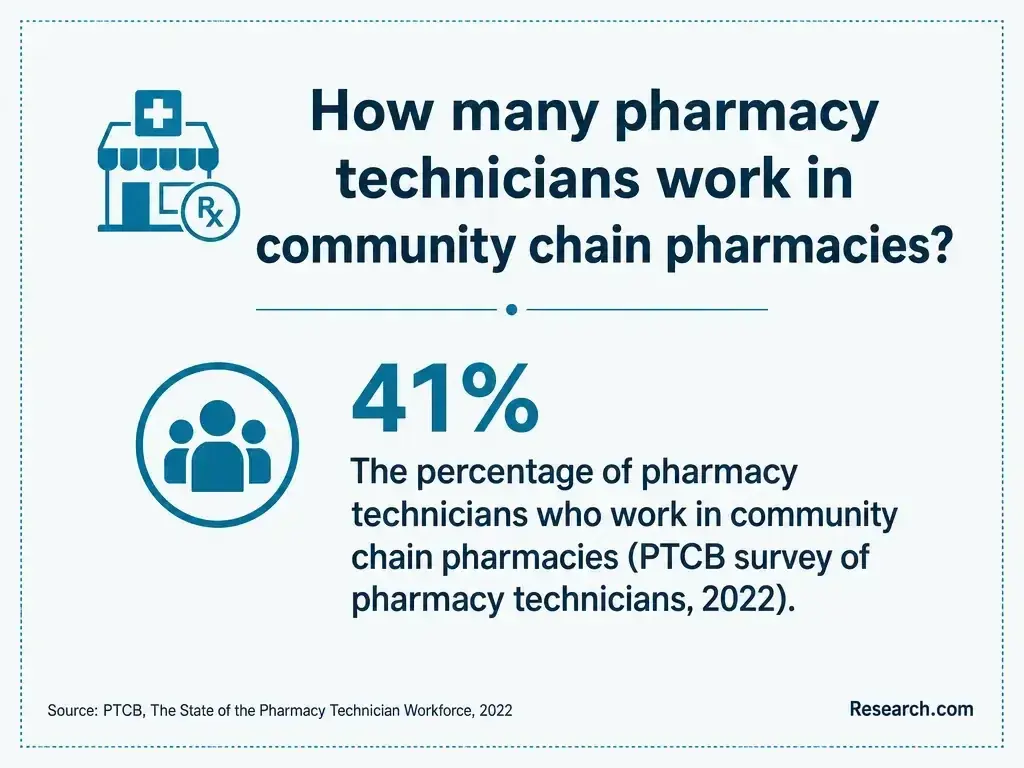
Retail and grocery pharmacies, hospital pharmacies, outpatient clinics, long-term-care pharmacy operations, and mail-order or specialty pharmacies offer different work. In the Raleigh area, hospital systems such as WakeMed and UNC Health Rex make inpatient pharmacy a practical setting to investigate alongside retail openings. Check individual job postings: a hospital may seek sterile-compounding experience or national certification even when an entry-level retail role does not.
Location affects the training choice. If a program's practical experience is available only at sites outside your usual commute, transportation and shift availability can determine whether you finish. Ask where students complete any required worksite experience and whether the school arranges placements or expects students to find them.
A reliable Raleigh-specific starting wage should come from current local job postings or an official metropolitan-area wage release, not from a national median. The U.S. Bureau of Labor Statistics reports a $45,750 national median annual wage for pharmacy technicians in May 2025. That figure covers experienced and newly employed workers across the country; it is not a forecast of what a new graduate will earn in Raleigh.
Compare posted pay for the settings you would actually accept, including shift differentials where stated. Then weigh any expected pay improvement against training costs and earnings forgone while studying. A higher-paying hospital opening is useful evidence only if its experience and certification requirements are realistic for your first job.
Duration depends on the route and schedule. A focused certificate or continuing-education course generally takes less time than an associate degree; employer training unfolds alongside paid work. There is no single classroom-hour requirement that makes every Raleigh program equivalent. Ask each provider for its current clock or credit hours, lab hours, worksite requirements, and typical time to completion on your schedule.
Speed has a trade-off: an accelerated course leaves less time to practice calculations, insurance rejections, and dispensing workflows before applying for jobs. If you are considering an associate's degree accelerated route, first establish whether the extra credential and its longer training period serve a pharmacy role you want. A shorter occupational credential may be the more direct entry path.
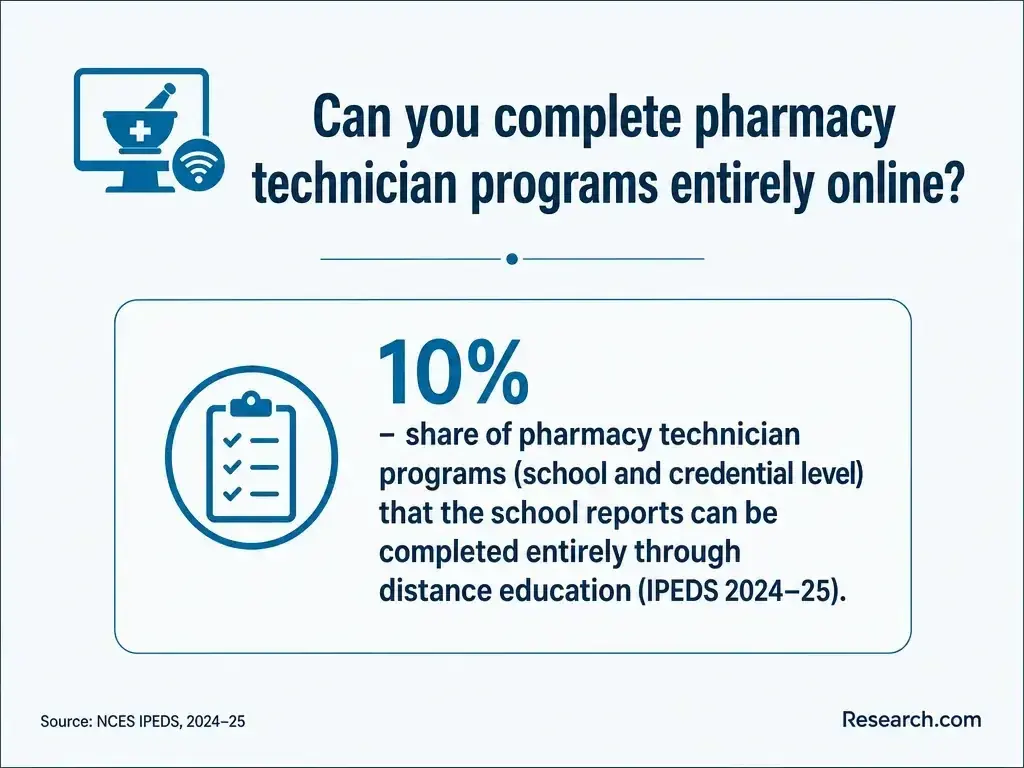
Online study can cover terminology, calculations, drug classifications, regulations, and exam preparation. A campus or hybrid program can provide supervised practice with prescription workflows and equipment; a pharmacy worksite adds experience with real systems and professional supervision. An online course is not a substitute for required practical experience or North Carolina registration (North Carolina Board of Pharmacy).
The format comparison below identifies what to verify before choosing for convenience alone:
| Format | Potential advantage | Critical check |
| Online coursework | Flexible theory study | How practical skills and worksite experience are obtained locally |
| Hybrid | Remote study plus scheduled practice | Required campus visits and placement travel |
| On-campus | Regular access to instructors and labs | Class times, commute, and worksite arrangements |
Working students comparing cheap online colleges for working students should check the pharmacy technician program itself, rather than assuming a flexible institution offers a fully remote path into this hands-on occupation.
There is no defensible single Raleigh average that covers college courses, career schools, and employer-paid training on the same basis. Request an itemized, current quote for each option. Include tuition, mandatory fees, books or software, uniforms, background checks or health requirements if applicable, certification-exam and registration costs, travel to labs or worksites, and wages you would forgo. Employer training may reduce upfront tuition but can require you to learn on the employer's schedule.
Aid depends on the specific program, not its advertising. Federal Student Aid determines eligibility for federal aid, and short noncredit courses may differ from eligible college programs. If you are reviewing online schools accept fafsa options, confirm that the particular pharmacy technician program qualifies. Also ask about scholarships, North Carolina workforce assistance, payment plans, and whether an employer covers exam fees.
Depending on the route, you might earn a course-completion certificate, college certificate, diploma, or associate degree. Those are educational credentials. Certified Pharmacy Technician (CPhT) is a professional certification awarded by the Pharmacy Technician Certification Board (PTCB) after its eligibility requirements and examination are met; it is not awarded merely for attending class. North Carolina Board of Pharmacy registration is separate again (PTCB; North Carolina Board of Pharmacy).
Ask which credential appears on the final transcript or completion record and whether the curriculum meets your intended certification exam's eligibility pathway. If you are comparing what is the easiest 2 year degree to get, ease alone is a poor measure here: the useful question is whether the added coursework, time, and cost improve access to your target pharmacy role.
Requirements vary by provider and by pharmacy worksite. Ask about a high school diploma or equivalent, minimum age, placement assessments, immunizations, background screening, and any requirements for an externship. A school may admit you even if a particular placement site has additional conditions. Confirm those conditions before paying a nonrefundable fee.
Employer training has a different entry point: you apply for a qualifying job and complete the training its supervising pharmacy requires. Previous pharmacy or healthcare work may help, but do not assume it earns course credit. Ask a college whether it formally evaluates prior learning or accepts transfer credit before counting on a shorter schedule.
A useful entry-level curriculum connects medication names and dosage forms with pharmacy math, prescription entry, inventory control, insurance processing, patient privacy, error prevention, and communication. Practice matters as much as memorization: students should be able to identify when a prescription or calculation needs pharmacist review rather than trying to resolve a clinical question independently (U.S. Bureau of Labor Statistics).
For hospital ambitions, ask whether the program introduces aseptic technique, sterile products, and hazardous-drug safety - and whether those topics are practiced in an appropriate lab or worksite rather than covered only in videos. For retail ambitions, look closely at hands-on claim processing and customer-service scenarios. Similarly named certificates can provide substantially different preparation.
North Carolina requires pharmacy technicians to register with the North Carolina Board of Pharmacy; registration is not the same as graduating from a program or holding national certification. The Board recognizes training routes that include employer-supervised training, so a trade-school certificate is not the only way into the occupation. Review the Board's current registration instructions and have a prospective employer clarify its hiring and training requirements before starting work (North Carolina Board of Pharmacy).
National certification is a separate credential. PTCB's CPhT eligibility routes include completion of a PTCB-recognized education or training program or qualifying work experience, followed by its exam and other eligibility requirements (PTCB). Employers can set additional expectations. Institutional accreditation, pharmacy technician programmatic accreditation, school authorization, Board registration, and certification each answer a different question; none automatically grants the others.
Start with the job you want, then compare the least costly credible routes that can get you there. Wake Technical Community College is one local provider to investigate, but compare its current offering with employer training and any other accessible options on the same terms. Institutional accreditation does not itself establish certification eligibility or guarantee a worksite placement. For pharmacy technician-specific accreditation, check the program's current status with the American Society of Health-System Pharmacists/Accreditation Council for Pharmacy Education (ASHP/ACPE), if the program claims it.
Use these questions when contacting admissions staff and employers; written answers make differences easier to verify:
- What exact credential is awarded, and which certification eligibility route does the training support?
- How many supervised lab and worksite hours are included, where do they occur, and who arranges placement?
- What is the full cost through job readiness, including exams, registration, travel, and required supplies?
- What are the current completion and placement measures, how are they defined, and do they cover this specific program?
A red flag is a promise that an online certificate alone guarantees certification, registration, placement, or a particular salary. For return on investment, consider completion likelihood, aid, debt, forgone earnings, your current pay, plausible post-training pay, and how long you expect to work in the field - not institution type or tuition alone.
An entry-level role may lead to more specialized work in inpatient medication distribution, sterile compounding, specialty pharmacy, inventory, or technician coordination. Progression depends on openings, supervised experience, employer requirements, and sometimes additional certification. An initial retail position can build prescription-processing skills, but it does not automatically qualify someone for sterile-compounding work (U.S. Bureau of Labor Statistics; PTCB).
If you are weighing what are the best college majors for the future against near-term occupational training, keep the decision focused on your goal: pharmacy technician training is a direct route to technician work, not a substitute for a different career credential. Choose a longer program only when its added skills or recognized credential justify its cost for the roles you intend to pursue.
The U.S. Bureau of Labor Statistics projects 6.4% national growth in pharmacy technician employment from 2025 to 2035. That points to continued demand nationally, but it is not a Raleigh hiring forecast or a guarantee of a local vacancy. Compare current postings by setting and note how often they request certification, work experience, or evening and weekend availability.
Technology also shapes the work: automated dispensing and electronic prescription systems make accuracy, troubleshooting, and communication important alongside medication knowledge (U.S. Bureau of Labor Statistics). A program is more valuable when its practice reflects the systems and safety routines used in the pharmacies where you plan to apply.
Best Pharmacy Technician Training Programs & Trade Schools in Raleigh for 2027
Investing in training is an important decision. Research.com created this ranking to help readers compare pharmacy technician programs with other options serving the same occupation and location. Its team checks multiple education and outcomes sources for credibility and accuracy; nevertheless, readers should confirm current program details directly before enrolling.
Only programs with completions reported to the Integrated Postsecondary Education Data System (IPEDS) are eligible. The best-programs ranking evaluates student outcomes; earnings and return on investment; costs and debt; and quality and recognition. Programmatic accreditation or relevant industry recognition contributes 20% of the score, institutional accreditation 10%, and student support services 10%. The remaining 60% covers outcomes, earnings, and costs, with weights distributed through an entropy-based method that gives more weight to indicators that vary more across programs. An affordability ranking, where offered, scores only tuition, cost of attendance, student debt, and federal loan default rates using entropy-based weights; it does not include accreditation or other quality measures in its score.
The ranking draws on the following sources. Some accreditation and industry sources cover other trades, not pharmacy technician training specifically:
- IPEDS database
- National Center for Education Statistics
- College Scorecard database
- Peterson's database
- Commission on Accreditation of Allied Health Education Programs (CAAHEP)
- Accrediting Bureau of Health Education Schools (ABHES)
- Commission on Dental Accreditation (CODA)
- Dental Assisting National Board (DANB)
- National Center for Construction Education and Research (NCCER)
- Apprenticeship.gov Partner Finder
Use the ranking to narrow your search, not as a substitute for checking North Carolina registration requirements, hands-on training, and your full costs. Employer training and other routes absent from IPEDS may still be viable. Read more about how Research.com creates its rankings.
# 2 position
Wake Technical Community College - Pharmacy Technician/Assistant.
certificate or diplomaFrequently asked questions about pharmacy technician programs in Raleigh
Can I become a pharmacy technician without trade school?
Potentially. North Carolina recognizes employer-supervised training as a route, but technicians must follow North Carolina Board of Pharmacy registration requirements. Ask hiring pharmacies what training they provide and whether they prefer certification.
Is national certification required for every Raleigh pharmacy technician job?
Do not assume it is required for every entry-level job. Board registration and national certification are different; an individual employer may require or prefer certification (North Carolina Board of Pharmacy; PTCB).
Can I complete all my training online?
Some coursework can be online, but verify how you will gain practical skills and any required worksite experience. An online completion certificate alone does not establish North Carolina registration or certification eligibility.
Is a pharmacy technician certificate worth the cost?
It may be if it provides practice, exam preparation, and access to jobs you could not reach as easily through paid employer training. Compare its total cost and time away from work with the requirements in local postings.
What should I check before paying an enrollment deposit?
Get written confirmation of the awarded credential, total charges, lab and worksite arrangements, refund policy, and the certification pathway the program supports. Check registration requirements directly with the North Carolina Board of Pharmacy.
- U.S. Bureau of Labor Statistics - Pharmacy Technicians
Used to verify salary, employment outlook, and typical education requirements.
https://www.bls.gov/ooh/healthcare/pharmacy-technicians.htm - NCES College Navigator (IPEDS)
Used to verify programs offered and institutional accreditation.
https://nces.ed.gov/collegenavigator/ - PTCB - Certified Pharmacy Technician (CPhT)
Professional certification reference for graduates of this occupation.
https://www.ptcb.org/credentials/certified-pharmacy-technician - Wake Technical Community College - official website
Official school website (programs, tuition, admissions).
https://www.waketech.edu/