# 1 position


Audited and Verified:
Our Editorial and Data Verification Process
Research.com uses government datasets, official education statistics and primary institutional information to support its career and degree guides. Our review process checks factual accuracy, occupational definitions, source dates and the requirements associated with the credentials discussed.
How This Article Was Fact-Checked
Our editorial team verifies salary estimates, employment projections, education requirements and program information against original data providers and official organizations. Salary figures are checked against the relevant occupational definitions and reporting periods. Information about licensure, accreditation and required in-person training is reviewed separately.
Fact-checked and verified on:

Co-Founder and Chief Data Scientist

Reviewed by Karolina Broda
Fact-Checker and Data Verification
Choosing a paralegal associate degree in North Dakota means weighing a limited local job market against program cost, practical experience, and career fit. The U.S. Bureau of Labor Statistics projects virtually no national growth for paralegals and legal assistants from 2025 to 2035, making those choices especially important. This guide explains how to compare degree pathways, costs, and employment prospects. It also accompanies the Best Paralegal Associate Degree Programs in North Dakota for 2027 ranking, created by the Research.com team of data scientists to help students identify programs worth considering.
A paralegal associate degree combines college-level general education with legal research, writing, document preparation, and law-office procedures. Paralegals support lawyers but do not practice law independently or give legal advice. The central choice is whether you want a degree built chiefly for entry into legal support work or one whose courses are designed to transfer more broadly.
An Associate of Applied Science (AAS) typically emphasizes occupational coursework. An Associate of Arts (AA) or Associate of Science (AS) may devote more credits to transferable general education; either can be useful for paralegal work if its legal coursework is substantial. Ask for a degree audit showing exactly which legal courses, electives, and supervised experiences you would complete. A similarly named associate degree is not equivalent if it lacks legal research, writing, and document-management practice.
For someone seeking the quickest route to a particular legal-support task, a shorter alternative may be worth comparing with the associate degree. Compare its credits, employer recognition, and total cost rather than assuming that entries on a list of best certificate programs that pay well lead to the same work or award transferable college credit.
Potential workplaces include private law firms, corporate legal departments, government offices, and organizations handling matters such as real estate, insurance, or tribal law. The U.S. Bureau of Labor Statistics identifies legal services as a major employer of paralegals and legal assistants. In North Dakota, proximity matters: a student seeking an in-person placement should check the actual pool of legal employers within commuting distance rather than assume an online degree comes with a local internship.
Work also varies by employer. A small firm may need someone comfortable switching between client intake, filing, and case preparation; a larger office may assign narrower document-review or litigation-support duties. Students interested in tribal legal settings should ask employers what jurisdiction-specific knowledge they expect rather than assume a general legal studies course covers it.
The national median annual wage for paralegals and legal assistants was $62,890 in May 2025 (U.S. Bureau of Labor Statistics). That is the midpoint for workers across experience levels and employers nationwide - not a North Dakota starting salary or a return promised by an associate degree. Before accepting an offer or estimating loan payments, compare current North Dakota and local-area wage figures for the same occupation from the U.S. Bureau of Labor Statistics or the state's labor-market agency.
Evaluate earnings against what you already make, not just the national median. A working adult may gain less from a modest pay increase if completing the degree requires reduced work hours, substantial borrowing, or a long commute. Relevant office experience, strong writing, and proficiency with legal software can also affect which positions are attainable.
Associate degrees commonly require about two academic years of full-time study, but the school's published credit requirement and course rotation determine your actual finish date. Part-time study, prerequisite coursework, and an internship offered only in certain terms can extend the schedule. Request a term-by-term plan that includes general education, legal courses, and any work-based requirement before deciding whether an advertised completion time fits your life.
Previously earned college credit may shorten the path only after the receiving school evaluates it. Ask which credits count toward the degree requirements, not merely how many transfer onto a transcript; an accepted elective might not replace a required legal research course.
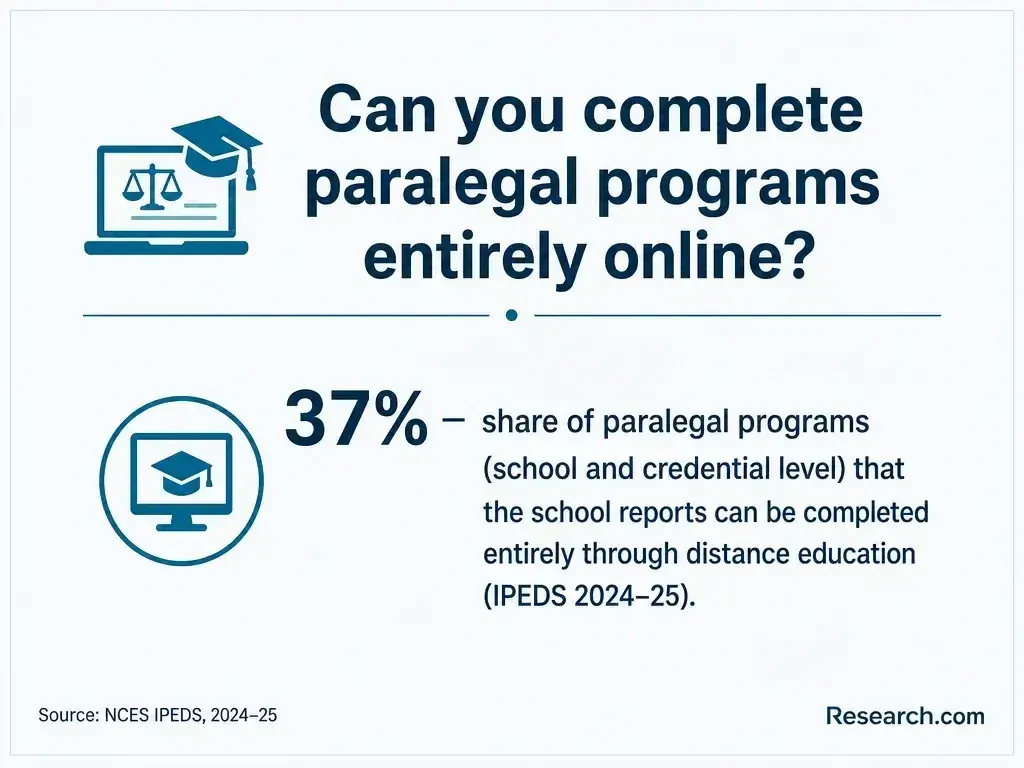
Online study can reduce travel across North Dakota and make scheduled work easier to maintain. Legal reading, research, and writing may work well remotely; an internship, court observation, or employer-based project may still require a suitable local site if the program requires one. On-campus study can offer more face-to-face feedback and access to nearby legal employers, but commuting and fixed meeting times add costs.
Use a list of top universities online only as a starting point. For any specific associate degree, confirm that legal courses are offered in the format advertised, that the school can serve North Dakota students, and that the school will help you arrange any required local experience. Online delivery alone establishes neither transferability nor job readiness.
There is no reliable single price for every North Dakota student: tuition can vary by institution, residency classification, course load, and delivery format. A published annual tuition figure also is not the price of finishing the degree. Ask each school for an estimate covering the credits you still need, mandatory fees, books and legal research software, technology, transportation to classes or placements, and living expenses. Include earnings you would give up by reducing work hours.
Compare net total cost to completion after grants and scholarships, alongside likely borrowing and time to finish. An accelerated schedule may reduce living and commuting costs but cost more in lost wages if it makes full-time employment impractical. An inexpensive first year is not a bargain if required legal courses are infrequent and delay graduation.
Students at an eligible institution and degree program may qualify for federal grants, loans, or work-study after submitting the Free Application for Federal Student Aid; eligibility depends on individual circumstances (Federal Student Aid). Ask the school's aid office about current North Dakota aid, institutional or tribal scholarships where applicable, employer tuition assistance, and whether changing to part-time enrollment would alter an award. Do not count an anticipated award as available funding until the school confirms it.
Borrowing should be tied to a specific career plan. If your immediate goal is a narrower legal-office skill, compare the aid and career value of the associate degree with shorter options, including certifications for jobs that pay well; the linked examples are not substitutes for checking whether a legal employer wants your particular coursework.
Expect to document secondary-school completion or an accepted equivalent and meet the institution's placement and admissions rules; legal courses may have writing or other course prerequisites. Requirements differ by school, so ask for the current catalog rather than assuming admission to the institution means immediate entry to every course in the degree.
If you have prior college work, request an official transfer evaluation before committing. Also confirm whether an internship requires a background check or a minimum grade in core legal courses. Those are program or placement rules where specified, not a statewide paralegal licensing process.
Look for a sequence that teaches students to find and verify legal authorities, write accurately, manage case information, and understand professional boundaries. Typical subjects include legal research and writing, civil litigation, contracts, legal ethics, and office technology, alongside general education in composition and other college-level subjects. The specific catalog - not a generic course list - determines what a student will actually study.
Ask to see assignments or course descriptions for research using current legal databases, drafting and proofreading documents, handling confidential information, and electronic filing where taught. An internship or supervised project can test these skills in a real workflow; if none is required, ask what other assessed practice the program provides. The U.S. Bureau of Labor Statistics describes research, drafting, and organizing files as core paralegal duties.
Specialization at the associate level often comes from electives, a placement, or the subjects emphasized in required courses rather than a formally named concentration. Litigation, real estate, family law, and business-related legal work can call for different documents and procedures. Choose courses with the work you hope to seek in mind, but retain a foundation in research, writing, ethics, and legal technology so you are not dependent on one type of vacancy.
In a smaller local market, verify that employers near you actually handle the practice area you want. A specialized elective is less useful as an employment strategy if relevant placements and openings would require a move you do not intend to make.
Start with the role you want, then test whether each degree provides the coursework, practical experience, schedule, and price needed to pursue it. A ranking helps identify options, but it cannot tell you whether your prior credits transfer or whether an internship fits around your job. Confirm institutional accreditation through the U.S. Department of Education's recognized-accreditor information; ask separately about any paralegal-program approval or recognition the school claims. Institutional accreditation, program-specific recognition, and credit-transfer decisions are different matters.
Use the following questions when speaking with admissions and program staff. Their answers should let you compare actual completion plans, not just brochures.
Be wary of promises that accreditation guarantees a job or that an occupational median wage describes new graduates. Keep future academic decisions separate from the associate-degree comparison; resources such as easiest master's degree to get do not establish that this degree's credits will transfer. Obtain the receiving institution's written evaluation before treating transfer as part of your return on investment.
A graduate might pursue paralegal, legal assistant, litigation-support, or legal administrative work, depending on the employer's requirements and the applicant's experience. Entry duties may center on organizing records and preparing drafts under lawyer supervision; greater responsibility can come with demonstrated accuracy, knowledge of a practice area, and the ability to manage complex cases. Optional professional certification may help some applicants demonstrate knowledge, but it is not the same as permission to practice law independently.
If you want an associate degree that also supports later study, compare an AA or AS transfer plan with an AAS career-entry plan and obtain written confirmation about which credits a receiving institution would accept. Do not choose a paralegal associate degree on the assumption that it automatically creates a fast route to a much later qualification; even a resource about fast paced master's degree programs cannot answer that transfer question for you.
The U.S. Bureau of Labor Statistics projects −0.3% national employment change for paralegals and legal assistants from 2025 to 2035. That projection describes a nearly flat occupation nationally, not an absence of replacement openings or a forecast for North Dakota. It does mean applicants should not rely on broad growth alone: local employer contacts, a useful internship, and evidence of strong legal writing may matter more to an initial search.
North Dakota students should search openings by feasible commuting area and compare the stated duties with their coursework. Someone unable to relocate may have fewer suitable choices than a statewide search suggests; someone open to multiple practice areas or remote-capable work may have a wider search, subject to each employer's location and supervision requirements. Before borrowing, compare recent local postings and entry-level pay with your expected degree cost and existing earnings.
Investing in an associate degree is a significant decision. Research.com created its ranking to help readers compare programs against relevant alternatives, using reported outcomes, costs, and quality indicators rather than relying on reputation alone. Programs are evaluated against others in the same occupation and location; only programs with completions reported to IPEDS are eligible. That coverage rule does not mean an unlisted program is unavailable or unsuitable.
Best-program rankings assess student completion and full- and part-time retention; earnings one year after completion and earnings relative to annual attendance cost; tuition, attendance cost, debt, and federal loan default rates; and accreditation, relevant recognition, and student support. Relevant programmatic accreditation or industry recognition receives 20% of the score, institutional accreditation 10%, and student support 10%. The remaining 60% covers outcomes, earnings, and costs, with weights distributed through an entropy-based method that gives more weight to indicators that vary more across programs. Most-affordable-program rankings score only costs and debt using that method; they do not include accreditation or other quality indicators in the score.
The following databases and organizations were used in creating the ranking. Some serve broader occupational rankings and should not be mistaken for paralegal-specific accreditors or evidence that a particular paralegal program holds their approval.
Use the ranking to narrow your choices, then confirm current program availability, degree requirements, and your own net cost with each school. More detail on the approach is available in Research.com's methodology.
# 1 position
# 2 position
Legal Assistant/Paralegal
Delivery mode: Online
26.34
/ 100
Final score
Accreditation
Institutional accreditation from Higher Learning Commission.
United Tribes Technical College received a Research.com Trade Program Score of 26.34/100.
It may be if the degree adds legal research, writing, and practical experience you need at a manageable net cost. Compare that cost and any lost wages with realistic local opportunities; a national median salary does not measure your personal return.
An AAS usually prioritizes occupational coursework; an AA or AS may offer a more transfer-oriented course mix. Compare the actual legal courses and obtain written confirmation of any intended credit transfer.
Some programs may deliver coursework online, but a required internship or other practical experience may need a local site. Confirm the format of every required component with the school.
Paralegals work under lawyer supervision rather than holding a license to practice law independently. Confirm an employer's education and experience requirements; do not confuse optional professional certification with a law license.
No. Accreditation and credit acceptance are separate decisions. Ask the institution you hope to transfer to for a written, course-specific evaluation.