
Best Court Reporter Training Programs & Trade Schools - Top Court Reporting Schools in Pennsylvania for 2026

Co-Founder and Chief Data Scientist
Choosing the right court reporter trade school in Pennsylvania is an important step toward a rewarding career. This article introduces the best programs for 2026, carefully ranked by the Research.com team of data scientists to help you make an informed decision.
By exploring these top schools, you’ll gain insight into options that offer quality education and strong career prospects. Earning a diploma or certification can open doors and set you on a path to success in the legal and transcription fields.
Take this opportunity to discover programs that fit your goals and start building your future with confidence.
Key benefits of finishing court reporter trade school in Pennsylvania
- Graduates of court reporter trade schools in Pennsylvania can expect competitive salaries, often starting around $62,600 and reaching up to $100,200 annually, with top earners making over $118,000.
- Career paths include working as official court reporters, freelance reporters, or captioners, offering flexibility and growth opportunities, as demonstrated by graduates from well-known Pennsylvania trade schools.
- Completing court reporter training online provides convenience and the ability to balance work or family, a benefit highlighted by successful online graduates who quickly enter the workforce with essential skills.
- Best Court Reporter Training Programs & Trade Schools - Top Court Reporting Schools in Pennsylvania for 2026
- What can I expect from court reporter trade schools in Pennsylvania?
- Where can I work after finishing court reporter trade schools in Pennsylvania?
What can I expect from court reporter trade schools in Pennsylvania?
Students enrolling in court reporter trade school programs in Pennsylvania can expect an intensive curriculum focused on technical mastery and professional readiness. Graduates from well-regarded institutions like Luzerne County Community College describe the early challenge of learning stenotype machines, a specialized keyboard essential for rapid transcription, requiring a typing speed target of 225 words per minute. This hands-on training is paired with coursework in legal and medical terminology, English grammar, and business mathematics, ensuring a comprehensive foundation tailored to Pennsylvania's legal system.
Programs often demand specialization choices between stenography, voice writing, or digital reporting, with timelines ranging from six months for digital reporting to two years for an Associate's Degree. Students share positive experiences of frequent transcription assignments and speed-building drills, which build confidence and precision. Instructors provide detailed feedback, helping students refine their skills for certification exams like the Registered Professional Reporter (RPR) or the Pennsylvania state exam, known for its rigorous 95% accuracy requirement.
Successful graduates feel well-prepared for diverse roles, from courtrooms to captioning services, appreciating the alignment of training with real-world demands and the supportive learning environment that fosters both skill and self-assurance.
Where can I work after finishing court reporter trade schools in Pennsylvania?
After completing a court reporter trade school program in Pennsylvania, graduates often find employment as Official Court Reporters within county courts such as the Court of Common Pleas. Counties like Berks and Lycoming actively hire, offering starting salaries near $56,000, with the potential to earn up to $75,400 plus transcript production income and comprehensive benefits. Graduates from popular Pennsylvania trade schools frequently describe the rewarding experience of working in real courtroom environments, capturing critical legal proceedings with precision.
Many also secure roles at the federal level, including positions at the United States District Court for the Eastern District of Pennsylvania in Philadelphia. These federal jobs provide stable career paths and are accessible to those who have completed accredited programs. Freelance reporting and deposition services represent additional avenues, where graduates transcribe depositions and arbitrations for law firms, enjoying flexible schedules and diverse assignments.
Other career options include closed captioning for live events or administrative roles in legal support organizations. Graduates appreciate the ongoing educational support available in Pennsylvania, which helps them stay competitive and confident in their evolving careers.
Graduates of court reporter trade schools in Pennsylvania typically start with salaries around $31,000 per year, according to Salary.com. This aligns with many new professionals who, after completing hands-on training at well-known Pennsylvania trade schools, step confidently into entry-level roles earning in the low $30,000s. These figures reflect real experiences of recent graduates who have successfully transitioned from classroom learning to paid court reporting positions.
With time and additional certifications, these graduates often see their annual income rise significantly, reaching between $45,000 and $83,000 as skills sharpen and reputation builds. In urban hubs like Philadelphia, starting salaries can be higher, closer to $81,000 annually, reflecting the city's demand for skilled court reporters and its higher cost of living.
Many graduates describe the satisfaction of quickly moving from training to a rewarding career, noting that the investment in popular Pennsylvania trade schools pays off through steady salary growth and job stability across the state's legal sectors.
- Most court reporter programs in Pennsylvania require a high school diploma or GED before applying.
- Stenography programs usually take about two years and require reaching a minimum speed of 225 words per minute.
- Certification is required for employment, with options including Pennsylvania state certification or national credentials like the Registered Professional Reporter (RPR).
- Tuition costs range from $5,000 to $15,000, with extra fees for equipment and certification exams.
- Entry-level court reporters earn between $40,000 and $50,000 annually, while experienced reporters can make $60,000 or more.
Completing a court reporter trade school program in Pennsylvania typically takes between 18 and 24 months, depending on the school's curriculum and the student's pace. Graduates from popular trade schools in the state often describe the experience as intense but rewarding, noting that the focused timeframe helped them stay motivated and engaged.
For example, students attending well-regarded Pennsylvania programs find that the balance of theory and hands-on practice accelerates skill acquisition. Many report feeling a strong sense of accomplishment as they progress through real-world transcription exercises, which simulate actual courtroom scenarios. This practical approach ensures they are prepared for the demands of the profession shortly after graduation.
Flexible scheduling options at several trade schools also allow some students to complete their studies faster by attending accelerated courses or dedicating extra hours each week. The supportive learning environments reported by graduates make it easier to manage the rigorous coursework, fostering confidence and readiness for certification exams within two years or less.
The primary difference between online and on-campus court reporter trade school programs in Pennsylvania lies in delivery and structure. Online programs, such as those offered by Court Reporter EDU Pennsylvania, provide graduates with the freedom to learn at their own pace, balancing coursework with jobs or family life. These graduates often appreciate mastering advanced tools like speech-to-text technology and Eclipse Vox CAT systems from home, though they must stay self-motivated without face-to-face instructor support.
On-campus programs at schools like Lehigh Carbon Community College and the Community College of Allegheny County demand regular attendance, offering in-person instruction and hands-on training with shorthand machines. Graduates value the immediate feedback and direct access to faculty, which fosters a collaborative learning environment and structured progress over the typical two-year associate degree.
Many Pennsylvania students find hybrid programs, such as those at CCAC, provide a satisfying balance-combining virtual flexibility with scheduled in-person sessions to suit diverse learning preferences and busy lifestyles.
The average tuition fees for court reporting programs in Pennsylvania vary significantly depending on residency and institution, typically ranging from about $1,890 to $5,670 per year. Graduates from the Community College of Allegheny County report that Allegheny County residents benefit from tuition of $1,890 annually, while other Pennsylvania residents and out-of-state students pay $3,780 and $5,670 respectively. This tiered pricing structure highlights the importance of residency status in calculating the total expenses for court reporter training in Pennsylvania.
At Lehigh Carbon Community College, a similar pattern emerges with tuition fees of $2,812.50 for Schuylkill County residents, $3,750 for other Pennsylvania residents, and $5,625 for out-of-state students. Graduates from these programs often mention how knowing the exact cost breakdown helped them plan their budgets effectively, enhancing their confidence to commit to the trade school journey.
Beyond tuition, students must consider supplemental costs such as books, equipment, and supplies. For example, some students at the University of Pennsylvania pay $6,104 when they do not require a steno machine, while those who need the specialized machine see costs rise to $7,899. These additional expenses can influence the total financial commitment a student anticipates when entering court reporter training.
Financial aid options including federal aid, scholarships, and grants are commonly accessed to mitigate these costs. Prospective students often find it valuable to explore all aid possibilities with the financial aid offices of their chosen schools. For those weighing alternatives, resources like the top legal studies associate's degree online listings can offer useful supplementary insights into related pathways.
Court reporter trade school students in Pennsylvania benefit from several targeted financial aid options that ease the burden of tuition and related costs. For example, the Pennsylvania Court Reporters Association (PCRA) provides a $500 scholarship annually to students who have completed at least one semester and have faculty nominations. Graduates from institutions like Plaza College and Luzerne County Community College have found this scholarship especially helpful in managing expenses during their studies.
Beyond state-specific aid, national organizations such as Veritext and the National Court Reporting Foundation offer scholarships and tuition assistance, often linked to completing introductory courses. These opportunities have supported Pennsylvania students at schools like the Community College of Allegheny County, enabling them to continue without financial stress.
Private scholarships, like the Maria Stahl Court Reporting Scholarship, award $1,000 based on academic merit and financial need, directly benefiting students by applying funds to tuition or bookstore costs. Additionally, most Pennsylvania trade schools participate in federal aid programs, including Pell Grants and loans, accessible through FAFSA applications, providing essential support for many aspiring court reporters.
To enroll in court reporter trade school programs in Pennsylvania, candidates generally must meet several key prerequisites that ensure readiness for the rigorous training ahead. Most trade schools require applicants to have a high school diploma or GED, establishing a fundamental educational baseline.
Additionally, many programs emphasize strong English proficiency, both written and verbal, since accurate transcription and understanding of legal terminology are crucial. Graduates from Pennsylvania trade schools often highlight how early mastery of grammar and vocabulary helped them excel in classes and later in their careers.
Some schools also require applicants to pass an entrance exam or demonstrate basic computer skills, reflecting the digital tools used in modern court reporting. For example, students from well-known Pennsylvania institutions recall how initial computer literacy assessments prepared them for real-world transcription tasks.
Key prerequisites include:
- High school diploma or GED
- Proficiency in English language and grammar
- Basic computer skills or passing an entrance test
These requirements help ensure that students in Pennsylvania's court reporter trade schools are equipped to handle the program's intensity, ultimately fostering confidence and success in their studies and future careers.
Students enrolled in court reporter trade schools in Pennsylvania engage in a focused curriculum designed to build practical skills essential for legal transcription careers. Graduates often describe the intensity and reward of mastering machine shorthand (stenography), a critical skill for capturing verbatim courtroom dialogue in real time.
Typical courses include:
- Machine shorthand and transcription: Students train extensively to convert shorthand notes into precise transcripts, gaining confidence through repetitive practice.
- Legal and court procedures: Understanding courtroom dynamics helps students anticipate and accurately document proceedings.
- Medical and legal terminology: This specialized vocabulary prepares students to transcribe complex expert testimony with clarity.
- Computer-aided transcription and digital reporting software: Hands-on experience with industry-standard technology readies students for modern court environments.
- Ethics and professionalism: Emphasized throughout to instill confidentiality and integrity, qualities graduates consistently highlight as crucial in their careers.
Graduates from popular Pennsylvania trade schools often share that learning to meet strict speed and accuracy benchmarks-such as 180 to 225 words per minute-was challenging but deeply satisfying, boosting their confidence to excel in legal settings.
Court reporter trade school programs in Pennsylvania typically offer three core specializations that align with diverse career paths and evolving technology in the industry. Graduates often describe their training as both challenging and rewarding, especially when mastering court reporter specializations in Pennsylvania like stenographic reporting, voice writing, and electronic reporting.
Stenographic reporting, taught at institutions such as the Community College of Allegheny County and Luzerne County Community College, focuses on using a stenotype machine for real-time transcription. Students appreciate gaining skills in machine shorthand and specialized legal terminology, which allow for immediate, accurate courtroom documentation.
Voice writing, available at Lehigh Carbon Community College, trains students to use a stenomask paired with voice recognition software. Graduates highlight this method's usefulness in fast-paced court environments where stenotype machines may not be practical.
Electronic reporting, provided by the Community College of Philadelphia, involves recording proceedings digitally and transcribing them afterward. This specialization appeals to those interested in leveraging audio technology and transcription software efficiently.
Enrolling in these Pennsylvania court reporting program specializations equips students with versatile skills that match personal interests and emerging industry demands. For students looking to diversify their qualifications further, combining court reporter training with related fields such as homeland security can be advantageous-for example, reviewing fast online homeland security degree programs.
Choosing from the best court reporter trade schools in Pennsylvania requires careful attention to accreditation, curriculum relevance, and program flexibility. Graduates from Central Penn College, known for its top court reporting programs in Pennsylvania, often praise the school's strong career services and high job placement rates, which ease the transition into the workforce. Likewise, programs like the Community College of Philadelphia attract students seeking affordable options; its Digital Court Reporter course costs around $795 and includes potential financial aid, making it accessible for many.
Programs with comprehensive curricula covering legal and medical terminology, real-time reporting, and certification preparation-such as the Registered Professional Reporter (RPR)-are critical for career readiness. Students benefit when schools offer flexible schedules, including evening or online classes, accommodating diverse lifestyles. Many Pennsylvania students appreciate locating their programs near key courthouses, like those in Pittsburgh's vibrant community, for practical experience opportunities.
Financial considerations are important; prospective students might explore options such as a low cost master of legal studies online to enhance credentials without excessive debt.
Graduates of court reporter trade school programs in Pennsylvania gain access to diverse career paths that leverage their specialized training. Many pursue roles as official court reporters in county, state, or federal courtrooms, providing real-time transcripts during criminal trials and civil cases. These positions offer rewarding experiences, especially for those studying at well-known Pennsylvania trade schools where hands-on courtroom practice is emphasized.
Others explore freelance court reporting careers in Pennsylvania, working flexibly with attorneys, corporations, and unions to document depositions and arbitrations. Freelance graduates often highlight the variety and autonomy this path offers compared to traditional court roles.
Additional opportunities include:
- CART captioning for live events supporting the deaf and hard-of-hearing community
- Broadcast captioning for television and emergency broadcasts
- Legislative reporting within the Pennsylvania General Assembly or U.S. Congress
- Specialized transcription services for government or medical sectors
According to state data, court reporter job opportunities in Pennsylvania remain strong, with over 100 job postings reported recently.
Graduates keen on advancing their expertise sometimes pursue the cheapest masters degree in forensic science online to complement their court reporting skills, broadening potential roles and earning power.
The court reporter job outlook in Pennsylvania reveals a steady, though modest, demand for graduates from trade school programs in this field. With around 1,020 court reporters employed statewide in 2022 and a projected growth of 4% by 2032, new entrants can expect a small but consistent number of openings annually. Graduates from Pennsylvania's well-regarded trade schools often highlight the importance of state and national certifications like Registered Professional Reporter (RPR) to enhance their competitiveness in the job market.
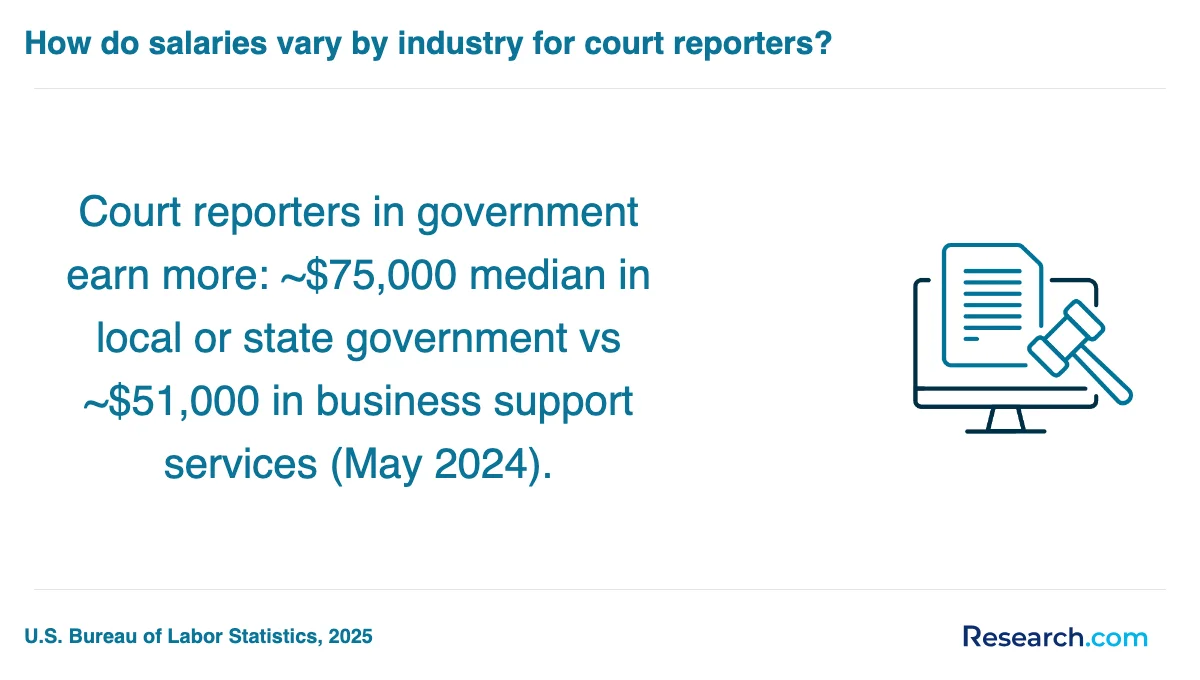
Job market activity is notably stronger in metropolitan areas such as Philadelphia, where many graduates find rewarding roles with salaries reflecting the court reporter salary trends Pennsylvania 2026. Average annual pay hovers around $80,744 statewide, with Philadelphia averaging slightly higher at $81,292, and top earners reaching over $118,000. Real-life experiences from recent graduates emphasize that advanced certifications and specialization can substantially impact earnings and job stability.
For those interested in expanding career options, combining court reporting skills with related fields is an emerging trend; exploring a cyber crime degree alongside court reporting has proven useful for diversified employment opportunities.
Best Court Reporter Training Programs & Trade Schools - Top Court Reporting Schools in Pennsylvania for 2026
# 1 position
Community College of Allegheny County - Court Reporting and Captioning/Court Reporter.
associateThe Court Reporting and Captioning/Court Reporter program at Community College of Allegheny County offers a hybrid format with some distance-education options. It prepares students to transcribe legal proceedings using print or electronic methods, covering legal terminology, shorthand, equipment operation, and professional ethics. The program is accredited by the Middle States Commission on Higher Education. Annual in-state tuition is $4,842, and median earnings one year after completion are $19,412.30.
# 2 position
Luzerne County Community College - Court Reporting and Captioning/Court Reporter.
associateLuzerne County Community College offers a hybrid Court Reporting and Captioning/Court Reporter program that prepares students to accurately record and transcribe legal proceedings using print or electronic methods. The curriculum covers legal terminology, shorthand, equipment operation, regulations, and professional ethics. Annual in-state tuition is $6,450. The program is accredited by the Middle States Commission on Higher Education.
# 3 position
Community College of Allegheny County - Court Reporting and Captioning/Court Reporter.
certificate or diplomaThe Court Reporting and Captioning/Court Reporter program at Community College of Allegheny County offers a hybrid format with some distance-education options. It prepares students to transcribe legal proceedings accurately using print or electronic methods, covering legal terminology, transcription, shorthand, and equipment operation. The program is accredited by the Middle States Commission on Higher Education. Annual in-state tuition is $4,842, and median earnings one year after completion are $19,412.30.
Frequently Asked Questions about court reporter
After completing a court reporter trade school in Pennsylvania, preparing for the job market involves several key steps. First, obtaining certification is essential. The National Court Reporters Association (NCRA) offers the Registered Professional Reporter (RPR) credential, which significantly improves employment prospects.
Next, gaining practical experience through internships or freelance opportunities can help build a strong resume. Pennsylvania's demand for court reporters is steady, with the U.S. Bureau of Labor Statistics projecting a 6% growth rate nationally through 2032, suggesting stable opportunities.
Networking with local court reporting associations and attending industry events in Pennsylvania also enhances job connections. Lastly, developing proficiency in realtime reporting and technology tools is crucial, as many employers now expect these skills.
Employers in Pennsylvania seek several key skills when hiring court reporter trade school graduates. Accuracy is paramount; court reporters must transcribe spoken words with near-perfect precision. According to the Bureau of Labor Statistics, the demand for skilled transcriptionists is growing, emphasizing the need for strong attention to detail. Proficiency in stenography machines and realtime reporting software is also critical, as many courts require immediate transcripts during proceedings.
Strong listening and comprehension skills help reporters capture complex legal language correctly. Time management is essential to meet deadlines, especially in busy court settings. Communication skills are valued as reporters often interact with attorneys and judges. Pennsylvania's state licensing requirements further ensure graduates possess these competencies before entering the workforce.
Finding internships relevant to court reporter trade school programs in Pennsylvania involves several strategic steps. Start by contacting your trade school's career services, as many schools maintain relationships with local courts and legal firms that offer internship opportunities. Networking through professional organizations such as the Pennsylvania Court Reporters Association can also provide leads on internships and mentorship programs.
Additionally, inquire directly with county courthouses across Pennsylvania, as some offer unpaid or paid internships for aspiring court reporters. According to the U.S. Bureau of Labor Statistics, practical experience is critical for certification exams, making internships valuable for skill development.
Online job portals and state government websites occasionally list court reporter internships, so regularly monitoring these can be beneficial.
Obtaining a court reporter trade school diploma in Pennsylvania can significantly enhance career mobility and advancement opportunities. The diploma provides essential skills in transcription, legal terminology, and stenography, which are critical for employment in courts, legal firms, and government agencies. According to the U.S. Bureau of Labor Statistics, the demand for court reporters in Pennsylvania is expected to grow by 7% from 2021 to 2031, indicating steady job availability.
Graduates with formal diplomas often find higher starting salaries and better chances for certification, such as the Registered Professional Reporter (RPR) credential. Certification improves credibility and opens doors to advanced roles, including realtime captioning and official court reporting. Pennsylvania's legal system values accredited training, which supports upward social mobility through stable and well-paying careers.
Students enrolled in court reporter trade schools in Pennsylvania can benefit from part-time positions that enhance their skills and provide relevant experience. Common opportunities include transcription work, which hones typing speed and accuracy-key abilities for court reporting. Freelance captioning for live events or broadcasts is another option, allowing practice with real-time text production.
Additionally, internships or assistant roles in local law firms or court offices offer exposure to legal terminology and courtroom procedures. According to the U.S. Bureau of Labor Statistics, Pennsylvania's demand for court reporters is steady, with opportunities concentrated in urban centers like Philadelphia and Pittsburgh. Engaging in these roles can improve employability upon graduation.
To choose the best Court Reporter degree program near me in Pennsylvania, start by identifying programs and universities that are accredited and offer specialized training in court reporting. Consider factors such as curriculum, faculty expertise, and the availability of internship opportunities to gain practical experience. Research resources like Research.com can provide information on schools near Pennsylvania that have a strong emphasis on quality education in this field.
- Best Court Reporter Training Programs & Trade Schools - Top Court Reporting Schools in New York for 2026
- Best Court Reporter Training Programs & Trade Schools - Top Court Reporting Schools in Ohio for 2026
- Best Court Reporter Training Programs & Trade Schools - Top Court Reporting Schools in Illinois for 2026
- Best Court Reporter Training Programs & Trade Schools - Top Court Reporting Schools in Alabama for 2026
- Best Court Reporter Training Programs & Trade Schools - Top Court Reporting Schools in Florida for 2026
- Best Court Reporter Training Programs & Trade Schools - Top Court Reporting Schools in Wisconsin for 2026
- Best Court Reporter Training Programs & Trade Schools - Top Court Reporting Schools in Minnesota for 2026
- Best Court Reporter Training Programs & Trade Schools - Top Court Reporting Schools in Kansas for 2026
- Best Court Reporter Training Programs & Trade Schools - Top Court Reporting Schools in Texas for 2026
- Best Court Reporter Training Programs & Trade Schools - Top Court Reporting Schools in Arizona for 2026
- How to Become a Court Reporter in Pennsylvania (Certification & Guide) https://legalcareerpath.com/court-reporter-pennsylvania/
- Pennsylvania Court Reporting Schools | How to Become a Court Reporter by Meeting License Requirements in PA https://www.courtreporteredu.org/pennsylvania/
- HACC's Court and Realtime Reporting program can be a path to an exciting, lucrative career choice https://www.hacc.edu/newsroom/2007/haccs-court-and-realtime-reporting-program-can-be-a-path-to-an-exciting-lucrative-career-choice.cfm
- Paralegal Studies & Court Reporting https://www.ccac.edu/academics/programs/business-and-accounting/paralegal-studies-and-court-reporting.php
- Online Digital Court Reporter from Pennsylvania Highlands Community College https://ed2go.pennhighlands.edu/training-programs/digital-court-reporter/
- Luzerne County Community College - Spotlight https://www.luzerne.edu/spotlight/readmore.jsp
- Careers in Court Reporting https://www.pcra.com/careers-in-court-reporting
- Online Digital Court Reporting with Legal Transcription from Pennsylvania College of Technology https://onlinetraining.pct.edu/training-programs/digital-court-reporter-and-legal-transcription/
- Allentown, Pennsylvania Court Reporter Programs https://www.trade-school.com/programs/Court-Reporter/PA/Allentown
- How To Become a Court Reporter (School, Duties & Salary) https://www.allcriminaljusticeschools.com/specialties/court-reporter/


