Choosing a speech pathology degree in Washington means balancing licensure eligibility, clinical training, debt, and access to jobs in schools and health care. This guide explains the options, costs, admissions, career paths, and decision points that matter most. It also features the 2027 Most Valuable Speech Pathology Degree Programs Ranking in Washington, created by the Research.com team of data scientists to help students make an informed choice about which speech pathology degree programs are worth considering.
Key findings about speech pathology degrees in Washington
A Washington speech-language pathologist typically needs a qualifying master's degree, supervised post-graduate experience, examination, and state licensure; a bachelor's degree alone does not qualify someone for independent SLP practice.
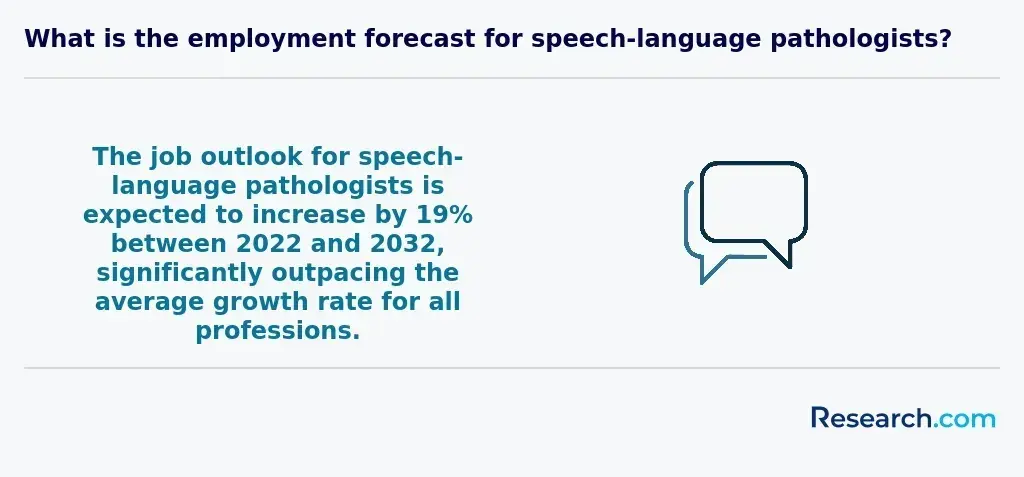
The national median annual wage for speech-language pathologists was $97,870 in May 2025, while BLS projects 17% employment growth from 2025 to 2035; strong demand improves the case for a graduate degree but does not remove the need to manage tuition and debt carefully.
Washington applicants should prioritize CAA-accredited graduate programs with clear clinical-placement support, because online coursework alone cannot replace the supervised practicum and clinical fellowship required for professional practice.
What can I expect from a speech pathology degree in Washington?
"Speech pathology" usually refers to speech-language pathology (SLP), the clinical field focused on communication, swallowing, voice, language, fluency, and cognitive-communication disorders. For most people seeking Washington licensure, the relevant degree is a master's in speech-language pathology or communication sciences and disorders with an SLP clinical curriculum.
A bachelor's degree in communication sciences and disorders is useful preparation, but it is not a terminal practice credential. Career changers often complete prerequisite courses before entering a master's program. The graduate curriculum combines academic study, simulated or supervised clinical work, and placements with clients across the lifespan.
This comparison shows which educational route generally fits each goal.
Education route
Best fit
What it can lead to
Key limitation
Bachelor's in communication sciences and disorders
Students beginning the field
Graduate-school preparation; support roles where permitted
Does not independently qualify a graduate for SLP licensure
Post-baccalaureate prerequisites
Career changers with an unrelated bachelor's degree
Eligibility to apply to many SLP master's programs
Adds time and tuition before graduate enrollment
Master's in speech-language pathology
Future licensed SLPs
Clinical fellowship, national certification pathway, state licensure application
Requires intensive clinical education and post-degree requirements
Doctoral study
Researchers, faculty, or advanced clinical leaders
Research, teaching, leadership, or specialized scholarship
Usually unnecessary for entry-level clinical SLP practice
Washington is a practical choice for students who expect to build local school, hospital, rehabilitation, or early-intervention networks. However, applicants should not assume that every Washington graduate program offers the same client populations or placement geography. Ask whether placements may require travel, whether the program arranges them, and whether rural placements are available if you plan to work outside the Puget Sound region.
Where can I work with a speech pathology degree in Washington?
Licensed SLPs work wherever communication and swallowing assessment or intervention is needed. In Washington, schools are a major employment setting, while health systems, outpatient clinics, skilled nursing facilities, early-intervention providers, and telepractice organizations broaden the market.
The setting you target should influence the program you choose because the preferred clinical populations, schedule, employer credential expectations, and reimbursement environment differ considerably.
Public and private schools: evaluate speech, language, fluency, social communication, and academic-language needs; school roles may also require Washington educator certification through the Office of Superintendent of Public Instruction.
Hospitals and rehabilitation settings: assess swallowing, aphasia, motor speech, voice, and cognitive-communication conditions, often in coordination with physicians, occupational therapists, and physical therapists.
Early intervention and pediatric clinics: support infants, children, caregivers, and developmental teams, with frequent emphasis on language development and family-centered care.
Skilled nursing and home-health settings: serve adults with neurological, swallowing, voice, or cognitive-communication needs; caseload and productivity expectations can differ substantially by employer.
University clinics, research, and telepractice: combine direct care, clinical supervision, research, or remote service delivery, subject to employer policies and applicable licensure rules.
Students considering school employment should investigate the additional education-credential pathway before enrolling. Students focused on medical SLP should compare adult dysphagia, neurogenic communication, and hospital-placement exposure rather than choosing solely on overall tuition.
The newest national Occupational Outlook Handbook figure reports a median annual wage of $97,870, or $47.05 per hour, for speech-language pathologists in May 2025 (U.S. Bureau of Labor Statistics). This is a national median, not a promise of starting pay in Washington; actual compensation varies by setting, experience, schedule, employer, credentials, and location.
For decision-making, compare prospective income with the full cost of becoming licensed, not only a first-year salary. School jobs may offer predictable calendars and public-sector benefits, while medical, contract, and private-practice roles can have different pay structures, productivity demands, and benefit arrangements.
The following factors matter more than a single salary estimate when evaluating return on investment.
ROI factor
Why it matters
How to use it
Total net price
Tuition is only one cost; fees, housing, travel, clinical requirements, and lost earnings affect borrowing
Compare the estimated total cost after grants and scholarships
Time to completion
A longer program can increase both tuition and opportunity cost
Confirm prerequisite, clinical, and graduation timelines
Completion probability
Debt is harder to manage if a student leaves before earning the qualifying degree
Ask about progression policies and clinical-placement support
Career setting
Pay and schedules vary across schools, health care, and private practice
Match clinical experiences to your intended employer type
Debt repayment horizon
Loan payments should be considered over time, including interest and changing earnings
Model conservative earnings and repayment scenarios before borrowing
Readers exploring settings with stronger earning potential can compare roles through this guide to highest paying speech pathology jobs and careers. Use compensation information as planning context, not as a guarantee that a particular degree or employer will deliver a particular salary.
The most valuable programs make their route to professional practice easy to verify: they clearly state accreditation status, prerequisite expectations, clinical-practicum structure, graduation requirements, placement support, and total cost. For Washington applicants, a program's ability to support Washington licensure and provide appropriate supervised clinical education matters more than broad institutional reputation.
The supplied program pages identify institutions in the District of Columbia rather than Washington. They therefore should not be treated as Washington program options or evidence for a Washington ranking. Their location distinction is important for applicants because clinical-placement arrangements and state licensure planning are jurisdiction-specific.
University of the District of Columbia: The supplied page is for a District of Columbia-based speech-language pathology offering, not a Washington program. A Washington-bound student should verify whether any out-of-state curriculum, practicum, and supervised-experience pathway satisfies Washington Department of Health requirements before applying.
Gallaudet University: Gallaudet's Hearing, Speech, and Language Sciences department is located in the District of Columbia and has a distinctive institutional connection to deaf and hard-of-hearing communities. That focus may be especially relevant for students seeking preparation around deafness and communication access, but it does not substitute for confirming Washington licensure compatibility.
George Washington University: The supplied George Washington University page is associated with speech, language, and hearing education in the District of Columbia. Applicants should request program-specific information on clinical placements, degree requirements, and whether the program has determined eligibility for Washington licensure.
Howard University: The supplied Howard University URL is an institution-level page rather than a verified speech-language pathology program page. It should not be used to infer a particular SLP degree structure, clinical-hour requirement, or Washington licensure outcome without direct program documentation.
When comparing actual Washington options, treat these as nonnegotiable questions: Is the graduate program accredited by the Council on Academic Accreditation in Audiology and Speech-Language Pathology (CAA)? Does it document its Washington licensure determination? Who secures placements, what client populations are represented, and what costs are attached to off-campus clinical work? Applicants seeking nearby comparisons may also review valuable speech pathology programs in district of columbia, while recognizing that District of Columbia requirements and program geography differ from Washington's.
A full-time master's degree in speech-language pathology commonly takes about two academic years, often including summer clinical education. The total path is longer for students who need undergraduate communication-sciences prerequisites, attend part time, or must complete a post-graduate clinical fellowship after graduation.
For a student entering with an unrelated bachelor's degree, the timeline typically has three stages: prerequisite coursework, the clinical master's program, and post-degree supervised practice and licensing steps. A student who already has the expected foundational courses can usually move through the first stage more quickly.
Acceleration can be useful when it genuinely preserves clinical quality and fits your finances. It is less attractive if it forces extensive borrowing, prevents paid work needed for living costs, or limits the medical or school-based placement exposure that matches your career plan. Explore program structures through this overview of accelerated SLP programs.
Online and campus-based SLP master's programs can both include rigorous academic instruction, but neither format eliminates the need for supervised clinical practicum. The key comparison is not whether lectures are delivered online; it is whether the program can provide eligible clinical experiences, faculty supervision, and a documented path toward Washington licensure.
This table highlights the trade-offs Washington applicants should evaluate before choosing a delivery format.
Factor
Online or hybrid program
On-campus program
Course access
Can reduce commuting and widen access for working students
Offers regular in-person access to faculty, peers, and campus clinics
Clinical training
Still requires local or arranged in-person clinical placements
May have more direct connection to university clinics and regional affiliates
Scheduling
Often offers greater flexibility for didactic coursework
Usually follows a more fixed cohort and campus schedule
Geographic risk
Students must confirm Washington placement availability before enrollment
Students may need to relocate or commute for required experiences
Best fit
Self-directed students with stable local placement and support plans
Students who value in-person clinical infrastructure and cohort interaction
A common mistake is assuming an online degree is automatically licensure-ready in every state. Before paying an enrollment deposit, obtain written confirmation of the program's Washington licensure determination, placement process, residency expectations, and all travel costs. Compare formats and admissions expectations through online speech language pathology programs.
A reliable statewide "average cost" is not appropriate without a consistent, current program-level dataset covering all Washington SLP programs. Published tuition changes by institution, residency status, credit load, academic year, and whether clinical terms carry additional charges. Applicants should therefore compare each school's official cost of attendance rather than rely on a single statewide estimate.
The most useful cost comparison separates billed tuition from the expenses that make a clinical graduate degree affordable or unaffordable in practice.
Cost category
Why it changes the comparison
Question to ask
Tuition and mandatory fees
Public institutions may charge different resident and nonresident rates; private nonprofit institutions may use a single published rate
What is the total tuition and required-fee estimate for the full program?
Clinical-placement expenses
Travel, parking, background checks, immunizations, testing, and professional attire can add costs
Which practicum costs are required but not included in tuition?
Living expenses
Seattle-area housing and commuting can materially change borrowing needs
Can I complete placements while living where I can reasonably afford to live?
Prerequisite coursework
Career changers may pay for courses before the master's degree begins
Which prerequisites must be completed, and can prior coursework transfer?
Lost earnings
Heavy clinical schedules can reduce the feasibility of full-time employment
What work schedule have current students realistically maintained?
In-state tuition can be a meaningful advantage at public institutions, but residency eligibility, time to degree, aid, and clinical travel can outweigh a lower posted rate. For perspective on how state-level cost comparisons can differ, see how much does it cost to become a speech pathologist in arizona.
Graduate SLP students commonly combine federal Direct Unsubsidized Loans, scholarships, assistantships where available, employer benefits, savings, and, for eligible borrowers, Graduate PLUS Loans. Federal Student Aid states that Graduate PLUS is available to eligible graduate or professional students enrolled at least half time in an eligible program who meet federal student-aid requirements and do not have an adverse credit history; borrowers must also complete the required federal application process (Federal Student Aid).
Because aid packages vary sharply by institution and clinical schedule, compare net cost rather than scholarship headlines. The following steps can reduce avoidable borrowing.
File the FAFSA as early as possible and review each school's aid deadline separately.
Request a written estimate showing tuition, fees, health insurance, and the school's allowance for housing and clinical travel.
Ask the department about graduate assistantships, clinic positions, research roles, and scholarships reserved for communication-sciences students.
Check whether your employer, school district, health system, or military benefit offers tuition support in exchange for a service commitment.
Borrow conservatively and compare repayment scenarios before accepting Graduate PLUS or private loans.
Washington residents should also check current state-administered aid eligibility and institution-specific awards, since availability and funding rules can change. A service obligation can be valuable when it aligns with where you want to work; it is less attractive when it restricts your early-career mobility or does not cover enough of the total program cost.
View the chart data as a table
SLP annual wage spread - Washington metro area (May 2025) (Source: U.S. Bureau of Labor Statistics (OEWS May 2025))
Category
Value
10th percentile
$72,800
25th percentile
$77,830
Median
$99,960
75th percentile
$129,700
90th percentile
$135,830
Admission requirements vary by school, but most clinical master's programs expect a completed bachelor's degree, academic preparation in communication sciences and disorders, recommendation letters, a personal statement, and evidence that the applicant can handle graduate-level clinical education. Programs may admit students from other majors, but those applicants often need designated prerequisite courses.
Common foundational coursework includes phonetics, speech and hearing science, language development, anatomy and physiology related to speech and hearing, audiology, and research methods or statistics. Each program decides which prior courses it will accept, so transfer credit is never automatic.
Before applying, build a course-by-course checklist against each program's published prerequisites. Ask admissions staff whether an older course remains acceptable, whether online prerequisites are permitted, when missing courses must be completed, and whether you can apply while prerequisites are in progress. Do not confuse admission eligibility with licensure eligibility: both must be verified.
A clinical SLP master's program develops the scientific knowledge and clinical judgment needed to assess and treat communication and swallowing disorders. Course titles differ, but CAA-aligned programs generally cover the major scope-of-practice areas alongside clinical practicum.
Students commonly encounter the following subject areas, which should be evaluated in relation to the populations they hope to serve.
Language development and disorders in children and adults
Speech sound disorders, phonological disorders, and motor speech disorders
Fluency disorders and voice or resonance disorders
Augmentative and alternative communication
Aphasia, traumatic brain injury, dementia, and other cognitive-communication disorders
Dysphagia and other swallowing disorders
Audiology foundations, counseling, ethics, and evidence-based practice
Clinical methods, diagnostics, documentation, and supervised practicum
Look beyond course names. A program may offer dysphagia or bilingual-language coursework, yet the amount of clinical exposure can differ. Students should ask which experiences are required, whether specialty electives are offered regularly, and whether faculty expertise aligns with their intended practice setting.
Most entry-level SLP master's degrees prepare graduates as broad generalists because Washington licensure is based on qualifying education and professional requirements rather than a narrow graduate concentration. Specialization is more often built through electives, practicum placements, clinical fellowships, continuing education, and employer experience.
Useful focus areas can include pediatric language and literacy, autism and neurodiversity-affirming practice, bilingual or multilingual service delivery, swallowing disorders, voice, fluency, augmentative communication, traumatic brain injury, aphasia, and hearing-related communication. Students interested in medically complex adult care should prioritize programs with relevant faculty and placements; future school clinicians should seek strong pediatric and educational-service experiences.
A red flag is selecting a program because it advertises a specialty without confirming access to actual clients, supervisors, or electives in that area. A broad CAA-accredited degree with dependable placements may be a better investment than a nominal specialization that is difficult to access.
The best program is the one that can realistically move you from your current academic background to your intended Washington practice setting with manageable cost and credible clinical support. A ranking can narrow the search, but it cannot determine whether a program accepts your prerequisites, fits your work obligations, or provides the clinical experiences you need.
Use this sequence to compare finalists consistently.
Confirm that the degree is CAA-accredited or that the school clearly explains its accreditation status and Washington licensure implications.
Calculate total estimated cost, including prerequisites, fees, housing, travel, and income you may forgo during clinical terms.
Ask how clinical placements are assigned, how far students travel, which populations are available, and what happens if placement capacity changes.
Match curriculum and placement strengths to your target setting: schools, pediatrics, hospitals, rehabilitation, or adult care.
Review admissions selectivity, prerequisite policies, cohort schedule, graduation requirements, and support for students balancing work or caregiving.
Compare completion timelines and debt under conservative assumptions rather than assuming a high salary immediately after graduation.
Do not choose solely by tuition, ranking position, or format. Lower tuition can lose its advantage if a program requires extensive unpaid travel or delays graduation; a higher-cost option may be reasonable only when aid, shorter completion, dependable placement infrastructure, and your likely career path support the difference.
View the chart data as a table
On-time completion rate (Source: ASHA EdFind / program reports)
Category
Value
<85%
0
85–<90%
0
90–<95%
1
95–<100%
3
100%
0
A qualifying SLP master's degree can support several career directions after graduates complete applicable supervised experience, examination, certification, and Washington licensing requirements. The degree is especially suited to people who want clinical work that combines science, communication, counseling, documentation, and interdisciplinary care.
This overview connects common pathways with the preparation that usually matters most.
Career path
Typical clients
Preparation priority
School-based SLP
Children and adolescents
Pediatric language, speech sound disorders, literacy, collaborative educational practice, and Washington school credential planning
Medical SLP
Adults and children in acute or outpatient care
Dysphagia, neurogenic communication disorders, medical documentation, and hospital or rehabilitation placements
Early-intervention SLP
Infants, toddlers, and families
Developmental language, caregiver coaching, and family-centered service delivery
Skilled nursing or home-health SLP
Older adults and adults with complex conditions
Swallowing, cognition, functional communication, and understanding productivity expectations
University clinic, research, or teaching
Students, clients, or research participants
Research experience and, for many faculty roles, doctoral education
People who mainly want to support communication services without completing a clinical master's degree should examine related roles before committing to this path. The SLP route is demanding and regulated; it fits applicants who want the responsibility of assessment and treatment, not those seeking a short credential with immediate independent practice authority.
View the chart data as a table
Where speech-language pathologists work - United States, 2025 (Source: U.S. Bureau of Labor Statistics (OOH, May 2025))
Category
Value
Educational services (schools)
39%
Offices of therapists & audiologists
25%
Hospitals
13%
Nursing & residential care
5%
Self-employed
5%
Other settings
13%
The national outlook for speech-language pathology is favorable: the U.S. Bureau of Labor Statistics projects employment growth of 17% from 2025 to 2035 and an average of about 12,500 openings annually over that period. These are national projections, not Washington-specific vacancy counts, but they indicate that aging-related health needs, developmental services, and communication and swallowing care continue to support demand.
In Washington, job availability can differ by region and setting. Large metropolitan areas may offer more employers and specialty settings, while rural and smaller communities may create opportunities for clinicians willing to serve broader caseloads or travel between sites. Students should search current postings in the counties where they expect to live before choosing a specialty focus or assuming telepractice will solve all geographic constraints.
AI and digital tools are increasingly relevant to documentation, telepractice workflows, and assistive communication, but they do not replace the licensed clinician's assessment, clinical reasoning, counseling, and ethical responsibilities. Graduates who can use technology appropriately while maintaining client privacy and evidence-based care may be better prepared for changing employer workflows.
2027 Most Valuable Speech Pathology Degree Programs Ranking in Washington
Investing in graduate education can affect your finances, career timeline, and professional eligibility for years. Research.com's ranking is designed to make that decision more transparent by evaluating programs through consistent, source-verifiable indicators rather than relying on reputation alone. Rankings score programs on academic and research strength, cost, graduate outcomes, student profile, and institutional quality, then rank them by the dimension identified in the ranking title.
For on-campus programs, Research.com uses data-driven, entropy-based weights that are set for the specific ranking. Online-program evaluations use a methodology adapted to distance learning: campus-related indicators are excluded, while program structure and student support receive more emphasis. Fixed online weights are graduation rate 30%, research 25%, institutional profile 15%, and students, cost, and course measures 10% each.
The ranking draws on the following established education-data sources:
IPEDS database, for institution and program reporting data
Use the ranking as a starting point for comparing value, then verify that each shortlisted program meets your clinical, accreditation, scheduling, and Washington licensure needs. Readers can review the full approach on Research.com's methodology page.
# 1 position
University of the District of Columbia
Master
Master of Science in Speech-Language Pathology
70.58
/ 100
Final score
Program length
2 years / 5 semesters (3 years / 7 semesters extended track for non-SLP backgrounds)
Council on Academic Accreditation in Audiology and Speech-Language Pathology (CAA) of ASHA
Status AccreditedID 7731e7c5-2b14-4ad1-9d7f-01c721d29d6aValid 2021-2029
Last known review scheduled for August 2028
Verify accreditation
University of the District of Columbia earned a Research.com Value Score of 70.58/100, supported by $29,241 total tuition + mandatory fees and 100% Praxis pass rate. Its Master of Science in Speech-Language Pathology is listed by ASHA EdFind as CAA-accredited through 2029, with the most recently listed accreditation review scheduled for 2028.
Admissions data from
ASHA EdFind
(updated 11/03/2025)
Master of Science Degree (MS) residential program in Speech-Language Pathology
60.67
/ 100
Final score
Program length
Two-year, five-semester program
Required credits
56 (semester credit hours, ASHA EdFind)
Acceptance rate
59% (63 of 107 applications)
GPA range
3.01 - 4.00
Offers with funding
~38% (24 of 63 offers)
Application deadline
Fall admission: February 15
Class size
10
Degrees granted
22
Application process
CSDCAS
Prerequisites
Undergraduate prerequisites required: Yes; prerequisite courses offered; available online
Additional requirements
Comprehensive exam
Accreditation
Council on Academic Accreditation in Audiology and Speech-Language Pathology (CAA) of ASHA
Status AccreditedID f009f42d-c0e0-4f75-a2a2-c5aa90cc310eValid 2026-2034
Last known review scheduled for August 2033
Verify accreditation
Gallaudet University earned a Research.com Value Score of 60.67/100, supported by $37,146 total tuition + mandatory fees and 94% Praxis pass rate. Its Master of Science Degree (MS) residential program in Speech-Language Pathology is listed by ASHA EdFind as CAA-accredited through 2034, with the most recently listed accreditation review scheduled for 2033.
Admissions data from
ASHA EdFind
(updated 09/23/2025)
Council on Academic Accreditation in Audiology and Speech-Language Pathology (CAA) of ASHA
Status AccreditedID 2222b61c-4432-413e-bb06-3a50a32ad609Valid 2025-2033
Last known review scheduled for August 2032
Verify accreditation
George Washington University earned a Research.com Value Score of 44.55/100, supported by $90,994 total tuition + mandatory fees and 90% Praxis pass rate. Its Master of Arts in the Field of Speech-Language Pathology is listed by ASHA EdFind as CAA-accredited through 2033, with the most recently listed accreditation review scheduled for 2032.
Admissions data from
ASHA EdFind
(updated 10/31/2025)
Council on Academic Accreditation in Audiology and Speech-Language Pathology (CAA) of ASHA
Status AccreditedID c2106382-b5ba-4363-8f2e-5e94f1e6f32dValid 2026-2034
Last known review scheduled for August 2033
Verify accreditation
Howard University earned a Research.com Value Score of 42.4/100, supported by $118,824 total tuition + mandatory fees and 85% Praxis pass rate. Its Speech-Language Pathology (M.S.) is listed by ASHA EdFind as CAA-accredited through 2034, with the most recently listed accreditation review scheduled for 2033.
Admissions data from
ASHA EdFind
(updated 10/30/2025)
Frequently asked questions about speech pathology degree in Washington
Do I need a master's degree to become a speech-language pathologist in Washington?
Yes. A bachelor's degree alone does not qualify someone for independent SLP practice. Applicants generally need a qualifying graduate degree plus the supervised experience, examination, and state licensing steps required by the Washington Department of Health.
Does an online SLP master's degree qualify for Washington licensure?
It may, but only if the program meets applicable education and clinical-training requirements and supports a path to Washington licensure. Confirm the school's written Washington licensure determination and clinical-placement process before enrolling.
Is CAA accreditation important?
Yes. CAA accreditation is a central quality and eligibility check for students pursuing the standard professional pathway. Verify the program's current accreditation status directly, because program status can change.
Can I apply with a bachelor's degree in another subject?
Often yes, but you may need prerequisite coursework in communication sciences and disorders. Ask each school for a transcript review rather than assuming that general psychology, biology, or education courses will satisfy specific requirements.
How long does the full path take?
A full-time clinical master's program commonly takes about two years. Career changers may need prerequisites first, and graduates must complete post-degree professional requirements before independent practice.
Are speech-language pathologists in demand?
Nationally, BLS projects 17% employment growth for speech-language pathologists from 2025 to 2035. Local opportunities still vary by employer, specialty, and Washington region, so review current jobs where you intend to work.
See What Experts Have To Say About Studying Speech Pathology
ASHA EdFind - Accredited Speech-Language Pathology Programs Used to verify CAA accreditation or candidacy status for graduate SLP programs. https://find.asha.org/ed/
Audiology and Speech-Language Pathology Interstate Compact Used to verify interstate practice privileges and participating states for speech-language pathologists. https://aslpcompact.com/compact-map/