Choosing a speech pathology program in Virginia means balancing licensure eligibility, clinical training, debt, and access to the jobs you want. This guide is for future speech-language pathologists and career changers comparing graduate options. It explains program formats, costs, admissions, Virginia licensure, and career value. It also features the 2027 Most Valuable Speech Pathology Degree Programs Ranking in Virginia, created by the Research.com team of data scientists to help students make an informed choice about which programs are worth considering.
Key findings about speech pathology degrees in Virginia
Virginia speech-language pathologist licensure generally requires a qualifying graduate degree, supervised clinical experience, and a passing Praxis examination; a bachelor's degree alone does not qualify someone to practice independently (Virginia Board of Audiology and Speech-Language Pathology).
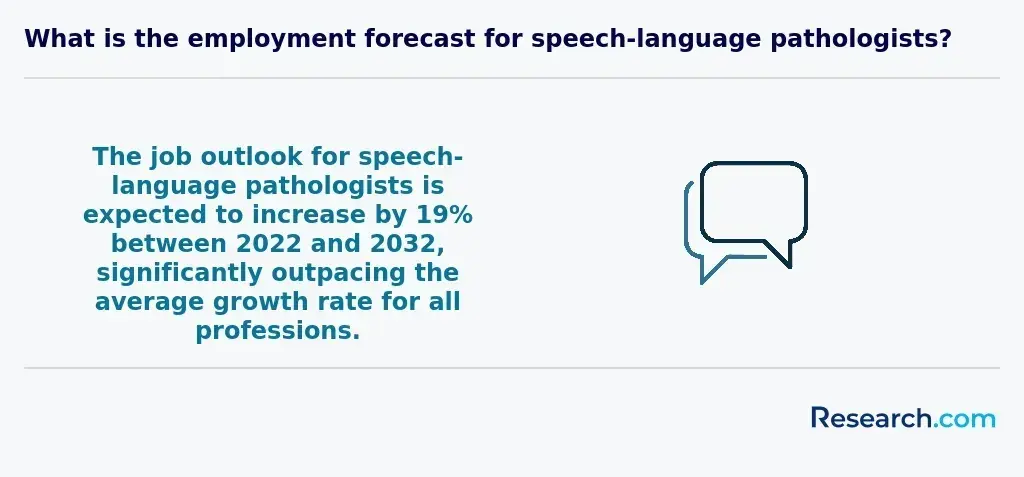
Speech-language pathologists had a national median annual wage of $97,870 in May 2025, and the occupation is projected to grow 17% from 2025 to 2035, with about 12,500 annual openings nationwide (U.S. Bureau of Labor Statistics).
For most applicants, a CAA-accredited master's program with structured clinical placements is the central investment decision; compare total cost of attendance, completion pattern, placement access, and licensure alignment before treating tuition as the deciding factor.
What can I expect from a speech pathology degree in Virginia?
A speech pathology degree usually means a graduate degree in speech-language pathology, communication sciences and disorders, or a closely related title. It prepares students to assess and treat communication, speech, language, voice, swallowing, cognitive-communication, and feeding disorders across the lifespan. In Virginia, the professional entry route is generally a master's degree followed by the state's supervised-experience and examination requirements.
The most common path begins with a bachelor's degree in communication sciences and disorders, then a two-year graduate program. Applicants from psychology, education, linguistics, health sciences, or other majors can also qualify, but often need prerequisite coursework before or during admission. Students seeking format flexibility can compare online slp masters programs, but should confirm whether clinical placements can be completed where they live and whether the program meets Virginia licensure requirements.
The comparison below clarifies which academic route fits different starting points.
Education route
Best fit
What it usually enables
Important limitation
Bachelor's in communication sciences and disorders
Students beginning their education pathway
Graduate-school preparation and support roles, depending on employer requirements
Does not itself qualify a person for independent SLP practice
Master's in speech-language pathology
Applicants seeking clinical SLP practice
Preparation for clinical fellowship, Praxis, certification, and state licensure steps
Requires significant clinical education and postdegree supervision
Post-baccalaureate prerequisites
Career changers without CSD coursework
Fills foundational science and communication-disorders requirements
Adds time and cost before graduate enrollment
Doctoral study
Students targeting research, faculty, leadership, or specialized academic careers
Advanced research and scholarly preparation
Usually is not necessary for entry-level clinical practice
A master's is worth considering if you want direct patient care and are prepared for a regulated profession with clinical requirements. It is less suitable if you want only a quick credential, cannot complete in-person practicum obligations, or prefer a role that does not require graduate-level clinical preparation. In those cases, related paths such as special education, behavior analysis, audiology support, rehabilitation services, or health administration may fit better.
Where can I work with a speech pathology degree in Virginia?
Speech-language pathologists work wherever communication or swallowing needs intersect with education, health care, rehabilitation, and aging. Virginia's mix of large health systems, public school divisions, military-connected communities, pediatric providers, and rural health areas creates varied placement and employment options. The setting matters because it changes caseloads, schedules, payer rules, and the population you serve.
The following settings are the most relevant places to target during clinical placements and an early job search:
Public schools, where SLPs support students' communication access, individualized education programs, and educational participation.
Hospitals and outpatient medical centers, where work can include stroke recovery, traumatic brain injury, voice, swallowing, and medically complex care.
Skilled nursing facilities, home health agencies, and rehabilitation providers, where adult neurogenic communication and dysphagia services are common.
Early-intervention and pediatric clinics, where clinicians often work with developmental language, autism-related communication needs, speech sound disorders, and feeding concerns.
University clinics, private practices, and telepractice providers, where roles may combine direct care, supervision, specialty services, or flexible scheduling.
Students should ask each program where recent clinical placements occur, whether placement travel is likely, and whether the program can support interests such as medical SLP, bilingual service delivery, or school practice. Clinical affiliation access can be more consequential than a small tuition difference because placements shape supervised experience, professional references, and familiarity with employers. For a broader look at role options, review these highest paying speech pathology jobs and careers.
Salary is an important part of return-on-investment planning, but it should not be treated as a promised graduate outcome. The U.S. Bureau of Labor Statistics reported a national median annual wage of $97,870, or $47.05 per hour, for speech-language pathologists in May 2025. This is the latest wage reference specified for the occupation, not a forecast of what any Virginia graduate will earn.
Pay can differ materially by employer type, experience, region, productivity expectations, benefits, and whether a position follows a school-year or year-round calendar. Medical and post-acute roles may offer different compensation structures than school positions, while rural or high-need markets may use recruitment incentives that are not reflected in a base wage figure.
Use salary information as one part of an ROI calculation, not as a shortcut. A practical comparison should account for total program cost, financial aid, time out of the workforce, probability of completing the program, post-graduation fellowship timing, baseline earnings, likely work setting, and how long you expect to remain in the profession. A lower-priced program can be the stronger investment when it has reliable clinical placement support and allows you to finish without excessive borrowing; a higher-cost option needs a clear advantage that justifies the added debt.
Strong programs are not interchangeable simply because they prepare students for the same profession. The most useful differences are program structure, clinical education design, pathway availability, and the match between a student's intended setting and the program's training model. Accreditation and eligibility should be the first screen; differentiators should be used after that screen is met.
These program highlights focus on concrete features that can matter when comparing the institutions represented in this ranking.
James Madison University: JMU's Department of Communication Sciences and Disorders brings speech-language pathology education together with broader communication-sciences training, giving students a departmental pathway from foundational study into graduate clinical preparation. This structure can be particularly useful for Virginia undergraduates who want continuity between prerequisite work, faculty relationships, and master's-level study; applicants should still verify the current graduate curriculum and placement expectations directly with the department.
Longwood University: Longwood's speech-language pathology program emphasizes the graduate professional pathway in a smaller public-university setting, which may appeal to students seeking a focused clinical-training environment rather than a large research-university experience. Its value is strongest for applicants who want to ask detailed questions about cohort support, local placement geography, and the feasibility of completing clinical requirements in central or southern Virginia.
Old Dominion University: Old Dominion University offers an M.S. Ed. pathway in speech-language pathology, a degree title that signals its education-school context while still serving preparation for clinical practice. Its Hampton Roads location may be meaningful for students who want to explore placements and employment connected to the region's schools, health systems, military-connected communities, and rehabilitation providers; program fit depends on the actual clinical affiliations available during enrollment.
University of Virginia: The University of Virginia's M. Ed. in Communication Sciences and Disorders connects speech-language pathology preparation with an education-focused academic environment. This may suit applicants who value an interdisciplinary lens on communication, learning, and clinical practice, but they should compare the program's required sequencing and clinical schedule against work and relocation constraints before applying.
Program webpages can change between admission cycles, so verify current accreditation status, required credits, clinical-hour expectations, cost, and cohort availability with each institution. For a cost-centered comparison alongside the value ranking, see the most affordable speech pathology programs in Virginia.
For students who already hold the expected prerequisites, a full-time master's in speech-language pathology commonly takes about two academic years, including classroom work and clinical practicum. The precise timeline can be longer when a program uses summer terms, assigns external placements that follow site schedules, or requires prerequisite courses before graduate admission.
After the degree, aspiring Virginia SLPs generally need to complete a supervised clinical fellowship and meet examination requirements before independent licensure. That means the decision timeline is not merely "how long until graduation"; it is "how long until I can legally practice independently." Students changing fields should budget additional time for anatomy and physiology, statistics, phonetics, language development, hearing science, and other prerequisites.
Accelerated plans can make sense for applicants able to study full time and manage a compressed clinical schedule. They are not automatically cheaper: year-round enrollment may reduce time away from earnings, but it can also limit work hours and make placement rescheduling harder. Compare standard and accelerated speech pathology programs by total cost, required residency periods, clinical placement support, and licensure disclosures rather than advertised speed alone.
Online and campus-based speech pathology degrees can both include virtual lectures, simulations, and digital case tools, but neither format eliminates hands-on clinical education. Students must complete supervised clinical experiences in approved settings. For Virginia applicants, the practical question is whether a program can arrange, approve, and supervise placements near their home or whether travel and relocation will be necessary.
This comparison identifies the trade-offs that most often affect working adults and traditional full-time students.
Factor
Online or hybrid program
Campus-based program
Course access
May reduce commuting and allow more geographic flexibility
Usually follows a location-based class schedule and campus routine
Clinical placement
Still requires in-person supervised work; local placement availability must be confirmed
May offer closer coordination with affiliated local clinics, schools, or hospitals
Best fit
Self-directed students with stable schedules and verified placement feasibility
Students who prefer direct campus access, local cohort contact, and established regional placement networks
Main risk
Assuming online coursework automatically means Virginia licensure eligibility or local placements
Underestimating relocation, commuting, and reduced work flexibility
Choose an online format only after receiving clear written answers about Virginia authorization, placement responsibility, required campus visits, clinical supervision, and what happens if a placement falls through. Choose on-campus study when proximity to faculty, university clinics, and regional placement relationships will materially improve your ability to complete requirements. In either format, accreditation and clinical quality matter more than the delivery label.
There is no single statewide average cost that reliably represents every speech pathology degree in Virginia, because published tuition can vary by institution, residency classification, credit load, fees, clinical charges, housing, and program length. A meaningful estimate must use each school's current graduate tuition and its full cost-of-attendance budget rather than an unverified statewide average.
Students should compare costs in the same way across schools. The table separates expenses that are commonly overlooked from tuition itself.
Cost category
Why it changes the comparison
What to verify
Tuition and mandatory fees
May differ by residency, credit load, and summer enrollment
Per-credit or full-program tuition and required university fees
Clinical education expenses
Externships can create costs beyond classroom study
Travel, parking, professional liability coverage, background checks, testing, and health requirements
Living costs
Can exceed a modest tuition difference over multiple terms
Housing, food, transportation, insurance, and relocation needs
Opportunity cost
Reduced work hours can affect borrowing and total financial pressure
Whether employment is realistic during coursework and full-time practicum
In-state public tuition can be an important advantage for eligible Virginia residents, but lower tuition is not the same as lower total cost. Ask whether a program has mandatory summer study, whether placements may require long-distance travel, and whether scholarships are renewable. Applicants comparing nearby markets can also use how much does it cost to become a speech pathologist in arizona as a reminder that cost structures are state- and institution-specific, not nationally uniform.
Graduate aid for speech pathology students can combine federal loans, institutional scholarships, assistantships, external awards, and employer support. Availability varies by school and by enrollment status, so students should build a funding plan before committing to a cohort rather than assuming aid will cover all clinical and living expenses.
The most relevant options to investigate include:
Federal Direct Unsubsidized Loans, subject to federal annual and aggregate borrowing limits and student eligibility rules.
Graduate PLUS Loans for eligible graduate or professional students who complete the required federal application and credit review; borrowers should evaluate this option carefully because it can increase long-term debt.
University scholarships and graduate assistantships, which may be limited in number and may require service, research, teaching, or full-time enrollment.
Departmental aid and external professional scholarships, which can be especially useful for students interested in underserved populations or specific practice areas.
Employer tuition assistance or workforce incentives, particularly for applicants already employed by school divisions, health systems, or rehabilitation organizations.
Federal aid rules and loan terms can change, so review current eligibility directly through Federal Student Aid and the institution's financial-aid office. Virginia residents should also compare state and campus opportunities with regional alternatives, including the Inexpensive Speech Pathology Degree Programs Ranking in Washington, DC, if commuting or relocation broadens their choices. Do not borrow based solely on the maximum amount offered; borrow against a conservative completion and repayment plan.
View the chart data as a table
SLP annual wage spread - Virginia (May 2025) (Source: U.S. Bureau of Labor Statistics (OEWS May 2025))
Category
Value
10th percentile
$66,890
25th percentile
$77,830
Median
$96,250
75th percentile
$116,790
90th percentile
$132,400
Admission to a speech-language pathology master's program is competitive because programs must ensure students can progress through demanding academic and clinical work. Requirements vary by institution, but Virginia applicants should expect schools to review academic preparation, communication skills, professional readiness, and capacity to meet clinical participation standards.
Common prerequisites are typically grouped into academic foundations and application materials:
Undergraduate coursework in communication sciences and disorders or documented equivalents, often including phonetics, speech and hearing science, language development, anatomy and physiology, audiology, and communication disorders.
Statistics and specified science coursework, which may be needed to meet graduate admission standards and professional certification education standards.
Official transcripts, a personal statement, recommendation letters, and a résumé or record of relevant observation, service, research, or work experience.
English-language proficiency documentation when required for applicants educated outside the United States.
Background checks, immunizations, drug screening, CPR training, or other compliance items before clinical placement, depending on the school and site.
A common mistake is applying only to programs that appear "easiest" without checking prerequisite match, accreditation, clinical placement model, and outcomes. A better approach is to create a prerequisite audit for every school and apply to programs where your academic preparation and schedule are genuinely compatible. For comparison ideas, review these speech language pathology programs, while remembering that admission selectivity does not replace fit or licensure alignment.
Graduate speech pathology curricula combine scientific foundations, diagnostic reasoning, treatment planning, ethics, and supervised clinical practice. Course titles differ across Virginia institutions, but a qualifying program should progressively move students from foundational knowledge to evidence-based clinical decision-making with children and adults.
Students commonly encounter coursework in the following areas:
Speech sound disorders, language disorders, fluency, voice, resonance, and motor speech disorders.
Neuroanatomy, acquired language disorders, cognitive-communication disorders, and dysphagia.
Audiology, aural rehabilitation, hearing screening, and the relationship between hearing and communication.
Research methods, evidence-based practice, assessment, counseling, professional ethics, and cultural-linguistic responsiveness.
Clinical practicum and externship experiences that require direct supervision and performance evaluation.
Do not choose a program by course titles alone. Ask how students are assessed in clinic, when they begin external placements, what populations they see, and whether clinical assignments include the areas you may want to practice after graduation. Students interested in medical practice should look carefully for swallowing, adult neurogenic, and hospital-placement exposure; students focused on schools should ask about pediatric language, literacy, augmentative communication, and special-education collaboration.
Speech pathology master's programs do not always use formal concentration labels, but students can often develop a focus through electives, research, clinic assignments, and externships. A specialization should be viewed as focused preparation, not as a substitute for broad competence across the full scope of speech-language pathology.
Common areas students may pursue include pediatric speech and language, school-based practice, adult neurogenic disorders, dysphagia, voice, fluency, augmentative and alternative communication, autism-related communication support, bilingual or multilingual service delivery, and early intervention. Availability depends on faculty expertise and clinical affiliations, so an advertised interest area has the most value when the program can show relevant coursework and placement opportunities.
Choose a focused pathway when it aligns with a likely first job and the school can support that interest with real clinical exposure. Avoid narrowing too early if you have not worked with different age groups or settings; broad placements can be more valuable during graduate school because many new clinicians refine their interests through supervised practice.
The best Virginia program is the one that keeps you on a realistic path to licensure while fitting your finances, learning style, and geographic constraints. Rankings can help create a shortlist, but they cannot determine whether a program can place you in the clinical settings you need or whether its schedule works with your responsibilities.
Before submitting an application or deposit, use this decision sequence:
Confirm that the graduate program's accreditation and curriculum support your intended certification and Virginia licensure path.
Calculate total cost of attendance, including travel, health requirements, testing, housing, and likely reduced earnings during clinical training.
Ask for clear information about clinical placement responsibility, placement geography, supervision, and procedures when a placement changes.
Compare program sequence, summer enrollment, campus-visit requirements, and the realistic ability to work while enrolled.
Review outcomes and support services carefully, then speak with admissions staff about your prerequisite gaps, transfer-credit options, and career goals.
Red flags include vague answers about accreditation or state authorization, unclear clinical-placement policies, pressure to enroll before financial aid is finalized, and promises that sound like guaranteed employment or salary. The strongest decision is usually based on verified eligibility, manageable borrowing, clinical fit, and a timeline you can complete - not prestige or a single ranking position.
A speech pathology degree can support several career paths, although independent clinical practice as an SLP requires completion of applicable licensure steps. The right path depends on whether you prefer children or adults, education or health care, stable schedules or varied caseloads, and direct treatment or research and leadership.
The table summarizes common directions and the preparation emphasis that can help students compare them.
Career path
Typical employer
Useful graduate preparation
School-based SLP
Public or private schools
Pediatric language, literacy, AAC, special-education collaboration, and school placements
Adult neurogenic disorders, dysphagia, cognitive-communication, and medical placements
Early-intervention clinician
Community programs, clinics, home-based providers
Infant and toddler development, family coaching, feeding, and interdisciplinary care
Post-acute or geriatric SLP
Skilled nursing, home health, rehabilitation providers
Swallowing, dementia-related communication, documentation, and adult clinical experience
Academic or research professional
Universities, research centers, health organizations
Research methods and often doctoral-level preparation
Students should avoid assuming one practicum locks them into a lifelong specialty. Early jobs often reflect local openings and fellowship availability. Still, selecting a program with relevant clinical exposure can make the transition into a preferred setting more credible and less dependent on self-directed catch-up learning.
View the chart data as a table
SLP employment by state (United States, May 2025) (Source: U.S. Bureau of Labor Statistics (OEWS May 2025))
State
Value
AK
340
AL
2,060
AR
2,430
AZ
3,390
CA
16,930
CO
4,420
CT
2,390
DC
390
DE
690
FL
10,080
GA
4,030
HI
270
IA
1,540
ID
1,210
IL
9,040
IN
3,310
KS
1,690
KY
2,610
LA
3,000
MA
5,290
MD
3,510
ME
640
MI
4,730
MN
3,890
MO
3,230
MS
1,790
MT
490
NC
5,600
ND
630
NE
1,310
NH
720
NJ
6,840
NM
1,250
NV
1,270
NY
15,310
OH
7,270
OK
1,870
OR
1,600
PA
6,570
PR
150
RI
720
SC
2,190
SD
410
TN
3,320
TX
19,120
UT
1,460
VA
4,460
VT
430
WA
3,570
WI
2,940
WV
880
WY
240
The national job outlook for speech-language pathologists is favorable: employment is projected to grow 17% from 2025 to 2035, much faster than the average for all occupations, with about 12,500 openings projected annually over the decade (U.S. Bureau of Labor Statistics, 2025-35 projections). This national projection is useful context, but it does not measure guaranteed openings in a specific Virginia city or school division.
In Virginia, job-search conditions can differ by region and setting. Northern Virginia, Hampton Roads, Richmond, and other population centers may offer broader employer variety, while smaller communities may present different needs, travel expectations, and recruitment patterns. School vacancies can follow academic-year hiring cycles; medical and post-acute employers may recruit on a more continuous basis.
Demand should influence program selection in a practical way: prioritize placements that build skills relevant to the settings and regions where you expect to work. Also ask whether the program helps students understand fellowship opportunities, employer documentation expectations, and the transition from student clinician to licensed professional. Labor-market demand strengthens the case for the degree only when the program is affordable enough to complete and prepares you for the work settings you can realistically access.
2027 Most Valuable Speech Pathology Degree Programs Ranking in Virginia
Education is a major financial and career decision, especially in a licensed field where the wrong program format or accreditation status can delay eligibility to practice. Research.com developed this ranking to help prospective students compare programs using consistent evidence rather than relying only on reputation, marketing claims, or tuition sticker price.
Research.com rankings score programs on academic and research strength, cost, graduate outcomes, student profile, and institutional quality, then rank schools by the dimension named in the ranking. On-campus rankings use data-driven, entropy-based weights tailored to the ranking, while online rankings use an approach adapted to distance learning: graduation rate 30%, research 25%, institutional profile 15%, and students, cost, and course factors at 10% each. Campus-related indicators are excluded from online evaluations, with greater emphasis placed on program structure and student support.
The Research.com team used the following sources to check institutional, enrollment, outcomes, and cost-related information:
IPEDS database, for federally reported institutional and student data.
Peterson's database, for college and program information used in comparative evaluation.
College Scorecard database, for federal information on costs, student outcomes, and institutional measures.
Readers can use the ranking as a starting point to identify programs that deserve a closer look, compare value signals, and build a shortlist suited to their budget and professional plans. For a fuller explanation of the scoring approach and safeguards used in Research.com rankings, review Research.com's methodology.
Master of Science (M.S.) in Speech-Language Pathology (Residential)
74.86
/ 100
Final score
Program length
Two years / 5 semesters
Required credits
45
Acceptance rate
33% (101 of 303 applications)
GPA range
3.27 - 4.00
Offers with funding
~12% (12 of 101 offers)
Application deadline
Fall admission: January 15
Class size
59
Degrees granted
29
Application process
CSDCAS University online application
Prerequisites
Undergraduate prerequisites required: Yes
Additional requirements
Portfolio
Accreditation
Council on Academic Accreditation in Audiology and Speech-Language Pathology (CAA) of ASHA
Status AccreditedID 0f6dff1e-213f-410f-8b0c-a55e2917e151Valid 2026-2034
Last known review scheduled for August 2033
Verify accreditation
James Madison University earned a Research.com Value Score of 74.86/100, supported by $26,550 total tuition + mandatory fees and 99% Praxis pass rate. Its Master of Science (M.S.) in Speech-Language Pathology (Residential) is listed by ASHA EdFind as CAA-accredited through 2034, with the most recently listed accreditation review scheduled for 2033.
Admissions data from
ASHA EdFind
(updated 10/23/2025)
Master of Science in Communication Sciences and Disorders
70.98
/ 100
Final score
Program length
5-6 semesters (two years) for students with completed undergraduate CSD coursework; 8-9 semesters without undergraduate CSD major. Year 1: on-campus; Year 2: hybrid format focused on externship.
Required credits
53
Acceptance rate
50% (68 of 136 applications)
GPA range
3.09 - 4.00
Offers with funding
~28% (19 of 68 offers)
Application deadline
Fall admission: February 1
Class size
25
Degrees granted
23
Application process
CSDCAS University online application
Prerequisites
Undergraduate prerequisites required: Yes; prerequisite courses offered; available online
Accreditation
Council on Academic Accreditation in Audiology and Speech-Language Pathology (CAA) of ASHA
Status AccreditedID 9d493921-fc2c-4d0b-9140-a7835744df99Valid 2023-2031
Last known review scheduled for August 2030
Verify accreditation
Longwood University earned a Research.com Value Score of 70.98/100, supported by $25,707 total tuition + mandatory fees and 98% Praxis pass rate. Its Master of Science in Communication Sciences and Disorders is listed by ASHA EdFind as CAA-accredited through 2031, with the most recently listed accreditation review scheduled for 2030.
Admissions data from
ASHA EdFind
(updated 08/11/2025)
Council on Academic Accreditation in Audiology and Speech-Language Pathology (CAA) of ASHA
Status AccreditedID dd19e0c6-3adc-495e-8686-aa33f3f79629Valid 2026-2033
Last known review scheduled for February 2032
Verify accreditation
Old Dominion University earned a Research.com Value Score of 62.41/100, supported by $35,736 total tuition + mandatory fees and 97% Praxis pass rate. Its Master of Science in Speech-Language Pathology is listed by ASHA EdFind as CAA-accredited through 2033, with the most recently listed accreditation review scheduled for 2032.
Admissions data from
ASHA EdFind
(updated 09/03/2026)
Communication Sciences and Disorders: M. Ed. - Master of Education
61.91
/ 100
Final score
Program length
5 semesters / (Blue Path, for applicants with a communication disorders background); 7 semesters / (Orange Path, for applicants without a CSD background). Full-time
Council on Academic Accreditation in Audiology and Speech-Language Pathology (CAA) of ASHA
Status AccreditedID bfdfd1fd-29b8-4542-9c68-bb5cc29cd0f5Valid 2022-2030
Last known review scheduled for 2029
Verify accreditation
University of Virginia earned a Research.com Value Score of 61.91/100, supported by $32,400 total tuition + mandatory fees and 100% Praxis pass rate. Its Communication Sciences and Disorders: M.Ed. - Master of Education is listed by ASHA EdFind as CAA-accredited through 2030, with the most recently listed accreditation review scheduled for 2029.
Admissions data from
ASHA EdFind
(updated 10/13/2025)
Frequently asked questions about speech pathology degree in Virginia
Do I need a master's degree to become a speech-language pathologist in Virginia?
Generally, yes. Independent professional practice requires graduate education and additional state requirements, including supervised experience and examination steps. Confirm current requirements with the Virginia Board of Audiology and Speech-Language Pathology before enrolling.
Should I choose a CAA-accredited speech pathology program?
CAA accreditation is an important safeguard because it is closely connected to professional preparation and certification pathways. Verify the program's current accreditation status directly and ask how its curriculum aligns with Virginia licensure requirements.
Can I complete a Virginia speech pathology degree online?
Potentially, but clinical education remains in person. Confirm that the program is authorized for Virginia students, can support local placements, and meets Virginia licensure requirements before applying.
How long does it take to become an SLP after a bachelor's degree?
A full-time master's commonly takes about two years when prerequisites are complete. Add time for supervised postdegree clinical experience and licensing steps; career changers may need additional prerequisite coursework.
What is the national median salary for speech-language pathologists?
The U.S. Bureau of Labor Statistics reported a national median annual wage of $97,870 in May 2025. Actual Virginia pay varies by setting, location, experience, workload, and benefits.
What is the biggest mistake to avoid when selecting a program?
Do not assume that low tuition, online delivery, or a strong ranking alone makes a program right for you. Check accreditation, total cost, clinical-placement support, scheduling, and Virginia licensure alignment before making a commitment.
See What Experts Have To Say About Studying Speech Pathology
ASHA EdFind - Accredited Speech-Language Pathology Programs Used to verify CAA accreditation or candidacy status for graduate SLP programs. https://find.asha.org/ed/
Audiology and Speech-Language Pathology Interstate Compact Used to verify interstate practice privileges and participating states for speech-language pathologists. https://aslpcompact.com/compact-map/
James Madison University - Master of Science (M.S.) in Speech-Language Pathology (Residential) Official program page (curriculum, tuition, and admissions). https://www.jmu.edu/chbs/csd/ms-slp/index.shtml
Longwood University - Master of Science in Communication Sciences and Disorders Official program page (curriculum, tuition, and admissions). https://www.longwood.edu/slp/