Research.com is an advertising-supported site. Featured placements, sponsored links, advertising widgets and labeled paid mentions in articles involve schools, brands or advertising networks that compensate us. Some universities also pay us to process their current program data, but no payment influences our ranking methodology, scores or positions, or the other editorially independent information published on this site.

2027 Best Clinical Mental Health Counseling Degree Programs Ranking in Philadelphia

Imed Bouchrika, PhD

by Imed Bouchrika, PhD

Co-Founder and Chief Data Scientist

Charles Figley, PhD

Reviewed by Charles Figley, PhD

Counseling & Trauma Research Expert

Table of Contents

What can I expect from a Clinical Mental Health Counseling degree in Philadelphia?

A clinical mental health counseling degree prepares students to assess concerns, build therapeutic relationships, plan care, and practice under supervision. For someone seeking a counseling career in Pennsylvania, the relevant option is generally a qualifying graduate program - not a bachelor's degree or a short certificate by itself. Coursework is paired with supervised practicum and internship experience; the Pennsylvania licensing board sets the requirements for the eventual LPC credential.

The distinction between programs matters. Thomas Jefferson University identifies its master's with community and trauma counseling, while La Salle University offers a Professional Clinical Counseling M.A. A student drawn to trauma-informed community practice may prioritize the former's stated focus. Someone considering La Salle should establish whether its current curriculum is intended as a complete entry route or fits their existing graduate education before comparing the degrees as interchangeable (Thomas Jefferson University; La Salle University).

Where can I work with a Clinical Mental Health Counseling degree in Philadelphia?

Potential workplaces include community mental health agencies, hospital behavioral health services, outpatient practices, substance-use treatment providers, and nonprofit programs. Philadelphia's mix of health systems and community providers makes placement setting an important program-selection question: work with a hospital team may offer different supervision and client populations from work in an outpatient agency.

Ask schools where recent students actually completed placements and who arranged them. A degree can also support roles that do not require independent practice, but job titles and duties depend on the employer and the graduate's license status. Do not assume that a school counseling position follows from a clinical mental health counseling degree; school credentials have separate rules (Pennsylvania Department of Education; Pennsylvania licensing board).

2027 Best Clinical Mental Health Counseling Degree Programs Ranking in Philadelphia

# 1 position

Thomas Jefferson University

Master

Community & Trauma Counseling Master of Science

Delivery mode: hybrid

91.67

/ 100

Final score

Program length
two years (seven semesters)
Specialization
Clinical Mental Health Counseling
Required credits
60 semester credits

Accreditation

Accredited by the Council for Accreditation of Counseling and Related Educational Programs (CACREP), with institutional accreditation from the Middle States Commission on Higher Education (MSCHE).

Valid 2030-03-31 Verify accreditation

Thomas Jefferson University earned a Research.com Counseling Program Score of 91.67/100. The program is CACREP-accredited, valid through 2030-03-31.

# 2 position

La Salle University

Master

M.A. in Professional Clinical Counseling

Delivery mode: campus

83.06

/ 100

Final score

Program length
2 years, 1 semester full-time
Specialization
Clinical Mental Health Counseling
Required credits
60 semester credits
GPA range
3.00 - 4.00
Program completion rate
69% (2024-25)
Employment or doctoral admission
82% (2024-25)
Licensure exam pass rate
88% (2024-25)
Application deadline
Fall: August 10; Spring: December 10
Application process
direct
GRE
no
Prerequisites
Official transcripts must reflect a minimum of 9-12 hours in psychology, marriage and family studies or counseling.
Additional requirements
Official transcript(s); resume/CV; three letters of recommendation; essay/personal statement on interest in counseling and mission alignment; engagement with program faculty/staff via Open House, virtual info session, or one-on-one meeting.

Accreditation

Accredited by the Council for Accreditation of Counseling and Related Educational Programs (CACREP), with institutional accreditation from the Middle States Commission on Higher Education (MSCHE).

Valid 2031-03-31 Verify accreditation

La Salle University earned a Research.com Counseling Program Score of 83.06/100, supported by 88% licensure exam pass rate and 69% program completion rate. The program is CACREP-accredited, valid through 2031-03-31.

Frequently asked questions about Clinical Mental Health Counseling degree in Philadelphia

Do I need a master's degree to become an LPC in Pennsylvania?

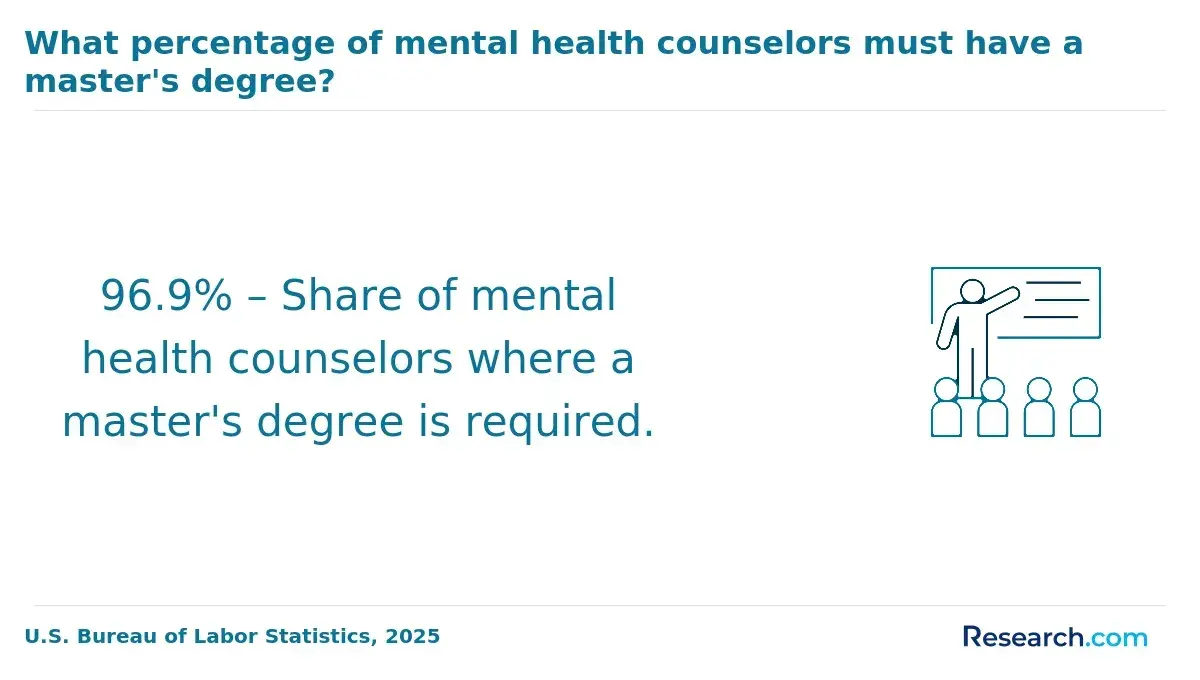
Yes. Pennsylvania requires qualifying graduate education as well as other licensure steps. Check the current degree and coursework rules with the state licensing board before enrolling; a counseling-related title alone is insufficient (Pennsylvania licensing board).

Does a counseling master's automatically qualify me for a license?

No. Licensure is a separate state process involving education and additional requirements, including supervised experience and an examination. Confirm the current requirements directly with the Pennsylvania licensing board.

Is CACREP accreditation the same as university accreditation?

No. CACREP accredits eligible counseling programs; institutional accreditation applies to the college or university. Verify both statuses and ask how the particular degree meets your intended state's rules (Council for Accreditation of Counseling and Related Educational Programs; Pennsylvania licensing board).

Can I complete clinical training online?

Online classes do not eliminate supervised clinical training. Ask where you would complete practicum and internship, who secures or approves the site, and whether your work schedule can accommodate its hours (Council for Accreditation of Counseling and Related Educational Programs).

Is the degree worth the investment?

It can be if the curriculum fits your intended credential and the likely career improvement justifies the full cost. Compare net price, debt, completion time, forgone earnings, and plausible post-degree roles against your current options; the national median wage is not an individual earnings forecast.

Do you have any feedback for this article?