Choosing a Massachusetts counseling master's program means looking beyond the degree name: tuition, supervised training, and licensure fit can change whether a program is worth the investment. This guide is for future counselors and working professionals comparing those trade-offs. It accompanies the 2027 Best Clinical Mental Health Counseling Degree Programs Ranking in Massachusetts, created by the Research.com team of data scientists to help students make an informed choice about programs worth considering. You'll learn how to compare costs, formats, training, and career prospects before applying.
Key findings about Clinical Mental Health Counseling degrees in Massachusetts
For a Massachusetts licensed mental health counselor (LMHC) goal, compare programs against the state board's graduate coursework, supervised training, and examination rules; a counseling degree alone does not confer a license.
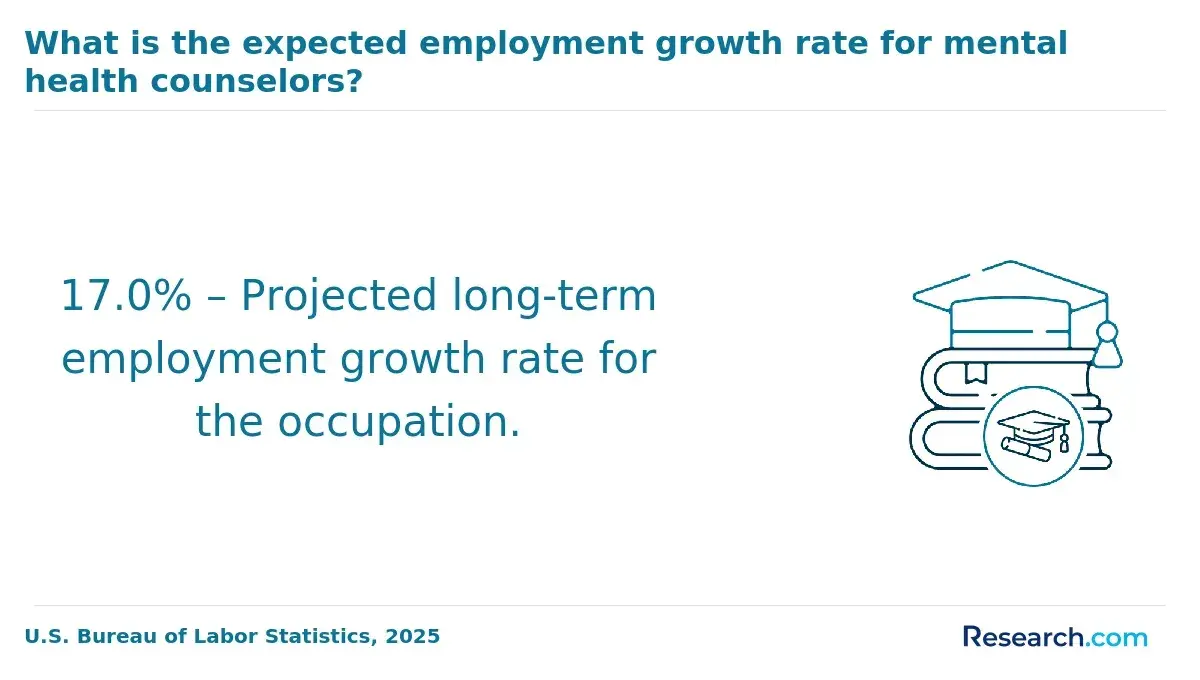
The U.S. Bureau of Labor Statistics reports a $59,350 national median annual wage in May 2025 for the relevant mental health counseling occupational group and projects 18% U.S. employment growth from 2025 to 2035. Neither figure predicts a Massachusetts graduate's earnings or job offer.
Compare the full cost of completing clinical training - not tuition alone - and ask where an online or campus program can arrange board-appropriate placements near where you live.
What can I expect from a Clinical Mental Health Counseling degree in Massachusetts?
Clinical mental health counseling is graduate preparation for assessing concerns, developing treatment plans, providing counseling, and working within ethical and professional limits. For readers seeking the Massachusetts LMHC credential, the relevant path is a qualifying master's-level education followed by the additional supervised experience and examination required by the Massachusetts Board of Registration of Allied Mental Health and Human Services Professions. Graduation and licensure are separate milestones.
Programs may be titled clinical mental health counseling, mental health counseling, or simply counseling. A title is less useful than a written review of the curriculum and fieldwork against Massachusetts requirements. CACREP accreditation is a program-level quality signal, while institutional accreditation concerns the school; neither should be treated as automatic proof that every graduate meets every state licensing requirement (CACREP; Massachusetts Board of Registration of Allied Mental Health and Human Services Professions).
This degree fits someone who wants sustained client-facing clinical work and can accommodate supervised training. Someone primarily interested in prescribing medication, providing school-based counseling, or entering a research-only role should compare the distinct education and licensing routes for those goals before committing.
Where can I work with a Clinical Mental Health Counseling degree in Massachusetts?
Potential settings include community mental health organizations, outpatient clinics, hospitals, substance-use treatment services, college counseling services, and private practices. The role available to a new graduate can differ from that available to an independently licensed LMHC: employers may require supervision while a graduate completes the state's post-degree requirements (Massachusetts Board of Registration of Allied Mental Health and Human Services Professions).
Location should shape the program search. A placement near Boston may expose a student to large hospital systems and dense referral networks, while a program closer to home may make recurring supervised work more practical elsewhere in the state. Ask each school where students actually complete placements, who secures them, and whether its supervision arrangements fit the settings in which you hope to work.
The U.S. Bureau of Labor Statistics reports a $59,350 national median annual wage for May 2025 for the occupational group covering mental health counseling (BLS Occupational Outlook Handbook). This is an occupation-wide U.S. midpoint, not a starting salary, Massachusetts-specific wage, or estimate of what graduates of a particular school earn.
For an investment decision, compare likely pay at the stage when you would enter the workforce with your current earnings - not just with a national median that includes experienced workers. Setting, supervision status, hours, and later licensure can all affect compensation. Request program-specific employment information when available, and ask whether reported outcomes include graduates working in supervised roles rather than independently licensed practice.
These programs point to different ways of preparing for counseling work. Their most useful distinctions concern clinical focus, public-university access, professional program design, and the place of faith in training - not an assumption that one feature suits every applicant.
Boston University: Its Master of Arts in Mental Health Counseling and Behavioral Medicine is a 60-credit program that explicitly connects counselor preparation with behavioral medicine. That focus may suit applicants interested in the relationship between mental health and medical care, rather than a broadly titled counseling curriculum (Boston University program information).
Bridgewater State University: Its mental health counseling program offers a public-university option for applicants comparing Massachusetts programs. For a cost-conscious student, its distinguishing value is the opportunity to check public-university tuition and fees against private-school offers while also confirming how field placements fit their commute and work schedule (Bridgewater State University program information).
Springfield College: Its degree is explicitly organized as clinical mental health counseling, making the professional counseling pathway the central point of comparison. Applicants seeking that defined clinical focus should ask how its coursework, supervision, and placement process match their intended client population and Massachusetts licensing plans (Springfield College program information).
Gordon-Conwell Theological Seminary: Its Master of Arts in Counseling places counselor education in a theological setting, a materially different academic environment from the other options here. It may fit applicants who want faith and counseling considered together; applicants pursuing an LMHC should separately verify that their chosen curriculum and fieldwork satisfy the Massachusetts board (Gordon-Conwell Theological Seminary program information).
Published program descriptions can change. Before deciding, request the current degree plan, placement handbook, tuition schedule, and a written explanation of how the specific program supports the license you intend to seek.
A full-time counseling master's commonly takes about two years; part-time study can take longer. The decisive variable is often the sequence of clinical courses and placements, not merely the number of classes a student can take each term. A working applicant should ask when placements occur and whether those hours can coexist with a job.
Plan for a second timeline after graduation if independent Massachusetts licensure is the goal. The state board requires qualifying supervised experience and an examination in addition to graduate education; completing the degree does not complete the licensing process (Massachusetts Board of Registration of Allied Mental Health and Human Services Professions). An accelerated degree is useful only if its pace still permits affordable, feasible fieldwork and adequate preparation.
Online delivery can reduce trips to class, but it does not eliminate in-person clinical training. Campus study may make regular contact with faculty and nearby placement networks easier; either format can become inconvenient if required fieldwork is far from home. Confirm residency requirements, placement support, and state eligibility before treating "online" as "study entirely from anywhere."
The comparison below separates delivery from the clinical obligations that matter most to a prospective Massachusetts counselor.
Consideration
Online program
On-campus program
Course access
May reduce commuting; scheduled live sessions or campus visits may still apply.
Regular travel to campus is generally part of the schedule.
Clinical placement
Usually completed in person; local site approval and supervision need confirmation.
Usually completed in person; proximity to a campus does not guarantee a placement.
Best fit
Students who need course-location flexibility and can secure suitable local training.
Students who benefit from in-person learning and can reach classes and field sites.
For an out-of-state online program, obtain written confirmation about Massachusetts educational requirements. For either format, ask whether the school finds placements or expects students to find their own (Massachusetts Board of Registration of Allied Mental Health and Human Services Professions; institution program policies).
There is no single trustworthy Massachusetts-wide price that captures every counseling master's program. Published institutional graduate tuition averages are not the same as a program's total charge: required credits, program-specific rates, fees, and enrollment pace differ. Use each school's current tuition schedule and degree plan to build a comparable total rather than treating an institution-wide average as a quote (NCES IPEDS; institution tuition schedules).
Include placement-related travel, books, required clearances, and income forgone during clinical training. At public universities, check the rate that applies to your residency and enrollment status; do not assume a private nonprofit school costs more after aid. The most affordable clinical mental health counseling programs can help form a shortlist, but obtain an individual cost estimate before ruling a school in or out.
Graduate students should start with the FAFSA to establish eligibility for available federal aid, then ask each school about institutional scholarships, graduate assistantships, payment plans, and placements that provide compensation. Federal loan availability and limits depend on current Federal Student Aid rules and the student's eligibility; an aid offer should be checked for loans that must be repaid versus grants or scholarships that generally do not (Federal Student Aid).
Massachusetts students should also check whether they qualify for any state-administered assistance, rather than assuming an undergraduate state grant carries over to graduate study (Massachusetts Office of Student Financial Assistance). Compare offers against the whole degree: a smaller annual bill may still lead to higher total borrowing if part-time enrollment extends the program or prevents paid work.
Applicants generally need a bachelor's degree; programs set their own rules for prior psychology coursework, academic records, recommendations, statements, interviews, and experience. A psychology major is not automatically required everywhere, so career changers should check the actual prerequisites of each program rather than self-selecting out (institution admissions policies).
Ask admissions staff two separate questions: whether your background qualifies you to enter, and whether the degree plan you would complete is intended to meet Massachusetts LMHC educational requirements. Also ask how prior graduate credits are evaluated. Transfer credit may reduce coursework, but a school's willingness to accept a class does not by itself establish that the state board will count it toward licensure (Massachusetts Board of Registration of Allied Mental Health and Human Services Professions; institution transfer policies).
Expect training in counseling theories and techniques, assessment and diagnosis, ethics, research, group counseling, multicultural practice, and supervised clinical work. Programs can differ in how they address substance use, trauma, behavioral medicine, or faith-related concerns. Review the required-course sequence - not just elective titles - to see which interests receive sustained attention (institution degree plans; CACREP standards).
In Massachusetts, course content matters because the licensing board evaluates the qualifying education and experience behind an LMHC application. Request a curriculum-to-licensure map from the program, particularly if you plan to transfer credits or study online from outside the state (Massachusetts Board of Registration of Allied Mental Health and Human Services Professions).
Students may encounter electives or focused training in addiction, trauma, child and adolescent counseling, behavioral medicine, or couples and family work. These are not interchangeable credentials. An elective can deepen clinical interests without creating a separate license or replacing supervised experience required for a particular role (institution degree plans; Massachusetts Board of Registration of Allied Mental Health and Human Services Professions).
Choose a focus by its required courses and accessible placements. For example, Boston University's behavioral-medicine emphasis may appeal to someone interested in health-related settings, while a student seeking school-counselor roles should examine the distinct school-counseling credential route rather than assume a clinical mental health degree qualifies them for it (Boston University program information; Massachusetts Department of Elementary and Secondary Education).
The best fit is the program that can get you through qualifying education and feasible clinical training at a cost you can sustain. Rankings can identify options to investigate; the most valuable clinical mental health counseling programs offer another comparison lens, but value depends on your aid offer, existing earnings, likelihood of completion, and career goal.
Before paying an enrollment deposit, work through these checks with each finalist:
Ask for a written account of how the current degree plan addresses Massachusetts LMHC educational requirements, including clinical training.
Get the total expected price for your enrollment pace, including fees and the likely cost of travel to placements.
Ask where recent students completed placements, how sites were approved, and what happens if a placement falls through.
Request clearly dated program-level completion, employment, and applicable exam-outcome information; ask how each measure is defined.
Compare the likely change from your current earnings with aid, borrowing, forgone income, and the time needed to finish the degree and pursue licensure.
A common mistake is choosing the lowest advertised tuition while overlooking an impractical placement schedule. Another is treating CACREP status, online availability, or a ranking position as a licensing guarantee. Verify the degree, delivery format, and intended state of practice separately.
View the chart data as a table
Best score by program (Source: Research.com)
Category
Value
Gordon-Conwell Theologic
91.42
Springfield College
91.56
Bridgewater State Univer
92.18
Boston University
92.96
A graduate may pursue supervised counseling roles and, after meeting additional state requirements, seek LMHC licensure. Experience and employer requirements may then open paths in clinical specialization, program coordination, supervision, or private practice. The license and scope needed for a particular position should be checked with the Massachusetts board and the employer, not inferred from the master's title alone (Massachusetts Board of Registration of Allied Mental Health and Human Services Professions).
If you are comparing counseling with an adjacent profession, keep the credentials distinct. Marriage and family therapy, school counseling, and psychology have different preparation and licensing or certification routes. The right investment depends on which work you want to perform and which credential employers will require for it.
View the chart data as a table
Wage range - Mental Health Counselors in Massachusetts (BLS OEWS, May 2025) (Source: BLS)
Category
Value
10th percentile
43,180
25th percentile
47,540
Median
59,890
75th percentile
76,950
90th percentile
96,200
The U.S. Bureau of Labor Statistics projects 18% national employment growth from 2025 to 2035 for the occupational group that includes mental health counselors (BLS Employment Projections). That is a U.S. projection, not a forecast of Massachusetts openings or a promise that a newly graduated counselor can secure a preferred job.
For a local decision, search current Massachusetts postings in the setting where you want to train. Note whether they accept graduates completing supervision, require an LMHC, or expect a specialty you would need to develop. Compare those requirements with each school's placement network. The most popular clinical mental health counseling programs may reveal additional schools to investigate, but popularity alone does not establish local employer fit.
2027 Best Clinical Mental Health Counseling Degree Programs Ranking in Massachusetts
Investing in graduate education is a consequential decision. Research.com designed its counseling rankings to give readers a more credible starting point than reputation alone, using multiple sources to check program characteristics and outcomes. The ranking is a comparison tool, not a substitute for confirming current tuition and licensure eligibility with a school.
The Best ranking first combines program completion (40%), employment or doctoral admission (20%), applicable licensure-exam pass rates (20%), CACREP programmatic accreditation (16%), and federal Title IV institutional eligibility (4%). Shares are adjusted when a criterion does not apply. Program cost then contributes a smaller component - about 7% of the final score. The same approach applies to online and campus programs; other Research.com counseling rankings order programs by the dimension named in their titles.
The team used these data sources to assess programs and cross-check information:
IPEDS database - institutional reporting on enrollment, awards, and costs.
These checks help readers narrow a shortlist while recognizing that published outcomes may not capture an individual student's circumstances. See Research.com's methodology for more detail.
# 1 position
Boston University
Master
MA in Mental Health Counseling & Behavioral Medicine
Delivery mode: campus
92.96
/ 100
Final score
Program length
2 years
Specialization
Clinical Mental Health Counseling
Required credits
60 semester units
Program completion rate
92.3% (2022-23)
Employment or doctoral admission
100% (2022-23)
Licensure exam pass rate
100% (2022-23)
Accreditation
Accredited by the Council for Accreditation of Counseling and Related Educational Programs (CACREP), with institutional accreditation from the New England Commission of Higher Education (NECHE).
Boston University earned a Research.com Counseling Program Score of 92.96/100, supported by 100% licensure exam pass rate and 92.3% program completion rate. The program is CACREP-accredited, valid through 2031-03-31.
# 2 position
Bridgewater State University
Master
Master of Education in Mental Health Counseling
Delivery mode: campus
92.18
/ 100
Final score
Program length
24 months
Specialization
Clinical Mental Health Counseling
Required credits
60 semester credits
GPA range
2.50 - 4.00
Application deadline
Fall: February 1; Spring: October 1
Application process
direct
GRE
Conditional: GRE required if undergraduate GPA is below 3.0 (combined 291 for 2.80-2.99, 292 for 2.50-2.79), unless the low-GPA course remedy is completed or the applicant holds a master's degree
Prerequisites
Master's degree, or undergraduate GPA of 3.0+ (GRE not required); applicants below 3.0 must either submit GRE scores (combined 291 for GPA 2.80-2.99, 292 for GPA 2.50-2.79) or take two of four designated department courses and earn a B or above…
Accreditation
Accredited by the Council for Accreditation of Counseling and Related Educational Programs (CACREP), with institutional accreditation from the New England Commission of Higher Education (NECHE).
Bridgewater State University earned a Research.com Counseling Program Score of 92.18/100. The program is CACREP-accredited, valid through 2032-03-31.
# 3 position
Springfield College
Master
M.Ed. in Clinical Mental Health Counseling
Delivery mode: hybrid
91.56
/ 100
Final score
Program length
2-3 years
Specialization
Clinical Mental Health Counseling
Required credits
60 semester credits
Program completion rate
95% (2022-23)
Employment or doctoral admission
100% (2022-23)
Application deadline
Domestic: rolling; International Fall: Apr 1; International Spring: Oct 1
Application process
direct
Additional requirements
Online application, essay (2-3 double-spaced pages), resume, two letters of recommendation, interview, official transcripts from each college/university attended.
Accreditation
Accredited by the Council for Accreditation of Counseling and Related Educational Programs (CACREP), with institutional accreditation from the New England Commission of Higher Education (NECHE).
Springfield College earned a Research.com Counseling Program Score of 91.56/100, supported by 95% program completion rate and 100% employment or doctoral admission rate. The program is CACREP-accredited, valid through 2033-10-31.
# 4 position
Gordon-Conwell Theological Seminary
Master
MA in Counseling (MACO)
Delivery mode: hybrid
91.42
/ 100
Final score
Program length
Full-Time: 3 Years
Specialization
Clinical Mental Health Counseling
Required credits
72 semester credits
GPA range
3.00 - 4.00
Employment or doctoral admission
100% (2025-26)
Licensure exam pass rate
100% (2025-26)
Application process
direct
Prerequisites
Bachelor's degree (or prior graduate degree) from an accredited institution required; 9 semester hours in psychology and/or related disciplines recommended but not required; life experience considered as modification
Additional requirements
Online application form, two essays, résumé, transcripts, three references, and a face-to-face (or video) interview with two MACO faculty
Accreditation
Accredited by the Council for Accreditation of Counseling and Related Educational Programs (CACREP), with institutional accreditation from the New England Commission of Higher Education (NECHE) and the Commission on Accrediting of the Association of Theological Schools (ATS).
Gordon-Conwell Theological Seminary earned a Research.com Counseling Program Score of 91.42/100, supported by 100% licensure exam pass rate and 100% employment or doctoral admission rate. The program is CACREP-accredited, valid through 2027-10-31.
Frequently asked questions about Clinical Mental Health Counseling degree in Massachusetts
Does a counseling master's degree automatically qualify me as an LMHC?
No. Massachusetts requires qualifying education, supervised experience, and an examination. Confirm your program's curriculum and your subsequent licensing steps with the state board (Massachusetts Board of Registration of Allied Mental Health and Human Services Professions).
Do I need a bachelor's degree in psychology?
Not necessarily. Admission prerequisites vary by program, so applicants from other fields should check required prior courses and any conditions of admission (institution admissions policies).
Can I complete the degree entirely online?
Coursework may be online, but clinical placements require direct, supervised practice. Check for campus visits and whether the program can support an approved placement where you live (institution program policies).
Is CACREP accreditation required for every Massachusetts LMHC applicant?
Do not assume either that CACREP accreditation is universally required or that it replaces a board review. Check the Massachusetts board's current education rules and ask a program to document how its specific degree meets them (CACREP; Massachusetts Board of Registration of Allied Mental Health and Human Services Professions).
Is the degree worth it if I already work in a helping profession?
It may be if independent clinical counseling is your goal and the expected career benefit justifies tuition, borrowing, placement-related income changes, and the time to licensure. Compare those costs with your present earnings and the roles you could pursue without another degree.