2027 Best AI Courses for Graduate Students With Certificates

Co-Founder and Chief Data Scientist
Graduate students and working professionals often face difficulty finding accredited, flexible courses that provide recognized certificates to enter the artificial intelligence field. Many programs demand prior technical experience or full-time commitment, limiting accessibility for those from unrelated backgrounds.
This lack of clear pathways can delay career transitions and reduce competitive advantage in a fast-growing job market. Selecting the right course is crucial to gaining relevant skills efficiently and demonstrating credibility to employers.
The article explores top artificial intelligence courses tailored for graduate students seeking certification, helping readers identify programs that fit their schedules, prerequisites, and career goals.
Key Things You Should Know
- Graduate AI courses with certificates offer specialized skills in machine learning, NLP, and computer vision, vital for the projected 23% job growth in AI roles by 2029.
- Many top U.S. universities and online platforms provide accredited AI programs allowing flexible study, often completed in under a year, appealing to working professionals.
- Certified AI training enhances employability with average salary increases of 15%, reflecting strong industry demand for verified expertise in data-driven decision-making.
Advance Your Career with AI Online Courses
Artificial Intelligence: Implications for Business Strategy
This program provides an introduction to Artificial Intelligence and their implications for business strategy. Earn an official digital certificate.

Oxford Artificial Intelligence Programme
Explore this Oxford Artificial Intelligence programme offered in a flexible learning environment and explore topics like machine learning, automation, and robotics.

Implementing Agentic AI: Building Your Organizational Playbook
This online MIT Agentic AI course offers a practical approach to deploying AI agents in your organization, including a custom playbook. 3 weeks, exclusive launch price.

AI Adoption: Driving Business Value and Impact
This online MIT AI Adoption: Driving Business Value and Impact offers practical frameworks to close the gap between AI potential and business reality.

Artificial Intelligence in Pharma and Biotech
Discover the applications and limitations of artificial intelligence in pharma and biotech with this MIT online short course.

What makes a graduate-level AI certificate program reputable and worth pursuing?
A reputable graduate-level artificial intelligence certificate program delivers rigorous coursework rooted in industry standards and current research. It covers essential concepts like machine learning, neural networks, natural language processing, and data analytics.
Programs affiliated with accredited universities or recognized research institutions hold greater credibility due to academic quality oversight. Hands-on experience is crucial, often including real-world datasets, collaborative projects, or partnerships with industry leaders to develop practical skills.
When assessing top accredited artificial intelligence programs for graduates, consider transparent certification pathways, clear course completion criteria, and the inclusion of capstone projects.
Faculty expertise, especially those active in AI research or industry, significantly enhances program value. Flexible options such as part-time or online formats accommodate graduate students managing professional and academic commitments.
Specializations like computer vision, robotics, or ethical AI offer students the ability to align their learning with specific career goals. Connections to career services and alumni networks further support job placement.
Notably, Purdue University projects a 43% job growth for AI and machine learning roles from 2019 to 2029, with over 40,000 related job postings in the U.S. within a recent year-long period, underscoring the value of a recognized certificate.
Prospective candidates should evaluate programs based on curriculum relevance, faculty quality, experiential learning, accreditation, and career support. Exploring options such as a 2 year computer science degree online can also provide valuable pathways toward AI expertise.
Advance Your Career with AI Online Courses
Artificial Intelligence: Implications for Business Strategy
This program provides an introduction to Artificial Intelligence and their implications for business strategy. Earn an official digital certificate.
Oxford Artificial Intelligence Programme
Explore this Oxford Artificial Intelligence programme offered in a flexible learning environment and explore topics like machine learning, automation, and robotics.
Implementing Agentic AI: Building Your Organizational Playbook
This online MIT Agentic AI course offers a practical approach to deploying AI agents in your organization, including a custom playbook. 3 weeks, exclusive launch price.
How do AI certificate courses differ from full master's degrees in artificial intelligence?
AI certificate courses vs full master's degrees differ significantly in scope, duration, and depth. Certificates focus on practical skills like machine learning, natural language processing, or data science tools, offering targeted training over a few months.
In contrast, master's programs provide a comprehensive theoretical foundation covering core AI principles, algorithms, ethics, and research methods over one to two years, preparing students for advanced roles or research careers.
Time commitment and cost are key factors distinguishing these paths. Certificates accommodate working professionals seeking quick skill upgrades, while master's degrees require full-time study and greater financial investment.
Data from Stanford University indicates that graduates of certificates in AI and data science report a median salary increase of 8-13% within a year, highlighting certificates' value for immediate career advancement.
Artificial Intelligence certificates and master's programs impact careers differently: master's graduates often access senior technical or research roles and doctoral opportunities, while certificates provide efficient, cost-effective routes to current industry demands. Prospective students should assess their goals, resources, and timing before deciding.
For those exploring educational options, researching related fields can also be valuable. For instance, online mechanical engineering degrees offer alternative STEM pathways that complement AI careers.
What types of AI graduate certificates are available online versus on campus?
Graduate certificates in artificial intelligence are offered both online and on campus, each with unique benefits. Online programs focus on flexibility with asynchronous classes and virtual labs, ideal for balancing work or personal commitments.
These certificates often cover foundational topics like machine learning, data analytics, and neural networks. On-campus programs provide more hands-on experience, with access to faculty, research labs, and collaborative projects, suiting students who prefer structured learning environments.
Many online AI graduate certificates are designed for working professionals aiming to acquire skills quickly, often completing courses within six months to a year. These programs may include real-world case studies and projects aligned with industry needs.
On-campus options tend to follow traditional semester schedules, offering broader curricula that include ethics in AI and interdisciplinary approaches. For those comparing AI graduate certificates online vs campus programs, career goals and learning preferences play a crucial role.
The 2024 Coursera-Burning Glass Institute report highlights a 23% average salary boost for graduates of credit-eligible online AI certificates, compared to 14% for non-credentialed learners. This demonstrates the value of accredited online education beyond mere convenience.
Prospective students should prioritize programs offering transferable credits toward master's degrees and hands-on components that support their professional growth.
Graduate students seeking the best artificial intelligence certificate options for graduate students may also explore MS data science online programs, which can complement or extend AI expertise in related fields.
Which accreditation and quality standards should AI graduate certificate programs meet?
AI graduate certificate program accreditation standards in the US play a crucial role in credential recognition and transferability. Regional accreditation from bodies like the Higher Learning Commission (HLC) or the Middle States Commission on Higher Education (MSCHE) ensures institutions meet rigorous academic and administrative criteria.
Additionally, program-specific accreditation or alignment with the standards of professional organizations such as ABET enhances program credibility by confirming coverage of key competencies in computing, data science, machine learning, and ethical AI considerations.
Quality benchmarks for accredited AI graduate certificates include a curriculum that reflects current industry demands with hands-on projects, modern tools, and advanced topics like neural networks and natural language processing. Faculty expertise in AI research or relevant industry experience is essential. Programs offering measurable learning outcomes and capstone projects better prepare graduates for the workforce.
Financially, AI and machine learning specialists earn median salaries of $136,620, which supports a favorable earnings-to-debt ratio compared to the average $54,158 debt carried by U.S. master's students in computer and information sciences. Selecting a high-quality accredited program minimizes financial risk while supporting career advancement.
Applicants should verify program registration with the U.S. Department of Education and seek evidence of continuous improvement and student support services including career counseling. For those interested in related fields, exploring the best cybersecurity courses can also provide valuable certification options.
What core courses and technical skills are typically covered in AI graduate certificates?
Graduate certificates in artificial intelligence emphasize foundational knowledge and essential technical skills critical for advanced work in the field. Core coursework often covers machine learning algorithms, deep learning methods, and data science principles, teaching students how to design and implement predictive models effectively.
Practical AI applications are addressed through studies in natural language processing (NLP) and computer vision, equipping learners to develop chatbots, image recognition systems, and similar technologies. Technical proficiency typically includes programming languages such as Python and R, along with experience using AI frameworks like TensorFlow, PyTorch, and scikit-learn.
Mathematical underpinnings are included through topics in statistical analysis, probability, and linear algebra, providing the theoretical foundation to understand AI algorithms.
Advanced subjects might explore reinforcement learning, robotics, and ethical considerations, highlighting the multidisciplinary nature of the field. Hands-on projects and case studies are common to foster real-world experience.
The World Economic Forum's Future of Jobs 2025 report forecasts a 39% increase in AI and machine learning specialist roles. Additionally, 97% of surveyed companies plan to adopt AI technologies by 2025, signaling strong industry demand for certified professionals skilled in both theory and practice.
What are the typical admission requirements and prerequisites for AI certificate students?
Admission to AI certificate programs generally requires a bachelor's degree in STEM fields like computer science, engineering, mathematics, or statistics. Candidates should have foundational skills in programming languages such as Python or R and basic knowledge of calculus, linear algebra, and probability theory.
Some programs may also expect familiarity with data structures, algorithms, or introductory machine learning concepts, particularly at the graduate level where transcripts often must reflect quantitative coursework or relevant professional experience.
Many institutions set minimum GPA criteria, typically around 3.0 on a 4.0 scale, and may request letters of recommendation or a statement of purpose outlining career objectives in AI. When applicants come from non-traditional backgrounds, coding challenges or technical tests might be used to assess aptitude.
Online AI certificate options usually have fewer formal prerequisites but expect learners to be self-motivated with basic programming and statistics knowledge. Those interested in data science or analytics roles should seek programs prioritizing practical skills in model building and data management.
According to LinkedIn's 2025 Jobs on the Rise report, roles such as "AI/ML Data Scientist" are expanding nearly 30% annually, emphasizing the competitive advantage of earning AI certificates. Prospective students are encouraged to check course prerequisites carefully and prepare to meet academic and technical standards.
How long do AI graduate certificate programs take and what do they cost?
AI graduate certificate programs typically last between six months and one year, depending on full-time or part-time enrollment. Intensive full-time options can be completed in as little as three to six months, while part-time programs designed for working professionals often extend to nine or twelve months.
These certificates usually require three to six graduate-level courses that cover foundational and advanced AI topics such as machine learning, neural networks, and natural language processing.
Program costs vary significantly. Public universities charge between $5,000 and $15,000, whereas private institutions and specialized tech schools may exceed $20,000.
Online programs offer a more affordable alternative, ranging from $3,000 to $10,000. Many schools provide flexible payment plans or employer reimbursement options, easing financial barriers for working students.
Interest in certificates focusing on generative AI and large language models (LLMs) is rapidly increasing. The GitHub 2024 State of the Octoverse report shows a 248% year-over-year increase in generative AI repositories, with LLM projects accounting for more than half of that growth.
Skills in prompt engineering and LLM operations are becoming highly sought after in the job market.
Graduates should consider program length, costs, and specializations carefully to match their career goals, balancing rapid entry into generative AI roles with more comprehensive AI expertise.
What career paths and job roles can AI certificates help graduate students access?
AI certificates offer access to varied career roles crucial for graduate students seeking to leverage emerging technology.
These credentials qualify professionals for positions like machine learning engineer, data scientist, AI researcher, and AI product manager. Organizations increasingly demand specialists in natural language processing, computer vision, and other advanced algorithm-driven roles.
Industry-specific certificates tailor skills to sectors such as healthcare, finance, robotics, and automotive technology. According to the NVIDIA and FTI Consulting AI in Healthcare report, 75% of U.S. health-system leaders plan to increase hiring for AI roles by 2026, with 82% viewing AI as highly strategic. This creates demand for certified experts in medical imaging, clinical data analysis, and health informatics.
Graduates also find opportunities in finance as quantitative analysts or fraud detection specialists, utilizing AI expertise in predictive modeling. Robotics fields require autonomous systems engineers skilled in real-time data and sensor integration.
Corporate roles include AI business analysts and ethics consultants, blending technical skills with management.
AI certificates address employer needs by validating practical experience in programming frameworks, data manipulation, and ethical AI deployment. They help close skill gaps and align qualifications with targeted industries and roles, aiding graduates to meet specific hiring criteria.
What salary ranges and job outlook can AI certificate holders realistically expect?
AI certificate holders in the United States can anticipate annual salaries ranging from $80,000 to $140,000, depending on their experience, role, and industry.
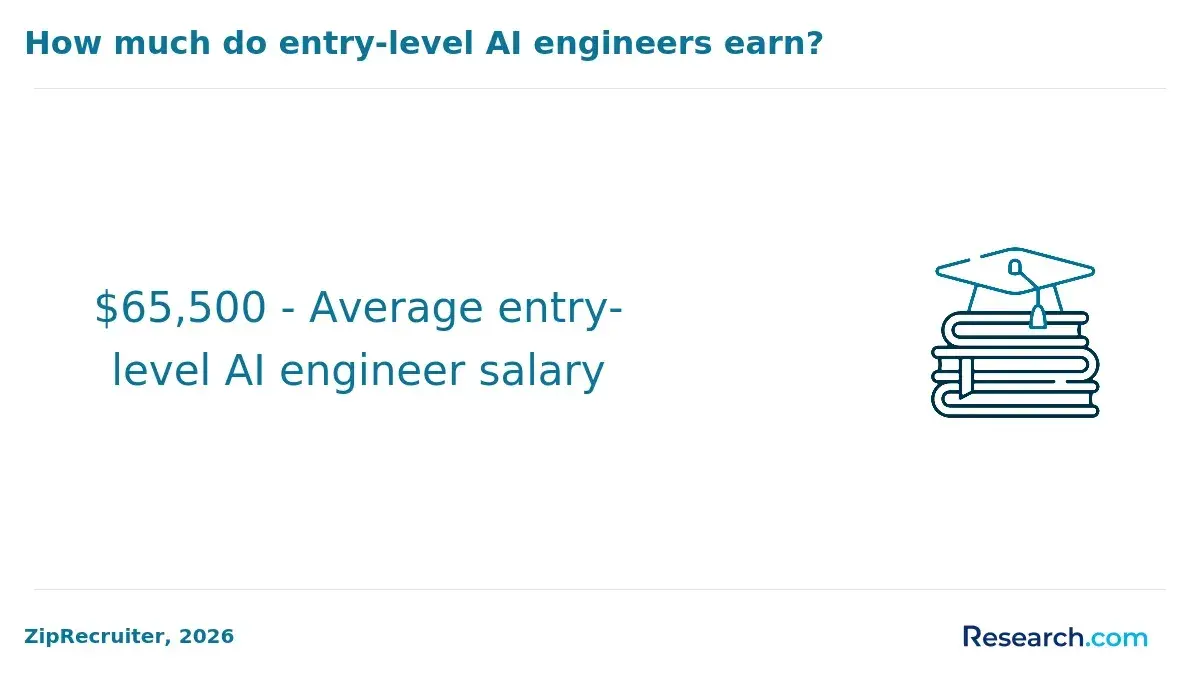
Entry-level jobs like AI data analysts or machine learning specialists typically start near $80,000, while advanced roles such as AI engineers, research scientists, or AI architects often earn between $130,000 and $140,000. Combining certification with experience in software development, data science, or cloud computing further enhances earning potential.
The demand for AI skills continues to grow strongly across sectors like healthcare, finance, technology, and manufacturing. The U.S. Bureau of Labor Statistics projects a 23% employment growth rate for computer and information research scientists from 2022 to 2032, signaling expanding opportunities for AI professionals. This growth is driven by the wider adoption of AI technologies and automation.
Admissions trends support this positive outlook. A report from the National Association for College Admission Counseling (NACAC) indicates 61% of U.S. graduate computing programs have eliminated GRE requirements, leading to a 17% increase in certificate applications over two years. Greater accessibility encourages more professionals to gain AI skills.
AI certificates are beneficial for those shifting careers or looking to upgrade skills efficiently. Employers seek candidates demonstrating practical AI competence without the need for full graduate degrees. Choosing certificate programs aligned with industry demands and offering hands-on projects can improve job placement and career advancement.
How can prospective students compare and choose the best AI graduate certificate for their goals?
When selecting AI graduate certificates, prioritize curriculum relevance, skill depth, and career alignment. Choose programs with specialized courses that match your goals, such as machine learning, natural language processing, or computer vision.
Focus on certificates emphasizing practical tools like Python, TensorFlow, or cloud AI platforms, supplemented with hands-on projects and capstones, which better prepare you for industry demands.
The IBM 2025 Global AI Adoption Index reveals that 51% of enterprises are actively hiring for AI roles, yet 41% cite a lack of AI skills as a hiring barrier. This highlights the importance of structured, comprehensive upskilling through certificates rather than superficial exposure. Look for programs featuring recognized faculty, industry partnerships, or alliances that support networking and internships.
Flexibility matters: part-time, evening, or online delivery suits working professionals. Confirm the accreditation of certificates and employer acceptance in your field. Carefully compare costs and explore available financial aid options.
Other Things You Should Know About Artificial Intelligence
While programming knowledge is advantageous, many 2027 AI certificate courses for graduate students offer foundational modules to accommodate beginners. However, familiarity with languages like Python can enhance learning and performance in complex subjects such as machine learning and neural networks.
Yes, many AI certificate programs provide students with opportunities to engage in research projects, either independently or alongside faculty members. These projects often focus on practical applications of AI techniques such as machine learning, natural language processing, or computer vision. Participating in research can enhance a student's understanding and improve their prospects for academic or industry roles.
Ethical considerations are increasingly emphasized in AI education, including issues around bias, privacy, and the societal impact of AI technologies. Many graduate certificate programs include discussions or dedicated courses on AI ethics to prepare students for responsible development and deployment of AI systems. Understanding these principles is essential for fostering trust and fairness in AI applications.
Many AI certificate programs provide career support services such as job placement assistance, mentoring, and connections to industry professionals. Networking events, alumni groups, and partnerships with tech companies can also be valuable resources for students seeking internships or employment after completing their certificate. These services help bridge the gap between academic learning and professional advancement.
References
- University Degree vs AI Bootcamp: Which is Best Career Path? https://agilefever.com/university-degree-vs-ai-bootcamp-which-is-best/
- AI Certification Programs: Which Ones Matter for Your Career https://www.businessplusai.com/blog/ai-certification-programs-which-ones-matter-for-your-career
- Choosing a master’s degree: data science or artificial intelligence | edX https://www.edx.org/resources/choosing-a-masters-degree-data-science-or-artificial-intelligence
- What are the requirements for completing the Introduction to AI and Building AI courses? https://www.elementsofai.com/ie/faq/what-are-the-requirements-for-completing-the-introduction-to-ai-and-building-ai-courses
- Ultimate Guide: How to Choose the Right AI Training Course to Boost Your Career - ONLC https://www.onlc.com/blog/how-to-choose-ai-training-courses/
- 11 Best AI Certifications in 2025 to Deepen Your Technical Knowledge | DigitalOcean https://www.digitalocean.com/resources/articles/ai-certifications
- 5 Exciting AI Careers: Unlock Opportunities Ahead https://www.ucertify.com/blog/ai-careers-and-machine-learning/
- Online Certificates for Job-Ready Skills | Grow with Google https://grow.google/certificates