2027 Best AI Courses for Compliance Professionals

Co-Founder and Chief Data Scientist
Compliance professionals face mounting challenges as regulations evolve alongside rapid advances in artificial intelligence technology. Staying current is essential to effectively manage risks, ensure ethical standards, and navigate new legal frameworks. Many struggle to find specialized training that bridges compliance expertise with practical AI knowledge.
This gap can hinder career progression and organizational readiness for technology-driven change. This article explores the best AI courses tailored for compliance professionals, focusing on flexible, accredited options that support a smooth transition into this critical interdisciplinary field.
Key Things You Should Know
- Top AI courses for compliance professionals in 2026 emphasize regulatory frameworks, ethical AI use, and risk management, reflecting a 35% growth in demand for AI-literate compliance roles since 2024.
- Curricula increasingly combine practical AI applications with legal standards, preparing students to navigate evolving U.S. regulations like the AI Accountability Act and data privacy laws.
- Providers offering AI compliance training report a 40% increase in enrollment from compliance officers, highlighting rising employer expectations for AI competency across industries.
Advance Your Career with AI Online Courses
Artificial Intelligence: Implications for Business Strategy
This program provides an introduction to Artificial Intelligence and their implications for business strategy. Earn an official digital certificate.

Oxford Artificial Intelligence Programme
Explore this Oxford Artificial Intelligence programme offered in a flexible learning environment and explore topics like machine learning, automation, and robotics.

Implementing Agentic AI: Building Your Organizational Playbook
This online MIT Agentic AI course offers a practical approach to deploying AI agents in your organization, including a custom playbook. 3 weeks, exclusive launch price.

AI Adoption: Driving Business Value and Impact
This online MIT AI Adoption: Driving Business Value and Impact offers practical frameworks to close the gap between AI potential and business reality.

Artificial Intelligence in Pharma and Biotech
Discover the applications and limitations of artificial intelligence in pharma and biotech with this MIT online short course.

What do AI courses for compliance professionals cover, and who are they designed for?
AI compliance training programs for professionals focus on integrating artificial intelligence tools into regulatory and risk management frameworks. These courses cover key topics covered in AI courses for compliance specialists such as data privacy regulations, algorithmic auditing, ethical AI use, machine learning basics, and automated compliance monitoring. They provide insights into AI-driven risk assessment models and teach how to interpret their outputs to support informed decisions.
Designed for compliance officers, risk managers, legal advisors, and regulatory analysts, the training equips learners to manage AI technologies within organizations. For example, a compliance officer in finance may evaluate AI algorithms used for fraud detection while ensuring compliance with standards like GDPR or CCPA. Risk managers gain skills in predictive analytics to identify potential compliance breaches proactively.
Practical elements include AI governance frameworks, bias mitigation strategies, and the use of AI tools for reporting and documentation. Participants receive hands-on experience with compliance automation software, helping streamline audits and regulatory filings. The demand for AI skills in compliance, risk, and regulatory roles surged by 64% on LinkedIn in 2024, significantly outpacing overall compliance job growth.
These AI compliance training programs for professionals prepare individuals to keep pace with evolving, technology-driven regulatory landscapes and bolster organizational resilience. Those exploring career paths can also benefit from reviewing available artificial intelligence degree jobs.
Advance Your Career with AI Online Courses
Artificial Intelligence: Implications for Business Strategy
This program provides an introduction to Artificial Intelligence and their implications for business strategy. Earn an official digital certificate.
Oxford Artificial Intelligence Programme
Explore this Oxford Artificial Intelligence programme offered in a flexible learning environment and explore topics like machine learning, automation, and robotics.
Implementing Agentic AI: Building Your Organizational Playbook
This online MIT Agentic AI course offers a practical approach to deploying AI agents in your organization, including a custom playbook. 3 weeks, exclusive launch price.
How can AI skills enhance a compliance professional's career and salary potential?
AI skills significantly enhance career growth with AI skills for compliance professionals by enabling them to navigate complex regulatory environments more efficiently. Mastery of AI-driven data analytics allows compliance officers to detect fraud, risk, and non-compliance patterns much faster than traditional methods. For instance, natural language processing (NLP) can automate contract and communication reviews, reducing human error and speeding up case resolution.
According to the Thomson Reuters Cost of Compliance 2024 Report, 73% of global compliance leaders now see AI and analytics expertise as essential core competencies, up from 46% in 2022. This trend illustrates increasing industry demand for professionals who can apply AI algorithms to real-time risk assessment and regulatory reporting.
Increasing salary potential through AI expertise in compliance is a key benefit for professionals with these skills. Roles like compliance data scientist or risk analytics manager, which require machine learning, data visualization, and AI-driven audit knowledge, usually offer salaries 15% to 25% higher than traditional compliance positions.
Additionally, practical AI knowledge improves collaboration with IT and data science teams, boosting a professional's strategic value and enabling automated compliance monitoring to reduce regulatory penalties. Prospective compliance officers should focus on courses covering AI ethics, data governance, and predictive analytics to match evolving job demands and advance their careers. Exploring an AI master's degree can prepare candidates to meet these challenges effectively.
What types of AI training paths exist for compliance professionals (certificates, degrees, bootcamps)?
Compliance professionals have several AI training avenues to choose from: certificates, degrees, and bootcamps, each suited to different career stages and learning preferences. Certificates focus on practical expertise in AI governance and compliance, often provided as postgraduate programs lasting 6-12 months. These are ideal for those seeking targeted skill upgrades without a full degree commitment.
Many who complete these AI certification programs for compliance professionals report salary increases of 18-22% within a year, according to the Georgetown University Center for Security and Emerging Technology. Degree offerings, such as master's programs in AI governance, data ethics, or technology law, provide comprehensive knowledge over 1-2 years full time. They prepare professionals for leadership roles by combining technical AI insight with regulatory frameworks.
Bootcamps are intensive, 3-6 month programs emphasizing hands-on skills and real-world problem solving with AI and compliance technology platforms. They suit professionals who need rapid immersion in applied concepts and tools. Choosing the right path depends on time, career goals, and budget. Certificates balance cost and recognition, degrees add depth and status, and bootcamps deliver fast, applied training.
Professionals should also consider legal compliance AI training courses' relevance to their roles and salary objectives. For those exploring related fields or interdisciplinary options, reviewing game design degrees can offer insights into affordable online education strategies applicable elsewhere.
Which AI courses for compliance professionals are offered by accredited U.S. institutions?
Several accredited U.S. institutions offer specialized AI courses for compliance professionals at accredited US universities. The University of California, Berkeley's School of Information provides a Professional Certificate in AI Ethics and Governance, focusing on regulatory frameworks and compliance challenges tied to AI deployment. Georgetown University offers an AI and Law certificate that addresses legal risk and ethical compliance in AI systems.
New York University's Stern School of Business delivers a program on AI Risk Management and Compliance, incorporating case studies from finance and healthcare-sectors representing over 60% of candidates pursuing AI governance certifications, according to EXIN's "Best AI Compliance Certification Guide 2025." The curriculum includes policy development, ethical auditing, and impact assessments important for compliance officers during digital transformation.
The Illinois Institute of Technology features a Master's level course on AI Governance and Policy, designed for professionals requiring in-depth technical and regulatory expertise to meet emerging federal regulations. These us-based accredited training programs in AI for compliance specialists complement growing certification options like IAPP AIGP, ISACA AI, and EXIN AICP, which have seen a 210% rise in exam registrations in 2024.
Compliance professionals aiming to advance in regulated sectors should consider combining university programs with recognized certifications. For those exploring various options, the best cybersecurity courses resource offers additional guidance.
How do online AI compliance programs compare with campus-based programs in flexibility and quality?
Online AI compliance programs offer greater flexibility compared to campus-based options, enabling professionals to balance education with work and other commitments. These programs typically provide asynchronous content accessible 24/7, allowing learners to progress at their own pace. In contrast, campus-based programs require fixed schedules and physical presence, which may limit access for working professionals or individuals in remote areas.
Both delivery methods can offer rigorous curricula. Online programs increasingly meet or surpass traditional standards by partnering with industry experts to include up-to-date content on compliance regulations and AI auditing techniques. Training in AI audit, risk, and model validation is emphasized across formats, supporting relevant workplace skills.
The ISACA State of Digital Trust 2024 report notes that organizations with formally trained AI auditors experience 27% fewer high-risk AI model findings in external audits, highlighting the value of structured training. Campus programs provide direct networking, immediate faculty access, and hands-on AI tool experience in labs. Online students benefit from interactive virtual labs, live webinars, and global peer groups that replicate these advantages remotely.
Choosing between formats depends on individual needs: campus programs suit those seeking immersive academic environments and local industry connections, while online programs offer flexibility, cost savings, and equivalent certification from reputable providers.
What core topics and tools are taught in AI courses for compliance professionals?
AI courses tailored for compliance professionals center on essential areas to help learners effectively leverage artificial intelligence within regulatory and risk management contexts. Core topics include AI ethics and governance, focusing on bias mitigation, transparency, and accountability in AI models. Regulatory frameworks such as GDPR, HIPAA, and industry-specific compliance standards are emphasized to show AI's impact on these policies.
Technical instruction often covers machine learning fundamentals, data privacy protocols, and AI-driven risk assessments. Participants gain skills in using AI-powered compliance tools for ongoing monitoring, anomaly detection, and automated reporting, thereby supporting audit trails and regulatory adherence.
Practical training includes hands-on experience with platforms like Python for data analysis and compliance software integrating AI modules. Natural language processing (NLP) is frequently taught to automate contract reviews, identify inconsistencies, and flag high-risk terms, reducing manual workload significantly.
The curriculum also addresses challenges such as interpreting AI outputs, managing false positives, and sustaining model validation. Scenario-based exercises and case studies prepare compliance teams to navigate evolving AI risks and regulatory changes efficiently.
Demand for focused AI and compliance education is rising rapidly, with enrollment in short micro-credentials across Coursera, edX, Udemy, and Skillsoft increasing by 180%. Over 55% of students cite immediate relevance to their current compliance roles as a key motivation, according to Coursera Global Skill Trends 2025.
What are the typical admission requirements for AI programs focused on compliance?
Admission requirements for AI programs focused on compliance vary by institution and program level but generally require a bachelor's degree from an accredited university. Applicants typically need a background in law, business, information technology, data science, or related fields. Some advanced programs may also require professional experience in compliance, risk management, or regulatory affairs, usually ranging from two to five years.
Those without a technical background might need to demonstrate proficiency in programming, statistics, or data analysis. Prerequisites often include knowledge of regulatory frameworks like GDPR, HIPAA, or sector-specific standards, especially in finance or healthcare compliance. Increasingly, familiarity with the EU AI Act and DORA is expected as these regulations define new compliance challenges related to automated decision-making and risk mitigation.
Applicants commonly submit a personal statement showing an understanding of AI's ethical and legal implications in compliance. Letters of recommendation from industry professionals or academic mentors help assess candidates' commitment and aptitude. Executive education aimed at financial professionals may require proof of employment in regulated institutions.
According to the European Banking Authority's survey, 68% of EU financial institutions had launched AI compliance training by late 2024, up from 19% in early 2023, underscoring increased demand for qualified practitioners. Prospective students should develop interdisciplinary skills combining regulatory knowledge, AI fundamentals, and practical compliance experience to meet evolving program standards.
How long do AI compliance programs take, and what do they typically cost?
AI compliance programs typically require 3 to 6 months to complete, depending on their complexity and delivery method. Short workshops may last only a few weeks, covering fundamental regulatory and ethical frameworks, while comprehensive certification courses span six months or longer, addressing AI governance, risk management, legal compliance, and emerging regulations like the EU AI Act or U.S. legislative proposals.
Training costs vary widely, from about $500 for concise online courses to over $5,000 for extensive in-person or blended programs offered by universities or specialized firms. Online courses offer flexibility and affordability, making them ideal for working professionals seeking to balance education with their careers. In-person formats often provide more networking and direct instruction but come at a higher price.
The IBM Global Skills Survey 2024 revealed that professionals completing AI governance training entirely online were 1.5 times more likely to receive AI-related promotions or role changes within a year compared to those who only attended traditional in-person classes. This highlights the growing value and accessibility of quality online AI compliance education.
- Accelerated career progress is often linked to accredited, well-designed online AI compliance programs.
- Additional expenses such as certification fees, materials, or mentoring can increase upfront costs but enhance long-term outcomes.
What AI-related job roles can compliance professionals pursue, and what is the job outlook?
Compliance professionals have growing opportunities in AI-related roles that blend regulatory expertise with technology insights. Common positions include AI compliance analyst, who monitors AI systems for legal and ethical adherence; AI governance specialist, developing policies for AI use; and risk manager, focused on mitigating AI-driven operational risks. Roles like AI ethics officer and data privacy officer also incorporate AI-specific requirements within broader compliance frameworks.
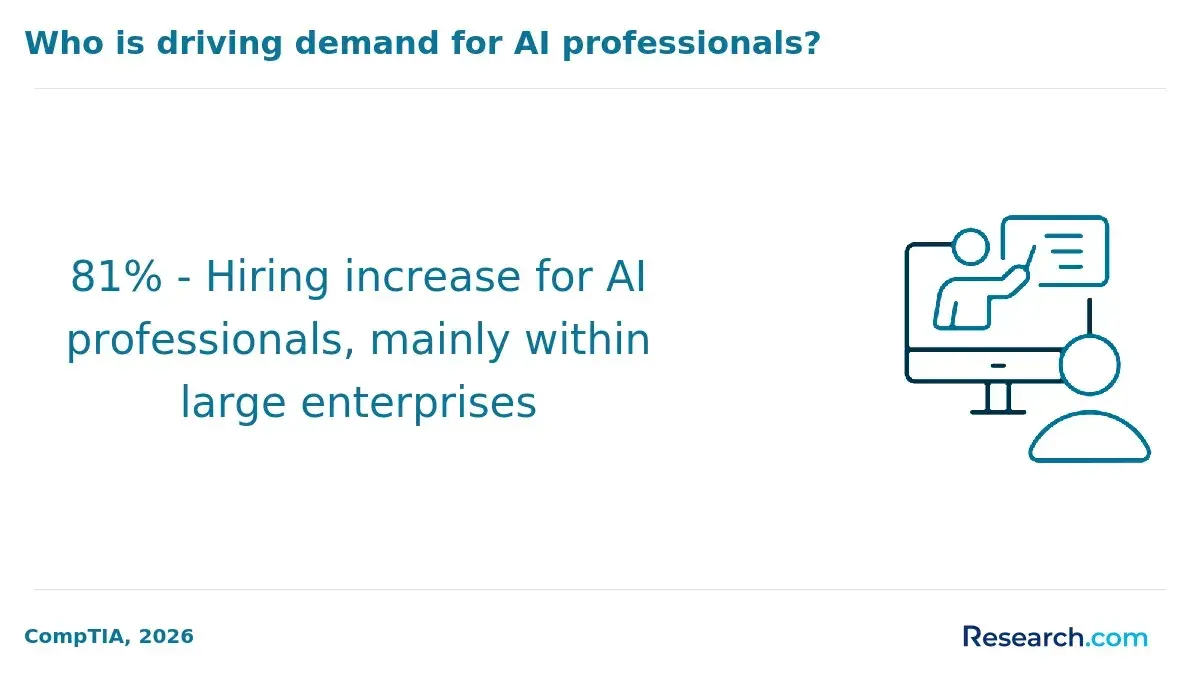
Demand for these roles is rising sharply, especially in finance, healthcare, and government sectors, driven by increasing regulatory scrutiny. The Deloitte Global AI Governance Survey 2024 reports that 63% of large enterprises invest in AI governance and compliance training, with those firms being 2.1 times more likely to see high returns from AI initiatives. This highlights how employer-supported education enhances organizational AI success and career prospects for candidates.
Upskilling paths emphasize courses in AI ethics, regulatory frameworks, bias detection, and audit methods. These prepare professionals for responsibilities like ensuring algorithm transparency, conducting bias audits, and aligning risk assessments with laws such as GDPR or the U.S. Algorithmic Accountability Act. Advanced roles often require combining compliance knowledge with data science or cybersecurity skills to manage AI compliance programs or consult strategically.
Professionals who can translate complex AI risks into actionable policies are increasingly sought after, marking a key intersection of technology and regulation.
How can compliance professionals evaluate and choose a reputable AI course or program?
Compliance professionals should focus on courses that blend technical artificial intelligence skills with industry-specific applications. Evaluate programs for curriculum relevance in areas like risk assessment, regulatory reporting, and automated monitoring systems. Courses that offer practical tools such as machine learning model interpretation and natural language processing tailored for compliance data are particularly valuable.
Check instructor and institution credentials to ensure expertise in both AI and compliance. Prioritize courses including real-world case studies or projects, preferably those affiliated with reputable industry bodies or regulatory agencies to stay aligned with evolving standards.
Flexibility in course format and content depth is important. Professionals with basic AI knowledge may benefit from specialized compliance automation modules, while others might need a full introduction to AI concepts. Compare durations, delivery methods (online or in-person), and access to mentorship or support networks.
Up-to-date material is essential due to rapid changes in AI technologies and regulations. Courses referencing recent trends better prepare learners for future shifts in compliance roles. According to the World Economic Forum Future of Jobs Report 2025, 40-45% of compliance tasks will be automated by AI by 2030, with demand rising by 30-35% for compliance professionals skilled in AI.
Other Things You Should Know About Artificial Intelligence
Compliance professionals working with artificial intelligence must prioritize ethics concerning data privacy, bias mitigation, and transparency. Ensuring AI systems comply with existing regulations like GDPR and avoiding discriminatory outcomes are critical responsibilities. Ethical frameworks help maintain trust and accountability in AI applications within regulated industries.
AI can automate risk assessment, monitor transactions for suspicious activity, and streamline reporting tasks in compliance workflows. This reduces human error and increases efficiency while enabling real-time detection of compliance breaches. However, reliance on AI also requires continuous oversight to validate algorithm decisions and maintain regulatory standards.
In 2027, top courses for compliance professionals include "AI for Compliance" by Coursera, which covers ethics and regulatory frameworks, and edX's "AI and Data Privacy" focusing on privacy laws. Bootcamps like Udacity's "AI in Financial Compliance" provide industry-specific skills critical for advanced compliance roles.
Yes, different sectors face unique AI compliance challenges reflecting their regulatory landscapes. For instance, healthcare AI must address patient data confidentiality, while financial AI systems focus on anti-money laundering controls. Compliance professionals must tailor AI oversight strategies to align with their industry's legal and ethical demands.
References
- EU AI Act Compliance training + certificate - DPO Europe https://data-privacy-office.eu/courses/artificial-intelligence-regulation-the-fundamentals-of-risk-management-personal-data/
- What Does AI Governance Cost? Budgets by Org Size https://governance.aicareer.pro/blog/the-costs-of-ai-governance
- AI Compliance Training: How Automation is Transforming Regulatory Education - iTacit Frontline Training & Digital Worplace https://itacit.com/blog/ai-compliance-training-how-automation-is-transforming-regulatory-education/
- Best AI Compliance Courses and Certifications in 2025 https://learnprompting.org/blog/ai-compliance-courses-and-certifications
- AI & Compliance | HCCA Official Site https://www.hcca-info.org/ai-compliance
- AI Regulation and Compliance Training in the US https://www.nobleprog.com/ai-regulation-and-compliance-training
- AI Foundations for Compliance Professionals Professional Certificate https://www.edx.org/certificates/professional-certificate/ica-ai-foundations-for-compliance-professionals
- ICA Specialist Certificate in AI for Compliance Professionals - Qualification https://www.int-comp.org/courses/ica-specialist-certificate-in-ai-for-compliance-professionals/
- AI Compliance Cost Calculator: Internal vs. External Validation - VerityAI https://verityai.co/blog/ai-compliance-cost-calculator-internal-vs-external
- AI Regulation and Compliance Training in Croatia https://www.nobleprog.com.hr/ai-regulation-and-compliance-training