Interview with Computer Science Experts: Answering Student’s Questions About Computer Science Trends

Co-Founder and Chief Data Scientist
Computer science is a flexible degree and career field, but that flexibility creates a hard decision: should you focus on software engineering, cybersecurity, artificial intelligence, data science, systems, research, or another path entirely? Students also have to decide whether a traditional degree, online program, internship-heavy route, certification, boot camp, or graduate study makes the most sense for their goals and budget.
This guide brings together expert insight, labor market data, and practical decision points to help students and early-career professionals plan a stronger computer science path. You will learn which skills matter most, how to choose a specialization, how internships affect hiring, which technologies deserve attention, how to compare degree programs, and what career options are available after graduation.
Data published in 2024 shows that computer and information technology occupations are projected to grow much faster than average from 2022 to 2032, with about 377,500 openings each year from growth and replacement needs. That does not mean every computer science graduate automatically lands a high-paying role, but it does mean well-prepared candidates have many possible directions.
Quick Answer: What Should Computer Science Students Focus on First?
Computer science students should build a strong foundation in programming, algorithms, data structures, mathematics, software design, teamwork, communication, and problem-solving before narrowing into a specialization. Internships, co-ops, open-source work, side projects, and GitHub portfolios can help students test career interests and prove their ability to employers.
The best specialization is usually the one that combines three factors: genuine interest, market demand, and demonstrated skill. Cybersecurity, software development, artificial intelligence, machine learning, and data-related fields continue to attract attention, but students should avoid chasing trends without developing durable technical fundamentals.
Experts We Interviewed
- Derek Riley, Ph.D. — Professor and Program Director, Electrical Engineering and Computer Science, Milwaukee School of Engineering
- Elan Barenholtz, Ph.D. — Associate Professor, Dept. of Psychology/Center for Complex Systems and Brain Sciences
- Walter Schilling, Jr., Ph.D. — Professor, Electrical Engineering and Computer Science, Milwaukee School of Engineering
- Martin Kang, Ph.D. — Assistant Professor of Information Systems and Business Analytics, College of Business Administration, Loyola Marymount University
- Kathleen Carley, Ph.D. — Professor of Computer Science, Software and Societal Systems Department, Carnegie Mellon University
- What skills matter most for a successful computer science career?
- How should students choose a computer science specialization?
- How valuable are internships and co-op programs for computer science students?
- Which emerging technologies should computer science students follow?
- What books, courses, and resources help computer science students learn effectively?
- How can students move from college into a professional computer science role?
- What financial strategies can help manage the cost of a computer science degree?
- How can I ensure my computer science degree remains future-proof?
- Are there alternative education paths for aspiring computer science professionals?
- How can diversity and inclusion influence computer science career opportunities?
- Is a non-dissertation doctoral program right for you?
- Can accelerated programs expedite my computer science career?
- Are online computer science degrees as reputable as traditional programs?
- How can I choose the right computer science degree program?
- What are the best career paths for computer science graduates?
- What is the current job market like for computer science graduates?
What skills matter most for a successful computer science career?
A computer science career requires more than knowing one programming language. Employers often want candidates who can learn new tools quickly, break down complex problems, write maintainable code, communicate with nontechnical stakeholders, and work productively in teams.
| Skill area | Why it matters | How students can build it |
| Programming fundamentals | Core coding ability supports nearly every technical role. | Practice with class projects, coding exercises, open-source contributions, and personal applications. |
| Algorithms and data structures | These concepts help students solve problems efficiently and prepare for technical interviews. | Take foundational courses seriously and revisit concepts through projects and interview practice. |
| Communication | Most computing work involves clients, teammates, documentation, and trade-off discussions. | Write clear project notes, present technical work, and practice explaining code to nontechnical audiences. |
| Teamwork and software process | Professional software is rarely built alone. | Use version control, code reviews, agile practices, and group projects. |
| Lifelong learning | Tools, frameworks, security risks, and employer expectations change quickly. | Follow reputable technical publications, experiment with new tools, and keep a portfolio current. |
- Dr. Derek Riley emphasizes that computer science professionals need a lifelong learning mindset because most computing jobs require workers to keep up with innovation and evolving best practices.
- Dr. Elan Barenholtz points to the ability to learn new skills and navigate the developer ecosystem as a central career skill.
- Dr. Walter Schilling stresses that many computer science graduates work as software engineers who must communicate with clients, collaborate on teams, and understand the engineering process.
- Dr. Martin Kang highlights the value of mathematics, science, engineering, and other foundational knowledge because advanced computer science skills build on those basics.
These responses reinforce a practical point: students should not treat “technical” and “soft” skills as separate career tracks. A software engineer who can code but cannot gather requirements, document decisions, test solutions, or work with others may struggle in professional settings.
A 2024 study on computer science education also connects effective learning with real-world applications, project-based assessment, and teamwork. It notes that knowledge gaps, limited technology access, and course availability can still affect student preparation. Dr. Kathleen Carley adds that students should strengthen computational thinking, programming, problem structuring, collaboration, and writing.
The chart below lists the top-paying occupations in computer science by annual median wage, according to data published in 2024 by the BLS.
How should students choose a computer science specialization?
Students should choose a computer science specialization by testing options through projects, internships, electives, research, and open-source work instead of relying only on job titles or salary expectations. A good specialization should fit your strengths, curiosity, and willingness to keep learning.
- Dr. Derek Riley recommends trying a field directly through an internship, open-source contribution, or personal project. In his view, students can discover whether they enjoy an area before taking a formal course, and later coursework becomes more useful when they already have context.
- Dr. Walter Schilling says students should see different parts of computer science in practice, especially through summer internships. Exposure to front-end work, back-end development, systems integration, user interface design, and related areas can clarify what students actually enjoy.
- Dr. Martin Kang encourages students to follow curiosity and consistently pursue topics that interest them because sustained engagement can reveal unexpected opportunities.
- Dr. Kathleen Carley advises students to weigh personal excitement, technical fit, and skill alignment instead of choosing only what appears most lucrative at graduation.
| If you enjoy... | Consider exploring... | Good first test project |
| Building user-facing products | Software engineering, web development, mobile development, UI-focused engineering | Create a working app with authentication, a database, and a deployed front end. |
| Protecting systems and investigating risk | Cybersecurity, information assurance, secure software development | Build a small lab to practice vulnerability scanning, secure configuration, and incident documentation. |
| Pattern recognition and prediction | Artificial intelligence, machine learning, data science | Train and evaluate a model using a public dataset, then explain its limitations. |
| Infrastructure and performance | Cloud computing, systems engineering, network administration, DevOps | Deploy an application using containers, monitoring, and automated testing. |
| Research and complex modeling | Graduate study, computational social science, robotics, simulation, human-centered AI | Replicate a small research experiment or simulation and write a technical summary. |
Labor market information can help students decide where to start, but it should not be the only factor. According to the BLS, fast-growing computer science-related roles include information security analysts at 32% projected growth, software developers at 26%, and computer and information systems managers at 15%. Strong demand is useful information, but students still need evidence that they like the work and can perform it well.
Dr. Barenholtz’s advice is straightforward: identify the area that excites you and learn what success in that area requires. That means reading job descriptions, talking to professionals, reviewing required tools, and building small projects before making a long-term commitment.
How valuable are internships and co-op programs for computer science students?
Internships and co-op programs are among the most useful ways for computer science students to connect classroom learning with professional expectations. They are not the only path into a technical role, but they provide evidence of experience, help students compare work environments, and can lead to stronger professional networks.
- Dr. Derek Riley views internships as important mainly because they create experience and professional connections, even though students can build experience in other ways.
- Dr. Elan Barenholtz considers internships critical because students learn what kind of role they want, while employers see how candidates perform in a real developer environment.
- Dr. Walter Schilling recommends multiple rotations, beginning early in college when possible. He notes that companies often use internships as a major recruiting channel and suggests using career centers, campus fairs, advisory boards, LinkedIn, ACM, IEEE Computer Society, and related student organizations.
- Dr. Martin Kang says even a small-company internship can be valuable when students work hard, learn actively, and use the experience as a platform for future opportunities.
Dr. Carley rated internships a 3 on a 1-to-5 importance scale where 5 means very important. Her perspective is useful because it prevents students from assuming there is only one acceptable route. Internships help, but mentorship, project quality, research work, and demonstrated technical ability also matter.
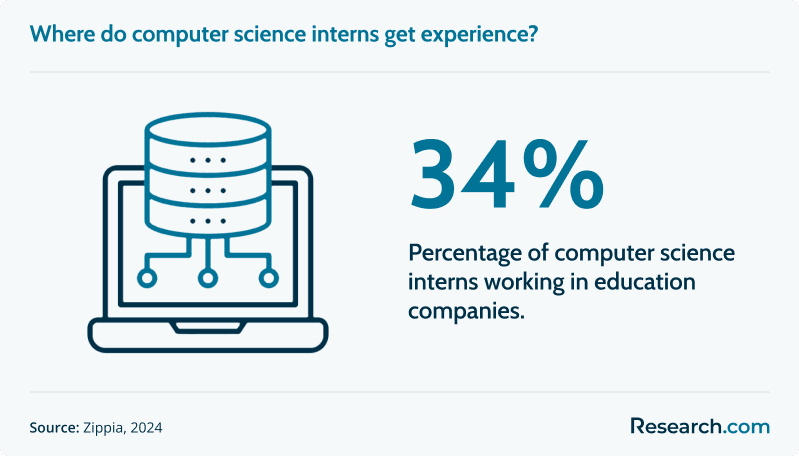
According to Zippia, over 12,050 computer science interns were employed in the US as of 2024, and these interns are 34% more likely to work at education companies than private companies. This suggests that students may find internship opportunities in educational settings as well as private industry.
| What to look for | Why it matters | Warning sign |
| Real project ownership | You need evidence of applied skills, not just observation. | The role is mostly shadowing, errands, or unrelated administrative work. |
| Mentorship | A good mentor helps you improve code quality, professional habits, and decision-making. | No one is assigned to review your work or answer technical questions. |
| Relevant technology exposure | The internship should help you test a possible career direction. | The tools or tasks have little connection to your goals. |
| Team collaboration | Professional development requires code reviews, meetings, documentation, and version control. | You work entirely alone with no feedback loop. |
| Possible return offer or referral | Internships can become hiring pipelines or networking assets. | The employer has no clear process for evaluating interns. |
Students should prioritize internships where they can build, test, document, and explain real work. Avoid choosing an internship only because the company name looks impressive. A smaller organization with strong mentorship and meaningful technical responsibility may be more useful than a prestigious role with limited hands-on work. This is different from comparing tuition-focused education options such as a master's degree under $10 000, where cost and delivery model may be the central decision factors.
Which emerging technologies should computer science students follow?
Computer science students should monitor emerging technologies, but they should not let trends replace fundamentals. The safest strategy is to build durable skills in programming, systems, algorithms, security, data, and software engineering while selectively learning tools that are shaping hiring needs.
- Dr. Walter Schilling warns that fashionable areas can shift. He notes that data science was highly popular a few years ago, but opportunities may be more limited for candidates who are not among the most qualified. He identifies cybersecurity as a consistently strong area because of a shortage of qualified professionals.
- Dr. Martin Kang recommends that students follow ACM and IEEE publications to understand current research and technical developments.
Students interested in cybersecurity can compare formal degree options, including the cheapest cyber security degree online, but they should also practice secure coding, risk assessment, incident response basics, and system hardening. Cybersecurity is not only a degree label; it is a discipline built through repeated exposure to real systems and threat models.
Several experts also point to artificial intelligence, machine learning, and large language models. Dr. Riley and Dr. Carley recommend learning how LLMs can support coding tasks while also understanding their limitations. These tools can help with drafting, debugging, explanation, and code generation, but students still need to verify outputs, understand logic, manage security risks, and avoid overreliance.
Dr. Barenholtz and Dr. Carley also identify artificial intelligence as a major area to watch. The AI market reached over 184 billion U.S. dollars in 2024, an increase of nearly 50 billion from the previous year, with projections exceeding 826 billion U.S. dollars by 2030. Dr. Carley also suggests looking at how AI can intersect with other areas, including social network analysis.
| Trend | Why students should care | How to learn responsibly |
| AI and machine learning | AI is affecting software, analytics, automation, research, and product development. | Learn model evaluation, data quality, bias, limitations, and practical deployment. |
| Large language models | LLMs are changing coding workflows and developer productivity expectations. | Use them as assistants, not substitutes for understanding, testing, and secure design. |
| Cybersecurity | Security concerns grow as systems, data, and AI tools become more widely deployed. | Study networks, secure coding, identity, cloud security, and incident response fundamentals. |
| Data and analytics | Organizations rely on data to guide decisions, but roles can be competitive. | Pair statistics and programming with domain knowledge and strong communication. |
| Human-centered and interdisciplinary computing | Computing increasingly overlaps with psychology, business, social systems, health, and policy. | Take electives or projects that connect technical systems to real users and organizations. |
The practical takeaway: follow trends, but build judgment. A student who understands core computing concepts can adapt as tools change. A student who only learns one hot tool may have to restart when the market moves.
What books, courses, and resources help computer science students learn effectively?
The best computer science resource is the one you will actually use consistently. Some students learn best through textbooks, while others need videos, podcasts, labs, documentation, research papers, or open-source examples. Strong students usually combine several resource types.
- Dr. Derek Riley advises students to identify the learning format that works best for them rather than forcing one medium.
- Dr. Elan Barenholtz notes that free and low-cost online courses, open-source communities, and developer ecosystems often expose students to newer material than traditional textbooks.
- Dr. Walter Schilling recommends joining professional organizations such as IEEE, ACM, Society of Women Engineers, and National Society of Black Engineers because they offer programming, networking, and student opportunities.
- Dr. Martin Kang reminds students not to overlook their formal curriculum and professors, who can point them toward current concepts and important trends.
More public high schools have recently added foundational computer science courses. Currently, 57.5% of public high schools in the US offer these classes, representing the largest percentage growth in the last five years. This expansion can increase early exposure and create more demand for accessible learning resources.
| Resource type | Best for | How to use it well |
| College curriculum | Building structured foundations | Do not skip fundamentals because advanced topics depend on them. |
| Online courses | Learning tools, frameworks, and supplemental concepts | Choose courses with projects, not passive lectures only. |
| Open-source projects | Seeing professional code and collaboration practices | Start with documentation fixes or small issues before larger contributions. |
| Professional societies | Networking, conferences, competitions, and career exposure | Attend events and volunteer instead of only listing membership on a resume. |
| Books and research papers | Deep conceptual understanding | Read selectively and summarize what you learn in your own words. |
Students who are interested in interdisciplinary computing can also study fields outside traditional computer science. For example, even the cheapest psychology degree online may expose students to human behavior concepts that matter in artificial intelligence, machine learning, user experience, and cognitive modeling.
For students interested in social network analysis, Dr. Carley recommends Social Network Analysis: A Handbook by John P. Scott and Social Network Analysis: Methods and Applications by Stanley Wasserman and Katherine Faust. For simulation, she recommends Simulation Modeling & Analysis by Averill M. Law, An Introduction to Agent-Based Modeling: Modeling Natural, Social, and Engineered Complex Systems with NetLogo by Uri Wilensky and William Rand, and Business Dynamics: Systems Thinking and Modeling for a Complex World by John Sterman.
The chart below lists the share of educational attainment of those working within the field of computer science, according to data published by Data USA.
How can students move from college into a professional computer science role?
The transition from school to work is easier when students graduate with evidence of ability, not just completed coursework. Employers may value a degree, but they also want to see projects, internships, code samples, technical judgment, communication skills, and the ability to operate in a production environment.
- Dr. Derek Riley says students should be ready to show what they can do through GitHub, coding challenges, side projects, internships, and similar evidence. He also notes that good employers hire for potential and person-job fit, not only a fixed list of tools.
- Dr. Elan Barenholtz recommends completing multiple internships when possible so students can compare roles and workplace environments.
- Dr. Walter Schilling says career preparation can begin as early as the first year through internship planning and continues as students test different locations, companies, and work assignments.
- Dr. Martin Kang emphasizes that computer science is both scientific and practical, so professionals must keep improving as market needs change.
- Dr. Kathleen Carley advises students to read deeply while they have time, practice teamwork, learn documentation, prepare to work with legacy systems, build for integration rather than always starting from scratch, and develop strong testing habits.
Research published in 2022 shows that higher education should support both technical preparation and personal development, including social and emotional skills. Technical skills such as data mining, programming, statistics, and big data are often valued for machine learning roles, while AI roles may place heavier emphasis on communication skills.
- Build a portfolio before senior year. Include finished projects with clear README files, screenshots, deployment links when appropriate, and notes on your role.
- Practice version control and collaboration. Learn branching, pull requests, issue tracking, code review, and documentation.
- Apply early for internships. Use career centers, faculty referrals, professional societies, alumni, and online platforms.
- Prepare for technical interviews gradually. Review algorithms, data structures, system design basics, and role-specific tools.
- Learn to explain trade-offs. Employers want to know why you chose one design, tool, or algorithm over another.
- Strengthen written and spoken communication. Students who want formal training in communication can explore options such as an affordable online master's in communication, especially if they plan to move into leadership, consulting, product, or cross-functional roles.
What financial strategies can help manage the cost of a computer science degree?
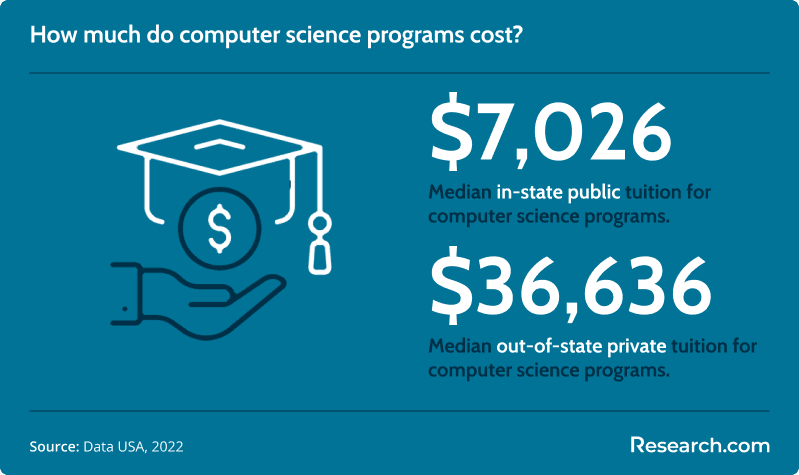
Managing the cost of a computer science education starts with comparing total cost, not just tuition. Students should consider fees, required hardware, software, transportation, housing, lost wages, course load, transfer credits, and time to completion. A lower tuition rate may not be the best value if the program has weak support, poor course availability, or limited career services.
| Cost strategy | When it helps | What to verify |
| Start at community college | You want to reduce lower-division costs before transferring. | Confirm transfer agreements and whether computer science prerequisites will count. |
| Choose an online program | You need schedule flexibility or want to avoid relocation costs. | Check accreditation, academic support, project expectations, and employer recognition. |
| Use scholarships and grants | You qualify based on need, merit, identity, field, location, or employer affiliation. | Review renewal rules, GPA requirements, and whether awards cover fees. |
| Seek employer tuition assistance | You are already working or planning to work while studying. | Ask about reimbursement caps, grade requirements, and required work commitments. |
| Compare adjacent programs | You want a technical role but may not need a traditional CS path. | Review outcomes, curriculum depth, and whether the program supports your target job. |
Students interested in security careers may compare an affordable cyber security degree online with a broader computer science degree plus security electives. The better choice depends on whether you want a security-specific path or a wider technical foundation.
How can I ensure my computer science degree remains future-proof?
No degree can guarantee a future-proof career, but some programs prepare students better for change. Look for a curriculum that teaches fundamentals, updates electives, integrates real projects, includes security and ethics, exposes students to AI and data, and gives students opportunities to work with teams and industry-relevant tools.
A future-ready program should not only teach current frameworks. Frameworks change. Students need transferable abilities: computational thinking, debugging, testing, system design, documentation, data literacy, cybersecurity awareness, and the judgment to learn new technologies responsibly. Students comparing long-term career outcomes can also review broader guidance on which degree is best for future.
Are there alternative education paths for aspiring computer science professionals?
Yes. A four-year computer science degree is a common route, but it is not the only way into technical work. Coding boot camps, certificates, associate degrees, self-study, apprenticeships, military training, community college transfer pathways, and employer-based training can all help students develop job-relevant skills.
| Path | Best fit | Limitations to consider |
| Bachelor’s degree in computer science | Students who want broad foundations, internship access, and long-term flexibility. | Usually requires more time and higher total cost than shorter pathways. |
| Associate degree or transfer pathway | Cost-conscious students who want a staged route into a bachelor’s program or entry-level technical work. | Transfer rules and course equivalencies must be checked carefully. |
| Coding boot camp | Career changers or focused learners targeting a specific development skill set. | Quality varies, and the curriculum may not cover deep CS theory. |
| Professional certification | Students targeting specific tools, platforms, or security-related roles. | Certifications usually work best alongside projects or experience. |
| Self-study plus portfolio | Highly disciplined learners who can build and document real projects independently. | Without credentials or work experience, getting interviews may be harder. |
Students exploring shorter or lower-cost routes can compare options such as 2 year degrees that pay 100k, but they should read outcomes carefully and avoid assuming any program guarantees a specific salary.
How can diversity and inclusion influence computer science career opportunities?
Diversity and inclusion affect computer science careers in several ways. Teams with varied backgrounds can identify user needs, ethical concerns, accessibility barriers, and product risks that more homogeneous teams may overlook. Inclusive workplaces can also improve mentorship, retention, and advancement for people who have historically faced barriers in technology fields.
Students from underrepresented groups should look for programs and employers with visible mentorship, active student organizations, transparent hiring practices, accessible reporting channels, and leadership accountability. Supportive communities such as professional societies, affinity groups, and alumni networks can help students find internships, referrals, conference opportunities, and role models.
Career exploration does not have to be limited to conventional software roles. Some students compare technology careers with other strong income pathways, including trades for women that pay well, before deciding which route best fits their strengths, financial goals, and preferred work environment.
Is a non-dissertation doctoral program right for you?
A non-dissertation doctoral program may fit experienced professionals who want advanced credentials, applied research experience, leadership preparation, or deeper technical specialization without pursuing a traditional dissertation. These programs may appeal to students interested in industry leadership, technology management, applied innovation, or practice-focused scholarship.
Before enrolling, ask whether the program is accredited, whether the doctoral format is respected in your target field, how the capstone or applied research requirement works, and whether faculty expertise aligns with your goals. Students comparing doctoral formats can review doctoral programs without dissertation to understand how non-dissertation options differ from traditional research doctorates.
Can accelerated programs expedite my computer science career?
Accelerated programs can shorten the time needed to earn a credential, but they are not automatically easier. They usually require heavier course loads, tighter deadlines, stronger time management, and fewer breaks. They work best for students who already have academic preparation, transfer credits, work experience, or the ability to study intensively.
| Choose an accelerated program if... | Be cautious if... |
| You can commit significant weekly study time. | You are balancing full-time work, caregiving, and limited study availability. |
| You already have transfer credits or prior technical experience. | You need extra time to build math, programming, or study foundations. |
| Your goal requires a credential quickly. | You need extensive internships, research, or networking time. |
| The program includes strong support and clear course sequencing. | Courses are compressed without adequate tutoring, advising, or project feedback. |
Students looking for shorter academic routes can compare options such as the shortest degree to get, but they should evaluate whether speed supports or undermines their long-term career readiness.
Are online computer science degrees as reputable as traditional programs?
Online computer science degrees can be reputable when they come from accredited institutions, include rigorous coursework, provide meaningful projects, offer student support, and produce graduates who can demonstrate job-ready skills. Employers generally care about the institution, accreditation, skills, experience, and portfolio more than whether every class was completed on campus.
However, quality varies. Students should verify accreditation, faculty qualifications, course delivery format, access to labs or cloud-based tools, internship support, career services, academic advising, and whether online students receive the same transcript or credential as campus students. Students comparing accessible online options can also review guidance on easy degrees to get online, while remembering that “easy” should not mean low-quality or weak career preparation.
How can I choose the right computer science degree program?
The right computer science program is the one that matches your goals, budget, learning style, academic preparation, and career timeline. Rankings can be useful, but they should not replace careful program evaluation.
- Accreditation: Confirm that the institution and program meet recognized quality standards. Accreditation affects transfer credits, graduate school eligibility, employer confidence, and financial aid access.
- Curriculum depth: Look for required coursework in programming, algorithms, data structures, computer systems, software engineering, databases, discrete mathematics, and security fundamentals.
- Specializations: Review whether the program offers electives or tracks in areas such as artificial intelligence, cybersecurity, software engineering, data science, or systems. Students focused on software careers may compare options like the cheapest software engineering degree.
- Experiential learning: Prioritize programs with internships, co-ops, capstones, research labs, industry partnerships, hackathons, or project-based courses.
- Faculty expertise: Check whether faculty members work in areas that match your interests and whether they publish, consult, or maintain industry relationships.
- Career support: Ask about employer recruiting, technical interview preparation, alumni networks, resume reviews, internship placement, and job-search coaching.
- Student support: Strong tutoring, advising, mentoring, and accessibility services can make a major difference, especially in demanding technical courses.
- Cost and financial aid: Compare total cost after grants, scholarships, transfer credits, employer assistance, and living expenses.
- Flexibility: Consider whether you need full-time, part-time, online, hybrid, evening, or asynchronous options.
- Outcomes: Review available graduation, retention, employment, internship, and alumni data, but be cautious about vague placement claims.
| Question to ask a school | Why it matters |
| Is the institution accredited, and does the computer science program have any program-level accreditation? | Accreditation can affect credibility, transferability, and eligibility for aid or graduate study. |
| What percentage of students complete internships or co-ops? | Experiential learning can strongly influence early career readiness. |
| Are online and campus students supported equally? | Online learners need access to advising, tutoring, labs, and career services. |
| How often is the curriculum updated? | Computer science programs should balance stable fundamentals with current tools and topics. |
| Can I see sample capstone projects or student portfolios? | Project quality reveals how well students apply what they learn. |
| What are the transfer credit policies? | Transfer rules can affect cost, time to graduation, and course sequencing. |
What are the best career paths for computer science graduates?
Computer science graduates can work in many roles, including software development, cybersecurity, data, AI, systems, cloud, consulting, and research. The best path depends on your technical strengths, preferred work style, tolerance for ambiguity, and interest in business, users, infrastructure, or theory.
| Career path | What the work involves | Good fit for students who... |
| Software Developer | Designs, builds, tests, and maintains applications and systems. | Enjoy creating products, solving implementation problems, and improving code over time. |
| Data Scientist | Uses data, statistics, programming, and machine learning to support decisions. | Like analysis, modeling, experimentation, and communicating insights. Students may compare options such as cheap MS in data science courses in USA. |
| Cybersecurity Analyst | Helps protect systems, networks, data, and users from security threats. | Are detail-oriented, curious about risk, and willing to keep up with changing threats. |
| Systems Architect | Plans complex technical systems and aligns architecture with organizational needs. | Have experience across software, infrastructure, scalability, and design trade-offs. |
| AI and Machine Learning Engineer | Develops models, pipelines, and systems that support machine learning applications. | Like mathematics, programming, experimentation, model evaluation, and applied research. |
| Database Administrator | Manages database performance, access, reliability, backup, and integrity. | Enjoy data organization, operational reliability, and system performance. |
| Network Administrator | Maintains network infrastructure, connectivity, access, and security. | Prefer infrastructure work and troubleshooting real-time operational problems. |
| IT Consultant | Advises organizations on technology strategy, implementation, and problem-solving. | Combine technical knowledge with communication, client service, and business thinking. |
| Web Developer | Builds and maintains websites and web applications across front-end and back-end systems. | Enjoy user-facing applications, rapid iteration, and visible product outcomes. |
| Mobile App Developer | Creates applications for smartphones, tablets, and mobile platforms. | Want to build consumer or enterprise apps for mobile users. |
Students should avoid choosing a career path from a job title alone. Read real job descriptions, identify required tools, complete a small project in that area, and talk to someone currently doing the work. That process gives a more accurate picture than salary lists or trend articles alone.
What is the current job market like for computer science graduates?
The job market for computer science graduates is generally strong, but it is uneven. Candidates with internships, portfolios, strong fundamentals, and role-specific skills tend to compete better than graduates who rely only on a degree credential. Demand also varies by specialization, location, employer type, and experience level.
Cybersecurity remains a notable area of demand. For information security analysts, the BLS projects about 16,800 job openings projected each year over the next decade. This demand is tied to the ongoing need to protect systems and data from cyber threats.
Software development also offers a large number of projected openings. There are about 153,900 projected annual openings for software developers, quality assurance analysts, and testers. Demand is supported by the continuing need for software applications, platforms, maintenance, testing, and improvement.
Fields such as data science, AI, and machine learning also offer opportunities, but students should expect competition and should build strong portfolios, math/statistics foundations, and practical deployment skills. Employers increasingly look for people who can apply tools responsibly, explain results, and work across teams.
The chart below lists the top occupations in computer science by projected employment growth from 2022 to 2032, according to BLS.
Common Mistakes Computer Science Students Should Avoid
- Choosing a specialization only for salary. High demand helps, but you still need interest, skill, and persistence in the day-to-day work.
- Ignoring accreditation. Accreditation can affect financial aid, transfer credit, graduate school admission, and employer confidence.
- Waiting too long to build projects. Students who start portfolios late may have less evidence of practical ability when applying for internships or jobs.
- Relying too heavily on AI tools. LLMs can assist learning and coding, but they can also produce incorrect, insecure, or poorly designed output.
- Focusing only on programming languages. Languages matter, but employers also value algorithms, systems, testing, documentation, security, and collaboration.
- Assuming online means easier. Reputable online programs can be rigorous and require strong self-management.
- Comparing only tuition. Total cost includes fees, equipment, time to completion, housing, transportation, and lost income.
- Skipping communication practice. Technical work still requires explaining decisions, writing documentation, and collaborating with stakeholders.
Key Insights
- Computer science students should master fundamentals before chasing trends. Programming, algorithms, data structures, systems thinking, testing, and communication remain highly transferable.
- The best specialization is tested through action. Internships, co-ops, side projects, open-source work, and research are better decision tools than guessing from course titles.
- Internships are valuable because they provide experience, mentorship, workplace exposure, and hiring connections, but strong portfolios and projects can also help demonstrate ability.
- AI, LLMs, cybersecurity, data science, and interdisciplinary computing are important areas to watch, but students should learn their limits as well as their uses.
- Online and accelerated degrees can be reputable when they are accredited, rigorous, well-supported, and aligned with career goals.
- Cost decisions should include total price, transfer credits, aid, employer support, time to completion, and career services—not tuition alone.
- Career outcomes are not guaranteed by any degree. Students improve their odds by building evidence of skill, seeking feedback, networking, and learning continuously.
More Information About the Experts We Interviewed:
Derek Riley, Ph.D.

Dr. Derek Riley has served as a professor at MSOE since 2016 and directs the Bachelor of Science in Computer Science program focused on AI. His work includes consulting and expert witness services in machine learning, deep learning, facial recognition, computational modeling, and related areas. His expertise spans deep learning, computer vision, algorithms, process modeling, Scrum, and mobile computing. He is also an NVIDIA DLI-certified instructor.
Elan Barenholtz, Ph.D.

Dr. Elan Barenholtz researches brain function and behavior through neural networks and robotics. He earned his Ph.D. in Cognitive Science from Rutgers University in 2004. He co-directs the Machine Perception and Cognitive Robotics Laboratory and is a member of FAU’s Brain Institute. He also serves on the NSF Panel and the editorial board of Frontiers in Psychology.
Walter Schilling, Ph.D.

Dr. Walter Schilling is an MSOE professor whose areas include software reliability, security, and embedded systems. Before joining MSOE, he worked at NASA Glenn Research Center and practiced as a software engineer at Visteon Corporation and Ford Motor Company. He holds a Ph.D. and an M.S. in Electrical Engineering from the University of Toledo and a B.S. from Ohio Northern University.
Martin Kang, Ph.D.

Dr. Martin Kang is an assistant professor of information systems and business analytics at LMU College of Business Administration. Before LMU, he taught at Mississippi State University and the University of Memphis. His research focuses on advanced computational statistics methods, including deep learning and econometrics. He earned his Ph.D. from Korea University Business School and his B.S. from Milwaukee School of Engineering. His work has appeared in major journals and at numerous conferences.
Kathleen Carley, Ph.D.

Dr. Kathleen Carley is a professor in Carnegie Mellon’s Software and Societal Systems Department. She directs the Center for Computational Analysis of Social and Organizational Systems (CASOS). Her research brings together cognitive science, social networks, and computer science to study complex social and organizational problems, including dynamic network analysis and computational social theory.
References:
- Bureau of Labor Statistics (BLS). (2023). Field of degree: Computer and information technology. Occupational Outlook Handbook. BLS.
- Bureau of Labor Statistics (BLS). (2024). Computer and Information Technology Occupations. Occupational Outlook Handbook. BLS.
- Data USA. (2022). Computer Science. Data USA.
- Expanding Computing Education Pathways Alliance (ECEP). (2023). 2023 State of Computer Science Education. Code.org.
- Goulart, V. G., Liboni, L. B., & Cezarino, L. O. (2022). Balancing skills in the digital transformation era: The future of jobs and the role of higher education. Industry and Higher Education, 36(2), 118-127. Unive.it.
- Loyalka, P., Liu, O. L., Li, G., Chirikov, I., Kardanova, E., Gu, L., ... & Tognatta, N. (2019). Computer science skills across China, India, Russia, and the United States. Proceedings of the National Academy of Sciences, 116(14), 6732-6736. PNAS.
- Thormundsson, B. (2024). Artificial intelligence (AI) market size worldwide from 2020 to 2030. Software. Statista.
- Verma, A., Lamsal, K., & Verma, P. (2022). An investigation of skill requirements in artificial intelligence and machine learning job advertisements. Industry and Higher Education, 36(1), 63-73. Sagepub.
- Zhu, M., & Wang, C. (2024). K-12 Computer Science teaching strategies, challenges, and teachers’ professional development opportunities and needs. Computers in the Schools, 41(1), 1-22. Taylor & Francis.
- Zippia. (2024). Computer Science Internship Demographics and Statistics in the US. Zippia.