
World Online Ranking of Best Mechanical and Aerospace Engineering Scientists - 2026 Report

Co-Founder and Chief Data Scientist
On April 24, 2026, Research.com released the 5th edition of its annual ranking of the top scholars in the mechanical and aerospace engineering discipline. The primary purpose of this detailed analysis is to provide a transparent, data-driven assessment of global academic excellence and highlight the contributions of leading minds in the field.
This comprehensive evaluation serves as a vital resource for academic institutions, policymakers, and aspiring researchers worldwide. By highlighting the most influential figures, the report enables universities to benchmark their research output against international standards.
For the 2026 edition, our research team meticulously examined over 3,400 profiles inspected across various scientific repositories. This rigorous verification process utilized OpenAlex, CrossRef, and other bibliometric databases to ensure the utmost accuracy of the collected publication metrics.
To be considered for this ranking, a scholar must possess a minimum D-index of 30 within the specific area of study. Beyond the raw D-index score, the final positioning in the report considers the proportion of work contributed to the field and any notable awards the scientist has received.
The key findings for the 2026 edition of the best mechanical and aerospace engineering scientists ranking
- Scholars from the United States dominate the ranking, representing 378 of the top 1,000 mechanical and aerospace engineering scientists globally.
- Based on the year-over-year data, China showed the most improvement, substantially increasing its national representation to secure the second spot with 131 scientists.
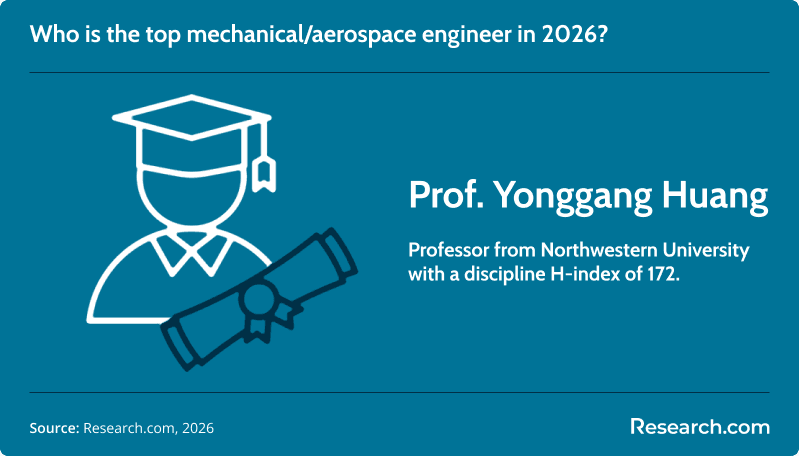
- Yonggang Huang from Northwestern University ranks as the #1 scientist in the world for this discipline with a D-index of 172.
- Massachusetts Institute of Technology (MIT) is the leading academic institution, hosting 23 of the world's most distinguished scholars in this field.
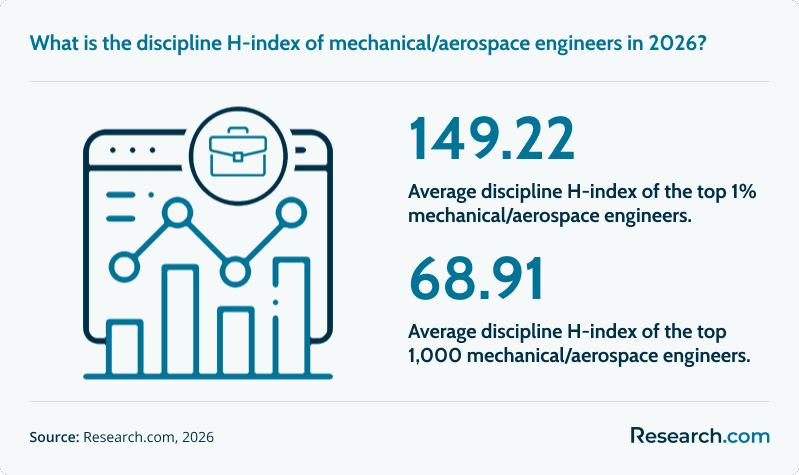
- The average D-index for the top 1% of scientists is remarkably high at 149.22, highlighting the immense citation impact of the absolute leaders.
- The global average for publications across the entire top 1,000 ranking stands at 381.64, underscoring the rigorous academic output required to maintain elite status.
The full ranking for the 2026 list of top mechanical & aerospace engineering scientists can be found here:
TOP MECHANICAL & AEROSPACE ENGINEERING SCIENTISTS RANKING
Latest studies in mechanical and aerospace engineering research
Recent advancements in the discipline have pushed the boundaries of ultrafast optical imaging and the astronomical observation of high-energy phenomena. Researchers at East China Normal University have developed compressed spectral-temporal coherent modulation femtosecond imaging (CST-CMFI), a novel camera capable of capturing events unfolding within a trillionth of a second. This breakthrough method simultaneously records light intensity and phase evolution, allowing scientists to track rapid plasma formation and electron movement in unprecedented detail.
In parallel, aerospace engineers and astrophysicists have made monumental strides in measuring the sheer energy of black hole jets. Utilizing a global network of radio telescopes, an international team directly observed the jets of Cygnus X-1 being deflected by stellar winds. These observations confirmed that the jets travel at half the speed of light and unleash energy equivalent to 10,000 Suns, providing crucial data for understanding galactic evolution.
Despite these remarkable discoveries, managing the vast amounts of data and ensuring the ethical application of such high-powered optical and astronomical technologies remains a persistent challenge. Engineers must continuously refine computational models to process complex imaging algorithms while addressing the practical limitations of integrating these systems into real-world manufacturing and space exploration.
Countries with the highest number of leading mechanical and aerospace engineering scientists
The United States continues to lead the global ranking with 378 top-tier scholars, though this represents a noticeable decline from the 432 scientists recorded in 2025. In contrast, China is rapidly closing the gap, surging to 131 representatives, up from 109 in the previous edition. This significant shift indicates a widening global decentralization of academic talent within the discipline.
The United Kingdom maintains its third-place position with 64 researchers, despite experiencing a slight dip from the 69 experts listed last year. Meanwhile, Canada and Australia have demonstrated robust year-over-year growth, climbing to 51 and 43 recognized scientists, respectively. Other notable shifts include Iran increasing its representation to 30 scholars, while Germany experienced a minor decline to 26 leading academics.
South Korea and France maintain a consistent presence in the rankings, hosting 23 and 20 elite researchers, respectively. Singapore rounds out the top ten with 19 scholars, reflecting a slight decrease from its standing in the previous report.
Please note that the country associated with a scientist is based on the affiliated research institution according to MAG, not on their actual nationality.
Institutions with the highest number of leading scientists
Massachusetts Institute of Technology (MIT) emerged as the dominant institution this year with 23 scholars, effectively maintaining its robust performance from the 2025 report. The University of Michigan–Ann Arbor fell slightly to second place with 21 scientists, reflecting a minor drop from the 24 previously recognized. The Georgia Institute of Technology and Stanford University followed closely, hosting 17 and 15 leading researchers, respectively.
Outside the United States, ETH Zurich and the University of Cambridge lead the international academic community, each with 12 highly ranked scholars. The National University of Singapore experienced a slight decline, dropping to 12 representatives from its previous high of 15. Meanwhile, Tsinghua University and the University of Toronto solidified their global standing, each boasting 11 leading scientists in the current evaluation.
Advancing mechanical and aerospace engineering research through online universities
The rapid expansion of digital learning environments has proven instrumental in advancing research in mechanical and aerospace engineering through online universities. By utilizing virtual laboratories and cloud-based simulations, these institutions provide aspiring engineers with unprecedented access to advanced computational tools. This digital infrastructure fosters international collaboration, allowing researchers to tackle complex aerodynamic and thermodynamic challenges without geographic limitations.
Furthermore, continuous investments in remote education networks are actively advancing mechanical and aerospace engineering research through online universities by bridging the gap between theoretical study and industrial application. Data suggests that digital academic platforms accelerate the dissemination of peer-reviewed findings and facilitate rapid technological iteration. Ultimately, this connected ecosystem empowers the next generation of scholars to contribute meaningfully to the global body of engineering literature.
H-index ranking—leaders, averages, and distribution
The foremost scholar in North America is Yonggang Huang from Northwestern University in the United States, who holds a global rank of 1 and a D-index of 172.
Representing Asia, Ali J. Chamkha of the Kuwait College of Science and Technology in Kuwait secures a global rank of 5 with a D-index of 146.
In Europe, the leading expert is Roland Siegwart from ETH Zurich in Switzerland, achieving a global rank of 7 with a D-index of 134.
For Oceania, Nam-Trung Nguyen of Griffith University in Australia captures the top regional spot, standing at a global rank of 58 with a D-index of 101.
Africa's highest-ranking academic is Josua P. Meyer from Stellenbosch University in South Africa, who reaches a global rank of 262 with a D-index of 75.
South America is represented by Michael J. Brennan from São Paulo State University in Brazil, holding a global rank of 350 alongside a D-index of 70.
The average D-index for the top 1% of scientists stands at a remarkable 149.22, compared to an overall average of 68.91 for the entire ranking.
When examining research output, the top 1% of scholars produced an average of 938.56 publications, significantly outpacing the overall ranking average of 381.64 publications.
Furthermore, the top 1% of leading experts amassed an average of 95,970.33 citations, heavily dwarfing the overall ranking average of 19,641.93 citations.
You can learn more about the methodology used to create this report here.
About Research.com
All research was coordinated by Imed Bouchrika, Ph.D., a computer scientist with a well-established record of collaboration on a number of international research projects with different partners from the academic community. His role was to make sure all data remained unbiased, accurate, and up-to-date.
Research.com is the number one research portal for science and educational rankings. Our mission is to make it easier for professors, research fellows, and students to progress with their research and find the top experts in a wide range of scientific disciplines. Research.com is also a leading educational platform that helps students find the best colleges, academic opportunities, and career paths.


