2027 How to Become an Art Teacher in Idaho: Requirements & Certification

Co-Founder and Chief Data Scientist
If you want to teach visual art in an Idaho school, the main decision is not whether you love art enough. It is whether you can meet Idaho’s teacher preparation, testing, certification, classroom experience, and renewal requirements in the right order. This guide explains how to become an art teacher in Idaho, what education and licensing steps to expect, how student teaching fits into the process, what salary information can and cannot tell you, and how to choose a path that supports both your artistic goals and your long-term teaching career.
The article is written for high school students planning a college major, career changers with an art background, current education majors, and practicing teachers who may want to add or strengthen an art endorsement. You will find practical checklists, comparison tables, common mistakes to avoid, and questions to ask before committing to a program or certification route.
Quick Answer: How Do You Become an Art Teacher in Idaho?
To become an art teacher in Idaho, you generally need a bachelor’s degree from an accredited institution, completion of a teacher preparation program, supervised student teaching, passing scores on required state assessments such as the Praxis II Art: Content Knowledge test (5134), a background check, and an Idaho K-12 teaching certificate with an art endorsement. The initial license is valid for five years, and renewal requires continued professional development or coursework.
Key Things You Should Know About Becoming an Art Teacher in Idaho
- Idaho schools need qualified teachers who can teach visual arts while also managing classrooms, aligning lessons with state standards, and supporting students with different skill levels and learning needs.
- As of 2023, the average salary for art teachers in Idaho is approximately $50,000 per year, though pay can differ by district, experience, grade level, and local salary schedules.
- The employment outlook for art teachers in Idaho is described as steady, with projections indicating a growth rate of about 5% over the next decade.
- Idaho’s cost of living index is around 95, where 100 is the national average, which may make a teaching salary go further than it would in some higher-cost states.
- Steps to become an art teacher in Idaho
- Education requirements for Idaho art teachers
- Certification and licensing process
- Student teaching, internships, and classroom experience
- Idaho art standards and curriculum expectations
- Job market, salary, and compensation expectations
- Professional development and continuing education
- Classroom management and teaching methods
- Additional resources for learning about teaching in Idaho
- Career advancement and specialization options
- Support resources for new Idaho art teachers
- Legal and ethical responsibilities
- Art teacher vs. English teacher certification pathways
- Advanced education and leadership roles
- Working with libraries and cultural institutions
- Mentorship, networking, and career growth
- Technology integration in Idaho art education
- Private school opportunities for Idaho art teachers
- Funding and classroom resources
- Interdisciplinary collaboration
- Challenges and trends in Idaho art education
How can you become an art teacher in Idaho?
Becoming an Idaho art teacher is a structured process. You need formal preparation in both art and education, proof of subject knowledge, supervised teaching practice, and state certification. The process is manageable when you treat it as a sequence rather than a single application.
| Step | What to Do | Why It Matters |
| 1. Choose the right degree path | Earn a bachelor’s degree from an accredited college, preferably in art education or a related field that includes teacher preparation. | Idaho certification depends on both academic preparation and completion of approved educator training. |
| 2. Complete teacher preparation | Take coursework in pedagogy, classroom management, curriculum planning, assessment, and art education methods. | Strong artists still need training in how students learn, how schools operate, and how to teach safely and effectively. |
| 3. Finish student teaching | Complete supervised classroom experience, typically in a real K-12 setting with a mentor teacher. | Student teaching shows that you can plan lessons, guide students, evaluate work, and manage classroom routines. |
| 4. Pass required exams | Prepare for and pass state-required assessments, including the Praxis II Art: Content Knowledge test (5134), with a minimum score of 151. | Testing verifies subject-area knowledge in art-making, art history, theory, and related content. |
| 5. Apply for certification | Submit your application, official documents, Praxis score, and background check materials for an Idaho K-12 certificate with an art endorsement. | Public school teaching requires state authorization before you can serve as the teacher of record. |
| 6. Renew and grow | Complete six semester credit hours of relevant coursework or approved professional development during the five-year license period. | Renewal keeps your certificate active and helps you stay current with standards, technology, and teaching methods. |
Boise State University and other Idaho institutions offer programs that may fit this pathway. Before enrolling, confirm that the program aligns with Idaho teacher certification requirements and includes the supervised teaching component you need.
Your application materials should also include a focused teaching resume and a professional portfolio. The portfolio should not only show your art; it should demonstrate how you think about instruction, student growth, media exploration, critique, cultural context, and assessment.
The broader art economy can be useful context, especially for teachers helping students understand creative careers. According to Statista (2024), the global art market changed notably between 2019 and 2023. It was valued at $64.4 billion in 2019, fell to $50.3 billion in 2020, rose to $65.9 billion in 2021, reached $67.8 billion in 2022, and then decreased slightly to $65 billion in 2023. These figures show recovery after a sharp decline, followed by a modest downturn in 2023.
What are the educational requirements for becoming an art teacher in Idaho?
Idaho art teachers need preparation in two areas: visual art content and professional teaching practice. A degree in art alone may not be enough if it does not include a state-recognized teacher preparation pathway.
- Bachelor’s degree: A bachelor’s degree is the usual starting point. The most direct option is art education, though a closely related art or education field may work if it includes the required teacher preparation components.
- Art coursework: Programs commonly include studio art, drawing, painting, sculpture, digital media, art history, art criticism, design, and art theory. This helps future teachers support students across multiple media and skill levels.
- Education coursework: Teacher candidates study lesson planning, child and adolescent development, assessment, classroom management, curriculum design, educational psychology, and instructional methods.
- Teacher preparation program: A state-aligned educator preparation program is essential because it connects coursework to supervised classroom practice and certification eligibility.
- Accredited institution: Accreditation matters. It affects transfer credit, financial aid eligibility, employer recognition, and whether the state will accept your preparation. Students comparing online options can review Research.com’s guide to nationally accredited online colleges.
- State-approved assessments: Candidates must pass required assessments to show competency in art content and professional teaching knowledge.
- Graduate study: A master’s degree or PhD is not required for every entry-level art teaching position, but advanced education may support salary movement, specialization, curriculum leadership, or administrative opportunities.
| Education Option | Best For | Important Caution |
| Bachelor’s in art education | Students who know they want K-12 art teacher certification in Idaho. | Confirm the program is designed for teacher licensure, not only studio practice. |
| Bachelor’s in studio art plus teacher preparation | Artists who want strong studio training and can add education requirements. | You may need additional coursework if the program does not include certification preparation. |
| Master’s degree in education or art education | Licensed teachers seeking advancement, specialization, or deeper instructional expertise. | Graduate study can be valuable, but it should match your career goal and budget. |
| MFA or related graduate art degree | Teachers who want advanced studio practice, postsecondary options, or deeper artistic development. | Students should compare costs carefully; Research.com’s guide to low tuition online MFA programs can help with that review. |
Boise State University and Idaho State University are examples of institutions noted for art education preparation. When comparing programs, ask whether student teaching is included, whether the program prepares you for the Praxis Art Content Knowledge exam, and whether graduates are eligible to apply for Idaho certification.
What is the certification and licensing process for an art teacher in Idaho?
Idaho’s certification process verifies that you have completed the required education, demonstrated subject competency, and cleared background screening. The Idaho State Department of Education is the central authority for teacher certification.
- Teaching certificate: Candidates need a valid Idaho teaching certificate to teach in public schools. For art, the target credential is typically a K-12 teaching certificate with an art endorsement.
- Teacher preparation: You must complete an accredited teacher preparation program with art education coursework, pedagogy, and supervised student teaching.
- Praxis Subject Assessments: Candidates complete the relevant Praxis assessment for art education, including Praxis Art Content Knowledge. This exam covers art history, theory, practice, and art-making knowledge.
- Background check: Idaho requires fingerprinting and criminal history review through the Idaho State Police and the FBI.
- Application materials: Applicants submit proof of education, required test scores, background check documentation, and other items through the Idaho SDE certification process.
- Fees: The application fee is currently set at $75. Fingerprinting and Praxis testing may create additional costs that vary by provider or testing center.
- License renewal: Idaho art teachers renew their licenses every five years and must complete ongoing professional development, coursework, or other approved learning activities.
- Requirement monitoring: Certification rules can change. Before making a major decision, verify current requirements with the Idaho SDE or your educator preparation program.
Certification Checklist for Idaho Art Teacher Candidates
- Confirm your college or university is accredited.
- Make sure your program includes Idaho-aligned teacher preparation.
- Complete required art and education coursework.
- Finish supervised student teaching.
- Pass the Praxis II Art: Content Knowledge test (5134) with the required score.
- Complete fingerprinting and background checks.
- Apply for the Idaho K-12 teaching certificate with an art endorsement.
- Track renewal requirements from the start of your first license cycle.
How important is teaching experience and what are the internship opportunities for art teachers in Idaho?
Teaching experience is one of the most important parts of becoming an art teacher because art classrooms have unique demands. You are managing materials, safety routines, demonstrations, cleanup procedures, critique conversations, differentiated projects, and student expression all at once.
- Student teaching requirement: Idaho candidates complete supervised teaching experience as part of certification preparation. Student teaching usually places candidates with a licensed mentor teacher for a substantial classroom-based experience.
- Minimum experience: Certification preparation commonly includes a minimum of 12 weeks of student teaching in an accredited program.
- Internship sources: Candidates can look for placements through their university, local school districts, community colleges, and educator preparation programs.
- Additional experience: Volunteering in after-school programs, summer camps, community art organizations, museums, or youth art classes can strengthen a resume and portfolio.
- Professional learning: Workshops and seminars can help candidates understand classroom routines, safety protocols, inclusive teaching, and assessment of creative work.
How to Get More Value From Student Teaching
- Set two or three measurable goals before the placement begins, such as improving critique facilitation or building better cleanup routines.
- Ask your mentor teacher to observe specific teaching moves rather than giving only general feedback.
- Keep examples of lesson plans, rubrics, student reflection prompts, and classroom management tools for your job portfolio.
- Practice adapting lessons for students with different skill levels, language backgrounds, and support needs.
- Reflect weekly on what worked, what failed, and what you would change before teaching the lesson again.
What are the standards and curriculum requirements for teaching art in Idaho?
Idaho art teachers are expected to teach in alignment with Idaho Content Standards and local district curriculum expectations. These standards help ensure that students do more than complete projects; they learn how to create, interpret, refine, present, and respond to art.
- Teacher competencies: Idaho’s expectations for visual arts teachers include artistic skill, visual analysis, historical and cultural understanding, creative expression, and age-appropriate instruction.
- Local flexibility: Idaho gives districts and teachers room to determine how standards are implemented, which allows art educators to adapt projects to local communities and student needs.
- Curriculum range: K-12 art programs may include visual arts, media arts, interdisciplinary humanities, design, critique, and creative problem-solving.
- Instructional alignment: Lesson plans should connect art-making to standards, vocabulary, process, reflection, presentation, and response.
- Available resources: The Idaho Department of Education provides standards information and resources that can support lesson planning and program design.
- Arts integration: Teachers may connect art to history, literature, science, technology, or community studies while still protecting the integrity of visual arts instruction.
| Curriculum Area | What Students Practice | How Teachers Can Support It |
| Creating | Generating ideas, experimenting with media, developing technique, and revising work. | Use demonstrations, process journals, skill-building exercises, and open-ended projects. |
| Presenting | Selecting, preparing, and explaining finished work. | Teach display standards, artist statements, critique language, and portfolio habits. |
| Responding | Interpreting images, discussing meaning, and evaluating artistic choices. | Use guided critique, visual thinking questions, and comparisons across artists and cultures. |
| Connecting | Relating art to culture, history, identity, community, and other subjects. | Design interdisciplinary projects and invite students to connect art to lived experience. |
Teachers who want deeper studio or curriculum preparation may consider graduate study, including low tuition online MFA programs, but the right choice depends on certification status, cost, and long-term career goals.
What is the job market like and what are the salary expectations for art teachers in Idaho?
The Idaho art teacher job market is best understood at the district level. Statewide averages are useful, but hiring, salary, benefits, and class assignments can vary widely between urban, suburban, rural, public, charter, and private school settings.
- Average salary: The average salary for art teachers in Idaho is around $50,000 per year. Teachers in urban areas such as Boise may earn more than $55,000, while teachers in more rural areas may see salaries closer to $45,000.
- Demand: The job market is described as stable, with schools continuing to need qualified educators who can teach visual arts and support well-rounded learning.
- Benefits: Compensation often includes more than salary. Health insurance, retirement plans, paid time off, and professional development support can significantly affect the overall value of a teaching position.
- Location matters: Applicants should review district salary schedules, local cost of living, commuting distance, class load, planning time, and supplies budget before accepting an offer.
| Compensation Factor | Why It Matters | Question to Ask |
| Base salary | Determines your regular income and may increase with experience or education. | Where would I enter on the district salary schedule? |
| Benefits | Health coverage, retirement, and paid leave can add substantial value. | What does the district cover, and what will I pay out of pocket? |
| Art supplies budget | A low materials budget can create pressure to fundraise or simplify projects. | What annual budget is available for consumable and reusable art materials? |
| Teaching load | Art teachers may serve many students across grades or campuses. | How many classes, students, preps, and schools are included in this role? |
| Professional development | Ongoing training supports renewal and better instruction. | Does the district fund workshops, conferences, credits, or release time? |
Bureau of Labor Statistics data cited for 2024 show that arts and design earnings differ substantially by occupation. Special effects artists and animators have the highest median salary among the listed arts and design roles at $106,500 annually. Fashion designers follow at $99,060, industrial designers at $79,290, interior designers at $76,250, set and exhibit designers at $62,510, and graphic designers at $58,910. These figures are not teacher salaries, but they can help art educators discuss creative career pathways with students.
One Idaho art teacher who graduated from Boise State University described the trade-off clearly: “I knew the salary would not make me rich, but helping students discover confidence through art made the work meaningful.” Her experience also highlights why candidates should consider location. A smaller community may offer fewer positions, but it can also provide strong relationships, visible impact, and a school culture where the art teacher is deeply connected to students and families.
What professional development and continuing education opportunities are available for art teachers in Idaho?
Continuing education is not just a renewal requirement. For art teachers, it is how you stay current with new media, assessment practices, inclusive instruction, safety procedures, and curriculum design.
- Grant support: Idaho art teachers may find grants that help cover workshop and conference costs, including funding up to $600 to support 50% of projected expenses.
- Idaho Commission on the Arts: The Idaho Commission on the Arts offers quarterly grant opportunities for professional growth. Applicants may include practicing artists, arts administrators, or K-12 teachers who have lived in Idaho for at least one year.
- Self-paced coursework: The Albion Center for Professional Development at Idaho State University offers self-paced online courses for $55 per credit, with options that can be transcribed as graduate-level credits.
- Museum-based training: Institutions such as the Boise Art Museum offer Summer Teacher Institutes and similar learning experiences focused on arts integration and classroom practice.
- Arts in Education Collective: Collaborative networks can help teachers share resources, design stronger programs, and advocate for arts education.
- Professional organizations: The Idaho Art Education Association (IAEA) provides networking, professional learning, and connection to other art educators.
- Online learning: Webinars and online courses can help teachers study contemporary art, digital tools, inclusive teaching, portfolio assessment, and classroom management without traveling.
- Adjacent fields: Teachers interested in school media, research, or resource curation may also explore top online library science degrees, especially if they want broader roles in educational resource support.
How to Choose Professional Development That Is Worth Your Time
- Check whether the training counts toward license renewal or district requirements.
- Prioritize workshops that produce classroom-ready lessons, rubrics, or project plans.
- Look for training in areas your program actually needs, such as digital art, adaptive materials, critique, or grant writing.
- Ask whether your district will reimburse fees, travel, credits, or substitute coverage.
- Keep documentation immediately so renewal paperwork does not become a last-minute problem.
What are effective classroom management strategies and teaching methods for art teachers in Idaho?
Art rooms are active learning spaces. Students move, use tools, share materials, talk through ideas, and make creative decisions. Effective management depends on routines that protect student creativity without allowing the room to become chaotic.
- Set routines before projects begin: Teach how to gather supplies, use tools safely, clean work areas, store unfinished work, and transition between demonstration and studio time.
- Use positive attention intentionally: Notice students who follow procedures, take creative risks, help peers, or revise thoughtfully. Recognition often improves behavior more effectively than constant correction.
- Teach through multiple modes: Combine visual examples, verbal explanation, step-by-step demonstration, written instructions, and hands-on practice so students with different learning styles can access the lesson.
- Differentiate assignments: Offer varied levels of complexity, media choices, or process options so beginners, advanced students, and students with support needs can succeed.
- Build critique skills gradually: Students need sentence stems, norms, and modeling before they can give useful feedback on each other’s work.
- Use collaboration carefully: Group projects can strengthen peer learning, but roles and expectations should be clear so one student does not carry the work.
- Reflect on instruction: After each unit, identify which routines, prompts, demonstrations, and assessments improved learning and which should be revised.
- Integrate technology when it improves learning: Digital drawing tools, virtual museum tours, online galleries, and multimedia projects can expand art instruction, but they should serve the lesson rather than replace foundational skills.
- Stay flexible: Art lessons often require adjustment because materials behave unexpectedly, students interpret prompts differently, and creative work develops at different speeds.
| Common Art Room Problem | Better Strategy | Why It Works |
| Students rush through projects | Require process sketches, checkpoints, reflection, and revision before final submission. | It makes creative thinking visible and slows students down without simply extending deadlines. |
| Cleanup takes too long | Assign table roles, use timers, label supplies, and model cleanup exactly. | Students are more successful when routines are concrete and repeatable. |
| Critiques feel personal or vague | Teach students to comment on choices, evidence, technique, and intent. | Structured critique protects students while developing visual analysis. |
| Wide skill gaps in one class | Use tiered prompts, optional challenges, and small-group demonstrations. | Students can work at an appropriate level without being separated publicly. |
| Technology distracts from art goals | Use digital tools only when they support composition, research, presentation, or media exploration. | Technology becomes part of artistic learning rather than a classroom distraction. |
Teachers who want broader preparation in pedagogy may compare online teaching certification programs and related education programs, especially if they are changing careers or adding credentials.
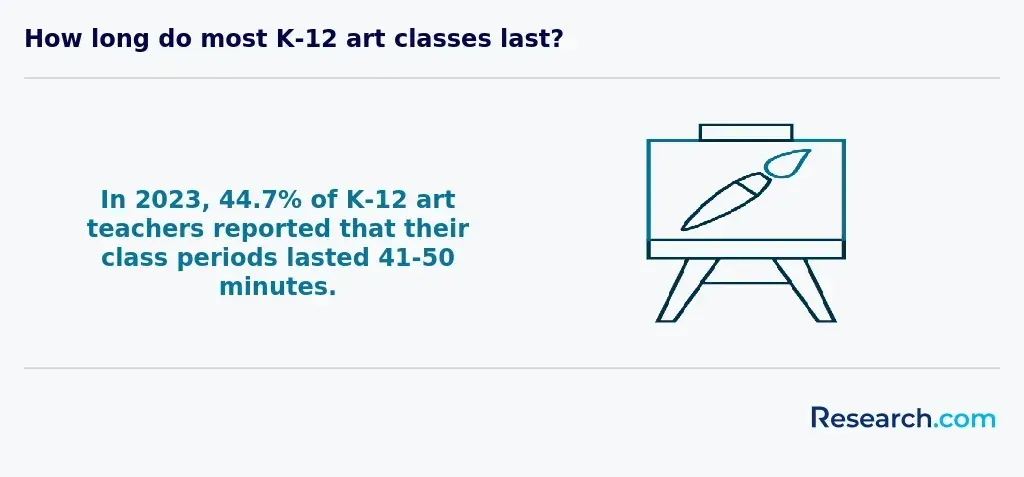
How long are most K-12 art classes? In 2023, 44.7% of K-12 art teachers reported class periods lasting 41-50 minutes, as shown below.
Are there any additional resources for learning about the teaching profession in Idaho?
Future art teachers should understand the broader Idaho teaching system, not only the art endorsement. Certification, district hiring, professional standards, and classroom expectations often overlap across teaching fields. Research.com’s guide on how to become a teacher in Idaho provides a wider overview of Idaho teaching requirements and can help candidates place the art-specific pathway in context.
What are the career advancement opportunities and specializations for art teachers in Idaho?
An Idaho art teaching career can grow beyond a first classroom assignment. Advancement may come through specialization, graduate education, leadership duties, curriculum design, department coordination, or movement into related education careers.
- Art therapy-informed practice: Teachers may study how art supports expression and emotional processing, while recognizing that clinical art therapy requires separate qualifications.
- Digital art and media: Digital illustration, animation, photography, video, and design tools can help students connect classroom art to current creative industries.
- Curriculum development: Experienced teachers may design district art sequences, assessment tools, standards-aligned units, and interdisciplinary projects.
- Department leadership: Art teachers may become department chairs, mentor teachers, program coordinators, or instructional leaders.
- Administration: Teachers interested in school leadership may pursue advanced education, administrative preparation, or endorsements that support movement into formal leadership roles.
- Alternative roles: Some educators move into museums, community arts programs, curriculum companies, education nonprofits, or other alternative education careers.
One Idaho teacher described beginning as a high school art teacher after graduating from Boise State University, then specializing in digital media and developing a curriculum that drew district attention. That path eventually led to an art department head role. The lesson is practical: specialization matters most when it solves a real school need.
What resources and support are available for new art teachers in Idaho?
New art teachers need more than lesson ideas. They need mentors, supply systems, classroom routines, renewal guidance, and a professional network that understands the demands of art education.
- Idaho Art Education Association: IAEA offers networking, professional development, peer support, and access to educators who understand Idaho art classrooms.
- Idaho State Department of Education: The SDE provides standards, curriculum information, certification guidance, and state-level education resources.
- District mentors: Local mentorship programs can pair new teachers with experienced educators who share classroom management strategies, lesson plans, and district procedures.
- Idaho Arts Commission: The commission offers grant information, arts education resources, and support for projects that connect schools and communities.
- Online lesson platforms: Sites such as Teachers Pay Teachers and Artsonia can provide project ideas, though teachers should adapt materials to Idaho standards and their own students.
- National professional organizations: NAEA membership can connect Idaho teachers to broader conversations about standards, advocacy, assessment, and visual arts education.
- Peer communities: Online forums and social media groups can help new teachers troubleshoot supply issues, classroom setup, critiques, and project sequencing.
- Local colleges and museums: Universities, colleges, museums, and cultural organizations may host workshops or collaborative programming for teachers.
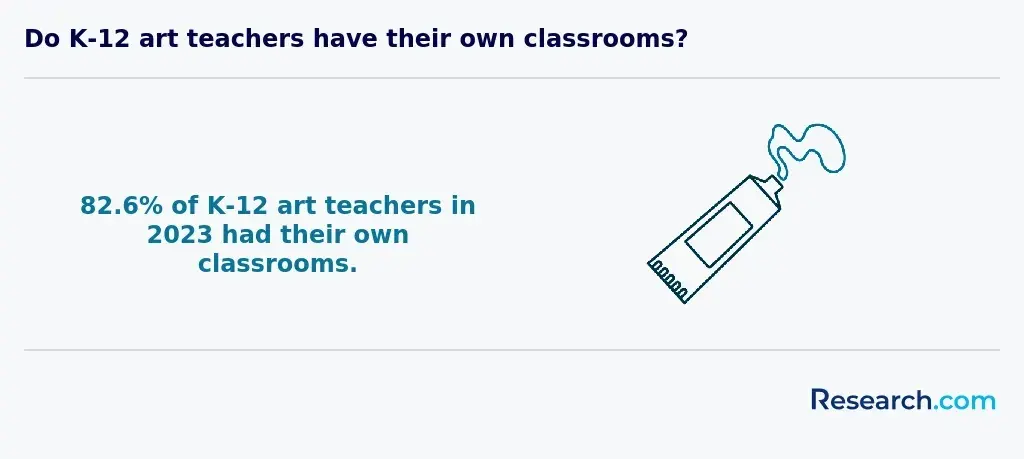
Do K-12 art teachers usually have their own rooms? In 2023, 82.6% of K-12 art teachers reported having their own classrooms, as shown below.
What are the legal and ethical considerations for art teachers in Idaho?
Art teachers handle student work, images, personal expression, classroom materials, and sensitive conversations. That makes legal and ethical practice essential.
- Student privacy: Teachers must protect student records and follow the Family Educational Rights and Privacy Act (FERPA).
- Mandatory reporting: Idaho educators must comply with state requirements for reporting suspected child abuse or neglect.
- Copyright and intellectual property: Art teachers should be careful when using copyrighted images, music, videos, or digital resources in instruction and student projects.
- Professional boundaries: Teachers should maintain appropriate communication, feedback, and relationships with students and families.
- Equitable access: Students should have fair access to materials, instruction, participation, and accommodations.
- Cultural sensitivity: Art projects should avoid stereotyping and should treat cultural traditions, symbols, and identities with care.
- Safe materials and tools: Teachers must use age-appropriate materials and provide clear safety instruction for tools, adhesives, paints, printmaking materials, and digital platforms.
Candidates new to education may benefit from reading Research.com’s guide on how to become an elementary school teacher in Idaho, because many professional responsibilities apply across teaching fields.
What do graduates have to say about becoming an art teacher in Idaho?
-
: "
Teaching art in Idaho has been deeply rewarding. My students are curious, willing to try new media, and proud when they see their ideas take shape. The community support and the state’s natural beauty give me constant inspiration for classroom projects. Marsha
"
-
: "
I value the room Idaho schools give teachers to design creative lessons. I can connect projects to student interests, and smaller class settings often make it possible to give students more individual feedback. Scott
"
-
: "
The strongest part of teaching art here has been the relationships. My students, their families, and local organizations often come together around community art projects, which makes the work feel connected to something larger than one classroom. Marina
"
How do art and English teaching certification pathways differ in Idaho?
Art and English teaching pathways both require teacher preparation, classroom experience, certification, and subject knowledge. The difference is the kind of subject expertise being verified. Art certification emphasizes visual art production, art history, design, critique, and creative teaching methods. English certification focuses more heavily on reading, writing, literature, language, grammar, and literacy instruction. Educators considering another endorsement or a cross-disciplinary career can compare the process with Research.com’s guide on how to become an english teacher in Idaho.
How can advanced education enhance leadership opportunities for art teachers in Idaho?
Advanced education can help art teachers move into roles that influence curriculum, mentoring, program design, and school policy. A teacher who wants to become a department chair, instructional coach, arts coordinator, or administrator may benefit from graduate study in education leadership or administration. An online master's in education administration can be one possible route for teachers who want structured leadership preparation while continuing to work.
How can art teachers in Idaho benefit from collaborations with libraries and cultural institutions?
Libraries, museums, galleries, historical societies, and cultural organizations can expand what an art teacher can offer students. These partnerships may provide access to archives, exhibitions, guest speakers, local history, public display opportunities, and community-based projects. Teachers interested in the educational role of libraries can also review Research.com’s guide on how to become a librarian in Idaho.
How can mentorship and networking drive career growth for art teachers in Idaho?
Mentorship helps new teachers avoid common early-career mistakes, while networking creates access to job leads, grant ideas, professional development, and leadership opportunities. Art teachers can grow by joining professional associations, attending workshops, sharing curriculum with peers, and learning from experienced educators. Teachers interested in formal leadership careers can also explore Research.com’s overview of jobs with educational leadership degree.
How can technology integration reshape art education practices in Idaho?
Technology is changing how students create, research, present, and critique art. Idaho art teachers may use digital drawing applications, online galleries, virtual museum visits, photography tools, animation software, and multimedia portfolios. The goal is not to replace traditional art-making but to help students build future-ready creative skills. Teachers comparing how technology appears in other subjects may find useful perspective in Research.com’s guide, How to be a middle school math teacher in Idaho?
How can art teachers in Idaho tap into private school opportunities to diversify their career paths?
Private schools may offer art teachers different class sizes, curriculum flexibility, religious or mission-based education models, and varied hiring expectations. Some private schools may not follow the same certification structure as public schools, but candidates should still check employer requirements carefully. For a broader view of this route, read Research.com’s guide on how to become a private school teacher in Idaho.
How can art teachers in Idaho integrate inclusive strategies to support diverse learners?
Inclusive art teaching means designing lessons that allow all students to participate meaningfully. Strategies include differentiated prompts, adaptive tools, flexible assessments, visual instructions, peer supports, extended work time, and multiple ways for students to show understanding. Art teachers who want deeper preparation for supporting students with disabilities can review Research.com’s guide to special education teacher certification in Idaho.
How can art teachers in Idaho secure additional funding and resources for their programs?
Art programs often depend on careful budgeting, grants, donations, community partnerships, and strong communication with school leaders. Teachers should connect funding requests to student learning, standards, exhibitions, career readiness, or school improvement goals. Local businesses, arts councils, parent groups, museums, and community organizations may also support supplies or events. Music teachers face similar resource and program-building questions, so Research.com’s guide on how to become a music teacher in Idaho may offer useful comparisons.
How can interdisciplinary collaborations enhance art teaching in Idaho?
Interdisciplinary work can make art more meaningful when it is planned carefully. Art teachers might collaborate with history teachers on visual culture, with English teachers on illustration and narrative, with science teachers on observation and design, or with technology teachers on digital media. These projects should deepen both subjects rather than turning art into decoration for another course. Teachers interested in history connections can compare pathways with Research.com’s guide on how to become a history teacher in Idaho.
What are the emerging challenges and trends shaping art education in Idaho?
Several issues are shaping the work of Idaho art teachers. Digital media is changing student expectations and classroom tools. Funding uncertainty can affect supplies, equipment, field trips, and professional development. Curriculum expectations continue to evolve, and teachers must balance traditional techniques with contemporary art practice. Student mental health and diverse learning needs also require thoughtful, inclusive instruction. Educators considering other grade levels or early childhood pathways can review Research.com’s guide on how to become a kindergarten teacher in Idaho.
Common Mistakes to Avoid When Becoming an Art Teacher in Idaho
| Mistake | Why It Can Hurt You | Better Move |
| Choosing a degree without checking certification alignment | A strong art program may not automatically qualify you for Idaho teacher certification. | Ask the program directly whether graduates are eligible for Idaho teacher certification with an art endorsement. |
| Looking only at tuition | Fees, materials, testing, fingerprinting, transportation, and unpaid student teaching can affect total cost. | Build a full budget before enrolling. |
| Waiting too long to prepare for Praxis | Testing delays can slow certification and job applications. | Begin studying while art history, theory, and studio content are still fresh. |
| Building only an artist portfolio | Hiring committees need evidence that you can teach, not only create. | Include lesson plans, rubrics, student teaching reflections, and examples of instructional thinking. |
| Ignoring rural and small-district opportunities | Focusing only on large cities may limit your search. | Compare positions by support, schedule, salary, community fit, and growth potential. |
| Assuming online coursework always meets requirements | Not every online program leads to Idaho licensure or includes required field experience. | Verify accreditation, state approval, and student teaching placement support. |
Questions to Ask Before Choosing an Idaho Art Teacher Program
- Is the institution accredited?
- Does the program lead to Idaho teacher certification with a K-12 art endorsement?
- Where do students complete student teaching placements?
- What Praxis preparation support is available?
- How many weeks of supervised teaching are required?
- What art media, digital tools, and studio facilities are included?
- Are graduates employed in Idaho public or private schools?
- What are the total costs, including fees, materials, testing, and travel?
- Can credits transfer if I change schools?
- Does the program support career changers, transfer students, or working adults?
Key Insights
- The most direct route to becoming an Idaho art teacher is a bachelor’s degree that includes an accredited teacher preparation program, supervised student teaching, required testing, and state certification.
- The Praxis II Art: Content Knowledge test (5134) is a major checkpoint, and candidates must earn the required minimum score of 151.
- The initial Idaho teaching license is valid for five years, so professional development and renewal planning should begin early in your career.
- Salary averages are useful, but district salary schedules, benefits, art supply budgets, class load, and location will determine the real value of a job offer.
- Art teachers need both creative skill and strong classroom systems. Routines for supplies, safety, critique, cleanup, and differentiation are essential.
- As of 2023, there are approximately 1,200 certified art teachers in Idaho, and the average salary is around $50,000 per year.
- Recent Idaho data indicate that art education programs have become more integrated into K-12 curricula, with a 15% increase in art program offerings over the past three years.
- As of 2023, there are 10 accredited institutions in Idaho offering programs that support pathways to certification.
- The Idaho State Board of Education requires prospective art teachers to pass the Praxis II exam in Art: Content Knowledge, and recent statistics show that over 80% of test-takers pass on their first attempt.
- In 2023, 44.7% of K-12 art teachers reported class periods of 41-50 minutes, and 82.6% reported having their own classrooms.
- The global art market was valued at $64.4 billion in 2019, declined to $50.3 billion in 2020, rose to $65.9 billion in 2021, reached $67.8 billion in 2022, and decreased to $65 billion in 2023.
- Among the cited arts and design occupations, special effects artists and animators had the highest median salary at $106,500 annually, followed by fashion designers at $99,060, industrial designers at $79,290, interior designers at $76,250, set and exhibit designers at $62,510, and graphic designers at $58,910.
Related Articles for Nearby States
- 2027 How to Become an Art Teacher in Montana: Requirements & Certification
- 2027 How to Become an Art Teacher in Washington: Requirements & Certification
- 2027 How to Become an Art Teacher in Oregon: Requirements & Certification
- 2027 How to Become an Art Teacher in Nevada: Requirements & Certification
- 2027 How to Become an Art Teacher in Utah: Requirements & Certification
- 2027 How to Become an Art Teacher in Wyoming: Requirements & Certification
- 2027 How to Become an Art Teacher in California: Requirements & Certification
- 2027 How to Become an Art Teacher in Colorado: Requirements & Certification
- 2027 How to Become an Art Teacher in Arizona: Requirements & Certification
- 2027 How to Become an Art Teacher in New Mexico: Requirements & Certification
References:
- Art Teacher EDU. (2011, December 7). Becoming an Art Teacher. Art Teacher EDU.
- Boise State University. (2011, May 26). Art Education. Boise State University.
- Brigham Young University-Idaho. 2024. Art Education: Composite (B.A.). Brigham Young University-Idaho.
- Idaho Commission on the Arts. 2024. Idaho Commission on the Arts. Idaho Commission on the Arts.
- Idaho State Department of Education. 2024. Arts and Humanities. Idaho State Department of Education.
- Idaho State Department of Education. 2024. Be an Educator. Idaho State Department of Education.
- Idaho State University. 2024. Self-Paced Online Courses. Idaho State University.
- Meet the Masters. (2023, February 14). Art Curriculum for Idaho Elementary Schools K-8. Meet the Masters.
- Next Steps Idaho. 2024. Art, Drama, and Music Teachers, Postsecondary. Next Steps Idaho.
- University of Idaho. 2024. Art Education (B.S. Art Ed.). University of Idaho.
Other Things You Should Know About Becoming an Art Teacher in Idaho
To start teaching art in Idaho in 2027, earn a bachelor’s degree in art or education, then complete an educator preparation program. Pass Idaho’s Praxis tests for Art content knowledge and apply for a teaching certificate through the Idaho State Department of Education.
Accelerated art degree programs can be a viable option for aspiring art teachers in Idaho, allowing you to complete your degree in a shorter timeframe, typically within 12 to 18 months. This can be particularly appealing for those eager to enter the workforce quickly.
- Competency: Competency is crucial in teaching, and while accelerated programs can provide a solid foundation in art education, they may not offer the same depth of experience as traditional programs. It's essential to ensure that the program includes comprehensive coursework in pedagogy, art history, and studio practices.
- Accreditation: Accreditation is a key factor when considering an accelerated program. In Idaho, programs must be accredited by recognized bodies, such as the National Association of Schools of Art and Design (NASAD) or the Council for the Accreditation of Educator Preparation (CAEP). Graduating from an accredited program ensures that your degree is respected and recognized by employers and licensing boards.
- State Acceptability: The acceptability of an accelerated program in Idaho largely depends on the specific requirements set by the Idaho State Department of Education. Generally, candidates must hold a bachelor's degree and complete a teacher preparation program to obtain a teaching license. Ensure that the accelerated program you choose meets these criteria.
- University Options: For example, Boise State University offers a Master of Arts in Teaching (MAT) program that can be completed in an accelerated format, focusing on art education. Similarly, Idaho State University provides a Bachelor of Fine Arts (BFA) with an emphasis on art education, which can be pursued at an accelerated pace.
Benefits and Drawbacks: While accelerated programs can be beneficial, consider the potential drawbacks, such as a more intense workload and less time for hands-on teaching experience. Balancing speed with quality education is essential for your future success as an art teacher.
In 2027, Idaho art teachers should adhere to state laws and ethical standards set by the Idaho State Department of Education. This includes maintaining professional conduct, ensuring student safety, respecting student diversity, and abiding by copyright laws while fostering a positive learning environment.