2027 Online Ed.D. in Leadership and Learning in Organizations vs. an Ed.D. in Higher Education Leadership: Which Fits Your Goals?
Audited and Verified:
Our Editorial and Data Verification Process
Research.com uses government datasets, official education statistics and primary institutional information to support its career and degree guides. Our review process checks factual accuracy, occupational definitions, source dates and the requirements associated with the credentials discussed.
How This Article Was Fact-Checked
Our editorial team verifies salary estimates, employment projections, education requirements and program information against original data providers and official organizations. Salary figures are checked against the relevant occupational definitions and reporting periods. Information about licensure, accreditation and required in-person training is reviewed separately.
Fact-checked and verified on:

Co-Founder and Chief Data Scientist
An Ed.D. in Leadership and Learning in Organizations and an Ed.D. in Higher Education Leadership can both develop your ability to lead change, but they prepare you to work in different settings. That distinction matters if you are an experienced professional choosing between cross-sector mobility and deeper expertise in colleges and universities. This guide compares the work each degree emphasizes, the demands of online study, and the costs and career evidence worth checking. You can use it to choose a program - or decide that a shorter route better serves your goal.
Key Things You Should Know
- Choose leadership and learning in organizations for cross-sector learning, development, and change work; choose higher education leadership when college or university governance and operations are central to your goal.
- Compare required courses and the final project, not just degree titles: either program may use an Ed.D. designation while preparing students for substantially different decisions and workplaces.
- Salary is tied to the occupation and your experience, not the doctorate: the US median for training and development managers was $133,000 in May 2025, versus $104,590 for postsecondary education administrators.
What Is an Ed.D. in Leadership and Learning in Organizations?
An Ed.D. in Leadership and Learning in Organizations is a practice-oriented doctorate focused on how people learn and how leaders improve organizations. Its potential applications extend beyond schools to employers, nonprofits, government agencies, healthcare organizations, and education institutions. The exact title, curriculum, and award requirements depend on the university; "leadership and learning" does not itself establish a particular concentration or credential.
The strongest fit is a professional who already influences training, organizational change, talent development, or improvement initiatives and wants to evaluate those efforts more rigorously. For example, a learning and development manager might investigate why employees struggle to apply a new process after training. Doctoral study could help that manager examine learning transfer and implementation - not assume that another training course will fix a workflow or incentive problem.
This route is less direct if your sole objective is to learn one technical skill or obtain your first supervisory role. A targeted course, mentored project, or employer leadership program may get you there sooner.
How Does an Ed.D. in Higher Education Leadership Compare?
A higher education leadership Ed.D. concentrates on the institutions that educate students after high school. It is generally the more relevant choice when you want to lead within a college or university and need to understand its governance, student services, academic operations, budgets, and accountability obligations.
The comparison below shows where each degree's focus is likely to matter most. These are decision criteria, not a promise that every program offers every course or project option.
| Decision factor | Leadership and learning in organizations | Higher education leadership |
| Primary setting | Organizations across sectors, including education | Colleges, universities, and related higher education systems |
| Typical leadership problem | Improving workforce learning, organizational performance, or change implementation | Improving institutional services, operations, or student-facing systems |
| Most valuable prior experience | Leading teams, learning initiatives, or organizational improvement | Working with higher education programs, people, policies, or operations |
| Potential limitation | May provide limited preparation in college-specific governance | May offer less depth in learning and change across nonacademic workplaces |
Neither path automatically qualifies you for a senior campus appointment. If higher education is your target, also examine the institution's professional network and available grants for doctoral study in higher education leadership; eligibility and award terms require confirmation with each provider.
Which Ed.D. Specialization Best Fits Your Career Goals?
Start with the decisions you expect to own, rather than the title you hope to hold. If you intend to lead workforce development across employers or consult on organizational learning, the broader doctorate may give you more relevant examples and project opportunities. If you expect to manage a student-success unit, academic program, or university operation, higher education leadership may better address your sector's constraints.
A cross-sector leader can still work at a university, and a campus administrator can use organizational learning methods. The difference is the expertise you would otherwise have to build yourself. Compare required courses, faculty backgrounds, project settings, and employer connections against your existing strengths. Research on organizational leadership doctorate cost and program value can help frame that comparison, but it cannot establish the return on a particular Ed.D.
If you primarily need institutional connections to move into higher education, test that career transition before enrolling. If you already have the relevant role and need one focused capability, a graduate certificate or supervised workplace initiative may be a better investment than either doctorate.
Online study changes where you attend, not necessarily when you must attend. An online Ed.D. may include live evening sessions, fixed cohort assignments, group research, and campus convenings. Campus-based study generally makes in-person interaction routine but may be impractical if you cannot relocate or travel regularly. Either format can support substantial faculty guidance; verify how that guidance actually works.
For a working professional, compare required attendance against your work calendar and the demands of the final project. Ask for a sample term schedule, live-session attendance policy, convening dates, group-work expectations, and leave rules. Confirm what happens if your employer or project site changes. When reviewing affordable distance learning Ed.D. degrees, include travel and time away from work rather than treating online tuition as the entire cost.
Both paths may teach leadership theory, qualitative and quantitative inquiry, program evaluation, ethics, and applied problem-solving. Their emphasis should differ in ways that matter to your work. An organizational learning curriculum might examine adult learning, learning transfer, organizational diagnosis, and change implementation. A higher education curriculum might emphasize governance, student affairs, academic administration, institutional policy, and resource decisions.
Read the required-course sequence rather than relying on an elective list. A course mentioning analytics does not necessarily provide advanced measurement training, and a leadership course does not establish expertise in university governance. Check whether the final requirement is an individual dissertation, dissertation in practice, team capstone, or another approved project. Its format affects the questions you can investigate, the data and permissions you may need, and how closely the work can serve your career goal.
Requirements vary by institution and entry term. Programs may evaluate graduate education, academic performance, professional experience, recommendations, a statement of purpose, and evidence that the applicant can undertake applied doctoral work. Some specify a master's degree or experience threshold; others assess preparation differently. Neither degree title establishes a universal requirement for an education master's, a GRE score, or a particular job title.
Present evidence suited to the program: organizational learning applicants can describe decisions they made about development or change initiatives, while higher education applicants can show responsibility for campus programs, operations, or student services. In either case, explain a genuine problem you want to investigate without claiming access to organizational data or approval you do not have. Applicants with specialist-level education should distinguish credits used to establish eligibility from credits actually applied toward the doctorate; Ed.D. pathways building on education specialist study still require a program-specific evaluation.
There is no reliable universal duration or price for either focus. Required credits, enrollment pace, course sequencing, and the final project's approval and completion process all affect time to graduation. An advertised completion timeline may assume uninterrupted enrollment; it is not a personal deadline or guarantee.
Request a written estimate for your intended entry term that separates tuition, mandatory fees, convening travel, and likely additional terms if the final project takes longer. Then check employer reimbursement caps, continued-employment conditions, and whether any assistance applies to doctoral study. Affordable doctoral education program comparisons can help identify schools to investigate, but use each school's published charges and your own schedule to compare the full commitment. A lower per-credit price may not produce a lower total cost.
The organizational route can complement experience in learning and development management, organizational development, workforce initiatives, or consulting. The higher education route can complement experience in student affairs, academic administration, institutional operations, or college-wide initiatives. In both cases, hiring depends on demonstrated responsibilities as well as education.
Consider the work behind the job title. A training manager may oversee staff, budgets, and evaluation of employee development; a postsecondary administrator may manage services, policies, and institutional stakeholders. Someone changing sectors should look for a feasible bridge, such as an internal project, a relevant portfolio, or mentorship. A doctorate alone does not substitute for the sector knowledge or management experience an employer requires. Neither general Ed.D. should be assumed to confer teacher, principal, or superintendent licensure.
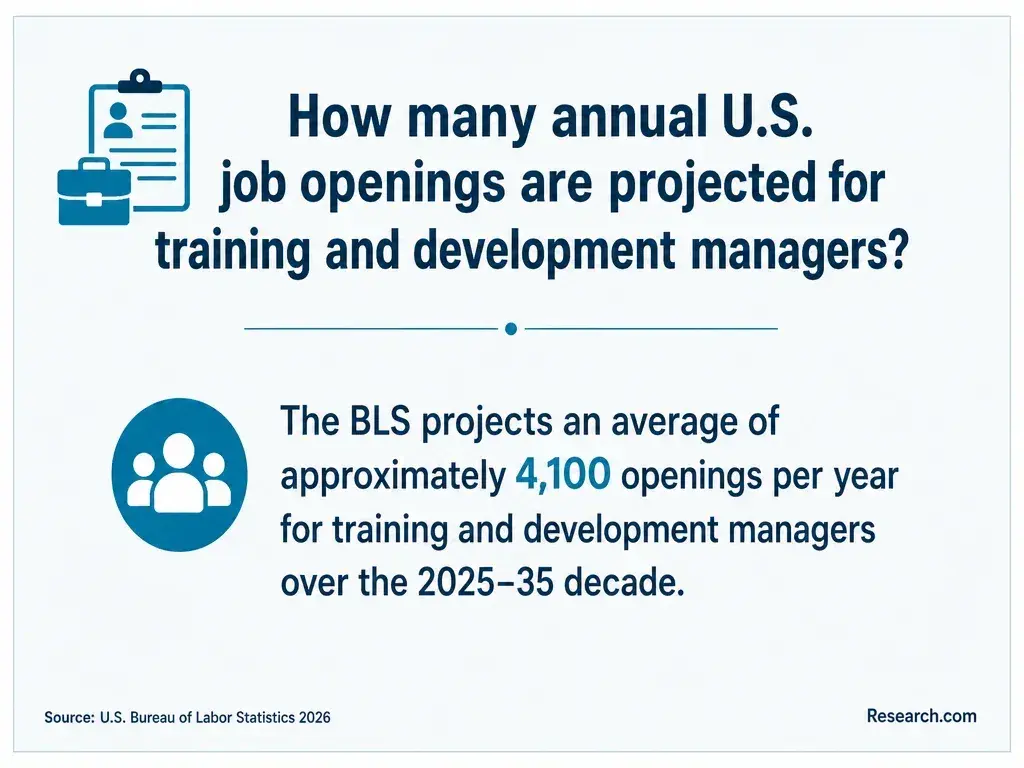
Occupation-level figures provide context, not an Ed.D. earnings forecast. The US Bureau of Labor Statistics reports a May 2025 median annual salary of $133,000 for training and development managers and projects 6.4% employment growth from 2025 to 2035. That occupation may be relevant to the organizational route, but its median reflects workers with varied qualifications and experience - not new doctorate recipients.
For postsecondary education administrators, the May 2025 median was $104,590, with projected growth of 1.8% over the same period. The difference between these occupational figures is not the financial benefit of choosing one Ed.D. over the other. Compare actual openings, pay ranges, and qualification requirements in your target location and sector; assess a prospective degree against roles you could realistically pursue.
How Can You Choose an Accredited and Reputable Ed.D. Program?
First, confirm the institution's accreditation through its official disclosures and the recognized accreditor's records. Then verify the exact degree designation and whether any advertised specialization is formally awarded. Institutional accreditation alone does not establish licensure eligibility, a particular program endorsement, or the quality of a prospective project match.
For each finalist, request the curriculum and final-project handbook for your proposed entry term. Ask who supervises projects, whether your intended organizational setting is eligible, what attendance is mandatory, and whether the school reports completion outcomes with clear definitions. Finally, speak with program staff about career support in your target sector. Choose the program whose required work, feasible schedule, and total cost fit the role you can credibly pursue - not simply the one with the broadest leadership language.
Other Things You Should Know About EdD Leadership
Possibly. Ask the program whether external partner sites are allowed, what approvals are required, and how you would obtain permission to use data. A partner's interest alone does not constitute academic approval.
Either may be relevant to some teaching roles, but departments set their own subject-area and experience requirements. An Ed.D. does not automatically qualify you to teach every higher education course.
Diploma and transcript practices vary. Ask the registrar how the degree and delivery format appear on official records rather than assuming the diploma will - or will not - identify online study.
That depends on the university's program-change rules, course availability, and whether completed work meets the new requirements. Obtain a written degree audit before assuming a change would preserve your timeline or credits.
- Building a Foundation for a Successful Doctoral Student Journey | nih.gov https://pmc.ncbi.nlm.nih.gov/articles/PMC9686258/
- Accreditation in the U.S. | ed.gov http://www.ed.gov/laws-and-policy/higher-education-laws-and-policy/college-accreditation/accreditation-in-the-us
- Learn Online | College of Southern Nevada https://www.csn.edu/education-and-training/learning-online
- What Topics Do EdD Students Research in the EdD Program? | Fairfield University https://www.fairfield.edu/news/insights/education-human-development/what-topics-do-edd-students-research.html
- How In-Person Experiences Enhance Online Degree Programs | umich.edu https://onlineteaching.umich.edu/articles/face-to-face-with-virtual-learners-how-in-person-experiences-enhance-online-degree-programs/
- Careers in Higher Education Leadership: Jobs and Skills You Need | NMSU Global Campus https://global.nmsu.edu/blog/education/careers-in-higher-education-leadership/
- What's the Difference Between Asynchronous and Synchronous Learning? | Ohio State Online https://online.osu.edu/content-hub/blogs/whats-the-difference-between-asynchronous-and-synchronous-learning/
- Doctoral dissertation or capstone: how to choose the right program | PhD/Doctorate | Capella University Blog https://www.capella.edu/blog/phd-doctorate/the-difference-between-a-dissertation-and-doctoral-capstone/
- Careers Leaders Can Pursue with an Ed.D. | Peabody Online | VU-EDU https://peabodyonline.vanderbilt.edu/edd-in-organizational-learning/edd-careers/
- What Career Paths Exist in Higher Education Administration? | WPUNJ https://online.wpunj.edu/degrees/education/masters-higher-education-administration-leadership/career-paths/