2027 Online Ed.D. in Leadership and Learning in Organizations: Checking Consulting Client Expectations About Doctoral Credentials
Audited and Verified:
Our Editorial and Data Verification Process
Research.com uses government datasets, official education statistics and primary institutional information to support its career and degree guides. Our review process checks factual accuracy, occupational definitions, source dates and the requirements associated with the credentials discussed.
How This Article Was Fact-Checked
Our editorial team verifies salary estimates, employment projections, education requirements and program information against original data providers and official organizations. Salary figures are checked against the relevant occupational definitions and reporting periods. Information about licensure, accreditation and required in-person training is reviewed separately.
Fact-checked and verified on:

Co-Founder and Chief Data Scientist
A consulting client may admire a doctorate without requiring one - or may screen proposals against formal credential rules. If you work in learning and development, organizational change, or leadership consulting, that distinction matters before you commit to an online Ed.D. This article shows how to check what your target clients actually expect, what an Ed.D. could add to your practice, and when experience or a shorter qualification would be a better investment.
Key Things You Should Know
- An Ed.D. may strengthen a consultant's credibility, but client requirements vary by contract, buyer, and type of work; check recent requests for proposals and speak with target buyers before enrolling.
- Evidence of relevant projects, sound methods, and implementable recommendations often matters more than the degree alone. The Ed.D. does not guarantee consulting work.
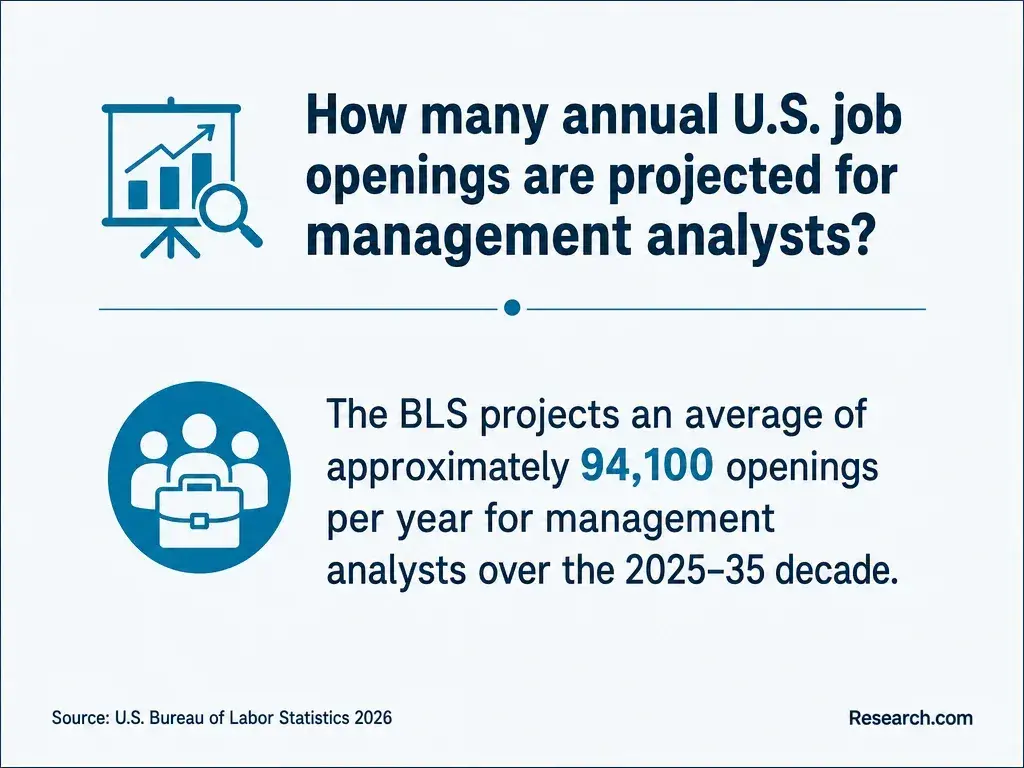
- For salary context, the US Bureau of Labor Statistics reports a $101,860 median annual salary for management analysts in May 2025, but that employee-occupation figure is not a forecast of a consultant's fees or Ed.D. return on investment.
What is an online Ed.D. in Leadership and Learning in Organizations?
An Ed.D. is a practice-oriented education doctorate. Programs focused on leadership and learning in organizations examine how adults develop skills, how organizations change, and how leaders use evidence to improve practice. "Online" describes where much instruction occurs, not necessarily a self-paced schedule: live classes, team projects, campus convenings, and an applied research requirement may still be part of a program.
For a consultant, the relevant distinction is between earning a doctoral credential and developing capabilities clients can use. A worthwhile program should help you diagnose a learning or performance problem, evaluate an intervention, and explain findings within the limits of the evidence. Confirm the exact degree title and final project at each institution; programs differ. If the required research product affects your choice, compare Ed.D. dissertation alternatives rather than assuming that "no dissertation" means no substantial applied project.
Do consulting clients value an Ed.D. in Leadership and Learning in Organizations?
Some do, but there is no universal client requirement. A doctorate can help establish research credibility, especially when a buyer wants an evaluation of leadership development or workforce learning. Other buyers may prioritize sector experience, references, procurement eligibility, price, or the ability to deliver a project. A credential preference is also different from a mandatory qualification in a request for proposals (RFP).
The table separates three situations that can look alike during a sales conversation but call for different decisions.
| Client signal | What it means for your degree decision |
| A written RFP requires a doctorate for the proposed lead or evaluator | The credential may be necessary for that contract; verify whether an Ed.D. qualifies and whether a qualified team member could fill the role. |
| A buyer says doctoral expertise is preferred | The degree may improve a proposal, but relevant work and demonstrated methods can still be decisive. |
| Buyers ask primarily for comparable results and references | Project experience and a credible portfolio may offer a more direct route than doctoral enrollment. |
To check your market, collect recent RFPs in the sectors and project types you intend to serve. Separate mandatory qualifications from scoring preferences, note whether requirements apply to a firm or an individual, and ask prospective buyers what evidence would distinguish two otherwise qualified consultants. Record the answers by client type. A school district commissioning a formal evaluation may assess credentials differently from a company hiring a facilitator.
Then examine what you can already demonstrate: a clearly scoped problem, your role in the work, methods used, decisions informed, and outcomes you can substantiate without breaching confidentiality. If buyers consistently identify missing sector experience or implementation capacity rather than a missing doctorate, address that gap first.
What careers can an online Ed.D. in Leadership and Learning prepare you for?
For an established learning and development professional or organizational leader, an Ed.D. may support a move toward consulting on leadership development, organizational learning, program evaluation, or change implementation. Those assignments require different strengths: a learning consultant might assess skill transfer, while an organizational development consultant may diagnose processes and stakeholder constraints before recommending training.
The degree can also complement work in training management, talent development, higher education, government, or nonprofit leadership. It does not substitute for leading projects, managing clients, knowing a sector, or winning contracts. If you are changing careers, identify the target consulting assignment first and build evidence of the required work through supervised projects, mentoring, or an internal role before relying on the doctorate as an entry credential.
Choose based on the work you intend to sell, not the perceived prestige of the letters. A practice-oriented Ed.D. is generally a closer fit for a working consultant who wants to investigate organizational problems and translate findings into action. A research-oriented Ph.D. may fit better when the goal is to conduct sustained scholarly research or pursue research-focused academic appointments. Either path can include rigorous methods; actual curriculum, faculty expertise, and project requirements matter more than the abbreviation.
If your strongest client need is facilitation, change implementation, or a specific technical skill, a targeted certificate, mentorship, or additional consulting experience may be faster and less costly than either doctorate. Consultants returning to an incomplete doctorate should separately investigate continuing an education doctorate after unfinished research; prior doctoral work does not automatically transfer or replace a new program's completion requirements.
Confirm that the university has recognized institutional accreditation and that the accreditation covers the institution awarding the degree. Check the accreditor's current directory and the university's disclosures rather than relying on an advertisement. Any claim of specialized recognition should be checked separately; institutional accreditation does not by itself establish a particular consulting certification or state licensure eligibility.
Accreditation is a baseline, not proof that clients will value the program. For a consulting-focused comparison, also inspect faculty expertise, research-methods training, access to project supervision, the final deliverable, and whether graduates can describe their work to prospective clients without disclosing protected organizational information.
Relevant study can include adult learning, leadership, organizational change, needs assessment, research methods, and program evaluation. A consultant should look beyond course titles: determine whether assignments require you to define a client problem, choose defensible measures, consider alternative explanations, and communicate realistic recommendations.
Ask how the program supervises applied work and what happens if employer or client data cannot be used. Academic approval, client permission, access to records, ethical review, and permission to share a finished product are separate matters. If completion speed is important, use accelerated education doctorate completion planning to frame questions about course sequencing and project milestones; a short advertised timeline is useful only if the required work is feasible alongside your consulting commitments.
Requirements vary. Schools may ask for a graduate degree or specified graduate coursework, professional experience, transcripts, recommendations, a statement of purpose, and evidence that the applicant can undertake doctoral study. Some assess leadership through responsibilities and decisions rather than a job title. Verify the proposed entry term's rules with the program; do not assume that every Ed.D. requires an education master's, a fixed number of management years, or a prior publication.
A consulting applicant can strengthen an application by describing a real organizational learning problem, their role in addressing it, and what they still need to investigate. If you hold an Ed.S., distinguish credits used to establish admission eligibility from credits actually applied to the doctorate. Review Ed.S. credit considerations for Ed.D. study, then request a written evaluation from the institution before budgeting for reduced coursework.
There is no reliable single duration or price for online Ed.D. programs. Required credits, enrollment pace, course availability, research approvals, and the final project affect completion. Compare each school's published tuition basis and required credits, then add mandatory fees, technology, any campus travel, and the income you might forgo during intensive terms. Ask what continued enrollment costs if a project takes longer than planned.
For a consultant, the financial test is whether likely clients require the credential or value capabilities that justify those costs - not whether a broad occupational salary exceeds tuition. Employer reimbursement or a client-sponsored project should count only when its terms are documented. The higher education leadership doctoral education funding guide offers a starting point for funding questions, but confirm aid eligibility, conditions, and the relevance of any listed program to your consulting goals directly with the institution.
The Bureau of Labor Statistics reports a May 2025 median annual salary of $101,860 for management analysts, an occupation that includes organizational consulting work, and projects 10.1% employment growth from 2025 to 2035. These figures describe an occupation, not Ed.D. graduates specifically. They cannot predict independent consulting revenue, contract volume, expenses, or the value a particular client assigns to a doctorate.
Use salary data as market context. For your own decision, compare the compensation or fees available in your target specialty with the work history and qualifications actual buyers request. A consultant already winning suitable engagements may gain more from deeper sector expertise than from another credential; someone repeatedly excluded by written doctoral requirements faces a different calculation.
Does an Ed.D. require a professional license or certification?
General organizational learning or leadership consulting does not carry a single Ed.D.-based professional license. The degree also does not automatically award a coaching, human resources, or change-management certification. Specific assignments can have separate rules: school-administrator roles, regulated professional services, and some public contracts may require credentials or approvals beyond an Ed.D.
Before pursuing a contract, check its scope of work and credential language with the buyer. If it involves a regulated role, confirm eligibility with the responsible state authority or certifying body. Do not treat a university's accredited status or a leadership course as proof that you meet those requirements.
Other Things You Should Know About EdD Leadership
State that you are a doctoral student or candidate only if your institution permits that designation. Do not list an unawarded Ed.D. after your name or imply that you meet a contract's completed-doctorate requirement.
Only within the permissions granted by the client and any data-use agreement. Seek approval for a redacted or generalized account, and avoid sharing identifiable records or unpublished findings without authorization.
Ownership and reuse depend on the client agreement, university policies, and any project-specific approvals. Settle access, publication, and portfolio rights in writing before using the engagement for doctoral work.
Disclose your role and financial interest to the client and academic supervisor. Agree on measures and reporting limits in advance, and consider independent review where impartiality is important to the client's decision.
- Understanding U.S. Accreditation | EducationUSA https://educationusa.state.gov/understanding-us-accreditation
- Accreditation in the U.S. | ed.gov http://www.ed.gov/laws-and-policy/higher-education-laws-and-policy/college-accreditation/accreditation-in-the-us
- Cost of Attendance (Budget) | 2025-2026 Federal Student Aid Handbook https://fsapartners.ed.gov/knowledge-center/fsa-handbook/2025-2026/vol3/ch2-cost-attendance-budget
- Full article: The meaning of higher education credentials in graduate occupations: the view of recruitment consultants https://www.tandfonline.com/doi/full/10.1080/13639080.2022.2162019
- Academics: Section 4: Academic Calendar, Admission, and Enrollment: Admission Requirements https://academics.waldenu.edu/handbook/registration-admission-enrollment/admission-requirements
- Doctorate in Learning and Leadership Frequently Asked Questions | University of Tennessee at Chattanooga https://www.utc.edu/health-education-and-professional-studies/applied-leadership-and-learning/doctorate-learning-and-leadership/faq
- EdD vs. PhD in Education: What's the Difference? | Northeastern University Charlotte https://charlotte.northeastern.edu/news/edd-vs-phd-in-education-whats-the-difference/
- EdD vs. PhD in Education: Choosing the Right Program | Goodwin College of Professional Studies https://drexel.edu/soe/resources/career-path/edd-vs-phd/
- Online Ed.D. in Leadership and Learning in Organizations | VU-EDU https://peabodyonline.vanderbilt.edu/edd-in-organizational-learning/