2027 Online Animal Science Degree Programs With No Personal Statement or Admissions Essay Required

Co-Founder and Chief Data Scientist
Applying to an online animal science program can be simpler when a college does not require a personal statement or admissions essay, but transcripts, GPA thresholds, prerequisites, and placement requirements may still determine admission.
This matters as online study remains common: the National Center for Education Statistics reported in 2024 that 54% of U.S. undergraduates took at least one distance-education course. This guide helps prospective students verify no-essay policies, compare program quality, anticipate remaining requirements, and choose an option that supports their animal-related career goals.
Key Things You Should Know
- A true no-essay online animal science application does not request a personal statement for standard admission, but it can still require official transcripts, a minimum GPA, science prerequisites, residency information, or proof of graduation; it is not automatic or open admission.
- Essay-optional means an applicant may choose to submit writing, while essay-waived usually means a school has temporarily removed a normally required essay for a particular term or applicant group; honors programs, scholarships, and competitive opportunities can still require written responses.
- Admissions convenience should not outweigh educational value: the U.S. Bureau of Labor Statistics reported a 2024 median annual wage of $78,770 for agricultural and food scientists, but job outcomes depend on the degree level, coursework, practical experience, location, and career path.
What Does No Personal Statement or Admissions Essay Required Mean for Online Animal Science Degree Programs?
"No personal statement or admissions essay required" generally means the standard application for a specific online animal science degree does not ask applicants to submit an original narrative about their background, goals, or readiness for college.
The admissions office instead evaluates documents and eligibility criteria that can be verified more directly, such as prior coursework and academic records.
The policy should be read narrowly. It may apply only to undergraduate applicants, degree-completion students, a designated online pathway, or a particular admissions cycle.
A school can also request an explanation of an academic gap, disciplinary history, residency status, or unusual transcript issue after reviewing an application. That is different from making every applicant submit a general admissions essay upfront.
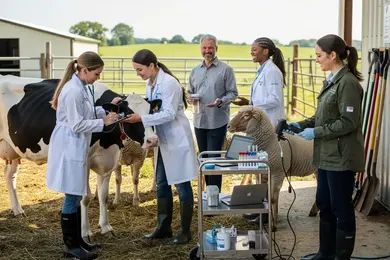
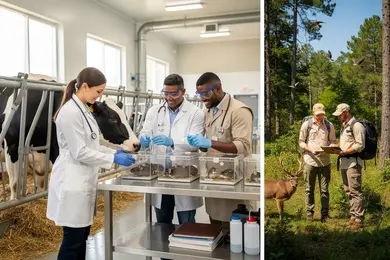
Animal science programs commonly cover animal nutrition, physiology, genetics, reproduction, production systems, welfare, business, and agricultural sustainability. Fully online options may deliver lectures and discussions online while requiring local, campus-based, intensive-session, or supervised practical work. Applicants should confirm the format before assuming that "online" means no in-person learning is needed.
What Admissions Requirements Do Online Animal Science Degree Programs Use Instead of an Essay?
Without an essay, colleges typically rely more heavily on academic evidence and administrative documentation. Requirements vary by institution and whether the applicant is a first-time student, transfer student, returning student, or degree-completion student.
The following comparison shows common alternatives to an admissions essay and what each item helps a school assess:
| Requirement | What the school evaluates | What applicants should confirm |
| Official high school or college transcripts | Academic preparation, completed credits, and grade trends | Whether transcripts must come directly from the prior school |
| Minimum GPA | Readiness for college-level science and quantitative coursework | The overall, transfer, and prerequisite GPA rules |
| Science or math prerequisites | Preparation for biology, chemistry, nutrition, or statistics courses | Required course titles, grades, and expiration limits |
| Test scores, if applicable | Placement or academic readiness | Whether scores are optional, required, or replaced by placement testing |
| Recommendation or résumé | Experience and readiness in selected or competitive pathways | Whether these are required for the degree, internship, or scholarship |
| Identity, residency, or immunization records | Enrollment eligibility and participation in practical activities | Deadlines and requirements for fieldwork or campus sessions |
Applicants interested in nutrition-focused animal careers should also distinguish animal nutrition coursework from human nutrition credentials. A nutritionist bachelor degree online pathway can have different prerequisites, professional expectations, and state-specific considerations.
A missing essay does not eliminate the need to present accurate records. Before applying, compare the admissions page with the program page and catalog, then ask an admissions representative whether the published requirements apply to your exact entry term and applicant category.
Who Is a Good Fit for Online Animal Science Degree Programs With No Admissions Essay?
No-essay admission can be a practical fit for applicants whose transcripts and completed coursework already show their readiness. It may reduce application time for working adults, transfer students, rural learners, military-connected students, and applicants applying to several programs with straightforward requirements.
The following applicants often benefit most when the program itself also meets their academic and career needs:
- Students with solid high school or college records who prefer evaluation based on documented academic performance.
- Working learners who need flexible online lectures but can complete any required laboratory, livestock, internship, or field components.
- Transfer students seeking a degree-completion route after earning credits in agriculture, biology, business, or general education.
- Applicants pursuing agricultural operations, animal production, feed and nutrition support, sales, extension-related work, or graduate study preparation.
A no-essay route may be a weaker fit for an applicant whose grades do not reflect current ability, who needs to explain a significant academic disruption, or who wants writing to highlight extensive animal-care experience.
In those cases, an essay-optional program can offer a useful chance to add context. Students planning veterinary school should also review prerequisite courses separately; an animal science bachelor's degree alone does not create eligibility for veterinary licensure.
These labels sound similar, but they create different application strategies. The most important step is to identify whether writing is not requested at all, merely optional, or removed under a temporary exception.
This table separates the policies so applicants can avoid assuming that an omitted essay is permanent or applies to every part of enrollment:
| Policy | Meaning for standard admission | Best applicant response |
| No essay required | The standard application does not include a personal statement or admissions essay. | Submit required records promptly and verify whether supplemental writing applies to your situation. |
| Essay-optional | Applicants may submit an essay, but are not required to do so for admission. | Consider submitting a concise, strong statement if it adds meaningful context not shown in transcripts. |
| Essay-waived | A usually required essay is temporarily or conditionally removed, often for a term, online pathway, or applicant group. | Read the waiver conditions and save the current admissions policy for your records. |
| Essay required | Written responses are part of the admissions review. | Follow the prompt precisely and allow time for revision and submission. |
Scholarship, honors, research, internship, and graduate-school applications may use separate rules. A student can qualify for no-essay undergraduate admission while still needing to write a scholarship statement or answer short-answer questions for a selective opportunity.
Not necessarily. A no-essay policy removes one application component; it does not disclose an institution's selectivity, lower the curriculum's rigor, or guarantee admission. Colleges can use GPA, completed credits, prerequisite grades, available cohort space, and transcript review to make admissions decisions.
Applicants should separate admissions simplicity from career preparation. The U.S. Bureau of Labor Statistics projects 6% employment growth for agricultural and food scientists from 2024 to 2034, faster than the average for all occupations.
That outlook is relevant to some animal science-related paths, but it does not mean every animal science graduate will qualify for a research scientist role; many positions require graduate education or specialized experience.
A program with an essay may be preferable when an applicant needs to demonstrate leadership, farm or laboratory experience, career goals, or improvement after a low-GPA period.
Conversely, a clear no-essay policy can be efficient when an applicant already meets documented requirements. Compare the academic standards, practical learning, transfer evaluation, and career alignment before treating either approach as "easier."
Start by confirming institutional accreditation recognized by the U.S. Department of Education or the Council for Higher Education Accreditation. Institutional accreditation affects the transferability of credits, federal financial-aid eligibility, and the credibility of the degree, though transfer acceptance is always decided by the receiving institution.
Animal science does not have one universal programmatic accreditor that applies to every bachelor's degree. Quality review therefore requires looking beyond the admissions page. Veterinary technology is a separate credential area: students considering that route should verify the relevant program approval and state eligibility rather than assuming an animal science degree meets veterinary technician requirements.
Students exploring adjacent clinical education can see how professional preparation is evaluated in an ASN program, where program approval and licensure alignment are central considerations.
Use the following checks to evaluate whether an online animal science program is academically and practically credible:
- Read the current catalog for required biology, chemistry, nutrition, genetics, welfare, production, and capstone courses.
- Confirm how laboratories, animal handling, internships, field experiences, or proctored assessments are completed.
- Review faculty credentials, student-support services, technology requirements, and access to advising.
- Ask whether internships are arranged, approved, or solely the student's responsibility.
- Verify that the curriculum supports your target role, graduate program, or professional-school prerequisites.
Red flags include vague course descriptions, unclear faculty information, unexplained fees, promises of professional eligibility without supporting details, and a failure to identify where practical learning occurs. A faster application should never substitute for verifying the credential's recognition and fit.
The process is usually shorter because an applicant does not need to draft and revise a general narrative, but document collection can still take time. Transcript delivery and transfer-credit evaluation are often the slowest steps.
Use this sequence to apply while preserving evidence of the school's stated policy:
- Identify the exact online animal science degree, entry term, and applicant category on the college's official admissions pages.
- Confirm in writing that a personal statement or admissions essay is not required for your application type.
- Review GPA, prerequisite, residency, application-fee, and testing or placement requirements.
- Request official transcripts early from every high school, college, or dual-enrollment institution required by the school.
- Complete the application accurately, including prior enrollment, disciplinary, and residency questions.
- Submit requested supporting documents and monitor the applicant portal for holds or additional requests.
- After admission, review transfer-credit results, financial-aid tasks, orientation, and any in-person course components before enrolling.
Do not leave optional fields blank without checking their purpose. A short explanation may be requested for a transcript discrepancy, and some colleges use separate forms for academic reinstatement or conditional admission. Keep copies of submitted materials and note the name and date of communications with admissions staff.
Yes, many transfer and adult applicants can apply through a no-essay process, but their requirements are frequently different from those for first-time students. A transfer applicant may need transcripts from every previously attended college, even if no credit was earned or the coursework will not transfer.
Adult students should ask whether the school uses overall GPA, most recent GPA, or transferable GPA and whether older science credits satisfy current prerequisites. Some institutions offer credit for prior learning, but eligibility, assessment methods, and maximum transferable credits vary.
Career changers can use no-essay admissions to reduce administrative friction, but they should still map previous credits to the degree plan. For example, someone comparing animal-sector training with short healthcare pathways may encounter distinct admissions and credential rules in a medical assistant certification accelerated program.
Before accepting an offer, transfer applicants should request a written or portal-based credit evaluation and confirm how many credits remain. A program that admits transfer students without an essay may still require an essay for academic forgiveness, an exception to a prerequisite, or a competitive internship placement.
No-essay admission usually does not change published tuition, federal-aid eligibility, or the underlying cost of an online animal science degree. Costs depend more on residency, institution type, credit load, online course fees, technology charges, laboratory or intensive-session costs, and the number of credits transferred.
For context, College Board reported that average published tuition and fees at public four-year U.S. colleges were $11,610 for in-state students in the 2024-25 academic year. This is a broad benchmark rather than an online animal science price: individual programs can cost substantially more or less, and published tuition is not the same as a student's net price after grants.
Complete the FAFSA as early as possible if you may use federal aid, and compare each school's net price, aid offer, borrowing needs, and refund policies. Students comparing professional healthcare graduate costs can see why program-level price details matter in this guide to the average cost of DNP program.
Scholarships are the major exception to a no-essay expectation. Many institutional and private scholarships require personal statements, career-goal essays, references, or short-answer responses even when degree admission does not. Do not skip scholarship opportunities solely because the college application had no writing component.
How Should You Compare Online Animal Science Degree Programs With No Admissions Essay?
Use no-essay status as one comparison point, not the deciding factor. The strongest option is the program that meets your academic preparation, budget, scheduling constraints, practical-learning needs, and intended career direction.
This comparison framework keeps application convenience in proportion to the factors that shape educational value:
| Comparison factor | Why it matters | Evidence to review |
| Admission policy | Clarifies workload and eligibility | Current policy for your applicant type and term |
| Accreditation and institution | Supports aid access and credit credibility | Recognized institutional accreditation and official catalog |
| Curriculum and practical learning | Determines preparation for animal-related work or further study | Course sequence, lab format, internships, and capstone requirements |
| Total cost | Affects borrowing and affordability | Per-credit tuition, mandatory fees, travel, and net-price estimate |
| Transfer policy | Can shorten time to completion | Written transfer evaluation and residency-credit requirement |
| Career alignment | Prevents pursuing the wrong credential | Prerequisite mapping, employer expectations, and graduate-school requirements |
Ask each college the same questions so the answers are comparable rather than relying on marketing language:
- Is the no-essay policy available to first-time, transfer, readmission, and international applicants, or only to selected groups?
- Could my application trigger a request for an additional statement or explanation?
- Which courses require in-person labs, animal handling, internships, or travel?
- What is my estimated total cost after all mandatory fees and expected transfer credits?
- Are scholarship, honors, or internship applications separate from degree admission?
- Which careers does this degree directly support, and which require additional education, certification, or licensure?
If you are also considering administrative healthcare work, compare credential requirements carefully rather than choosing solely by application length; medical billing and coding online schools often follow a different education-to-employment pathway. For animal science, choose the program that can document its academic quality, practical training plan, and relevance to your specific goal.
Other Things You Should Know About Animal Science
It can provide relevant coursework, but veterinary schools set their own prerequisites and may require specific laboratory courses, animal or veterinary experience, and standardized application materials. Compare the degree plan with the requirements of each veterinary school you may pursue.
Many accredited institutions issue the same degree title for online and campus formats, but policies vary. Employers generally focus on the institution, coursework, experience, technical skills, and role fit. Ask the school whether the transcript or diploma identifies the delivery format.
Yes. A school may request a short explanation for an academic issue, disciplinary disclosure, residency question, reinstatement request, or prerequisite exception. This is not necessarily a contradiction, but applicants should ask whether additional writing could be requested during review.
Useful transferable skills include data interpretation, biology and nutrition fundamentals, recordkeeping, animal welfare awareness, communication, problem-solving, and familiarity with agricultural systems. The value of each skill depends on the job, employer, and any additional training required.
- Ultimate Guide to Every Accredited Veterinary School in the U.S. https://www.hound.vet/blog/ultimate-guide-veterinary-schools
- Animal Science Degree- Best Schools, Major & Programs https://www.onlinedegree.com/bachelors/animal-science/
- Purina Animal Nutrition Scholarship - Scholarship America https://scholarshipamerica.org/scholarship/purina/
- Top Veterinary & Animal Science Scholarships https://www.vettechcolleges.com/blog/50-veterinary-animal-science-scholarships
- Tips for Your Vet School Personal Statement https://veterinary.rossu.edu/veterinary-school-resources-and-guides/tips-for-your-vet-school-personal-statement
- Lallemand Animal Nutrition Scholarship https://www.lallemandanimalnutrition.com/en/united-states/lallemand-animal-nutrition-scholarship-program/