2027 Illinois MCS-DS vs. Notre Dame Online MS in Data Science: Cost, Curriculum, Admissions, and Format

Co-Founder and Chief Data Scientist
Illinois's MCS-DS and Notre Dame's online MS in Data Science offer different credentials, so choosing between them takes more than comparing university names. Illinois awards a Master of Computer Science with a data science focus; Notre Dame offers a degree titled Master of Science in Data Science.
For working professionals weighing technical depth, scheduling, and expense, the deciding question is which program's actual courses and requirements fit the work they want to do. This comparison separates established differences from details you should confirm with each school before applying.
Key Things You Should Know
- Illinois's MCS-DS is a 32-credit Master of Computer Science, not a degree titled MS in Data Science. Notre Dame's credential is an MS in Data Science.
- Do not compare an advertised Illinois program price with a Notre Dame per-credit rate. Request a current, all-in estimate for the same expected enrollment period from both schools.
- Favor Illinois if its computer-science-centered course choices match your technical goals. Consider Notre Dame if its specific data science curriculum and scheduling better match your goals and working hours. Verify current course availability and live-attendance requirements before deciding.
Which program is better: Illinois MCS-DS or Notre Dame's online MS in Data Science?
Neither is universally better. The clearest established distinction is the credential: Illinois's data science pathway sits within its online Master of Computer Science, while Notre Dame awards an MS in Data Science. That difference matters if you want a computer science credential, but a degree title alone does not establish which program teaches more statistics, engineering, or applied modeling.
Choose Illinois if you want to evaluate data science through a computer science curriculum and its available technical electives. Give Notre Dame closer consideration if you want an explicitly named data science degree and its current course sequence fits your intended work. Before treating either as the stronger option, compare the courses you could actually take, not just the program descriptions.
How do the Illinois MCS-DS and Notre Dame online programs compare in cost and value?
Illinois requires 32 credits for its MCS. That establishes the academic volume, not your final bill. A defensible 2026 comparison needs current tuition and mandatory charges for your entry term, plus the costs created by how long you enroll.
Program prices and fee schedules can change; a precise, comparable total for both schools should be confirmed directly rather than inferred from different published pricing formats.
The table separates charges that are easy to confuse when estimating what you will pay.
| Cost component | What to compare at both schools |
| Tuition | The rate applicable to your program and entry term, multiplied by required credits unless the school quotes a fixed program price. |
| Mandatory fees | Technology, student, or other required charges, including whether they recur each term. |
| Situational costs | Books, software, travel if required, and any charges tied to extending or changing your enrollment. |
| Net personal cost | The amount remaining after confirmed employer assistance, scholarships, or other aid; borrowing adds financing costs. |
Ask each school for an itemized estimate based on your planned pace, then compare the same categories. A higher-priced option may still be worthwhile if its courses, support, or schedule better serve your goals, but a future salary increase should not be assumed.
If affordability is your overriding constraint and your interests extend beyond data science, cost-conscious artificial intelligence study options offer another comparison point.
What do students learn in the Illinois MCS-DS and Notre Dame data science curricula?
Illinois's MCS-DS approaches data science within a graduate computer science degree. For either program, the useful comparison is the required coursework and the electives available when you expect to enroll. A course catalog may show possibilities without establishing that every elective runs every term or that it fits your schedule.
The distinction below is a way to evaluate the curricula, not a claim that either degree guarantees every listed skill.
| Curriculum question | Illinois MCS-DS | Notre Dame online MS in Data Science |
| Degree framework | Master of Computer Science with a data science focus | Master of Science in Data Science |
| Technical depth to check | Which available courses cover computing, machine learning, data systems, and advanced electives? | How much required work covers programming, statistics, modeling, and data systems? |
| Applied work to check | Which courses produce substantial projects you can discuss with employers? | Are projects required, and what methods and deliverables do they involve? |
If responsible deployment is central to your target role, inspect syllabi for substantive assessment of privacy, bias, and oversight rather than relying on an ethics-related course title. Readers seeking that emphasis can also compare master's-level preparation in responsible AI governance.
How do the online formats differ between Illinois MCS-DS and Notre Dame?
Illinois delivers its online MCS coursework through an online platform, including Coursera-based course delivery. "Online," however, does not tell you whether a particular course has fixed deadlines, group meetings, or proctored assessments. Likewise, do not assume Notre Dame's online designation means entirely self-paced study or no required live participation.
For a working student, the consequential difference is the timetable you must follow. Request a sample weekly schedule from Notre Dame and examine Illinois syllabi for the courses you intend to take.
Confirm live sessions, time zones, group-work expectations, exam windows, and any campus visits with each program. This matters more than a general claim of flexibility if your job involves shifts, travel, or unpredictable hours.
What are the admission requirements for each data science master's program?
Check each program's admissions page for your intended entry term before preparing an application. In particular, distinguish a formal eligibility requirement from recommended preparation in programming, mathematics, or statistics.
Do not assume that a non-computer-science bachelor's degree automatically rules you out of either program, or that professional experience substitutes for a stated prerequisite.
Compare the current application checklist, academic preparation expectations, testing policy, deadlines, and any route for demonstrating readiness. If your previous major is outside computing, identify the technical gaps you need to close for coursework as well as admission.
Master's-level AI study after another major provides related context. Self-study may strengthen your preparation, but it satisfies a formal prerequisite only if the program says it does.
How long do Illinois MCS-DS and Notre Dame students take to graduate?
Illinois's 32-credit requirement makes course load a key determinant of completion time. For both schools, an advertised timeline should be read as a planned pace, not a promise: actual time depends on course availability, permitted enrollment load, breaks, and whether required work must be completed in sequence.
Ask each program for a sample plan that starts in your intended term and uses the number of courses you can realistically manage alongside work. Confirm any minimum or maximum completion period. If finishing quickly matters more than choosing between these two degrees, comparing shorter data science graduate pathways can help you test whether either timeline meets your goal.
Are Illinois MCS-DS and Notre Dame's online degrees accredited?
Both the University of Illinois Urbana-Champaign and the University of Notre Dame hold institutional accreditation from the Higher Learning Commission. Institutional accreditation concerns the university; it does not mean that every individual degree has a separate data-science-specific accreditation.
If accreditation affects employer reimbursement, further study, or another eligibility decision, confirm the institution's current status in the accreditor's directory and ask the relevant employer or organization whether it accepts the specific online degree. Do not mistake state authorization to enroll online students for program accreditation.
What careers and job roles can graduates pursue after either program?
Either curriculum may support applications for data scientist, machine learning, analytics, or data-focused software roles when a graduate can demonstrate the skills those employers request. The better match depends on completed coursework and prior experience, not the degree title alone.
A computing-heavy course plan may be particularly relevant to engineering-oriented roles; a plan emphasizing statistical analysis and communication may suit other analytical positions.
Before enrolling, collect a few current job descriptions for your target role. Compare their required methods, tools, and experience with the courses you could take and projects you could produce. A master's degree can add evidence of skill, but it does not replace employer-specific experience requirements or guarantee a transition into a new role.
What salaries and job outlook can data science graduates expect?
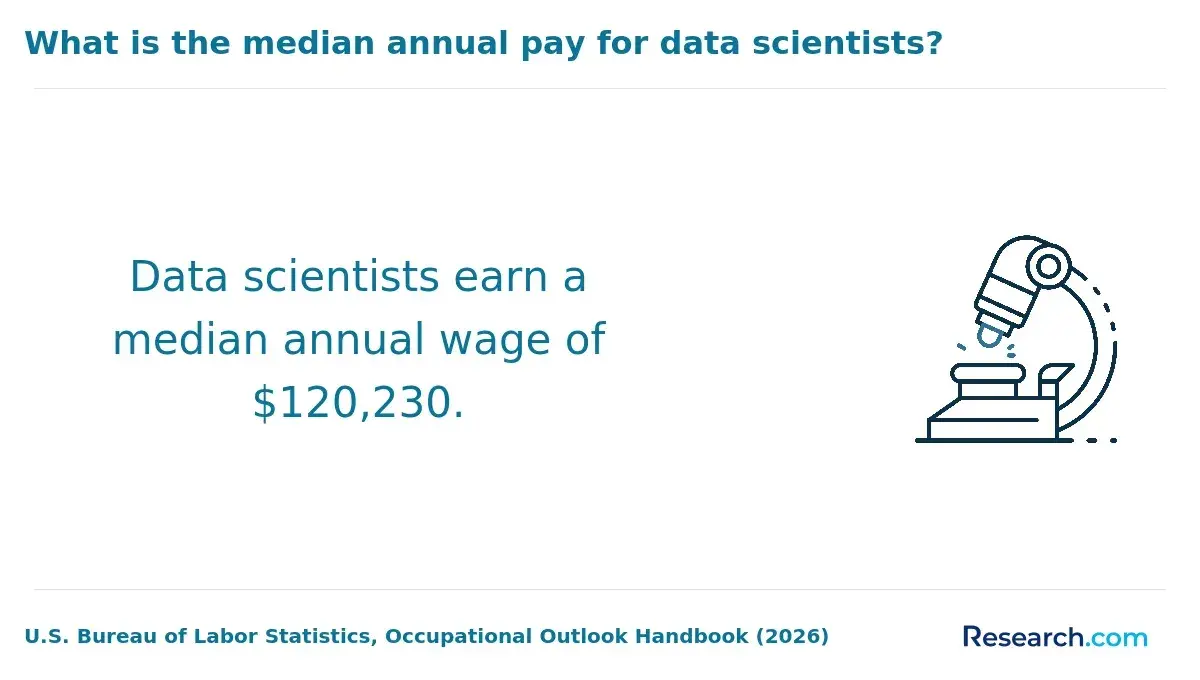
The U.S. Bureau of Labor Statistics reports a $120,230 median annual wage for data scientists in May 2025. That is a national occupation-wide figure, not an entry-level offer, a graduate salary for either university, or evidence that completing a master's causes someone to earn that amount.
BLS projects strong growth for data scientist employment from 2025 to 2035, but competition and pay will still vary by experience, location, employer, and specialty. Use local job postings and your current compensation to assess a realistic next move. For a closer look at how the target employer sector can affect that calculation, see sector-by-sector data science earnings comparisons.
Which online data science master's program best fits your career goals?
Start with the role you want, then compare the courses and projects available to you, your ability to meet the schedule, and your verified net cost. Illinois is the more direct choice if you specifically want a Master of Computer Science and its course options support your technical direction. Notre Dame deserves preference if you want an MS in Data Science and its confirmed curriculum and format better serve your intended role at a cost you can justify.
The most avoidable mistake is choosing from the degree names or headline prices alone. Before committing, obtain a current degree plan, a schedule for likely courses, an itemized cost estimate, and written answers to any admissions or attendance questions. If neither plan closes your actual skill gap within your time and budget, continuing to compare alternatives is a sound decision, not a missed opportunity.
Other Things You Should Know About Data Science Programs
Illinois awards a Master of Computer Science through the MCS-DS pathway. If the exact wording on a diploma or transcript matters to you, request confirmation from the university before enrolling.
Do not assume they will. Ask each program whether it accepts transfer credits, how many may count, and whether a prior course can satisfy a particular requirement.
Check the technology requirements for the courses you expect to take. Online delivery does not, by itself, establish what computer or software you will need.
Confirm the current degree requirements for your pathway. A course project, capstone, and thesis are different requirements; do not treat the presence of one as proof that another is required.
References
- Cost of Attendance (Budget) | 2025-2026 Federal Student Aid Handbook https://fsapartners.ed.gov/knowledge-center/fsa-handbook/2025-2026/vol3/ch2-cost-attendance-budget
- A Guide to Teaching Data Science - PMC - NIH https://pmc.ncbi.nlm.nih.gov/articles/PMC6519964/
- Data Science | Academic Catalog | The University of Chicago http://collegecatalog.uchicago.edu/thecollege/datascience/
- Data Science and AI Courses | du.edu https://ritchieschool.du.edu/data-science/courses
- Time Managment Calculator | School of Chemical Sciences | Illinois https://scs.illinois.edu/time-managment-calculator
- Machine Learning Online Course | Applied Machine Learning https://online-exec.cvn.columbia.edu/applied-machine-learning
- How to Become a Data Scientist | Harvard SEAS https://seas.harvard.edu/news/how-become-data-scientist