2027 Online Data Science Master's for Teachers: A Career Transition Guide

Co-Founder and Chief Data Scientist
An online data science master's can help a teacher move into analytical work, but the degree alone does not make the transition. Teachers bring strengths in explaining evidence, evaluating learning, and working with stakeholders; they may still need substantial preparation in programming, statistics, and data management.
This guide helps educators identify suitable target roles, judge whether a master's is necessary, and compare programs against the skills, schedule, and costs of a career change.
Key Things You Should Know
- Teaching experience is especially relevant to education analytics and edtech, but applicants still need evidence that they can work with code, statistics, and real datasets.
- A master's is useful when its technical courses and projects close specific gaps; a smaller credential or self-directed portfolio may be a better first step if the target role does not require graduate study.
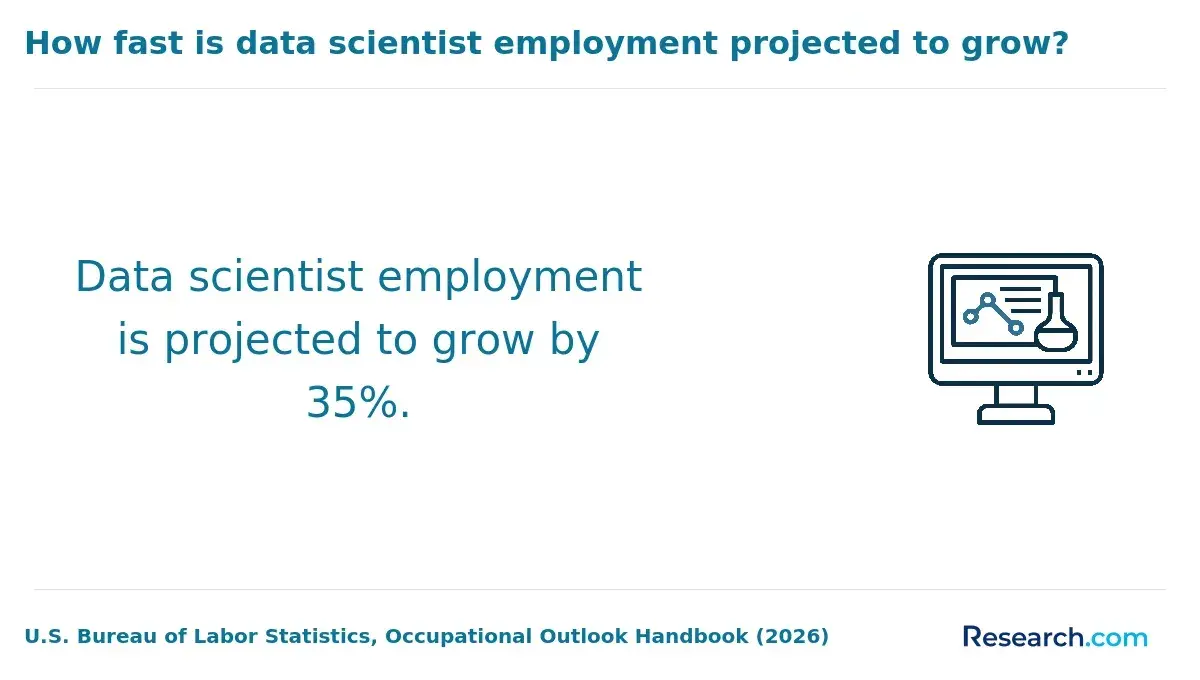
- The U.S. Bureau of Labor Statistics projects 35% employment growth for data scientists from 2025 to 2035. That outlook describes an occupation, not a guaranteed outcome for career changers.
What Is an Online Data Science Master's for Teachers?
It is a graduate degree in data science delivered primarily online, not usually a separate credential designed for licensed teachers. Its value for an educator depends on whether the curriculum converts classroom and school-system knowledge into demonstrable technical ability. Course titles alone are less informative than the coding assignments, statistical depth, and projects students complete.
A teacher interested mainly in dashboards, reporting, or program evaluation should also compare data analytics graduate study choices.
Data science programs may place greater emphasis on predictive modeling and computing, while analytics offerings may align more closely with decision-support roles; actual curricula vary.
Can Teachers Transition to Data Science With an Online Master's?
Yes, but the credible transition is from teaching experience plus new technical evidence to a defined analytical role - not from degree title to job offer. Teachers may already know how to frame questions, interpret imperfect assessments, explain findings to nontechnical audiences, and recognize when a metric misses important context.
Those strengths are particularly useful in education-related work, though they do not replace SQL, programming, statistical inference, or reproducible analysis.
Before applying, examine several postings for one target role and compare their recurring requirements with your current skills. If you lack basic coding and statistics, introductory study and a small, independently completed project can test your interest before a larger financial commitment.
If postings emphasize a portfolio rather than a graduate degree, consider building that evidence first. A master's becomes more compelling when you need structured technical training, substantial projects, and access to faculty feedback that you cannot readily obtain another way.
A common mistake is presenting classroom spreadsheets as equivalent to production data science experience. Instead, describe the question, data limitations, method, validation, and decision your work informed. Where possible, add projects using data you are permitted to share.
What Are the Best Data Science Career Paths for Teachers?
The best first target depends on whether you want to retain education-sector expertise or compete for broader technical roles. The comparison below distinguishes where teaching experience may carry the most weight from where new technical evidence matters most:
| Target role | Relevant teaching experience | Likely skill gap |
| Education data analyst | Interpreting assessment and attendance measures for school decisions | SQL, dashboards, and reliable data cleaning |
| Program evaluation or research analyst | Understanding interventions, outcomes, and stakeholder questions | Research design, statistical inference, and reporting limitations |
| Edtech product analyst | Understanding how learners and educators use a product | Product metrics, experimentation, and event data |
| Data scientist | Framing meaningful problems and communicating findings | Deeper programming, modeling, and model evaluation |
Education analytics or evaluation may offer the clearest way to use prior experience. A general data scientist role is a reasonable longer-term goal, but the teacher should expect to demonstrate technical competence independently of education credentials.
Educators drawn specifically to AI-focused work can use guidance on selecting an AI program based on target roles to decide whether data science or an AI-focused degree better fits the jobs they want.
What Do Online Data Science Master's Programs Teach?
Relevant programs typically combine programming, statistics, data preparation, databases, visualization, and machine learning. For a teacher changing careers, the critical question is not whether these subjects appear on a webpage, but whether students apply them to messy data, justify methodological choices, and communicate defensible results.
Look closely at project requirements. A strong portfolio project might investigate an education-related question, document missing or biased data, compare an appropriate baseline with a more complex method, and explain what a district or product team could responsibly conclude.
Use public or properly authorized data; access to student records through your teaching job does not automatically permit their use in coursework or a public portfolio.
If your goal involves AI in schools, check whether the curriculum addresses privacy, bias, and oversight alongside model building. An artificial intelligence master's specialization in governance may be worth comparing if responsible AI implementation, rather than general data analysis, is your primary aim.
What Are the Admission Requirements for Online Data Science Master's Programs?
Requirements vary by institution. A bachelor's degree is generally the starting point, but programs differ in how they assess calculus, linear algebra, statistics, programming, grades, professional experience, and application materials. A teaching credential neither automatically satisfies technical prerequisites nor automatically disqualifies an applicant.
Check each program's current admissions policy, then distinguish formal prerequisites from skills recommended for success. Ask whether a course taken before enrollment can fulfill a requirement, whether conditional admission is available, and what evidence, coursework, a coding project, or relevant work, admissions staff will accept. Self-study can prepare you to succeed without necessarily fulfilling a required credit-bearing course.
Application effort also varies. If an essay is a particular obstacle, comparisons of ML graduate programs without personal statement requirements illustrate why applicants should verify each school's materials checklist; those machine learning programs are not interchangeable with data science master's degrees.
How Long Does an Online Data Science Master's Take?
Completion time depends on credit requirements, prerequisite courses, course availability, and whether you enroll full time or part time. For a working teacher, a program's advertised shortest path may be less useful than the sequence you can actually follow while teaching.
A required course offered infrequently or a team project scheduled during the school year can extend the practical timeline.
Compare online data science master's options by program length, then confirm each school's current schedule directly. Ask whether summer enrollment can accelerate progress, whether courses are asynchronous, and how long you may take to finish. Choose a faster pace only if it leaves enough time to build the technical skills and portfolio your transition requires.
How Much Does an Online Data Science Master's Cost?
There is no reliable single price for an online data science master's. Published tuition may be charged per credit or per term, and the total can change with residency rules, required credits, fees, and enrollment pace. Without a current program-specific tuition schedule, a precise comparison would be misleading.
Request a written estimate for your likely course plan that separates tuition, mandatory fees, prerequisite courses, software or equipment, and any travel or in-person requirements.
Also account for the income and time you would give up if you reduce teaching hours. Check employer tuition assistance, scholarships, and federal aid eligibility with the relevant school or employer rather than assuming they apply.
For a career-change decision, compare that full cost with a less expensive route to the same target role, such as targeted coursework and a portfolio. Do not calculate a promised return by subtracting a teacher salary from a data scientist median: the median reflects workers with varied experience, roles, and locations, not the salary increase caused by earning a degree.
How Do Online and Campus Data Science Programs Compare?
An online format may let a teacher keep working and avoid relocation. A campus format may make face-to-face collaboration and access to local recruiting easier. Neither delivery mode establishes technical rigor or employment outcomes on its own; courses, projects, instruction, and support matter more.
For each program, verify whether "online" includes live sessions, fixed-time exams, group meetings, or campus visits. Compare access to faculty, project feedback, career services, and employer connections using the same questions for both formats.
Choose online study when its scheduling genuinely fits your teaching obligations; favor campus study when its specific resources justify the added time or relocation cost.
How Much Do Data Science Graduates Earn?
There is no single verified salary for graduates of online data science master's programs. The U.S. Bureau of Labor Statistics reports a $120,230 median annual wage for data scientists in May 2025. That is an occupation-wide figure, not an entry-level offer, a teacher-to-data-science pay increase, or an outcome attributable to a master's degree.
When assessing a program's salary claims, look for the graduating class, response rate, prior work experience, job titles, and locations represented. A school that does not report those details has not provided enough evidence to predict your earnings.
Compare likely openings for your target role with your current compensation and the degree's full cost before treating a higher occupational median as a reason to enroll.
How Can Teachers Choose an Accredited Data Science Program?
Start by verifying the institution's accreditation with its recognized institutional accreditor or the U.S. Department of Education's accreditation database.
Then check whether the school is authorized to enroll online students where you live; accreditation and state authorization answer different questions. Do not assume a data science degree grants or renews a teaching license - those rules depend on the state and credential.
A final program comparison should focus on evidence you can inspect. These checks help distinguish a useful transition pathway from an appealing degree label:
- Match required technical courses and project work to postings for your chosen role, not just to the program's marketing language.
- Confirm how the school handles your prerequisite gaps, working-teacher schedule, total cost, and access to meaningful project feedback.
- Ask for clearly defined career outcomes, while treating undisclosed results and salary claims without methodology as unknowns.
Choose the program only if its verified requirements and resources address gaps you could not more efficiently close elsewhere. That is a stronger basis for enrollment than a ranking, a short advertised timeline, or the assumption that any master's will secure a data science job.
Other Things You Should Know About Data Science
Possibly, but district salary schedules and rules for graduate-credit recognition vary. Ask your district whether the specific degree qualifies before enrolling for a pay-lane increase.
Not without appropriate authorization and privacy review. Removing names alone may not make student-level information safe to publish. Publicly available practice datasets are a safer starting point.
It depends on the internship's hours, your employment agreement, and the program's requirements. Ask whether part-time, summer, or employer-based projects are accepted before relying on an internship as your transition plan.
Not automatically. Colleges set their own hiring and course-assignment standards, which may consider graduate coursework, professional expertise, and teaching needs. Check the qualifications for the positions you want.
References
- Post-Secondary Employment Outcomes Tool Shows What You Might Earn Depending on the College You Attend | Census.gov https://www.census.gov/library/stories/2022/06/job-and-earnings-prospects-by-college-and-degree.html
- Cost of Attendance (Budget) | 2025-2026 Federal Student Aid Handbook https://fsapartners.ed.gov/knowledge-center/fsa-handbook/2025-2026/vol3/ch2-cost-attendance-budget
- Types of Financial Aid: Grants, Work-Study, and Loans | studentaid.gov https://studentaid.gov/understand-aid/types
- A Guide to Choosing Between Data Science vs. Data Analytics | UCLA MSOL Data Science https://www.msol.ucla.edu/data-science-engineering/articles/demystifying-data-guide-choosing-between-data-science-vs-data-analytics/
- What Is Data Science? Definition, Skills, Applications & More | Harvard SEAS https://seas.harvard.edu/news/what-data-science-definition-skills-applications-more
- Online Program - UChicago Data Science Institute https://datascience.uchicago.edu/education/masters-programs/online-program/
- Computer Science Bridge Program | Case School of Engineering https://engineering.case.edu/computer-and-data-sciences/bridge
- 4. Statistics & Data Science Major Course Requirements | arizona.edu https://kb.math.arizona.edu/mathcenter/index.php
- Prerequisite Key Topics - UVA School of Data Science https://datascience.virginia.edu/pages/prerequisite-key-topics
- Master's in Data Science - University of Notre Dame https://datascience.nd.edu/masters/