2027 Berkeley MIDS Statistics and Research Design Coursework: A Guide for Prospective Students

Co-Founder and Chief Data Scientist
Berkeley's Master of Information and Data Science (MIDS) is worth examining closely if you want to do more than build predictive models. Its statistics and research design coursework addresses how to frame questions, collect appropriate data, and judge whether results support a conclusion. For prospective students, the decision is whether that foundation - alongside programming and machine learning - matches their career goals, preparation, schedule, and budget. This guide separates the program's stated curriculum from the depth and outcomes you should confirm before enrolling.
Key Things You Should Know
- Berkeley MIDS identifies Statistics for Data Science and Research Design and Applications for Data and Analysis as distinct parts of its curriculum; their combination is especially relevant to students who need to evaluate evidence, not just produce models.
- MIDS is an online graduate program with live instruction and an immersion component. Confirm the current course sequence and any travel requirements before choosing a pace.
- The degree's value depends on fit and total cost, not a presumed salary increase: the U.S. Bureau of Labor Statistics reports a $120,230 median annual wage for data scientists in May 2025, not a Berkeley MIDS graduate salary.
What is Berkeley MIDS, and who is the program designed for?
Berkeley MIDS is the University of California, Berkeley's online Master of Information and Data Science. It combines quantitative reasoning, computing, and the application of data science to practical questions. The statistics and research design components make it particularly relevant to applicants who want to decide what evidence is needed before selecting an analytical method.
That includes professionals moving from analytics into data science and people whose work involves experiments, surveys, product decisions, or evaluating model results. It may be less suitable if your primary objective is a narrowly focused graduate degree in mathematical statistics. Course titles alone cannot establish how much theoretical statistics a student will study; compare syllabi and project expectations against your intended role.
What statistics and research design courses does Berkeley MIDS include?
Two named MIDS courses address the title's central question: Statistics for Data Science and Research Design and Applications for Data and Analysis. Read together, they indicate attention both to quantitative analysis and to deciding whether a study can answer its stated question. The table distinguishes that curricular emphasis from details a course title cannot verify.
| Course | Decision-relevant emphasis | Depth to verify in the current syllabus |
| Statistics for Data Science | Statistical reasoning used to analyze data and interpret uncertainty | Mathematical prerequisites, inference topics, assessment methods, and software used |
| Research Design and Applications for Data and Analysis | Formulating answerable questions and designing analyses around appropriate evidence | Coverage of sampling, observational studies, experiments, bias, and research ethics |
These subjects work together. A technically correct estimate can still be misleading if the sample is unrepresentative; a well-framed research question needs an analysis that accounts for uncertainty. To judge whether MIDS teaches them substantively, look for graded work in which students justify a design, identify threats to validity, analyze data, and explain limitations - not merely run code.
Applicants interested specifically in causal inference should ask which current electives or projects allow them to study experiments and observational comparisons in greater depth. Do not assume that a foundational research design course alone provides advanced specialization.
Is Berkeley MIDS online, and how long does it take to complete?
MIDS is delivered primarily online and includes live instruction; the program also describes an immersion experience. "Online" therefore should not be taken to mean entirely asynchronous or necessarily free of travel. Berkeley offers different pacing options, but a quoted completion time depends on the course load and schedule available to a particular student.
For someone employed full time, the important test is whether live class times, group work, and the sequence of statistics and research design courses leave enough time to practice between sessions. Ask Berkeley for a current term-by-term plan at your intended pace, the immersion location and attendance rules, and any restrictions on taking a break. If finishing quickly matters more than this particular curriculum, compare fast-track artificial intelligence master's study while checking whether those programs offer comparable research methods training.
What are the admission requirements for Berkeley MIDS?
Berkeley MIDS is a graduate program, so applicants should review its current degree, application, and documentation requirements directly before applying. Published admissions criteria and evidence of readiness are not the same thing: even where a particular prior major is not specified, statistics coursework, programming experience, and examples of analytical work can help an applicant show preparation for the curriculum.
For this article's focus, a useful readiness check is whether you can interpret a confidence interval, explain how selection bias might affect a finding, and use code to inspect a dataset. If those tasks are unfamiliar, targeted study and a small reproducible project can build preparation; they do not automatically satisfy any formal prerequisite Berkeley may impose. Applicants comparing application workloads can review ML master's degree options without a personal essay, but should verify MIDS's own current application checklist rather than infer its requirements from other programs.
How much does Berkeley MIDS cost, and what financial aid is available?
A reliable current total requires Berkeley's tuition and fee schedule for your entry term and intended pace. No specific MIDS tuition figure is presented here because an unverified per-unit price would give a misleading estimate. Beyond tuition, account for mandatory fees, materials or technology, immersion travel if applicable, and the financing cost of any loans. A slower pace can also change when payments come due, even if it does not change the degree's academic requirements.
Ask Berkeley for an itemized cost estimate and which institutional aid, payment arrangements, or federal aid options apply to you. Then check employer tuition assistance and its repayment conditions. Compare the resulting net cost, not Berkeley's headline tuition alone, with alternatives such as low-cost online AI degree programs - while noting that a lower-priced AI curriculum may not offer equivalent statistics or research design coursework.
Is Berkeley MIDS accredited and does it require professional licensing?
UC Berkeley holds institutional accreditation through the WASC Senior College and University Commission (WSCUC). That is an institutional status, not a claim that MIDS has separate programmatic accreditation in statistics or data science. Prospective students who need accreditation for employer reimbursement should check their employer's exact policy.
Data scientist and data analyst roles generally do not have a single professional license attached to the job title. A role in a regulated setting may still impose employer, industry, privacy, or occupation-specific requirements. MIDS should not be treated as a substitute for a license required for a different profession.
What skills and career paths can Berkeley MIDS coursework support?
The most direct contribution of statistics and research design is better judgment: choosing a measurable question, recognizing biased data, interpreting uncertainty, and explaining what an analysis cannot establish. Those skills can support data science, product analytics, experimentation, and research-oriented analytics work, particularly when paired with programming and a strong domain understanding.
A useful portfolio project would state a question, document how the data was obtained, justify the study design, analyze uncertainty, and discuss alternative explanations. This demonstrates more than a model accuracy score. If your target role instead emphasizes production pipelines and infrastructure, compare the time MIDS devotes to those topics with AI master's course options for data engineering. Research design is valuable in either setting, but it does not replace engineering practice.
What jobs and salaries can Berkeley MIDS graduates expect?
MIDS coursework may be relevant to data scientist and analytical roles, but a degree does not establish eligibility for a particular job or salary. The U.S. Bureau of Labor Statistics reports a $120,230 median annual wage for data scientists in May 2025. That figure describes workers in a national occupation - not recent graduates, MIDS alumni, or the pay increase attributable to earning the degree.
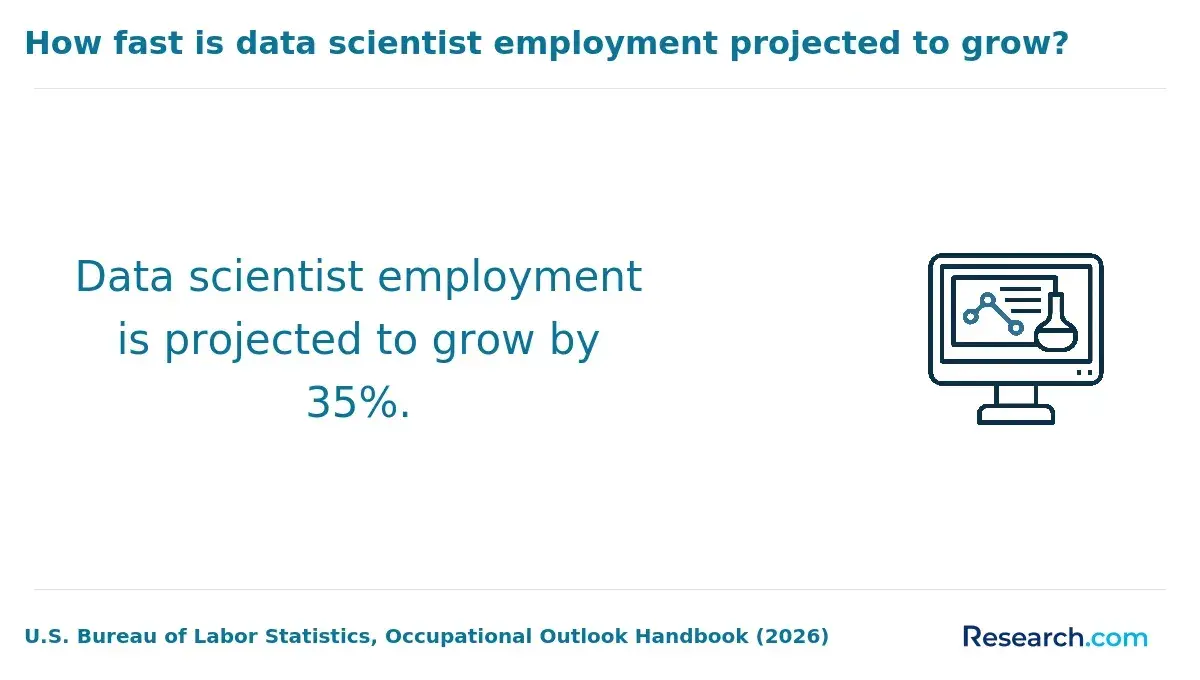
BLS also projects strong employment growth for data scientists from 2025 to 2035. Demand does not remove competition or make every graduate a fit for every opening. Evaluate potential returns using your current compensation, experience, target role, local market, and expected debt. If Berkeley provides alumni outcomes, ask who responded, when they graduated, what they earned before enrolling, and whether the figures describe all respondents or only those reporting salaries.
How does Berkeley MIDS compare with other data science programs?
For a statistics-focused applicant, compare programs by the work students must actually complete rather than by the presence of "statistics" on a course list. A program with deeper probability and inference may better suit a prospective statistician; one with stronger deployment requirements may better suit a machine learning engineer. MIDS's named research design course is particularly worth examining if you expect to evaluate experiments or make evidence-based organizational decisions.
Compare current syllabi, required projects, scheduling, and itemized net costs on the same basis. Also examine access to people who work in your target field: comparing alumni communities in AI graduate programs may help you identify useful questions, but network size or reputation alone is not evidence of job placement or instructional depth.
How should prospective students evaluate Berkeley MIDS for their goals?
Choose MIDS for this subject area if you want research design and statistics embedded in a broader data science education, can meet its scheduling demands, and can justify its full cost against your alternatives. A dedicated statistics program is more suitable when advanced statistical theory is the overriding goal; a more engineering-centered program may fit better when building production systems is the priority.
Before making a deposit, use the following checks to turn that fit judgment into a concrete decision:
- Request current syllabi for the named statistics and research design courses; look for graded assignments that require interpreting uncertainty and defending a study design.
- Map required courses and available electives to a target job description, identifying any missing causal inference, software engineering, or domain-specific skills.
- Get a personalized schedule and itemized cost estimate, including immersion and financing assumptions.
- Ask for outcome data with its methodology, and compare likely career changes with your existing experience rather than assuming a national salary applies to you.
The main mistake to avoid is treating a prestigious degree title - or one promising course title - as proof of the depth you need. A syllabus, representative project, and realistic budget provide firmer grounds for deciding.
Other Things You Should Know About Data Science
No. They can overlap in surveys, experiments, and interpreting behavior, but user-experience research also uses methods such as interviews and usability testing. Check assignments if you need substantial qualitative UX training.
Do not assume so. Obtain your employer's permission and confirm the course's data-handling rules first. Public, synthetic, or properly de-identified data may be safer alternatives.
A clear question, documented data, appropriate methods, checks for bias and uncertainty, reproducible work, and a conclusion limited to what the evidence supports.
Working fluency with at least one language used for data analysis can make coursework easier. Check the current course materials for required tools before choosing what to study.
References
- General Schedule Qualification Policies | U.S. Office of Personnel Management https://www.opm.gov/policy-data-oversight/classification-qualifications/general-schedule-qualification-policies/
- Statistical and Research Methodology in Education | IES https://ies.ed.gov/funding/research/programs/statistical-and-research-methodology-in-education
- Observational Studies - PMC - NIH https://pmc.ncbi.nlm.nih.gov/articles/PMC10589119/
- Catalog: Data Science Courses | UC Berkeley School of Information https://www.ischool.berkeley.edu/courses/datasci
- Doctor of Public Health | DrPH | Johns Hopkins https://publichealth.jhu.edu/academics/drph
- How to Become a Data Scientist | Harvard SEAS https://seas.harvard.edu/news/how-become-data-scientist
- Full article: Writing Assignments to Assess Statistical Thinking | tandfonline.com https://www.tandfonline.com/doi/full/10.1080/10691898.2019.1696257
- Data Science Curriculum | UC Berkeley School of Information's Online Master's Programs https://ischoolonline.berkeley.edu/data-science/curriculum/
- Top 12 Data Science Programming Languages | MDS@Rice https://csweb.rice.edu/academics/graduate-programs/online-mds/blog/programming-languages-for-data-science
- Designing Assessments of Student Learning | Teaching and Learning Resource Center https://teaching.resources.osu.edu/teaching-topics/designing-assessments-student