2027 Online Data Science Master's for Nurses: A Career Transition Guide

Co-Founder and Chief Data Scientist
An online data science master's can help nurses move into analytics without leaving their jobs immediately, but the degree is not a shortcut past programming and statistics. The best choice depends on whether you want to improve clinical decisions with data, build predictive models, or leave healthcare altogether. This guide shows nurses how to assess their readiness, compare programs, and choose a realistic first role - before committing to graduate tuition.
Key Things You Should Know
- A nursing background can be an advantage in healthcare analytics, but applicants still need evidence of quantitative and programming readiness; requirements vary by program.
- For most career changers, a clinical data analyst or informatics role is a more plausible first target than a senior data scientist position.
- The U.S. Bureau of Labor Statistics projects 35% growth in data scientist employment from 2025 to 2035, but that occupation-wide forecast does not predict an individual graduate's hiring prospects.
What is an online data science master's degree for nurses?
It is a graduate data science degree taken primarily online by someone with a nursing background—not usually a nursing-specific credential. Students learn to work with data, write code, evaluate statistical findings, and communicate results. Some programs allow healthcare electives or projects; others teach general-purpose methods without a clinical focus. Confirm the actual course options rather than relying on a program's marketing examples.
The distinction matters because nursing expertise is most valuable when it helps frame a sound question: for example, whether a model predicts a clinically useful outcome, whether documentation practices distort the data, or whether a proposed workflow is safe for staff and patients. A data science degree does not replace nursing education or confer advanced nursing practice authority. If your goal is specifically to design healthcare AI systems, compare the curriculum with graduate AI pathways into healthcare analytics before deciding which technical emphasis fits.
Can nurses apply to online data science master's programs?
Yes, nurses can apply to programs that accept applicants from varied undergraduate fields, but a BSN alone does not establish eligibility for every program. Some expect prior coursework in calculus, linear algebra, statistics, or programming; others offer preparatory courses. An RN credential may strengthen an application for clinically focused work, but it does not substitute for a stated mathematics prerequisite.
Separate formal eligibility from readiness to succeed. If a prerequisite must appear on a transcript, self-study may improve your skills without satisfying that rule. Before paying an application fee, send admissions staff your transcript and ask which requirements remain unmet, whether equivalent courses count, and whether missing work can be completed before or after admission. Seek an answer about the specific program, not a general reassurance that career changers are welcome.
How can nurses transition into data science careers?
Start with a target job, then work backward. Nurses already bring experience interpreting clinical context, documenting care, communicating risk, and noticing when a measure fails to reflect what happens at the bedside. Those strengths are particularly useful in healthcare analytics; they do not, by themselves, demonstrate SQL, Python, statistical modeling, or reproducible analysis.
A transition plan should produce evidence an employer can inspect, rather than relying on the degree title alone:
- Review local job postings for clinical data analyst, quality analyst, informatics analyst, and healthcare data scientist roles; note which tools and tasks recur.
- Build a foundation in SQL, Python, or R, and applied statistics before taking advanced modeling courses.
- Complete projects using appropriately authorized data, documenting the clinical question, data limitations, methods, validation, and a decision a stakeholder could make from the results.
- Seek an internal analytics assignment or cross-functional project where possible, then use that experience to test whether you prefer reporting, workflow improvement, or model development.
A master's is most defensible when your intended roles require deeper quantitative work and the program provides training and projects you cannot readily gain on the job. For an initial move into reporting or quality improvement, employer-supported experience or shorter training may be enough. If AI rather than broad analytics is your destination, matching an AI degree to your professional goals can help you assess that alternative.
What do online data science master's programs teach?
Relevant programs generally combine programming, data management, statistics, machine learning, and communication or visualization. Course titles alone do not show how deeply students practice those skills. For a nurse seeking technical roles, inspect syllabi and project descriptions: a passing introduction to machine learning is different from building, validating, and explaining models on imperfect data.
Healthcare-focused study should also leave room to examine missing or inconsistent records, bias across patient groups, privacy constraints, and whether a prediction would change a clinical decision. Ask whether you can pursue a healthcare project and who helps students obtain suitable data. A promised capstone is less useful if you cannot access an approved dataset or get feedback on clinical interpretation.
Choose broader data science training if you want flexibility beyond healthcare; prioritize substantial healthcare data work if clinical domain expertise is central to your career plan. If machine learning is the main attraction and price is a constraint, compare the required coursework with machine learning graduate programs on a $20,000 budget rather than assuming every data science degree offers the same depth.
How long and how much do online data science master's programs take?
There is no reliable single duration or price for online programs. Credit requirements, term schedules, prerequisite courses, enrollment pace, and tuition policies differ by school. For a nurse working shifts, the fastest advertised completion time may be less useful than a schedule you can sustain through clinical rotations, overtime, and group assignments.
Compare each school's published tuition and mandatory fees against the number of credits you would actually need. Add any preparatory courses, software or computer costs, required travel, and interest if borrowing; ask whether tuition changes during enrollment. Also account for reduced work hours if the pace would require them. Employer assistance can change the calculation, but confirm eligibility, annual limits, and any repayment obligation before treating it as available funding.
Ask programs for both a full-time and a working-professional course sequence, including when required courses are offered and how long a break is permitted. If time away from your current role is the main constraint, compare data science graduate programs for a shorter study timeline—then check whether the accelerated pace leaves enough room to master unfamiliar technical material.
How do online and campus-based data science master's programs compare?
Both formats can lead to a graduate degree; neither guarantees better instruction or employment. The practical difference for a working nurse is access: online study may preserve a clinical schedule and widen the choice of schools, while a campus program may make in-person collaboration and local recruiting easier. Either format can include live classes, team projects, or fixed deadlines.
Evaluate the operating details, not the label. Ask whether lectures are recorded, when live sessions occur in your time zone, how often teams meet, whether exams require scheduled proctoring, and whether any campus visits are mandatory. Also compare access to faculty, career services, and healthcare project partners. Online is the better fit if its actual timetable works around shifts; campus study may be worth considering if you can attend regularly and value its local employer connections.
What are the admission requirements for nurses applying to data science master's programs?
Requirements are program-specific. Schools may request an accredited bachelor's degree, transcripts, a statement of purpose, recommendations, a résumé, and evidence of quantitative preparation. A programming assessment, test score, or particular prerequisite course may also apply. Check the current admissions page for each program and confirm deadlines and exceptions directly.
Use your application to explain the connection between nursing and the work you want to do. A concrete example—such as investigating a quality measure, improving a documentation workflow, or collaborating with analysts—shows more than a general claim that healthcare uses data. Pair that experience with verifiable technical preparation, such as graded coursework or a project whose code and methods you can explain. Do not present an informal tutorial as equivalent to a required for-credit class unless the program explicitly accepts it.
How can nurses verify data science program accreditation and quality?
First verify that the institution holds recognized institutional accreditation using the accreditor's official directory or the U.S. Department of Education's accreditation database. Do not assume that nursing-program accreditation applies to a separate data science degree or that an unverified claim of "accreditation" identifies which institution and credential are covered. If you live in another state, also confirm that the school can enroll students where you reside.
Accreditation is a starting point, not proof of career fit. Request the current degree plan and check who teaches core courses, how projects are supervised, what technical work students complete, and whether support is accessible online. Be wary of a program that cannot clarify prerequisites, total required charges, or whether its advertised healthcare opportunities are available to online students. Rankings and testimonials cannot answer those individual questions.
What jobs can nurses pursue after earning a data science master's degree?
The strongest first target often depends on how much technical experience a nurse gains before and during the degree. These roles overlap, but employers may use the titles differently. The comparison shows why a role's daily work is more informative than its title alone:
| Potential role | Typical focus | Where nursing experience may help |
| Clinical or healthcare data analyst | Queries, reports, dashboards, and interpretation of care or operational measures | Understanding documentation and the clinical meaning of a metric |
| Quality improvement or population health analyst | Tracking outcomes, identifying variation, and evaluating interventions | Connecting findings to care processes and patient needs |
| Clinical informatics analyst | Improving information workflows and translating between clinical and technical teams | Recognizing how systems affect bedside work |
| Healthcare data scientist | Developing and evaluating statistical or predictive models | Framing clinically meaningful questions and checking whether results are usable |
A master's may help you compete for more technical work, but employers can still require demonstrated coding, modeling, and workplace experience. If you want to move away from healthcare, build projects in the new domain too; clinical expertise will be less direct evidence of fit. Apply against the skills in each posting, not an assumed career ladder.
What salaries and job outlook can nurses expect in data science?
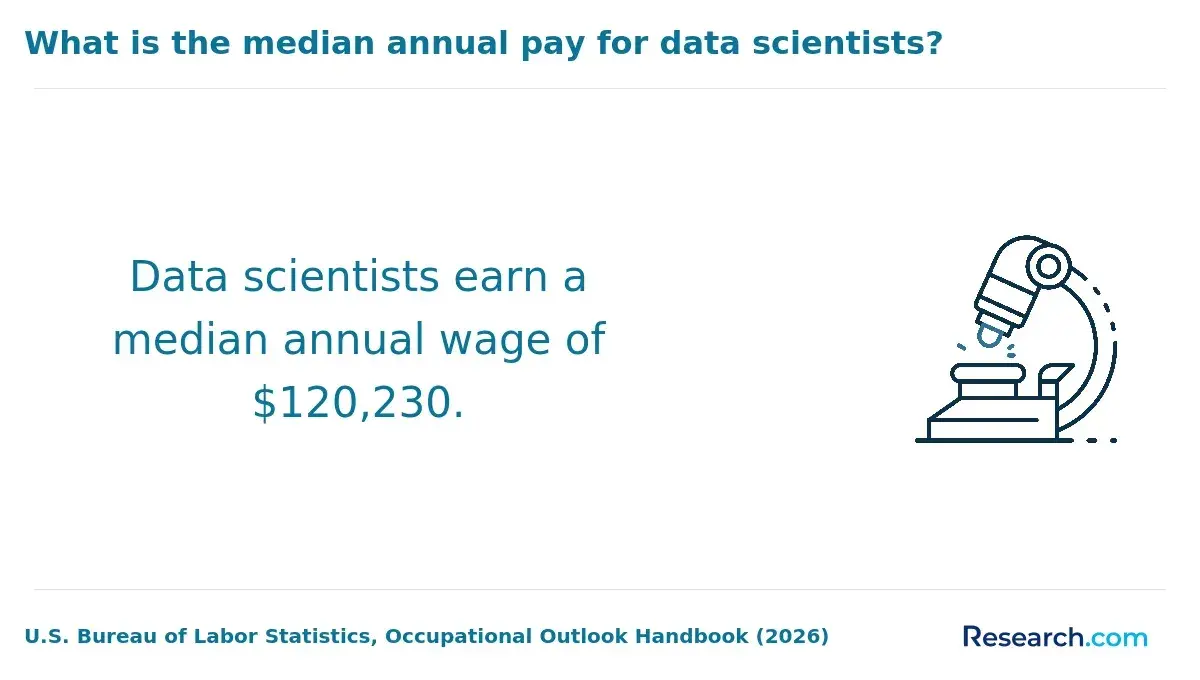
The U.S. Bureau of Labor Statistics reports a $120,230 median annual wage for data scientists in May 2025. That is an occupation-wide midpoint, not an expected starting salary for a nurse who completes a master's. Pay for clinical analyst, informatics, and data scientist positions can differ, as can pay by employer, location, responsibilities, and prior experience.
BLS projects data scientist employment to grow 35% from 2025 to 2035. The projection signals demand across the occupation, but it does not establish how many openings will suit new graduates or applicants seeking healthcare-only roles. Compare actual job postings in your target market with your current nursing compensation, including differentials and benefits, before estimating a financial return.
A common mistake is to compare a degree's tuition with the occupation-wide median and assume the difference is a payoff. Compare your likely total cost and any lost earnings with the roles you could credibly pursue both with and without the degree. If your intended work is primarily AI-focused, consider cost-conscious artificial intelligence study options as a separate comparison—not as evidence that a cheaper credential produces the same career result.
Other Things You Should Know About Data Science
No. A data science degree does not replace the nursing education, certification, and state requirements for advanced practice.
Not necessarily. Requirements depend on the job: some positions require an active RN license, while others value nursing experience without making licensure a condition of employment. Check postings and your state board's rules before letting a license lapse.
Do not assume you can. Workplace access is not permission to use records for coursework or a public portfolio. Obtain the necessary employer and program approvals, or use an approved de-identified or public dataset.
Do not assume graduate coursework qualifies. Credit rules depend on your state board, the course, and any applicable certification body. Confirm acceptance before counting it toward renewal.
References
- Understanding U.S. Accreditation | EducationUSA https://educationusa.state.gov/understanding-us-accreditation
- Accreditation in the U.S. | ed.gov http://www.ed.gov/laws-and-policy/higher-education-laws-and-policy/college-accreditation/accreditation-in-the-us
- What preparations do I need for graduate education? | Statistics & Data Science Graduate Interdisciplinary Program https://stat.arizona.edu/what-preparations-do-i-need-graduate-education
- Healthcare Data Analyst Career Guide: How to Get Started | University of San Diego Online Degrees https://onlinedegrees.sandiego.edu/health-data-analyst/
- How to Apply - Computer Science Bridge, MS | University of San Francisco https://www.usfca.edu/arts-sciences/programs/graduate/computer-science-bridge/how-to-apply
- From Bedside to Data, Nurses are Leading in Health Informatics | Logan University https://www.logan.edu/news/from-bedside-to-data-nurses-are-leading-in-health-informatics
- Online Master of Data Science Admission Requirements at Rice https://csweb.rice.edu/academics/graduate-programs/online-mds/admissions
- Data Science Specialization | uw.edu https://bime.uw.edu/datascience/
- Strength in Numbers: Using Data Science to Advance Nursing Knowledge - School of Nursing - University at Buffalo https://nursing.buffalo.edu/news-events/nurses-report.host.html/content/shared/nursing/articles/nurses-report/posts/big-data-science-analytics.detail.html
- Course Offerings - UT iSchool - The University of Texas at Austin https://ischool.utexas.edu/programs/course-offerings