2027 Master's in Data Science vs. Master's in Operations Research: Choosing Your Graduate Path

Co-Founder and Chief Data Scientist
A master's in data science and a master's in operations research can both lead to quantitative careers, but they train you to solve different kinds of problems. If you are choosing between them, the most useful question is whether you want to build insights and predictions from data or design better decisions under constraints. This comparison explains how to evaluate coursework, career goals, costs, and program fit before you apply.
Key Things You Should Know
- Choose data science if your target work centers on statistical modeling, machine learning, and data pipelines; choose operations research if it centers on optimization, simulation, and resource allocation.
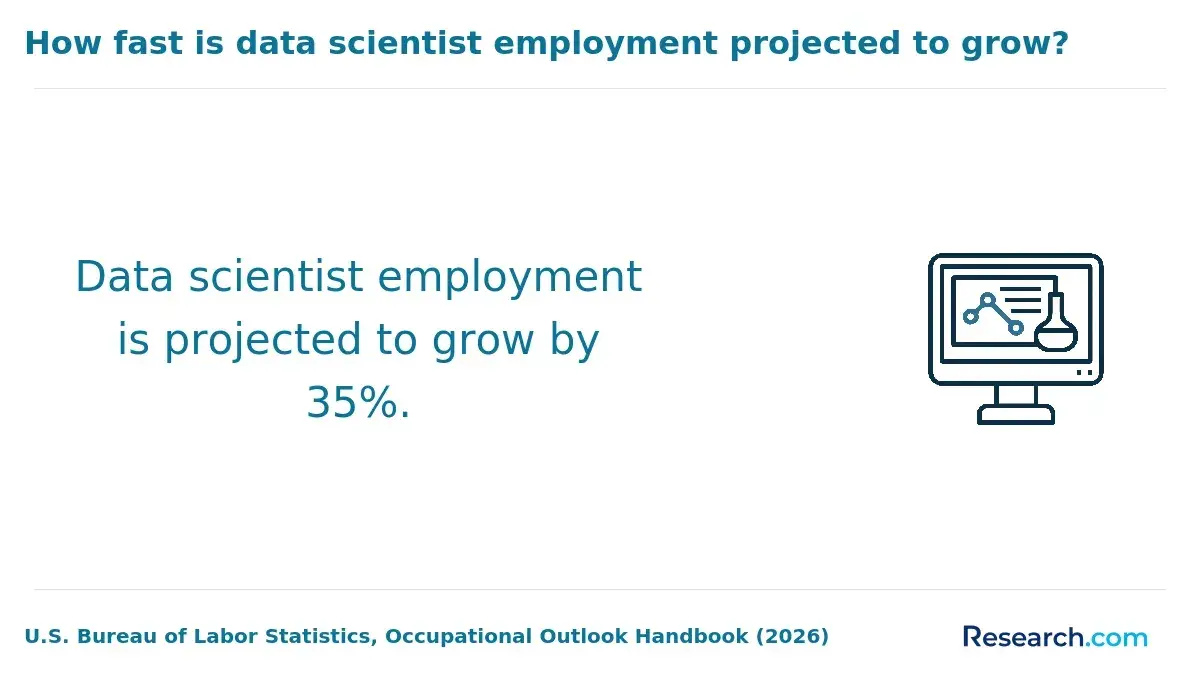
- The U.S. Bureau of Labor Statistics projects 35% employment growth for data scientists from 2025 to 2035, but that occupation-level forecast does not measure the payoff from a particular master's degree.
- Compare required courses and total attendance costs, not degree titles or tuition alone: programs within either field can differ substantially.
What is the difference between a master's in data science and operations research?
Data science focuses on learning from data; operations research (OR) focuses on selecting actions when resources, rules, and uncertainty constrain the choices. Both use mathematics and programming, and their methods can overlap. The distinction is the problem a program prepares you to tackle most deeply.
The comparison below describes common emphases, not requirements shared by every university. Use it to identify which questions you would rather spend your graduate study answering.
| Decision criterion | Data science | Operations research |
| Typical question | What patterns can we detect or predict? | Which feasible decision produces the best result? |
| Core emphasis | Statistics, machine learning, data preparation, and computing | Optimization, mathematical modeling, simulation, and decision analysis |
| Illustrative project | Predict equipment failures from sensor data | Schedule maintenance crews and equipment under capacity constraints |
| Potential trade-off | May offer less depth in optimization | May offer less depth in data engineering or machine learning deployment |
A useful test is to extend that equipment example: would you rather improve the failure prediction or decide what to repair first with limited staff and money? If both appeal to you, look for electives and projects that combine predictive modeling with optimization.
Which degree offers better career opportunities: data science or operations research?
Neither degree is universally better for employment. Data science is the more direct match for roles focused on extracting insights from large datasets and building predictive models. OR is a closer match for roles that require scheduling, routing, capacity planning, or other decisions subject to constraints. Employers may hire from either background when the applicant's projects demonstrate the needed methods.
The Bureau of Labor Statistics projects 35% growth in U.S. data scientist employment from 2025 to 2035. That signals strong projected demand for the occupation, not guaranteed openings for graduates or evidence that every data science program outperforms an OR program. For a closer look at how coursework connects to specific roles, see online data science degrees and labor market alignment.
Compare opportunities using the job postings you would actually pursue. Note whether they ask for predictive modeling and data infrastructure, optimization and simulation, or both; then check whether each shortlisted program requires those skills rather than merely offering them as optional electives.
How do data science and operations research curricula compare?
Both fields generally draw on probability, statistics, linear algebra, and programming. A data science curriculum is more likely to emphasize machine learning, data management, and communicating findings from data. An OR curriculum is more likely to emphasize mathematical optimization, stochastic models, simulation, and translating operational constraints into a solvable model. These are tendencies, not a substitute for reading a program's current catalog.
Look beyond course titles. An "AI" elective might teach predictive methods without addressing how to make an optimal decision from those predictions; an "analytics" course might cover optimization without teaching data pipeline development. If AI is your main goal rather than an added skill, compare affordable online AI programs as a third option, using the same curriculum and total-cost criteria.
For each program, inspect required courses, elective availability, and recent project descriptions. Give particular weight to work that resembles your intended job: a deployed predictive model for data science or a tested allocation or scheduling model for OR. A relevant project often reveals more about the training than the degree name.
What are the admission requirements for each master's degree?
Requirements vary by institution, so neither degree title establishes a universal prerequisite list. Both may expect evidence of quantitative ability and programming readiness. OR applicants should pay particular attention to calculus, linear algebra, and mathematical modeling expectations; data science applicants should check requirements in statistics, programming, and computing. Individual programs may specify coursework, allow preparation before enrollment, or evaluate equivalent experience differently.
Compare your transcript and experience against each school's stated requirements. If a gap appears, ask whether a course taken before admission would satisfy the formal prerequisite; self-study may improve readiness without meeting an official requirement. Application materials also vary. Applicants trying to avoid an essay can explore no-personal-statement machine learning master's programs, but must verify the current policy of any data science or OR program separately.
How long do these master's programs take and how much do they cost?
There is no reliable field-wide duration or price that applies to both degrees. Completion time depends on required credits, course availability, full- or part-time enrollment, and whether a thesis or project adds sequencing requirements. Compare published program plans using the pace you could realistically maintain, not just an advertised fastest path.
For cost, request a current estimate for the entire degree: tuition at your expected enrollment rate, mandatory fees, required materials, and any campus travel or residency expenses. Add the income you might forgo if you reduce work hours. This avoids the common mistake of comparing one school's tuition-only figure with another school's broader estimate.
Ask each school how scholarships, assistantships, employer benefits, and federal aid may apply to your enrollment status. For help identifying possibilities and questions to raise with financial aid offices, review data science graduate study funding options. Do not treat a future salary estimate as a guaranteed return on the amount you borrow.
Are online or campus-based programs better for data science and operations research?
The better format is the one that lets you complete the right technical work and obtain useful feedback. Online study can suit someone who must keep working or cannot relocate; campus study may make in-person collaboration and university resources easier to use. Neither format, by itself, establishes stronger quantitative training.
Ask whether classes meet live, when required courses are offered, how teams complete projects, and whether exams, residencies, or presentations require travel. Also confirm that an online program can enroll students in your state. If speed is a priority, online graduate AI programs with accelerated timelines offer a format comparison, but a shorter AI program is not automatically a substitute for the OR or data science curriculum you need.
What jobs can you get with either master's degree?
Possible targets for data science graduates include data scientist and machine learning-focused analyst roles. OR graduates may pursue operations research analyst, optimization analyst, or planning roles. Analytics positions can draw applicants from both fields, depending on whether the employer needs prediction, decision modeling, or a combination.
Job titles alone are unreliable guides. A "data scientist" opening might require substantial software engineering, while an "operations analyst" opening might prioritize business reporting over optimization. Before choosing a degree, collect postings for roles you want and compare their required methods with each program's required coursework and project opportunities. Prior work experience and domain knowledge will also affect which jobs are realistic after graduation.
How do salaries and job outlooks compare for graduates?
The Bureau of Labor Statistics reports a May 2025 median annual wage of $120,230 for U.S. data scientists. That is a median for people working in the occupation - not a starting salary, a master's-graduate salary, or evidence that the degree caused their earnings. The agency also projects about 24,800 annual data scientist openings, on average, from 2025 to 2035, including openings created when workers leave the occupation.
A defensible salary comparison needs equivalent, current occupational data for operations research analysts, using the same geography and reporting period. Without that matched figure, a numerical claim that one degree pays more would be misleading. For your own decision, compare compensation in target roles and locations, then account for your existing experience, program cost, and whether the degree would help you qualify for those roles.
Do either degree require licensing or professional certification?
Data scientist and operations research analyst roles generally do not have a single profession-wide license attached to the degree. A particular employer, industry, or specialized position may have separate requirements, so check the rules for the work you intend to perform rather than assuming a master's degree supplies an authorization.
Optional certifications can document familiarity with a tool or method, but they do not replace the mathematical preparation, programming skill, and project evidence an employer may seek. If a program advertises certification preparation, ask which credential it means, whether the exam costs extra, and whether your target job postings actually value it.
How can you choose an accredited master's program?
Start by confirming that the institution holds recognized institutional accreditation, then verify the status through the accreditor or an official U.S. education source. Do not assume that a program's use of "accredited" identifies a separate accreditation for its data science or OR degree. Accreditation is an important screen, but it does not establish that the curriculum fits your career goal.
Once you have screened institutions, use the following checks to make a final comparison:
- Match required courses and a substantial project to the methods in your target job postings.
- Confirm prerequisites, elective access, program pace, and any online attendance or travel requirements directly with the school.
- Request a comparable full-program cost estimate and ask how funding applies to your enrollment plan.
- Ask for clearly defined career-outcome information, including who was surveyed and when; do not treat an unverified placement claim as a guarantee.
Choose data science when building and using predictive systems is your primary goal. Choose OR when improving decisions under operational constraints is the stronger draw. If both matter, favor the program whose required training covers your weaker skill set and whose electives let you develop the other.
Other Things You Should Know About Data Science
Yes. You could predict demand from a dataset, then use those predictions to design an inventory or staffing decision. Notice which part you most want to improve: the prediction model or the decision model.
Not always. Research experience, strong recommendations, and preparation for the intended doctoral field matter. Ask prospective doctoral programs how they evaluate applicants from project-based master's degrees.
Use your underlying experience in both applications, but tailor the statement. Explain the particular problems you want to solve and why each program's methods fit them; also follow each school's current prompt.
Yes. Confirm that you may use and share the data, and remove or protect sensitive information where appropriate. A strong project should demonstrate sound judgment about data use as well as technical ability.
References
- Fast Facts: Tuition costs of colleges and universities (76) | ed.gov https://nces.ed.gov/fastfacts/display.asp
- 6 Questions to Ask Before Pursuing a Master's Degree in Data Science | UW Online Collaboratives https://uwex.wisconsin.edu/stories-news/6-questions-to-ask-before-pursuing-a-masters-degree-in-data-science/
- 4 Types of Data Analytics to Improve Decision-Making | Harvard Business School https://online.hbs.edu/blog/post/types-of-data-analysis
- How Much Do Data Scientists Need to Know About Statistics? | virginia.edu https://datascience.virginia.edu/news/how-much-do-data-scientists-need-know-about-statistics
- Data Science vs Statistics: What's the Difference? | MDS@Rice https://csweb.rice.edu/academics/graduate-programs/online-mds/blog/data-science-vs-statistics
- MS in Data Science, Curriculum & Specializations | Northwestern University https://sps.northwestern.edu/masters/data-science/curriculum-specializations.html
- Data Science - UCSD Catalog https://catalog.ucsd.edu/curric/DSC-gr.html
- Profiling data scientists in the digital labour market | sciencedirect.com https://www.sciencedirect.com/science/article/pii/S0263237322000810
- Data Science and Decision Science Skills: Are They Different and Does It Matter? · Issue 7.3, Summer 2025 https://hdsr.mitpress.mit.edu/pub/9ir6e1j6