2027 Graduate Public Health Preparation for Community-Based Participatory Research Roles

Co-Founder and Chief Data Scientist
Community-based participatory research (CBPR) requires more than knowing how to conduct a study. Researchers must work with community partners to shape questions, share decisions, protect participants, and produce findings the community can use. For prospective graduate students and early-career practitioners, the challenge is choosing preparation that builds both research skill and partnership experience.
This guide compares degree pathways, coursework, fieldwork, costs, and career options so you can identify the training you need - and avoid paying for a credential that does not match your intended role.
Key Things You Should Know
- For many CBPR coordination and applied evaluation roles, a relevant bachelor's degree plus community experience can be a starting point; an MPH or MS can add research and evaluation depth, while independent research leadership often calls for substantial experience or doctoral training.
- Prioritize supervised work in which community partners help set priorities, interpret findings, and decide how results are used. A course labeled "community engagement" does not, by itself, demonstrate CBPR readiness. There is no single CBPR salary category or universal degree requirement.
- Compare actual job descriptions, the program's fieldwork and supervision arrangements, and the full cost of participation before enrolling.
What is community-based participatory research in public health?
CBPR is an approach to research in which community members and academic or organizational researchers collaborate across the research process. Depending on the partnership, that can include identifying the problem, choosing methods, collecting and interpreting information, and deciding how to share and use findings. Its defining feature is shared influence over consequential decisions, not simply recruiting residents to complete a survey.
In public health, a partnership might investigate barriers to using a local service and use the findings to improve how that service is delivered. Partners still need a sound research design, clear responsibilities, appropriate consent and privacy practices, and an agreement about data access and dissemination. Community knowledge informs the work; it does not replace methodological rigor.
Community partners do not need graduate credentials to contribute expertise or share governance. Likewise, someone exploring a foundation-level role may find that comparing online public health bachelor's pathways is more relevant than committing immediately to graduate study.
What graduate degrees prepare students for community-based participatory research?
The best degree depends on the responsibility you want to hold: implementing a partnership, designing studies, or leading an independent research agenda. Degree names alone cannot establish what a student will actually practice.
The comparison below separates the main pathways by their usual educational purpose. Check each program's curriculum and supervised opportunities rather than assuming every degree of the same type offers CBPR training.
| Pathway | Best fit for a CBPR goal | Limitation to check |
| MPH | Community-engaged program planning, implementation, and evaluation in practice settings | Whether students can take qualitative or mixed-methods courses and work with an active partner |
| Research-oriented MS | Deeper study design and analysis for a research-team role | Whether community governance and applied partnership work are part of the training |
| DrPH | Experienced practitioners leading applied public health work with organizations | Required professional experience and access to a feasible practice project |
| PhD | Developing an independent, sustained research agenda | Faculty fit, funding, partnership continuity, and research access |
An MPH may be the most direct graduate route for an applied role, but it is not automatically the best route for advanced study design. A PhD applicant should weigh mentorship and funding together; epidemiology doctorate scholarships and grants are relevant only if that research focus fits the intended work. If your immediate gap is interviewing, facilitation, or evaluation, targeted training paired with supervised practice may serve you better than another degree.
What education and experience do CBPR public health roles require?
Requirements vary by employer and by how much authority the position carries. A project assistant may organize meetings, track recruitment materials, and document partner feedback under supervision. A coordinator may manage schedules, agreements, and data collection. An investigator or research director may be responsible for study design, funding, oversight, analysis, and long-term partnership commitments.
Community organization staff, health workers, and people entering from social science, clinical, or other fields may already have useful skills: listening, facilitation, local knowledge, service delivery, or relationship management. To move into research work, they may need to demonstrate interviewing, basic data handling, evaluation design, and ethical decision-making. Conversely, a technically strong analyst may need substantial experience working within community-led priorities.
Read job postings for tasks and required qualifications, not just "CBPR" in the title. For an entry-level position that accepts a bachelor's degree, compare the cost of that route with graduate study; a public health bachelor's affordability guide can help frame that decision. Prior nonprofit or volunteer work is valuable evidence, but it does not automatically meet an employer's research-experience requirement.
Useful preparation combines public health reasoning, research methods, and the ability to work responsibly with partners. Look for a sequence that moves from learning methods to applying them under supervision; an isolated elective is less persuasive than a project showing what you did and how decisions were shared.
When reviewing a curriculum, look for coursework and applied work that develop these connected skills:
- Community engagement and health equity: stakeholder relationships, power, structural context, and communication that avoids treating a community as a single viewpoint.
- Qualitative and mixed methods: interviewing, observation, sampling, reflexivity, analysis, and integration with quantitative findings.
- Epidemiology, biostatistics, and evaluation: defining a population and question, choosing useful measures, interpreting uncertainty, and avoiding unsupported causal claims.
- Research ethics and data governance: consent, confidentiality, appropriate review, partner permissions, and agreements about access and dissemination.
Ask whether a course leads to a supervised, partner-relevant deliverable and who assesses it. If you need only a defined skill gap rather than a graduate credential, compare a course or certificate with short online public health degree options - but do not mistake a shorter program for guaranteed access to community-based fieldwork.
Neither format guarantees meaningful CBPR experience. An online student may work with a nearby organization and meet a research team remotely; a campus student may have access to faculty partnerships but still be unable to join the project they want. The deciding factor is whether the program can support an approved, supervised role with a real partner.
Online programs can reduce relocation needs, but live meetings, group analysis, partner events, travel, or required campus visits may limit scheduling flexibility. Campus programs may make in-person collaboration easier while adding commuting or relocation costs. In either format, ask how students secure sites, whether existing employment can be used, what happens if a partner project changes, and who supervises the research and community relationship.
These questions matter especially for doctoral study, where a low advertised price cannot compensate for weak mentoring or inaccessible research sites. Use comparisons of online PhD programs in public health by cost as a starting point, then verify residency, supervision, funding, and partnership expectations directly with each program.
Requirements depend on the school, degree, and concentration. MPH applicants generally need an eligible prior degree and the materials specified by the program; a research-oriented MS may expect stronger quantitative or methods preparation. Programs can also differ on prerequisite courses, work experience, recommendations, tests, interviews, and application systems. An undergraduate major outside public health does not automatically rule out admission.
For a CBPR-focused application, distinguish eligibility from evidence of fit. Community service, partnership work, research assistance, or evaluation experience may strengthen an application even when none is formally required. Describe your specific responsibilities, what you learned about sharing decisions, and the research skills you still need to develop.
Before applying, check each program's published requirements for your intended entry term and ask admissions staff how outstanding prerequisites are handled. If admission accessibility is a priority, accessible admissions pathways for online MPH study can help identify programs to investigate; easier entry should not outweigh the availability of suitable methods training and supervised partnerships.
Time to completion depends on required credits, enrollment pace, course sequencing, and whether a field placement or thesis can begin when you need it. CBPR work can also depend on a partner organization's calendar and approvals, so an advertised program length may not describe the time needed to complete your preferred project.
Compare total expected cost, not tuition alone: required fees, travel, campus visits, fieldwork expenses, reduced work hours, and any continuation charges can change the calculation. Request a term-by-term estimate at your intended pace and ask which costs are covered by an assistantship or employer support, if either is actually available. Do not assume a proposed project will qualify for a paid placement.
For an MPH comparison, budget-friendly Master of Public Health programs provide a starting list. Confirm each school's current charges and whether its lower-cost route still includes the courses, supervision, and partner access your CBPR goal requires.
CBPR is an approach used across jobs, not a single occupation. Graduates may pursue community-engaged research coordination, program evaluation, health education, research assistance, or partnership-focused positions in universities, health departments, health systems, and nonprofits. The title matters less than whether the job gives you supervised responsibility for research quality and community decision-making.
An early-career candidate can build evidence through a placement or job that produces usable materials: an approved interview guide, an evaluation plan, a documented feedback process, or a report revised with partner input. Protect confidential information and obtain permission before sharing any work in a portfolio. More senior investigator or director roles typically require a record of managing studies, partnerships, staff, or funding - not merely completion of a graduate degree.
For experienced practitioners considering doctoral leadership rather than an initial CBPR job, public health doctorate financial planning and outcomes can inform the opportunity-cost discussion. First confirm that the doctorate advances a responsibility your current experience and employer cannot reasonably support through narrower training.
How can students choose an accredited public health program?
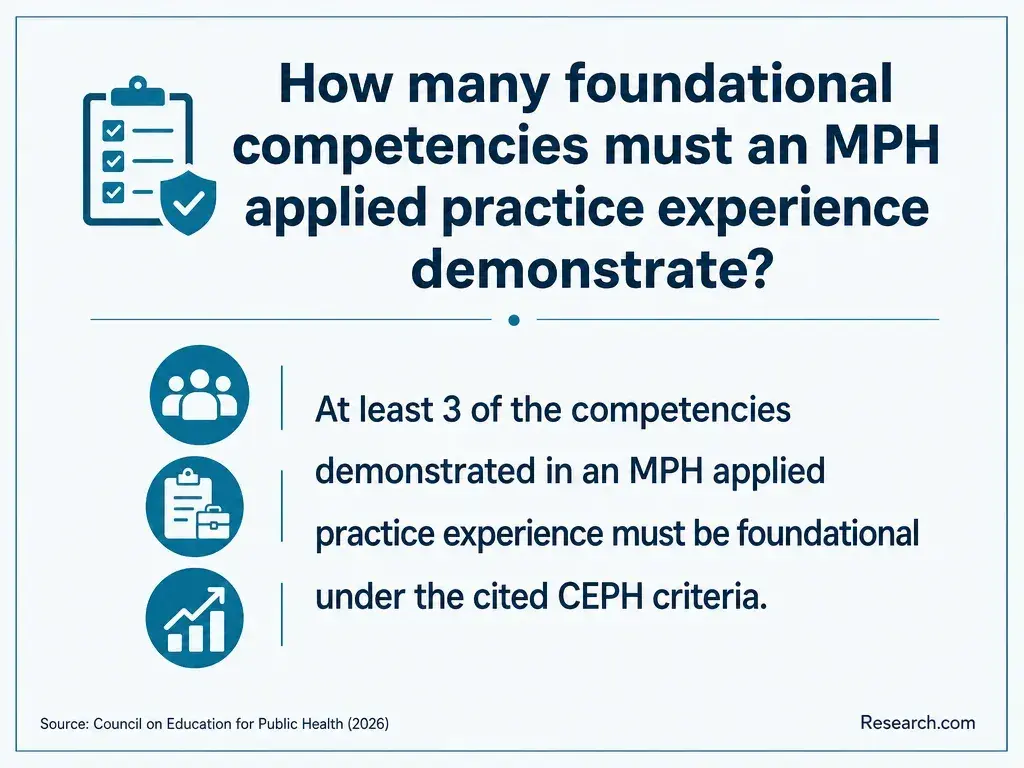
First confirm the institution's recognized accreditation, then check the Council on Education for Public Health (CEPH) listing for the specific school, unit, or program and degree you are considering. Institution-level accreditation and CEPH accreditation answer different questions; neither proves that a particular faculty member, course, or community partnership will be available to you.
After confirming accreditation scope, ask the program for recent course schedules, fieldwork rules, examples of permissible student responsibilities, and information about faculty or site supervision. Ask who approves a partner site, who handles research ethics and data-use questions, and what alternatives exist if a placement falls through. For an online MPH search, a list of CEPH-accredited MPH schools and programs can narrow the field, but verify each listing and its degree coverage with CEPH and the school before applying.
Choose the program that can show a feasible path from your current skills to the responsibilities you want: relevant methods, supervised partnership work, acceptable cost, and a schedule you can sustain. If no program can show that path, seek a stronger placement or targeted training before enrolling.
Other Things You Should Know About Public Health
No universal authorship rule applies to every contribution. Discuss credit, authorship criteria, review opportunities, and other forms of recognition early, then follow applicable publication and partnership agreements.
Not necessarily. The institution determines the applicable review process; students should not make that determination themselves. Community permission, privacy safeguards, and site approval may still be necessary.
Often, a project can budget for partner time and expertise, subject to funder and institutional rules. Agree on compensation expectations before requesting substantial work.
That should be addressed in the partnership and data-use arrangements before dissemination. Consent, confidentiality, funder terms, and publication policies may also constrain what can be released.
- CLAS Standards - Think Cultural Health - HHS.gov https://thinkculturalhealth.hhs.gov/clas/standards
- Community-based Participatory Research (CBPR) - PMC - NIH https://pmc.ncbi.nlm.nih.gov/articles/PMC6054913/
- CDC's Guiding Principles to Promote an Equity-Centered Approach to Public Health Communication https://www.cdc.gov/pcd/issues/2023/23_0061.htm
- MPH vs MS vs MHA: Which Public Health Master's Degree Is Right for You? | Tulane WSPH https://sph.tulane.edu/mph-vs-ms-vs-mha
- The benefits from culturally responsive community-based research partnerships | apa.org https://www.apa.org/research-practice/conduct-research/culturally-responsive-partnerships
- Importance of Community Based Participatory Research (CBPR) | brown.edu https://cfar.med.brown.edu/importance-community-based-participatory-research-cbpr
- How to build equitable partnerships between researchers and communities | UW School of Public Health https://sph.washington.edu/news-events/sph-blog/how-to-build-equitable-partnerships-between-researchers-and-communities
- Community-Based Participatory Research | Global Health E-Learning Program https://edgh.washington.edu/courses/community-based-participatory-research/
- Section 15. Qualitative Methods to Assess Community Issues | ku.edu https://ctb.ku.edu/en/table-of-contents/assessment/assessing-community-needs-and-resources/qualitative-methods/main
- Full article: The Ethics of Engagement and Representation in Community-based Participatory Research | tandfonline.com https://www.tandfonline.com/doi/full/10.1080/17496535.2023.2211756