2027 Comparing Online BS in Business Administration Options for Adults Planning a Second Career Before Retirement
Audited and Verified:
Our Editorial and Data Verification Process
Research.com uses government datasets, official education statistics and primary institutional information to support its career and degree guides. Our review process checks factual accuracy, occupational definitions, source dates and the requirements associated with the credentials discussed.
How This Article Was Fact-Checked
Our editorial team verifies salary estimates, employment projections, education requirements and program information against original data providers and official organizations. Salary figures are checked against the relevant occupational definitions and reporting periods. Information about licensure, accreditation and required in-person training is reviewed separately.
Fact-checked and verified on:

Co-Founder and Chief Data Scientist
A second career before retirement leaves less time to recover from an expensive degree that does not fit your goals. If you are considering an online BS in Business Administration, the deciding factors are not just tuition and advertised speed: your existing credits, work experience, target role, and available study hours all matter.
This guide compares degree-completion options with other routes into business, then shows you how to check scheduling, total cost, academic quality, and career relevance before you enroll.
Key Things You Should Know
- Choose an online BS in Business Administration when a target role values a bachelor's degree, your prior credits meaningfully reduce the remaining work, and you can sustain the program's actual weekly schedule.
- Compare schools using an official degree audit and a term-by-term course plan; accepted transfer credits do not necessarily satisfy business-core or residency requirements.
- Do not budget around a manager's salary. The U.S. Bureau of Labor Statistics reports a $75,940 median annual wage for human resources specialists in May 2025, but that occupation-wide figure is not a starting salary or a promise to degree holders.
What is an online bachelor's degree in business administration?
An online BS in Business Administration is an undergraduate degree covering several business functions rather than training for one occupation. Students generally combine general education with accounting, finance, marketing, management, operations, and quantitative coursework. "Online" describes how instruction is delivered; it does not establish that classes are self-paced, entirely asynchronous, or free of required meetings.
A BS, BBA, and BA in Business can have different curricula even when their names sound similar. Compare required courses and your target employer's expectations, not the initials alone. If speed matters, business degrees through accelerated online learning offer a starting point for comparing formats; confirm each school's current degree title, transfer rules, and required course schedule.
Is an online business administration degree worth it for a second career?
It can be worth pursuing if the bachelor's credential removes a hiring barrier and the curriculum fills gaps between your current experience and a realistic next role. Someone who has coordinated schedules, handled customers, or managed a small budget may be closer to an operations or administrative role than to a finance-specialist position. The degree can formalize that experience, but it cannot replace function-specific practice or guarantee a management job.
The comparison below starts with the change you want to make. The shortest route is not necessarily the best route, but a full second degree should solve a problem that narrower training cannot.
| Path | Best fit | Main limitation to check |
| Online BS in Business Administration | You lack a bachelor's degree and want access to roles requiring one, with flexibility across business functions. | Remaining credits, total cost, and whether the program builds evidence for your target role. |
| Targeted courses, certificate, or employer training | You already meet degree requirements and need a specific skill, such as spreadsheet analysis or purchasing. | Whether employers will recognize the training and whether it addresses an actual hiring barrier. |
| Specialized business bachelor's | You have a defined function in mind and need more focused preparation. | Whether specialized requirements add time or make prior credits less useful. |
For an adult staying employed, work-compatible business administration education options are most useful when compared against your actual shifts, caregiving duties, and employer benefits. If you already have a bachelor's degree, first test whether a certificate, supervised project, or internal transfer would address the gap at lower cost.
How do you choose an accredited online business administration program?
First, verify the institution's accreditation with the accreditor or the U.S. Department of Education's recognized-accreditor information. Then check whether any claimed AACSB, ACBSP, or IACBE accreditation covers the business school or the specific program being advertised. Institutional and business accreditation have different scopes; neither establishes that graduates secure particular jobs.
Request a written evaluation of previous coursework and an official degree audit showing what applies to general education, the business core, electives, and any residency requirement. Ask an adviser which required courses run each term, whether exams need remote proctoring, and whether group work, internships, or campus visits are mandatory. A published completion rate is useful only if you know which students it includes and over what period.
The US online business college selection guide can help build a shortlist. Before choosing, have each school explain its policies for your enrollment term and provide a feasible course sequence based on your record—not a generic transfer estimate.
The business core should help you read financial information, assess customers and markets, understand organizations, and make decisions using data. For a second career, the valuable question is how those courses connect to work you can demonstrate: a spreadsheet-based budget, a documented process review, or a marketing analysis using information you are authorized to use. Classroom exposure alone does not establish specialist expertise.
Compare concentrations by their required courses and applied assignments, not just their labels. An operations or supply chain focus may suit someone with purchasing or logistics experience; an analytics focus may require more statistics and spreadsheet work. Someone targeting supply chain roles can compare the broader BS with supply chain education costs and career prospects before committing to general business electives.
Check whether a concentration is formally recorded, adds credits, and is offered often enough to fit your completion plan. If a course proposes using employer information, obtain any required academic and workplace permission before sharing internal data.
Your timeline depends on credits that satisfy requirements, not simply credits a school accepts. An associate degree, previous bachelor's coursework, military learning, or prior college study may shorten the path, but prerequisites, upper-level business courses, and credits that must be earned at the graduating institution can still determine your finish date.
Ask each school for a term-by-term plan showing course availability and prerequisite order. Compare that plan at a pace you could maintain while working with a faster plan, and ask what happens if you need to pause. Shorter terms can compress deadlines without reducing coursework. Accelerated business bachelor's school comparisons are useful for finding formats to investigate, but an advertised fast track is not your individual graduation date.
Compare the cost of finishing, not the advertised tuition rate alone. Request the tuition basis—per credit, course, or term—and add mandatory fees, books, software, proctoring, and any travel. Then apply the school's evaluated remaining requirements. Extra prerequisite or residency courses can outweigh an apparently lower rate.
For each option, obtain an individualized aid offer and ask about employer reimbursement limits, eligible courses, grade requirements, and when payment arrives. Reimbursement after a term may still leave you needing cash or a loan upfront. Include any earnings you would give up by reducing work hours, and compare lower-tuition online business administration programs against the same remaining-credit and scheduling assumptions.
Schools commonly request a prior education record and official transcripts, but admission to the institution, admission to the business major, and acceptance of transfer credit are separate decisions. Ask whether particular math, accounting, economics, or statistics courses are required before entering the major or can be taken after enrollment. A long gap since your last class does not, by itself, show that you are ineligible.
Gather transcripts from every college attended and ask the admissions and transfer offices about course equivalencies, prior-learning assessment, and any second-degree rules that apply. If your experience is primarily supervisory and you are comparing degree types, fast-track undergraduate organizational leadership study may be another option to examine. Compare its actual credit evaluation and curriculum with the BS before applying; leadership experience does not automatically earn academic credit.
Online study can remove a commute, while campus study may make face-to-face contact and local recruiting easier. Neither format is automatically more flexible or more effective. The relevant comparison is whether you can attend, complete assessments, and build useful professional connections throughout the program.
These differences are worth checking against your work schedule and the time you have left to make a career change:
| Consideration | Online program | Campus-based program |
| Attendance | May include live sessions, fixed deadlines, and scheduled group meetings. | Usually requires travel at scheduled class times. |
| Career contact | May offer virtual advising, employer events, and remote projects; access varies. | May offer in-person events and local relationships; access varies. |
| Practical constraints | Requires dependable technology and a workable study space. | Requires commuting and may conflict with work or caregiving. |
Ask for sample course schedules in both formats rather than relying on "flexible" in a program description. Online business administration program cost-and-time comparisons can inform the online side of your shortlist, but compare each option with a campus program using your own remaining credits, fees, travel, and term schedule.
Start with roles adjacent to what you already do. A retail supervisor might pursue operations coordination; someone who has scheduled staff and maintained records might investigate HR support or administrative operations. Marketing coordination, purchasing, project coordination, and customer operations are other possibilities, but employers set different experience and technical requirements.
Read postings for tasks, not titles alone. Identify which duties you have already performed, which you can demonstrate through approved coursework or a project, and which require new experience. A project-management course, for example, does not confer a professional certification or qualify you to lead every project. If project work is your aim, compare the broad BS with affordability checks for accredited project management programs and with openings that value your existing industry knowledge.
What salaries and job outlook can business administration graduates expect?
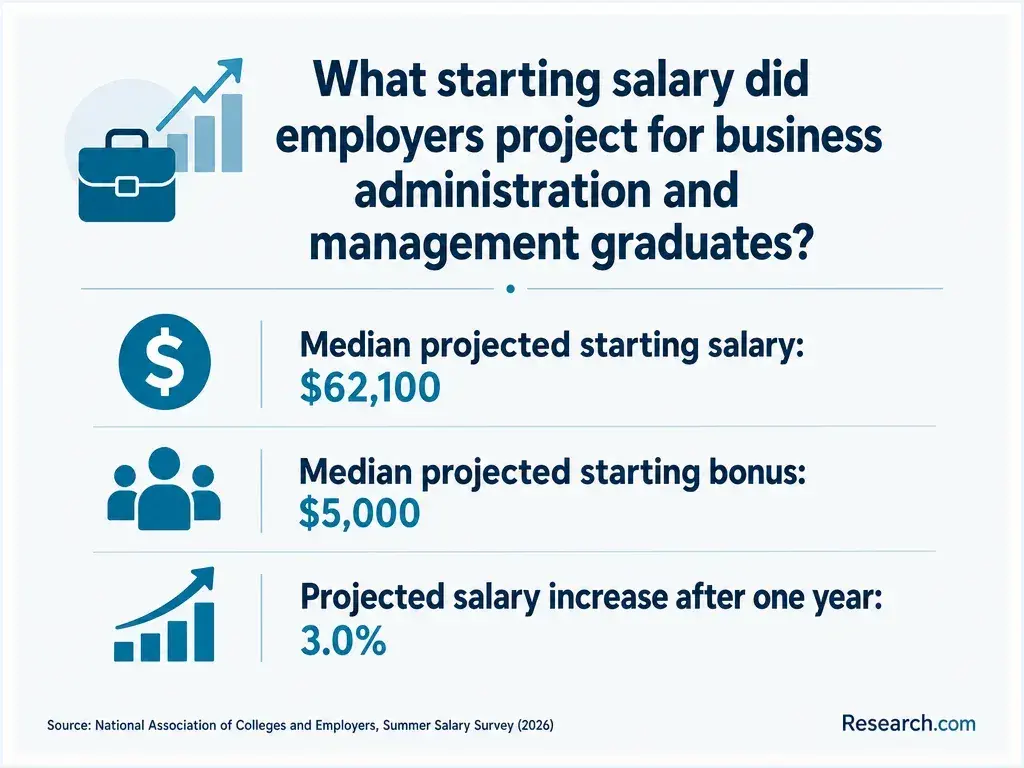
There is no single salary or growth rate for BS in Business Administration graduates. U.S. Bureau of Labor Statistics figures describe occupations that people enter through different education and experience paths. The examples below show why your target function—and your prior work—matter more than a degree-wide earnings claim.
| U.S. occupation | Median annual wage, May 2025 | Projected employment growth, 2025-2035 | Second-career interpretation |
| Human resources specialist | $75,940 | 6% | Relevant people-operations experience may help; requirements vary by employer. |
| Market research analyst | $78,760 | 7% | Research and analytical skills matter alongside business coursework. |
| Management analyst | $101,860 | 10% | Employers commonly expect relevant organizational or consulting experience. |
These are occupation-wide medians, not starting offers or earnings attributable to the degree. Geography, industry, experience, and the time you plan to remain employed all affect the payoff. Test a proposed degree against jobs you could plausibly seek, your likely completion cost, and any borrowing; ways to reduce tuition costs for a business degree matter especially when the time available to recover that investment is limited.
Other Things You Should Know About Business Administration
Possibly. Some schools assess documented learning through approved exams, portfolios, or other prior-learning processes. Ask what evidence is required, what it costs, and which degree requirements any awarded credit would satisfy.
Only if the program accepts the project and your employer permits the work and data use. Confirm supervision, confidentiality, and what you may include in a submitted or public portfolio.
Enrollment itself is generally not the deciding factor for Social Security retirement benefits. Earnings and the age at which you claim can matter. Check your circumstances with the Social Security Administration, especially if you plan to change work hours.
Reentry, catalog, course, and financial-aid rules can change. Before taking a break, ask the school how long your credits and degree plan remain applicable and what steps are required to return.
- Military Training Evaluation Program (MTEP) | dantes.mil https://www.dantes.mil/credit4training/
- Eligibility Requirements | Federal Student Aid https://studentaid.gov/understand-aid/eligibility/requirements
- Academic Progress to Degree | osu.edu https://ugeducation.osu.edu/academics/academic-progress-degree
- AACSB vs. ACBSP vs. IACBE: Business School Accreditation | Pittsburg State University https://degree.pittstate.edu/online-programs/mba/general/aacsb-accreditation-explained/
- Effective Practices that Support Adult Learners | acenet.edu https://www.acenet.edu/Research-Insights/Pages/Student-Support/Effective-Practices-Adult-Learners.aspx
- How to Get College Credit for Your Military Service - ASU Online https://asuonline.asu.edu/newsroom/online-learning-tips/military-credits-college-degree/
- Tuition & cost of attendance | UC Admissions https://admission.universityofcalifornia.edu/tuition-financial-aid/tuition-cost-of-attendance/
- Business Administration - UF Online - University of Florida https://ufonline.ufl.edu/degrees/undergraduate/business-administration/
- What Can You Do With a Business Degree? | snhu.edu https://www.snhu.edu/about-us/newsroom/business/what-can-you-do-with-a-business-degree
- Search Accredited Schools | AACSB https://www.aacsb.edu/accredited