2027 BS in Business Administration: Assessing Career Services Before Paying Tuition
Audited and Verified:
Our Editorial and Data Verification Process
Research.com uses government datasets, official education statistics and primary institutional information to support its career and degree guides. Our review process checks factual accuracy, occupational definitions, source dates and the requirements associated with the credentials discussed.
How This Article Was Fact-Checked
Our editorial team verifies salary estimates, employment projections, education requirements and program information against original data providers and official organizations. Salary figures are checked against the relevant occupational definitions and reporting periods. Information about licensure, accreditation and required in-person training is reviewed separately.
Fact-checked and verified on:

Co-Founder and Chief Data Scientist
Career services can make a business degree more useful, but a polished employer logo page tells you little about whether you will get help finding relevant work. Before committing to tuition, prospective BS in Business Administration students need to know who can use the services, what support is actually available, and whether reported outcomes apply to students like them.
This guide shows you how to test those claims alongside cost, accreditation, coursework, and realistic entry-level opportunities—so you can compare programs on evidence rather than promises.
Key Things You Should Know
- Ask for access rules, appointment availability, internship support, and outcomes for the specific business program—not just a campus-wide career-services brochure.
- Compare the total remaining degree cost with the help you are likely to use; career coaching has less value if appointments or recruiting events conflict with your schedule.
- Occupation-wide pay is not a graduate starting salary: the May 2025 median for market research analysts was $78,760 across workers at all experience levels.
What Is a BS in Business Administration?
A Bachelor of Science in Business Administration is an undergraduate degree covering several business functions rather than training for one occupation. Depending on the school, it may combine accounting, finance, marketing, management, operations, and quantitative coursework with a concentration or electives. A BBA or specialized business degree can overlap substantially, but its requirements and career preparation may differ.
That breadth makes career guidance especially important: students must translate general coursework into evidence for a particular role. If your goal is specifically project coordination, compare the curriculum and project management bachelor's credit transfer rules before assuming a specialized program and a general business degree offer the same route.
How Much Does a BS in Business Administration Cost?
There is no reliable universal price for this degree. Your decision depends on the school's charges, financial aid offer, accepted credits that apply to degree requirements, and how many terms you need to finish. The table separates costs that are easy to overlook when comparing career services promises.
| Cost component | Why it affects the comparison |
| Tuition and mandatory fees | Rates may differ by residency, course load, delivery format, or term. |
| Remaining required credits | Accepted transfer credits do not always replace business-core or residency courses. |
| Books, software, and travel | Online courses and in-person recruiting events can create different extra costs. |
| Borrowing and time away from work | Interest and reduced work hours can change the practical cost of finishing. |
Request a program-specific degree audit and written cost estimate before comparing net prices. Ask whether career events require travel and whether internships are paid; neither should be assumed. When considering a specialized alternative, presentations on project management program fees explained can help you identify charges that a tuition-only comparison misses.
How Can You Evaluate Career Services Before Choosing a Program?
Evaluate career services as a set of usable services, not a promise of employment. A strong office for your purposes can help you identify target roles, turn coursework and experience into credible work samples, prepare applications, and reach relevant employers. Its value depends on whether those services reach your program, location, format, and schedule.
Ask the career office—not only an admissions representative—for evidence you can compare across schools. These questions move from access to outcomes:
- Confirm eligibility: Can students in this exact BS program use individual coaching, recruiting platforms, employer events, and internship support? When does access begin?
- Test availability: How long is the typical wait for an appointment, and are evening, virtual, or asynchronous options available when you need them?
- Check relevant experience: Are internships sourced or merely posted? Who helps students evaluate unpaid roles, obtain academic approval, and build shareable, nonconfidential portfolio work?
- Examine employer access: Which employers recruit for entry-level business roles, where are those jobs located, and can online students participate on equal terms?
- Interrogate outcomes: For placement or salary claims, request the reporting cohort, graduation period, response rate, definitions, and results for this degree or a clearly identified comparable group.
A school-wide employment figure may conceal differences between business majors, online learners, and students already employed when they enrolled. Employer logos show a relationship, not that those employers hire graduates from this program. If you are working while studying, compare coaching hours and recruiting access with the scheduling realities discussed in flexible online study for business administration career growth. Favor the program whose support you can actually use for a defined target role; if an office cannot explain its access rules or outcome methods, treat its claims as unverified.
First verify recognized institutional accreditation for the school awarding the degree. It is an important check when considering federal student aid and future credit transfer, though neither aid eligibility nor transfer is automatic. Confirm the institution's current status and the location or delivery arrangement that applies to your enrollment.
AACSB, ACBSP, and IACBE provide business-focused accreditation, but their scopes differ. Check the accreditor's listing and the school's documentation to see whether the particular business program is covered; do not infer coverage from a university-wide statement. Business accreditation can inform program quality, but it does not establish career-office availability or employment results. For cost comparisons involving aid, review affordable business administration programs with federal aid access and then verify each school's current eligibility and your own aid offer.
Typical programs introduce financial statements, economics, marketing, management, operations, business law, statistics, and communication. The useful career-services question is how students turn those subjects into job evidence: a spreadsheet analysis, a supervised process-improvement project, or a clearly documented internship may support an application more effectively than a course title alone. Check which assignments are required, optional, or available through a concentration.
If you want an HR role, for example, compare the business school's HR electives and applied opportunities with human resources degree planning basics. Neither general business coursework nor an HR concentration automatically awards a professional certification or qualifies a graduate to manage staff.
Choose the format that lets you complete both coursework and career building activities. Campus programs may make nearby employer events easier to attend; online programs may preserve work hours or expand geographic access. Neither advantage is guaranteed. Ask whether online students receive the same career coaching, internship postings, mock interviews, and recruiting invitations, and whether events are recorded or offered virtually.
Also confirm live classes, group-project meetings, exam arrangements, required visits, and internship location rules. An online tuition rate is only one part of the comparison; online business colleges with competitive costs are a starting point for checking the full price and support available in your preferred format.
Schools commonly review prior education and transcripts, but admission to the university and entry into the business major may have different rules. Transfer applicants should ask which courses satisfy general education, quantitative prerequisites, and the business core; accepted elective credit may not shorten the major. Requirements for GPA, mathematics, accounting, or economics vary by institution and entry route.
Before applying, ask admissions for the current requirements and the transfer or advising office for an evaluation of prior courses. The business administration degree admissions requirements guide can help you organize those questions, but the school must determine your eligibility and credit applicability.
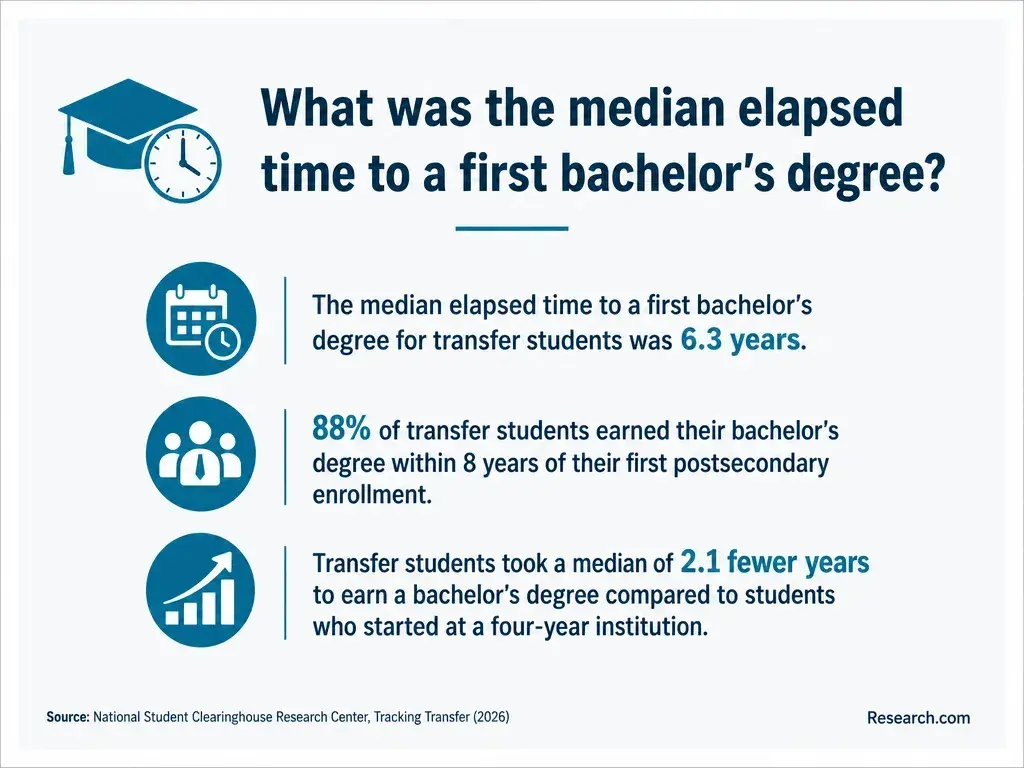
Completion time depends on applicable prior credits, enrollment pace, course sequencing, and whether required classes run when you can take them. An accelerated calendar does not eliminate required coursework or guarantee earlier access to internships and recruiting. Ask for a term-by-term plan showing remaining requirements, prerequisites, and expected graduation term before accepting a quoted finish date.
Use accelerated business bachelor's school comparisons to identify formats worth investigating, then confirm each program's current schedule and career-services access. A faster route is less attractive if its pace leaves no workable time for the experience your target jobs require.
The degree can support applications for roles such as operations coordinator, marketing coordinator, HR assistant or specialist, project coordinator, procurement staff member, and sales operations associate. Duties differ: operations roles may track processes and vendors, while marketing roles may help analyze customers and campaigns. Employers may also require relevant software skills, industry knowledge, or experience.
Use career coaching to choose a target function and document matching evidence from work, classes, internships, or approved projects. An existing employee may need a degree to meet a stated promotion requirement; a career changer may need hands-on experience before the same credential carries weight. Fast-track undergraduate study options may reduce calendar time, but they cannot substitute for role-specific skills or guarantee a management position.
What Salary and Job Outlook Can Business Graduates Expect?
Salary data describe occupations, not what every business graduate will earn. The U.S. Bureau of Labor Statistics reports a May 2025 median annual wage of $78,760 for market research analysts and projects 7% employment growth for that occupation from 2025 to 2035. The median includes experienced workers, and the occupation has its own skill and employer requirements; neither figure predicts a new graduate's offer.
For a personal return-on-cost decision, compare local postings for your target entry role with your current experience, likely borrowing, and remaining tuition. Ask the career office whether its reported graduate pay separates newly employed students from those who were already working. For broader context, browse through a business administration education length and salary outlook guide on reputable education portals, while treating occupation-level figures as context rather than a program outcome.
Other Things You Should Know About Business Administration
Possibly. Alumni access, appointment limits, and fees vary by school. Request the written policy if you expect to need help after finishing.
Some advisers discuss offer terms and negotiation, but services vary. Ask whether an appointment is available before your likely decision deadline.
Some offices connect students with entrepreneurship advisers or mentors; others focus on employment searches. Ask what support exists beyond résumé and interview coaching.
Usually only if you have the right to share them. Check course rules, employer permissions, confidentiality obligations, and whether sensitive information must be removed.
- Annual Earnings by Educational Attainment - COE https://nces.ed.gov/programs/coe/indicator/cba/annual-earnings
- Optional Practical Training (OPT) for F-1 Students | uscis.gov https://www.uscis.gov/working-in-the-united-states/students-and-exchange-visitors/optional-practical-training-opt-for-f-1-students
- Headquarters Student Internship Program | U.S. Department of the Treasury https://home.treasury.gov/about/careers-at-treasury/studentinternship-programs/headquarters-student-internship-program
- Internships & Recent Graduates | Millennium Challenge Corporation https://www.mcc.gov/careers/internships/
- Undergraduate Career Services & Job Support | TCU Neeley https://neeley.tcu.edu/degrees-programs/undergraduate/career-professional-development/alcon-career-center.php
- UW-Madison Employer Recruiting Policies & Guidelines | Career Services at UW-Madison https://careers.wisc.edu/employer-recruiting-policies/
- BBA Program Requirements | Undergraduate Academic Catalog https://catalog.westminsteru.edu/current/undergraduate/programs/business/bachelor-of-business-administration.html
- Engage and Recruit Talent - Gies College of Business https://giesbusiness.illinois.edu/corporate/engage-and-recruit-talent
- Employment Status - Career Outcomes - Northeastern University https://careeroutcomes.northeastern.edu/employment-status/
- Information for Graduating Students: SLU https://www.slu.edu/life-at-slu/career-services/internships/graduating-class.php