2027 Choosing an Online BS in Business Administration Around Transitioning Out of Military Service
Audited and Verified:
Our Editorial and Data Verification Process
Research.com uses government datasets, official education statistics and primary institutional information to support its career and degree guides. Our review process checks factual accuracy, occupational definitions, source dates and the requirements associated with the credentials discussed.
How This Article Was Fact-Checked
Our editorial team verifies salary estimates, employment projections, education requirements and program information against original data providers and official organizations. Salary figures are checked against the relevant occupational definitions and reporting periods. Information about licensure, accreditation and required in-person training is reviewed separately.
Fact-checked and verified on:

Co-Founder and Chief Data Scientist
Leaving military service can change your location, income, schedule, and career goals at once. An online BS in Business Administration may help you turn experience in logistics, personnel, procurement, or operations into a civilian career - but only if the program applies your prior learning, fits your transition, and is worth its remaining cost.
This guide shows transitioning service members and veterans how to compare degree audits, education benefits, online requirements, and career preparation before enrolling.
Key Things You Should Know
- Choose by the credits that satisfy degree requirements - not the total credits a school says it will accept. Get an official evaluation of military learning and previous college work.
- Compare your actual benefit eligibility, remaining tuition and fees, housing allowance, and course schedule. An online program is not necessarily self-paced or the lowest-cost choice.
- Match coursework and career services to a specific civilian role. The Bureau of Labor Statistics reports a May 2025 median wage of $82,320 for logisticians, but that occupation-wide figure is not a starting salary for business graduates.
What is an online BS in business administration for transitioning service members?
An online BS in Business Administration is a bachelor's degree covering how organizations make financial, operational, marketing, and personnel decisions. The "BS" describes the school's degree designation; it does not guarantee a particular quantitative focus. Online describes where instruction is delivered, not whether classes have live meetings or fixed deadlines.
For a service member moving into civilian employment, the degree can supply business vocabulary and academic credentials alongside existing experience. Someone who managed supply requests, supervised a team, or tracked readiness may already have relevant responsibilities but need practice with civilian accounting, spreadsheets, and employer-facing communication.
A broad business degree makes sense if you want flexibility across functions or need a bachelor's credential for roles you are already pursuing. If your goal is specifically organizational leadership, compare the curriculum and remaining credits with undergraduate leadership programs with shorter timelines. Neither degree substitutes for the experience employers expect in management positions.
How can military experience and credits transfer into an online business degree?
Request your Joint Services Transcript or Community College of the Air Force transcript, as applicable, along with transcripts from every college attended. A school may award credit for documented military training, occupational learning, examinations, or prior coursework. Its transfer office and academic department decide whether accepted credit fulfills general education, the business core, a concentration, or only free electives.
That distinction can change both your graduation date and your bill. For example, credit awarded for leadership training may count as an elective while an organizational behavior course remains required. Ask each school for a written degree audit showing outstanding courses, prerequisite sequences, institutional residency rules, and any limits on prior-learning credit. If an evaluation seems incomplete, ask what documentation supports a substitution or appeal.
Some online colleges offering accelerated bachelor's use shorter terms or other flexible structures. A faster calendar helps only when your applicable credits, required-course availability, and weekly study capacity support it; acceleration does not make missing requirements disappear.
How do veterans pay for an online business administration degree?
Start with the VA's determination of your education-benefit eligibility, not a school's description of itself as military-friendly. Depending on your record and the program, possible resources include GI Bill benefits, other applicable VA education programs, federal aid, state benefits, institutional scholarships, and employer assistance. Yellow Ribbon participation matters only when your benefit and the school's agreement make it applicable.
Ask the school's VA certifying official to explain how your intended enrollment would be certified. Confirm which tuition and fees a benefit covers, whether an online-only schedule changes your housing allowance, and how a change in course load, withdrawal, or break between terms could affect payments. Then compare the remaining charges with your aid offer and cash available while transitioning to civilian work.
If you are also comparing a project-focused degree, undergraduate project management grants and scholarship planning can help you identify aid questions to ask for that alternative. Do not assume an award or benefit available for one program will apply to another.
Online study may be the stronger fit if relocation, a new civilian job, or an unpredictable commute makes regular campus attendance difficult. Campus study may offer more useful in-person recruiting, tutoring, or peer contact. A hybrid option can be worthwhile if you can meet its travel requirements and the resulting instruction or connections support your target role.
Compare the obligations behind each format rather than its label. Ask for a sample course calendar showing live sessions, group meetings, presentations, exam proctoring, and deadlines. Also check whether internships or capstones require an approved local site. If you expect to work during the transition, guidance on how to balance employment and business administration college study can help you test a proposed course load against your actual workweek.
Finally, compare location-dependent costs and benefits. Saving a commute does not necessarily offset differences in tuition, technology fees, access to employers, or a housing allowance determined under applicable VA rules.
Programs commonly combine general education with accounting, economics, finance, marketing, management, business law, operations, statistics, and a strategy or capstone course. The course names and depth vary. For military-to-civilian transition, look beyond familiar leadership topics: financial statements, spreadsheet analysis, customer needs, and commercial purchasing may be the largest new learning areas.
Choose electives or a formal concentration around the work you want to do. Logistics experience may pair well with supply chain or operations courses; personnel experience may make HR coursework useful. Check whether the school actually awards a named concentration and whether its courses add time or credits. If supply chain is your clear destination, compare a general business degree with shorter supply chain degrees and career value rather than assuming the broad degree is the best route.
Ask whether a capstone can use an approved civilian workplace problem. Prior military work can inform a case analysis, but it does not give permission to submit restricted records, personal information, or proprietary material.
Requirements depend on whether you are applying as a first-time student, transfer student, or returning student. Schools generally ask for evidence of previous education and official transcripts; some business majors have separate entry requirements or require introductory mathematics, accounting, or economics before upper-level courses. Military service itself does not establish admission or waive those requirements.
Before applying, distinguish admission to the university from admission to the business major. Ask whether an unfinished associate degree affects your application route, how older coursework is evaluated, and which prerequisites you can complete after enrollment. A guide to prior education requirements for business administration applicants can help you prepare those questions, but the school's current catalog and admissions office control its rules.
Your remaining requirements - not the program's advertised completion time - determine the practical timeline. Prior college courses and applicable military credit can shorten it; missing prerequisites, infrequently offered upper-level courses, part-time enrollment, or a pause during transition can extend it.
Request a term-by-term plan and an itemized estimate from each school. The comparison below separates charges that are easy to overlook from factors that determine how long you will pay them.
| Cost or timing factor | What to confirm |
| Tuition | The rate for your enrollment category and each remaining required course |
| Additional charges | Technology, books, software, proctoring, and any campus-visit costs |
| Credit application | Requirements left after the official transfer and prior-learning evaluation |
| Course schedule | When required classes run and whether prerequisites delay enrollment |
| Net out-of-pocket cost | Charges remaining after confirmed benefits and aid - not anticipated awards |
For an initial comparison, shorter affordable business administration degree pathways may identify options to investigate. Recalculate each option using your own degree audit; a lower advertised tuition rate can still produce a higher completion cost if more courses remain.
Start with the work you have performed, then identify the civilian function that uses it. Supply and transportation experience may support applications for logistics or procurement positions; scheduling and process coordination may fit operations or project coordinator roles; personnel administration may translate toward HR support. Employers will still assess your software skills, industry knowledge, communication, and level of direct responsibility.
Translate military duties into evidence a civilian employer can evaluate: the process you coordinated, stakeholders you worked with, tools you used, and scope of your responsibility. Avoid claiming budget ownership, hiring authority, or measured results you cannot substantiate. Use career services to test that language against actual job postings and seek an internship or approved project if your target function is new to you.
If you primarily want project coordination, compare the business degree's project coursework with low-cost project management schools and aid options. A specialized program may offer more relevant assignments, while a broad business degree may preserve flexibility; neither automatically qualifies you for a professional certification or project manager position.
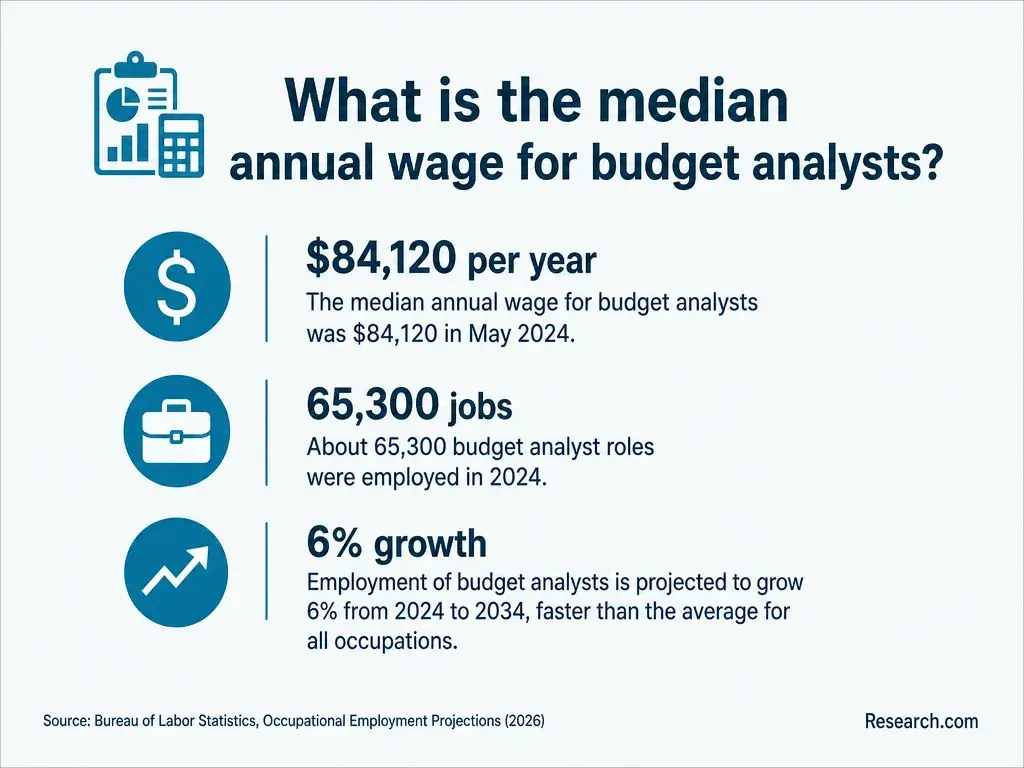
There is no single salary or growth rate for a BS in Business Administration. The relevant comparison is the occupation you can realistically enter with your combined military experience, education, and civilian skills. These Bureau of Labor Statistics figures describe entire U.S. occupations, not new graduates or veterans specifically.
| Occupation | Median annual wage, May 2025 | Projected employment growth, 2025-2035 |
| Logistician | $82,320 | 18% |
| Human resources specialist | $75,940 | 6% |
| Project management specialist | $102,320 | 7% |
Growth indicates projected demand across an occupation; it does not predict your chances of receiving an offer. Median wages include experienced workers and vary by location, industry, and role. Compare local postings and their requirements with your résumé before estimating the degree's potential return.
For that return calculation, weigh likely career relevance against remaining debt and time out of the workforce. Comparing affordable accredited business administration programs accepting FAFSA may help identify lower-cost candidates, but only a personalized aid offer and degree audit can establish your expected expense.
How can veterans choose an accredited online business administration program?
First, verify the institution's recognized accreditation and confirm the exact online degree in its current catalog. If a school advertises AACSB, ACBSP, or IACBE accreditation, check the accreditor's listing and whether its scope covers the business program you are considering. Institutional and business-specific accreditation are different claims; neither proves that a program fits your schedule or produces a particular job outcome.
Then request an official credit evaluation, remaining-course plan, itemized cost estimate, and written explanation of online attendance and assessment rules. Ask who advises veterans, certifies VA enrollment, helps with benefit changes, and connects online students with employers in your intended location. Compare answers for the same enrollment pace and target role across schools. If application costs matter, compare no-fee college applications - but do not let an application-fee saving outweigh a poor credit evaluation or weak course availability.
Choose the program that gives you a credible route from your existing experience to a defined civilian opportunity at a manageable remaining cost. If a school cannot explain how your credits apply or when you can take required courses, keep looking before committing benefits or taking on debt.
Other Things You Should Know About Business Administration
Yes, if the school accepts applications for your intended term. Confirm your expected availability for classes and ask the school's VA certifying official which benefit documentation it needs before certifying enrollment.
Contact your instructors and the school immediately about its military absence, withdrawal, and reentry policies. If you use VA benefits, speak with the certifying official before changing enrollment so you understand possible payment consequences.
Potentially, but transfer eligibility and approval follow Department of Defense and VA rules, not a college's admissions decision. Confirm the dependent's approved entitlement and the school's certification process before relying on it.
You can describe transferable skills, but do not include classified, restricted, personal, or proprietary information. Use an approved, sanitized example and check both applicable military rules and your instructor's requirements.
- Preparing for Higher Education | militaryonesource.mil https://www.militaryonesource.mil/resources/millife-guides/preparing-for-higher-education/
- About GI Bill Benefits | Veterans Affairs https://www.va.gov/education/about-gi-bill-benefits/
- Translate your military skills to a civilian career - VA Careers https://vacareers.va.gov/job-news-advice/translate-your-military-skills-to-a-civilian-career/
- Military Training Evaluation Program (MTEP) | dantes.mil https://www.dantes.mil/credit4training/
- USERRA | dol.gov https://www.dol.gov/agencies/vets/programs/userra/USERRA-Pocket-Guide
- Instructional Model - DoDEA Virtual School - DoWEA https://dvhs.dodea.edu/instructional-model
- Military Leave of Absence Criteria & Process - NCU Catalog https://catalog.ncu.edu/content.php
- Veteran/Military Admissions Information | Cal State LA https://www.calstatela.edu/admissions/veteranmilitary-admissions-information
- Military-Connected Resources | Career Exploration & Student Employment https://careerexploration.indiana.edu/resources/military-connected.html
- Being Deployed? | morainepark.edu https://www.morainepark.edu/pay-for-college/veteran-benefits/being-deployed/