2027 Clinical Teaching vs Classroom Teaching in Nursing: Preparation and Responsibilities
Audited and Verified:
Our Editorial and Data Verification Process
Research.com uses government datasets, official education statistics and primary institutional information to support its career and degree guides. Our review process checks factual accuracy, occupational definitions, source dates and the requirements associated with the credentials discussed.
How This Article Was Fact-Checked
Our editorial team verifies salary estimates, employment projections, education requirements and program information against original data providers and official organizations. Salary figures are checked against the relevant occupational definitions and reporting periods. Information about licensure, accreditation and required in-person training is reviewed separately.
Fact-checked and verified on:

Co-Founder and Chief Data Scientist
A nurse who enjoys teaching at the bedside may not enjoy designing a semester-long course - and a strong classroom lecturer may need additional preparation to supervise students during patient care. For RNs considering an educator role, that distinction affects qualifications, schedules, liability, and the education worth paying for.
This guide compares clinical and classroom teaching, explains how instructors prepare and evaluate students, and shows how to assess degree programs and job opportunities without assuming that every teaching position requires the same credential.
Key Things You Should Know
- Clinical teaching centers on supervised performance and patient safety; classroom teaching centers on course design, explanation, and assessment. Many faculty jobs combine both.
- An active RN license and relevant practice experience are common starting points, but degree requirements depend on the state, school, program level, and appointment. A graduate nursing degree is not a universal prerequisite for every clinical teaching role.
- Before paying for additional education, compare the job's required credential, teaching setting, supervised teaching experience, and total cost. Nursing education and advanced practice tracks prepare graduates for different work.
What is the difference between clinical teaching and classroom teaching in nursing?
Clinical teaching helps students apply nursing knowledge while providing supervised care in an approved setting. Classroom teaching develops the knowledge and clinical judgment students need before, during, and after those experiences. Neither is simply a more advanced version of the other: they require different preparation and evidence of student learning.
The comparison below focuses on where each instructor spends time and what they can directly observe.
| Teaching feature | Clinical instruction | Classroom instruction |
| Typical setting | Clinical site, skills lab, or simulation | In-person or virtual course sessions |
| Primary emphasis | Safe application of skills, communication, and clinical judgment | Concepts, evidence, care planning, and reasoning |
| Student evidence | Observed performance, documentation, feedback, and competency evaluation | Assignments, discussions, examinations, and other course assessments |
| Immediate constraint | Patient safety, site rules, supervision, and available learning opportunities | Course objectives, accessible instruction, assessment quality, and academic policies |
Some postlicensure courses emphasize academic work rather than traditional prelicensure rotations. Nurses comparing RN-to-BSN practice expectations should still check for projects or field experiences; the absence of a conventional clinical rotation does not erase the distinction between discussing care and observing a student provide it.
What responsibilities do clinical nursing instructors and classroom faculty have?
Clinical instructors typically orient students to the site, connect assigned experiences to course objectives, observe care within the school's supervision model, intervene when safety requires it, give timely feedback, and document performance. They coordinate with unit staff but should not assume that a busy staff nurse has accepted faculty responsibilities. The instructor's authority, student-to-instructor limits, and escalation process depend on school agreements, site policy, and applicable regulation.
Classroom faculty design learning activities, select and update material, teach concepts, write and review assessments, grade consistently, hold office hours, and identify students who need support. Full-time faculty may also advise students, revise curricula, serve on committees, and participate in scholarship or program evaluation. A faculty member who teaches both settings must connect course assessments with observed clinical performance without treating a test score as proof of safe practice.
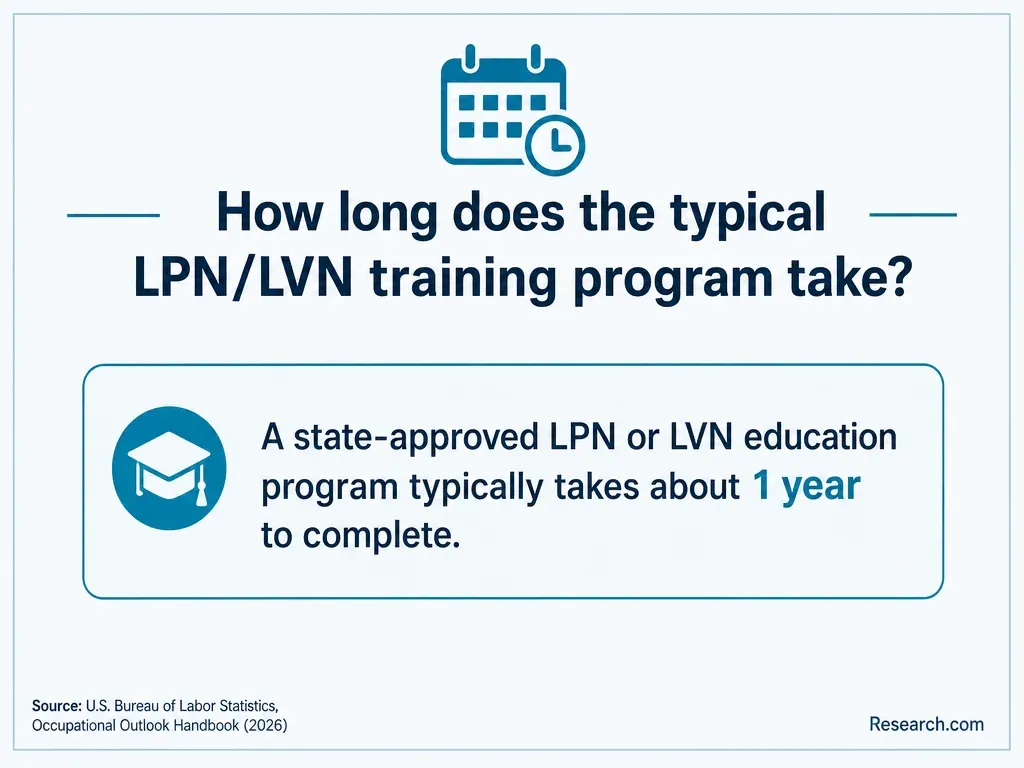
Responsibilities also vary by the students' intended license. A faculty member exploring practical nursing programs organized by duration should examine each program's actual clinical schedule and instructor expectations, rather than assuming a shorter program has fewer supervision demands on a given clinical day.
What qualifications are required to teach nursing students in the United States?
There is no single national hiring rule for every nursing instructor. Schools generally look for an appropriate nursing license, relevant practice competence, and preparation suited to the students and courses being taught. State board rules, nursing program standards, institutional policies, and the employer's job description determine the specific combination. A clinical adjunct position may have different requirements from a full-time faculty appointment or a graduate-level teaching role.
Ask the hiring school whether it requires an MSN or another graduate degree, accepts an RN enrolled in one, specifies recent specialty practice, or requires prior teaching experience. Also ask who evaluates clinical competence and provides orientation to grading, supervision, and site policies. Maintaining a license is distinct from demonstrating readiness to teach.
Graduate credentials are not interchangeable. For example, lower-tuition advanced practice nursing programs may prepare a nurse for a defined patient-care role, not for curriculum design or an educator appointment. Choose that route for teaching only if the prospective employer accepts its degree and the missing pedagogy can be addressed.
Start with the appointment you want, then work backward to its requirements. The pathways below differ in their direct relevance to teaching; none automatically confers a faculty position.
| Preparation | Potential teaching fit | Important limitation |
| RN preparation plus specialty practice and instructor development | Some clinical adjunct, preceptor, or skills-teaching opportunities | May not meet degree requirements for faculty appointments |
| MSN with a nursing education focus | Clinical instruction, classroom teaching, curriculum, and assessment | Employer and state requirements still control eligibility |
| Post-master's nursing education certificate | Targeted pedagogy for an RN who already holds an appropriate graduate degree | Certificate content and recognition vary; it does not replace a required degree |
| DNP or PhD with teaching preparation | Doctoral-level faculty roles and, depending on the role, practice scholarship or research | A doctorate alone does not guarantee educator-specific preparation |
An MSN education track is often the most direct graduate route for an RN who wants to teach prelicensure students. A DNP may fit an educator whose work also involves practice improvement or academic leadership; a PhD is more closely aligned with a research-intensive academic career. When reviewing time-efficient online DNP pathways, check whether their curriculum and teaching opportunities actually meet the intended faculty job requirements. A shorter doctorate is not automatically a shorter route into teaching.
Online delivery can reduce commuting, but it does not necessarily make teaching practica, live sessions, group work, or simulation activities asynchronous. Campus-based study may offer easier access to faculty observation and local teaching sites, while requiring regular travel. Either format can work if the student can complete an approved, observed teaching experience in the setting they hope to enter.
Before enrolling, request a term-by-term schedule showing live attendance, campus visits, practicum hours, who arranges the teaching site, and whether an existing workplace can be used. Working nurses should compare those fixed commitments with shifts and caregiving obligations - not just the advertised course format.
The same caution applies across online graduate nursing study. A nurse comparing PMHNP programs by tuition would need to investigate supervised patient-care placements; an educator student instead needs to investigate supervised teaching. Neither requirement can be inferred from the word "online."
Relevant coursework may cover curriculum design, learning theory, accessible instruction, test construction, assessment, feedback, simulation facilitation, and evaluation of clinical performance. A supervised teaching practicum should let the learner plan instruction, teach, receive observation-based feedback, and revise their approach. Course titles alone do not show how much experience a student gets in a real classroom or clinical group.
For clinical teaching, look particularly for preparation in setting expectations, identifying unsafe performance, documenting concerns fairly, and working with site staff without compromising patient privacy. For classroom work, examine how the program teaches instructors to align objectives, lessons, and assessments. Simulation can develop teaching skill, but its use does not automatically substitute for a program-required teaching practicum.
Educator and advanced practice curricula answer different questions. Short-format family NP degree and certificate routes should be judged against their patient-care preparation requirements, not used as substitutes for a nursing education curriculum merely because both award graduate credentials.
Postlicensure nursing education programs commonly review an applicant's RN license, nursing degree and transcripts, academic record, professional experience, and statement of goals. Some also request references, an interview, or evidence that the applicant can complete a teaching practicum. Requirements differ by degree and institution; an RN with a non-nursing bachelor's degree should ask about the specific program's entry and bridge policies rather than assume eligibility or exclusion.
Admission to the university is not always admission to the education track. Confirm whether teaching-site arrangements are required before matriculation or later, whether a background check or site onboarding applies, and how the school evaluates prior graduate coursework. Nurses also considering doctoral study can use information on DNP admissions and applicant preparation to frame questions, while checking the education track's own criteria.
Time depends on the credential, accepted prior coursework, enrollment pace, course sequence, and teaching-practicum availability. An MSN, a post-master's certificate, and a doctorate should not be compared by advertised calendar length alone: they begin from different educational starting points and lead to different awards.
For a realistic cost comparison, request a written estimate for tuition by credit or term, mandatory fees, books and technology, practicum-related travel, campus visits, and any extra terms needed to complete the sequence. Include the income effect of reducing work hours. Compare the total cost to finish the credential needed for the job, not just the lowest tuition rate; ask an employer whether tuition assistance covers the specific program and what repayment conditions apply.
A nurse weighing educator study against another specialty certificate may review comparing postgraduate FNP certificate schedules, but the shorter or cheaper credential is useful only if it prepares the nurse for the intended role. An FNP certificate is not a nursing education certificate.
Potential roles include clinical adjunct instructor, simulation educator, classroom faculty member, and academic program leader. Hospital-based nursing professional development positions also involve teaching, but their learners, schedules, and employer requirements may differ from those of college faculty. Clinical adjunct work can offer a way to test teaching fit; it may also involve variable course assignments rather than predictable full-time employment.
For US pay comparisons, the Bureau of Labor Statistics occupation nursing instructors and teachers, postsecondary is more relevant to college teaching than a general RN wage figure. Its published wage and employment projections describe an occupation - not an offer to a new instructor, a guaranteed return on an MSN, or every hospital educator job. Compare actual local postings by appointment type, contract length, benefits, clinical-day schedule, and required degree; use the latest BLS release for the corresponding occupation when assessing the broader market.
Someone who is not yet an RN faces a longer transition: first qualify for nursing practice, develop clinical experience, and then meet an educator employer's requirements. For that reader, exploring accessible accelerated BSN pathways concerns entry into nursing, not direct qualification for a faculty job.
How can students choose an accredited nursing education program?
Check the exact institution, degree, and nursing education track - not just a school's general reputation. Institutional accreditation, nursing program accreditation such as ACEN or CCNE where applicable, state board oversight, and authorization to enroll a student in a particular state answer different questions. Confirm each status with the responsible organization and ask the program which rules apply to your entry term.
Then compare the curriculum with two or three real job descriptions you would consider. Ask who secures the teaching practicum, where it can occur, who observes your teaching, whether clinical and classroom instruction are both available, and what happens if a site falls through. Request the full cost and schedule before committing. If the target job only requires clinical experience plus employer-provided instructor training, that may be a more direct next step than another degree.
Applicants who still need initial RN preparation should evaluate that decision separately. Nursing program options for first-time nursing students can help identify entry routes, but admission to an initial nursing program is not admission to a postlicensure educator track or a guarantee of future teaching eligibility.
Other Things You Should Know About Nursing
Often, yes. Ask about approved preceptor, patient-education, staff-training, or guest-teaching opportunities. Document what you taught and the feedback you received, while keeping patient and employer information confidential.
Many nurses do, particularly in part-time teaching roles. Check whether the proposed clinical teaching days, preparation time, and your practice schedule are sustainable - and whether the employer expects recent clinical practice.
Not universally. A professional certification can demonstrate qualifying educator preparation and experience, but it does not replace a required license, degree, or employer orientation. Check the credentialing organization's eligibility rules and the specific job posting.
Bring a concise teaching example, an explanation of how you would give constructive feedback, and questions about supervision, orientation, and evaluation. Use de-identified examples only; do not bring patient records or confidential student work.
- Clinical teaching practices of nurse educators - PMC - NIH https://pmc.ncbi.nlm.nih.gov/articles/PMC9575343/
- Classroom and clinical teaching in nursing: delineating differences | PubMed https://pubmed.ncbi.nlm.nih.gov/9220764/
- Unsafe Student Clinical Performance - Pitt School of Nursing https://www.nursing.pitt.edu/policies/305/
- Clinical Supervision of Medical Students | Brody School of Medicine Department of Academic Affairs https://medicine.ecu.edu/academicaffairs/educational-policies-and-standard-operating-procedures/clinical-supervision-of-medical-students-2/
- Clinical Setting Conduct | Department of Nursing https://nursing.tcnj.edu/students/behavior-in-practice-settings/
- Bridging Clinical Expertise and Pedagogy: The Dual Role of Nurse Educator | Texas A&M College of Nursing https://nursing.tamu.edu/degrees/msn-education/blog/clinical-expertise-pedagogy.html
- School of Nursing: Standard On Clinical Teaching And Supervision | University of North Carolina at Chapel Hill https://policies.unc.edu/TDClient/2833/Portal/KB/Article/132407/School-of-Nursing-Standard-On-Clinical-Teaching-And-Supervision